What to see
Visiting Nong Khiaw: Complete Guide to Northern Laos's Gem
We may earn a commission when you book through links on this page, at no extra cost to you. We don't visit or try the places we cover: we summarize published sources. How we work
In short
- Plan 2 to 3 days for Pha Daeng, the Tham Pha Tok caves and Muang Ngoi Neua; 4 to 5 days for several village treks.
- From Luang Prabang (130 to 150 km / 81 to 93 mi), a shared minibus takes 3.5 to 5 hours, about 80,000 to 120,000 kip.
- Muang Ngoi Neua is reached by boat from Nong Khiaw in about 1 to 1.5 hours; the last boat back leaves mid-afternoon.
- Guided treks are the main expense (100,000 to 180,000 kip a day on a tight budget); a tight-budget day costs about $12 to $21.
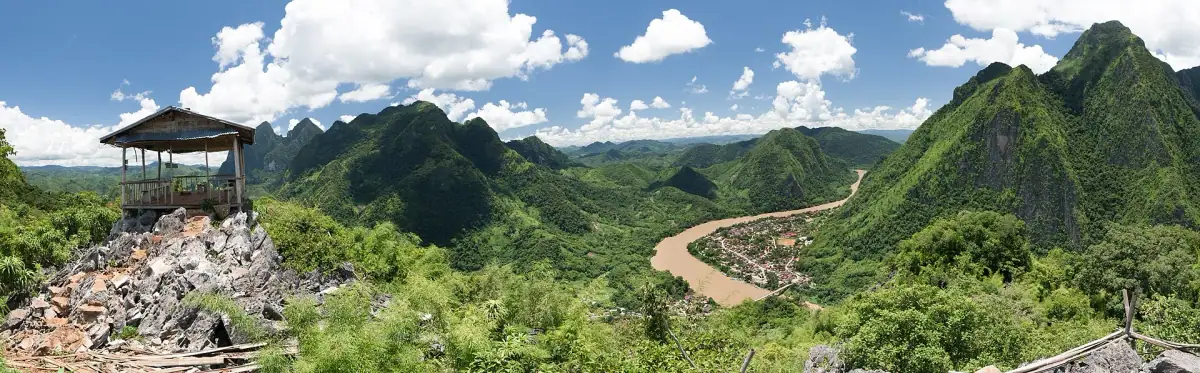
Nong Khiaw is one of Laos’s best-kept secrets, and yet travelers who arrive almost all say the same thing: it is the most beautiful place they saw in the country. The town sits on the banks of the Nam Ou, a turquoise river hemmed in by karst cliffs rising several hundred meters above the water. The evening light on the gray stone, the dugout canoes gliding silently on the current, the Hmong and Khmu villages clinging to the slopes: it all makes a landscape of almost unreal beauty.
Nong Khiaw is also an excellent starting point for Muang Ngoi Neua, one of the most isolated and genuine villages in Laos, reached only by boat. Between forest treks, historic caves and sunsets from viewpoints, Nong Khiaw offers a travel experience that slows the pace and leaves a lasting mark.
The Pha Daeng viewpoint: the essential sunset
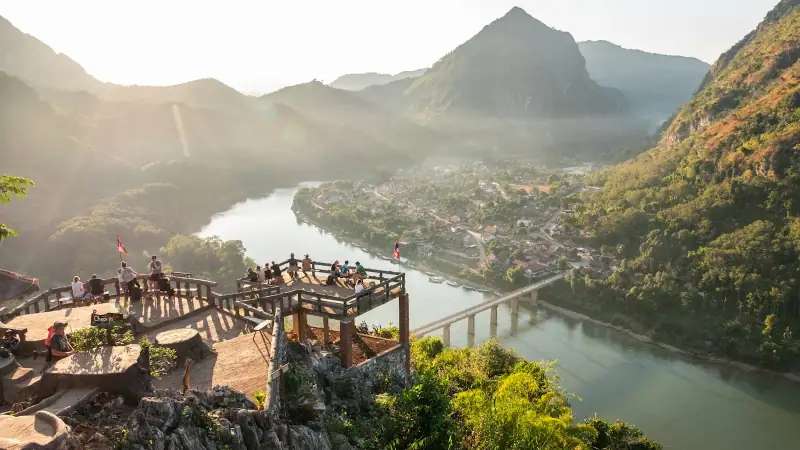
About 1 hour 15 minutes to 2 hours on foot from the center of the village (10 to 15 minutes to the start of the trail, then 1 to 1.5 hours of climbing), the Pha Daeng viewpoint is one of the most photographed in Laos. The trail climbs at a moderate grade through dry forest on a well-marked dirt path, of moderate difficulty. At the top the view suddenly opens onto the loop of the Nam Ou below, the limestone cliffs plunging into the river and the rice fields stretching to the northern horizon.
The best time is an hour before sunset: the low light colors the limestone walls orange and pink, the river shimmers, and a few buffalo come home from the fields in the rice paddies below. You will meet a few travelers but nothing like a crowd. Nong Khiaw has not yet reached Vang Vieng’s level of visitors.
Practical tips for Pha Daeng:
- Paid entry (a few thousand kip, a modest fee)
- Bring good shoes: the trail is slippery after rain
- Bring water: there is no refreshment on the way
- Set out 1 to 1.5 hours before sunset to enjoy the light
- Sunrise from the same viewpoint is even more spectacular, with morning mist in the valleys; leave at 5 to 5:30 am
There is a second, more distant and less visited viewpoint, reached from the west side of the bridge. The trail is less marked and you need to ask locals for the way.
Excursions in Nong Khiaw
Guided treks, boat trips and village visits with local guides.
The Tham Pha Tok caves: the memory of the bombs
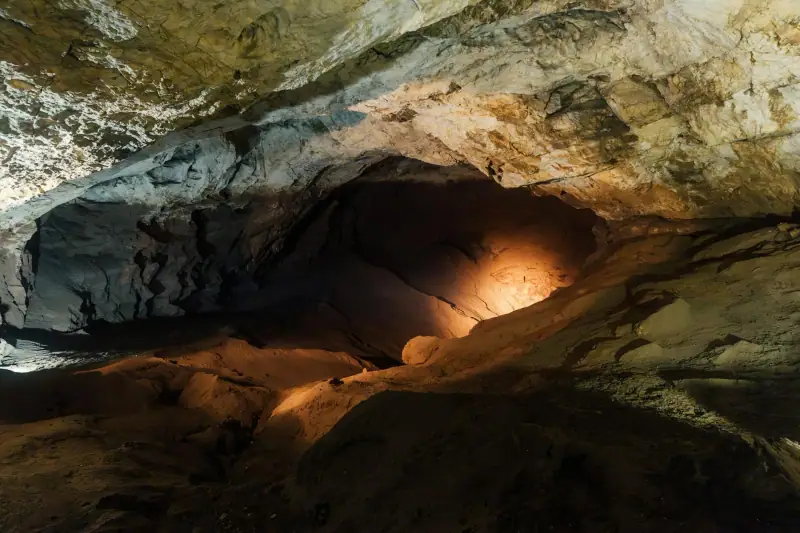
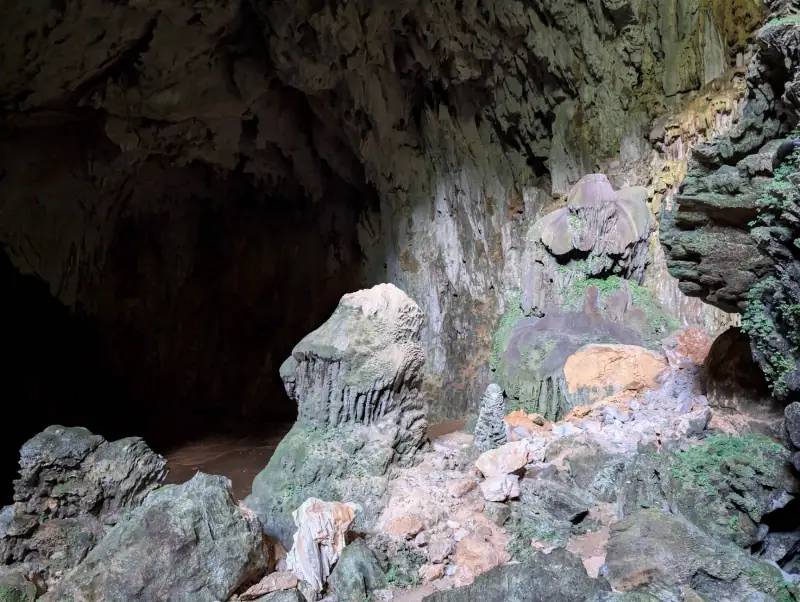
The Tham Pha Tok caves are about 2 to 3 km (1.2 to 1.9 mi) from the village, reached mainly on foot or by bike along the road that follows the Nam Ou. Boat trips with local operators are also possible, but access on foot is the most common. These are not ornamental caves: they were used by the local population and Pathet Lao soldiers as shelters during the American bombing of the Vietnam War (1964-1973), a period in which Laos was the most heavily bombed country per capita in history.
The interior of the caves still shows traces of that occupation: niches cut into the rock to hold oil lamps, sleeping spaces, and in the largest cavern, a former command post. Information panels in English and Lao set out the historical context. The visit takes on a particular meaning when you know that some Nong Khiaw families lived here for several years in a row, going out at night to farm their fields.
The Nam Ou itself, seen from a traditional boat, is strikingly beautiful on this stretch: cliffs rise straight from the water, trees grow in cracks in the rock, and the river winds in meanders that open a new panorama at every bend.
Practical information:
- Access on foot or by bike from the village center (~2 to 3 km / 1.2 to 1.9 mi by the road along the river)
- The riverbank path can be impassable in the rainy season, so take the road then
- Boat excursions combining the caves and Muang Ngoi Neua are offered by local operators
The article on caves in Laos presents the country’s finest caverns and how to reach them.
Muang Ngoi Neua: the village out of time
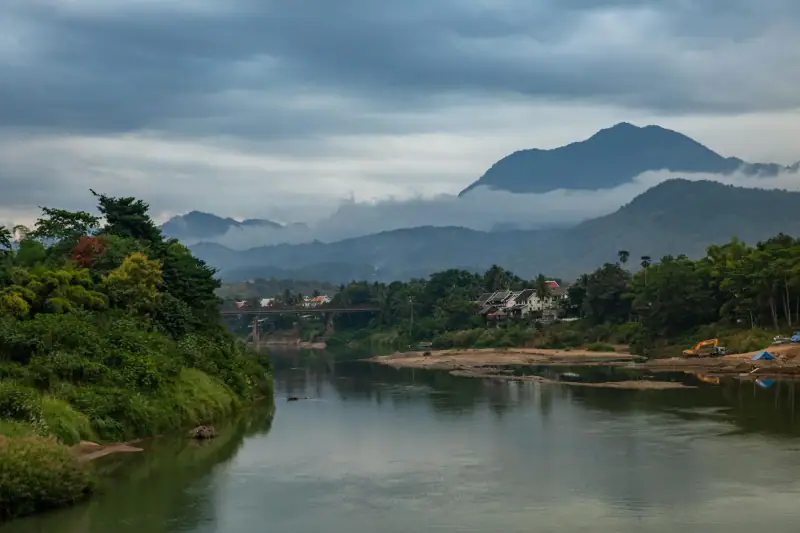
About 1 to 1.5 hours by boat from Nong Khiaw, going up the Nam Ou to the north, Muang Ngoi Neua is one of the most distinctive destinations in Laos. Muang Ngoi Neua is in practice reached only by boat from Nong Khiaw. A dirt track has existed since the 2010s, but it has no bridge to cross the final river and no public transport uses it. For travelers, the boat remains the only practical access. Electricity was available there only in the evening until recently. It is this inaccessibility that has preserved its exceptional character.
The village itself is a central beaten-earth lane lined with wooden houses, gardens and rudimentary guesthouses. Around it, terraced rice fields climb the slopes, karst cliffs frame the horizon, and caves dot the immediate landscape. Half-day or full-day treks leave the village for Hmong and Khmu hamlets that are even less visited.
What to do in Muang Ngoi Neua:
- Walk along the single main street in the evening, when residents gather in front of their houses
- Half-day trek to the rice fields and the Tham Kang caves (caves by a stream crossing a wooded ravine)
- Swim in the Nam Ou or in a natural pool 20 minutes from the village
- A night in a basic guesthouse, the feeling of being at the end of the world
Logistics:
- Boats link Nong Khiaw to Muang Ngoi Neua several times a day in tourist season (generally in the morning)
- The last boat back to Nong Khiaw leaves in mid-afternoon, so check the time with your guesthouse
- In high season (November-January), book your bed there in advance or leave early in the morning
Accommodation in Nong Khiaw
Guesthouses and bungalows on the Nam Ou: compare availability and book with free cancellation.
Trekking and ethnic minority villages
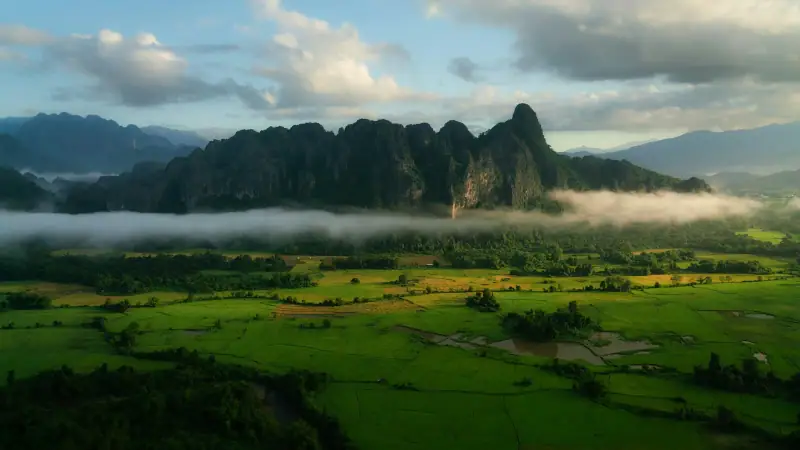
Nong Khiaw is one of the best starting points for trekking to the ethnic minority villages of northern Laos. The area has Black Hmong, Khmu and Tai Dam communities whose villages are scattered on the mountain slopes, one to several hours’ walk from the village.
The main trek routes:
One-day trek to the Khmu villages: one of the classic routes from Nong Khiaw, doable with a local guide. The trail crosses mixed forest, runs past corn and cassava fields, and reaches one or two villages where daily life (crafts, farming, cooking) follows very old rhythms. Back in the late afternoon. Moderate difficulty, about 15 to 18 km (9 to 11 mi) round trip.
Two-day trek with a night in a Hmong village: more physically demanding, this route heads up the ridges above Nong Khiaw to reach hamlets at altitude. The night is spent with a host family or in a basic dormitory. Waking in the mountains to a view of the misty Nam Ou valley is worth the climb.
Bike ride in the valley: for those who prefer not to walk too much, renting a bike (available at guesthouses, about 20,000 to 40,000 kip a day) lets you follow the Nam Ou for several kilometers north or south, cross rice fields and hamlets along the bank, and stop at viewpoints that open up beside the road.
Kayaking on the Nam Ou: several operators offer half-day or full-day kayak trips on the river. The level is accessible to beginners in the dry season. It is an excellent way to see the cliffs from the water and stop on sandbanks for a picnic.
The guide to hikes in Laos gives more detail on trek routes across the north of the country.
Bike or motorbike rental in Nong Khiaw
Explore the Nam Ou valley at your own pace. Bikes available at guesthouses, motorbikes at local agencies.
Where to stay in Nong Khiaw
Nong Khiaw is a small town of two neighborhoods separated by the bridge over the Nam Ou. The east bank (on the main road side, also called Ban Sop Houn) has most of the guesthouses, restaurants and trekking agencies. The west bank (Ban Nong Khiaw) is quieter, with a few stilt bungalows at the water’s edge.
River bungalows: the most popular option in Nong Khiaw. Wooden bungalows built on or near the bank of the Nam Ou, with a porch and a view of the cliffs. Comfort is basic but the setting is exceptional. Expect to pay about 80,000 to 180,000 kip a night depending on the season and facilities.
Brick-and-mortar guesthouses: more classic rooms with air conditioning or a fan, a private bathroom, sometimes a pool. Mostly on the east bank, in streets parallel to the main road. Ideal for travelers who arrive late or leave early by bus.
Eco-lodges: a few higher-comfort places, with bamboo bungalows using sustainable practices (solar hot water, waste sorting, local purchasing), have grown up in recent years within 3 to 5 km (2 to 3 mi) of the village.
The guide to cheap hotels in Laos offers selections for every budget in the northern destinations.
Eating in Nong Khiaw
Food in Nong Khiaw is simple and honest. Most restaurants are guesthouses that open their kitchens to passers-by. Menus mix traditional Lao dishes, a few northern specialties (pork with herbs, ginger rice soup), and the “traveler” classics (baguette sandwiches, crepes, basic pizza) typical of Laos’s small tourist towns.
Try:
- Khao niao with tam mak houng: the inseparable duo of northern cooking, sticky rice and spicy pounded green papaya. Found at street stalls in the morning and at midday
- Ping pa: Nam Ou fish grilled over embers, served with a sauce of lemongrass and fresh herbs. The river supplies fresh fish that local fishermen resell to restaurants
- Khao piak sen: fresh noodle soup in a pork or chicken broth flavored with ginger and green onions. The morning version, thick and comforting, is ideal before a trek
- Lao coffee: coffee from the Nong Khiaw area is less known than that of the Bolavens, but the small riverside cafes serve excellent filter coffee or iced condensed-milk coffee for a few thousand kip
The morning market, held early near the bridge, sells skewers, dried meat and local vegetables that Khmu and Hmong vendors bring down from the villages before sunrise.
How to get to Nong Khiaw
From Luang Prabang (about 130 to 150 km / 81 to 93 mi):
- Shared minibus: the most common solution. Minibuses leave daily from Luang Prabang (usually in the morning from the guesthouse area or the morning market). The trip takes between 3.5 and 5 hours depending on road conditions. Price around 80,000 to 120,000 kip.
- Note: the direct Luang Prabang-Nong Khiaw boat link has not been practical since a dam was built on the Nam Ou, blocking navigation downstream. The stretch navigable by public boat starts at Muang Khua (north). From Luang Prabang, the minibus remains the only practical option.
From Vientiane:
- The Laos-China high-speed train Vientiane-Luang Prabang (about 2 hours; check fares and times on the Laos-China Railway app), or an overnight bus (about 10 hours), then a minibus connection. Or a bus to Nong Khiaw by the national road (about 8 to 10 hours).
From Phongsali (north):
- There is no direct Phongsali-Nong Khiaw link. The trip needs a connection at Muang Xay (Udomxai) or via Muang Khua, bringing the total to about 7 to 10 hours at minimum. Mountain roads are in poor condition on some sections, but the scenery is exceptional.
Getting around locally:
- The village can be crossed entirely on foot in 20 minutes. The bridge links the two banks.
- Bikes for rent to explore the valley (20,000 to 40,000 kip a day)
- Motorbikes for rent at agencies for longer excursions
Budget in Nong Khiaw
Nong Khiaw is one of the cheapest destinations in Laos. Lodging is cheaper than in Luang Prabang or Vientiane, local food is affordable, and the main attractions (viewpoint, river) are free or cheap.
| Item | Tight budget | Comfort |
|---|---|---|
| Accommodation | 60,000-100,000 kip | 120,000-300,000 kip |
| Meals | 15,000-30,000 kip/meal | 40,000-80,000 kip |
| Local transport | 20,000-40,000 kip | 80,000-150,000 kip |
| Guided trek | 100,000-180,000 kip/day | 200,000-400,000 kip |
| Boat to Muang Ngoi | 40,000-60,000 kip round trip | n/a |
| Daily total | $12-21 | $29-52 |
The guided trek is the main expense. Negotiating directly with local guides (rather than through the big Luang Prabang agencies) saves money and better redistributes it to local communities.
The Laos budget guide gives the full ranges for planning your stay across the country.
Nong Khiaw in your itinerary
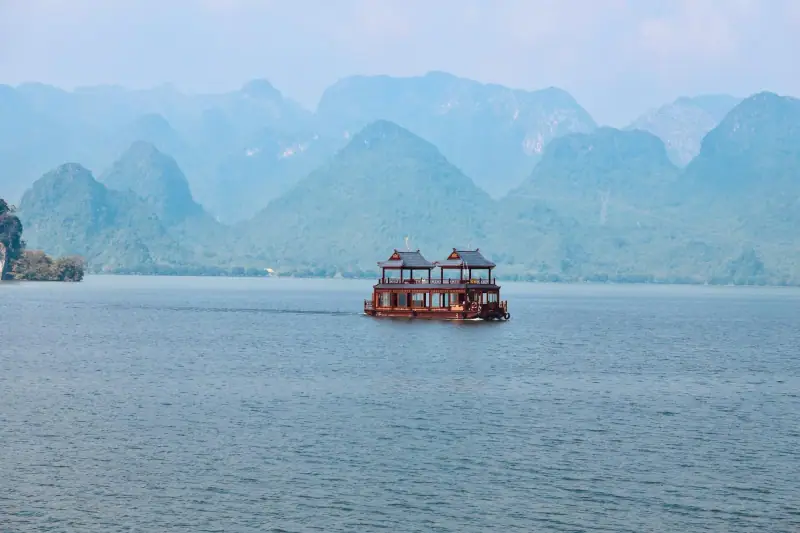
Nong Khiaw fits naturally into a northern Laos circuit in several ways:
Classic northern itinerary: Luang Prabang (3 to 4 days) → Nong Khiaw + Muang Ngoi Neua (3 to 4 days) → back to Luang Prabang or on to Phongsali
Including a Nam Ou descent: Muang Khua or Phongsali (Chinese/Vietnamese border) → a 2 to 3 day boat descent of the Nam Ou with stops at Muang Ngoi Neua and Nong Khiaw → Luang Prabang. It is one of the most beautiful river journeys in Laos, if you have the time.
Combined with Vang Vieng: Luang Prabang → Nong Khiaw → back to Luang Prabang → Vang Vieng → Vientiane. This 10 to 12 day circuit covers the two great natural landscapes of Laos: the karst scenery of the north and the limestone karst of the Nam Song valley.
To plan your whole itinerary, see the complete circuit through Laos and the guide to Luang Prabang’s top sights.
Flights to Luang Prabang
The nearest gateway to Nong Khiaw. Compare flights to Luang Prabang.
Nong Khiaw in brief: what to remember
Nong Khiaw is not a museum town, nor a beach resort, nor a theme park. It is a place where nature sets the tempo, and that is precisely why travelers who arrive for one night often stay three or four days.
The limestone cliffs rising from the river, the evening light on green water, the boats drifting silently downstream and the smoke of the houses rising into the blue evening make a picture that many describe as the best moment of their trip to Laos. It is not an exaggeration.
If you are doing northern Laos, do not pass through Nong Khiaw in a one-night transit. Give it the time it deserves.
Frequently asked questions
How many days should you plan in Nong Khiaw?
Two to three days let you enjoy Nong Khiaw comfortably: a sunset from the Pha Daeng viewpoint, a visit to the Tham Pha Tok caves, and a day of trekking or an excursion to Muang Ngoi Neua. Travelers who want to immerse themselves in nature and do several hikes to ethnic minority villages give it four to five days.
How do you get to Nong Khiaw from Luang Prabang?
From Luang Prabang, the minibus is the only practical option (usually leaving from the morning market or old-town agencies, about 4 to 5 hours on the road depending on conditions, around 80,000 to 120,000 kip); there is no longer a direct boat link from Luang Prabang. Direct shuttles are organized by most Luang Prabang guesthouses.
Is Nong Khiaw hard to reach?
No. The road from Luang Prabang is paved and passable in all seasons. Minibuses and songthaews leave daily. The town is divided into two banks linked by a bridge, and everything is on foot once you are there. You do not need to rent a motorbike to enjoy the sights near the village.
Can you trek alone from Nong Khiaw?
Some short trails (notably to the first viewpoints) can be done without a guide. For full-day treks to Hmong or Khmu villages, a local guide is strongly recommended: the trails are not marked, and guides directly support the economy of the villages visited. Trekking agencies offer day or multi-day packages with a night in a village.
Is the excursion to Muang Ngoi Neua worth the detour?
Yes, absolutely. Muang Ngoi Neua, reached by boat from Nong Khiaw, is one of the best-preserved villages in northern Laos: no drivable road, electricity only in the evening, terraced rice fields and caves in the surrounding cliffs. A night there lets you see it without the few day visitors. It is one of the most authentic experiences in the country.
Is Nong Khiaw suitable for families?
Yes, for children aged 8 to 10 and up who can walk a few hours. The Tham Pha Tok caves, the boat trip to Muang Ngoi and the Pha Daeng viewpoint are accessible to everyone. On the other hand, full-day treks to the villages at altitude are physically demanding and less suited to very young children.
When is the best time to visit Nong Khiaw?
The dry season (November to April) offers ideal conditions: blue skies, a turquoise Nam Ou and passable trails. November to February is the most pleasant period, with cool temperatures at altitude (15 to 22 °C / 59 to 72 °F at night). In the rainy season (May to October) the Nam Ou swells and turns brown, some trekking trails become slippery, but the vegetation is exceptionally green.
More Laos guides
Keep reading
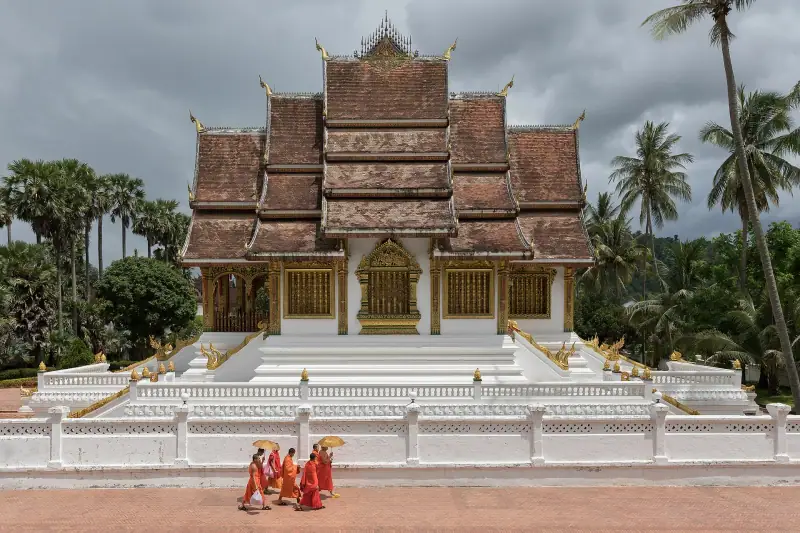
Luang Prabang: The 15 Must-Sees of Laos's Royal Town
What to see in Luang Prabang? The 15 top sights and activities of Laos's spiritual capital: temples, waterfalls, tak bat and markets.
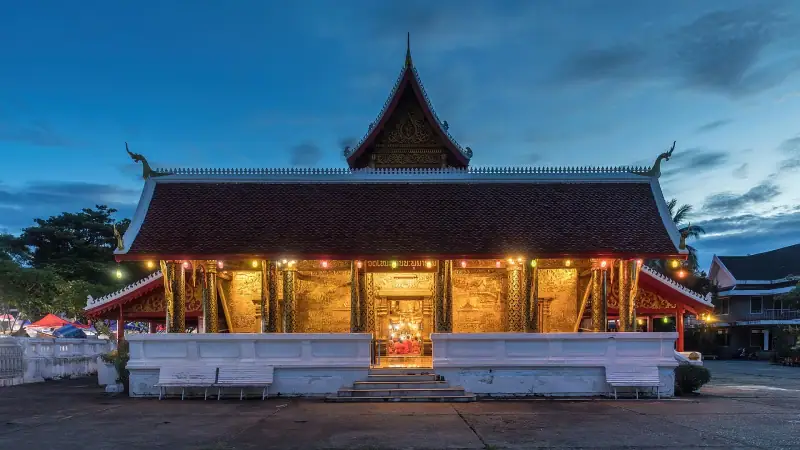
Visiting Luang Prabang: Complete Guide to Laos's Former Royal Capital
Complete guide to Luang Prabang: temples, tak bat, Kuang Si falls, Pak Ou, night market. Lodging, transport, budget and practical tips.
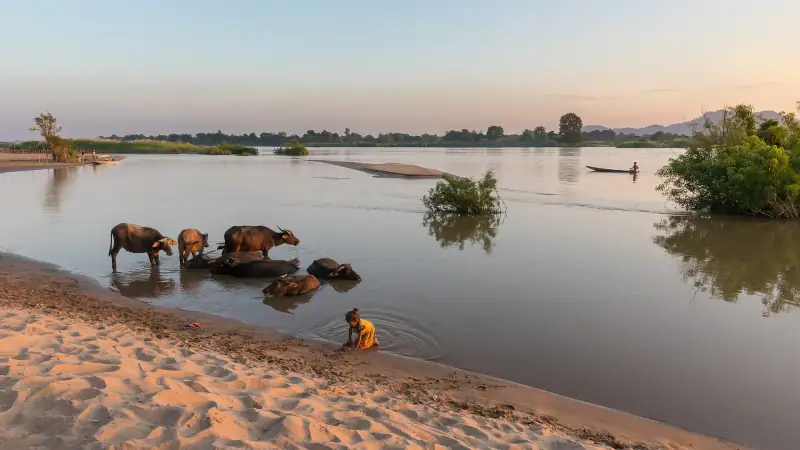
Visiting the 4,000 Islands (Si Phan Don): Complete Guide to Southern Laos
Complete guide to the 4,000 Islands (Si Phan Don): Don Det, Don Khon, Irrawaddy dolphins, Khon Phapheng falls, lodging and practical tips.
Ready-made
Laos itineraries
7 days
Laos in 7 Days: A Complete Itinerary for an Unforgettable Week
VientianeVang ViengLuang Prabang
Can be adapted in the planner
3 days
The Thakhek Loop: Complete Guide to Laos's Motorbike Circuit
Kong LorLak Sao

10 days
Laos in 10 Days Without a Car: A Realistic Train and Bus Itinerary
VientianeVang ViengLuang PrabangNong Khiaw