Itineraries
The Thakhek Loop: Complete Guide to Laos's Motorbike Circuit
We may earn a commission when you book through links on this page, at no extra cost to you. We don't visit or try the places we cover: we summarize published sources. How we work
Day by day: Classic 3-day Thakhek Loop
- Day 1Thakhek to Kong Lor village across the karst plateau
- Day 2Tham Kong Lor boat crossing, then drive to Lak Sao
- Day 3Lak Sao to Thakhek via Mahaxai caves and Nam Don pools
Where to sleep
- Kong Lor1 night
- Lak Sao1 night
Weather through the year on this route
| Jan | Feb | Mar | Apr | May | Jun | Jul | Aug | Sep | Oct | Nov | Dec | |
|---|---|---|---|---|---|---|---|---|---|---|---|---|
| High °F (°C) | 8831 | 9234 | 9636 | 9837 | 9234 | 8831 | 8630 | 8530 | 8530 | 8630 | 8530 | 8429 |
| Low °F (°C) | 6317 | 6720 | 7323 | 7725 | 7725 | 7524 | 7524 | 7524 | 7323 | 7122 | 6619 | 6317 |
| Rain in (mm) | 0.25 | 0.515 | 1.435 | 2.975 | 7.1180 | 7.9200 | 9.9255 | 10.9280 | 9.4240 | 3.590 | 0.820 | 0.310 |
Normals 1991–2020 at Pakse and Vientiane: averages over 30 years, not a forecast. Source: NASA POWER (MERRA-2), grid of about 50 km. Figures computed by us in November 2026.
In short
- The Loop covers 450 to 500 km (280 to 310 mi) in 3 to 4 days; 4 days is recommended, with nights in Kong Lor and Lak Sao.
- Tham Kong Lor is a navigable river cave about 7 to 7.5 km (4.3 to 4.7 mi) long; it can close in the rainy season when the river floods.
- There are no ATMs on the Loop: withdraw enough kip in Thakhek for 4 days of lodging, meals, fuel and entry fees.
- Never ride at night (dark by about 6 to 6:30 pm); the best season is November to April, with November to January the most pleasant.
The Thakhek Loop is, along with Vietnam’s Hai Van Pass and Thailand’s Mae Hong Son Loop, one of the most celebrated motorbike circuits in Southeast Asia. Traced through the limestone karst of Khammouane province in central Laos, it links, over 450 to 500 km (280 to 310 mi), landscapes that most travelers do not expect to find so wild: limestone towers rising from the plain, turquoise rivers hemmed in by cliffs, underground caves you can navigate by boat and minority villages virtually spared by mass tourism.
From Thakhek, the Loop makes a big circle north to Kong Lor Cave, the central pivot of the route, before coming back by the east along the Vietnamese border and through the Mahaxai valley. The return is by Route 12 to Thakhek. This three- to four-day circuit is accessible to intermediate riders and, for many travelers, is the strongest memory of their stay in Laos.
Preparing your Loop from Thakhek: the essentials before leaving
Before hitting the road, a few preparations are essential to keep the Loop trouble-free.
Renting the motorbike: several agencies concentrated around Fountain Square and the adjacent streets rent bikes. The most common are 100 to 125 cc semi-automatics, well suited to most sections of the Loop. For the track sections (especially in the northwest, between Kong Lor and Lak Sao), a bike with good ground clearance is a better choice. Always check the tires, front and rear brakes, lights and the on-board toolkit.
Filling up in Thakhek: gas stations become rare as you go deeper into the karst. Fuel is also sold in cans in villages, but often at a higher price. Set out with a full tank and make a habit of filling up whenever you can.
Carrying cash: no ATMs on the Loop. Withdraw enough kip in Thakhek to cover four days of expenses: lodging (30,000 to 100,000 kip a night depending on standard), meals (15,000 to 40,000 kip), fuel, and the entry fees at Kong Lor.
Bring a first-aid kit and a repair kit: puncture patches, a bike pump, patches for the inner tube. Mechanical breakdowns happen, and in isolated stretches help can be slow.
Never ride at night: darkness falls around 6 to 6:30 pm in season. The Loop road is poorly lit, animals cross the road, and some track sections become dangerous in the dark. Set out early each morning.
Guided tours of the Thakhek Loop
Choose a private-vehicle tour with a local guide for the full Loop, including Kong Lor and the Mahaxai caves.
Day 1: Thakhek → Kong Lor village (about 175 to 180 km / 109 to 112 mi)
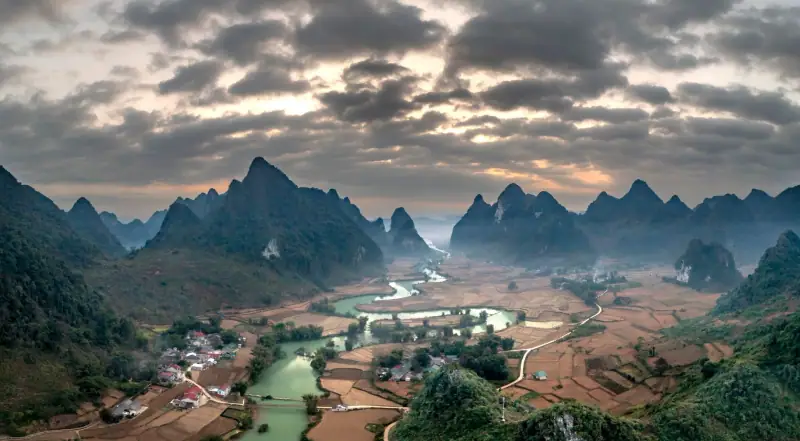
The first day is the longest in distance and the one that gradually introduces you to the heart of the Khammouane karst landscape.
Leaving by Route 12: from Thakhek, take Route 12 east for a few kilometers before turning north toward the interior province. The first few dozen kilometers cross a farming plain where rice fields stretch to the horizon, dotted with buffalo and thatched huts. Little by little, the first limestone towers appear on the horizon.
The climb to the Khammouane plateau: as you move away from the Mekong, the terrain changes radically. The plain gives way to a karst plateau where limestone mountains rise directly from the ground with no gradual foothills. Dense forests colonize the cliff faces, and secondary roads wind between the rock blocks. It is one of the most striking landscapes in Laos.
The villages on the way: the road crosses several villages of the province, often made up of bamboo stilt houses with vegetable gardens and free-roaming pigs. It is a chance to observe rural life in central Laos, still little exposed to mass tourism.
Arriving at Kong Lor village: after about 175 to 180 km (109 to 112 mi), Kong Lor village appears at the edge of a dense forest, at the foot of the limestone cliffs. This is where the guesthouses for the night are. The cave access is 1 km (0.6 mi) from the village along a road toward the mountain. Settle in, explore the village at sunset, and save your energy for the next morning’s crossing.
Lodging in Kong Lor: several basic but clean guesthouses are concentrated in the village next to the cave. Conditions are simple (a fan, a cold or lukewarm shower, mosquito nets), but the atmosphere is that of a genuine rural Lao village in an exceptional natural setting. Book ahead in high season (November to January).
Day 2: Crossing Tham Kong Lor + Kong Lor → Lak Sao (about 100 to 110 km / 62 to 68 mi)
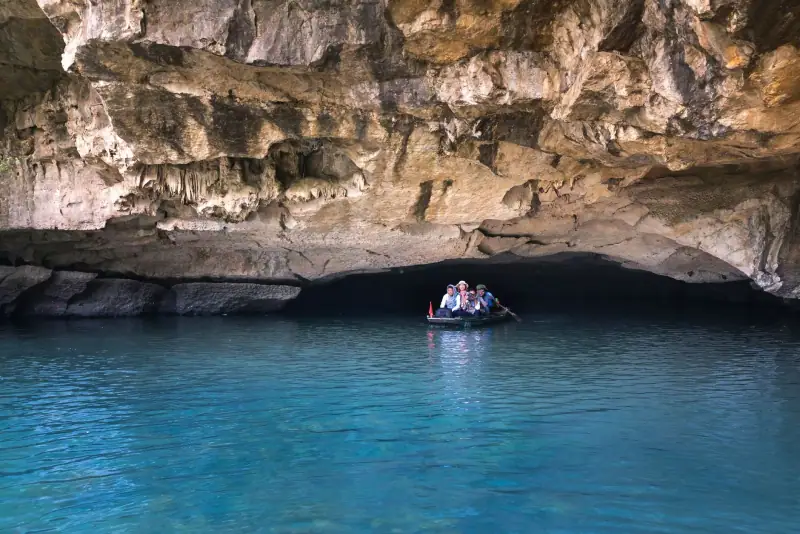
The high point of the Loop. The morning is devoted to crossing Kong Lor Cave; in the afternoon, you resume the road east to Lak Sao.
Tham Kong Lor Cave: one of Southeast Asia’s natural wonders
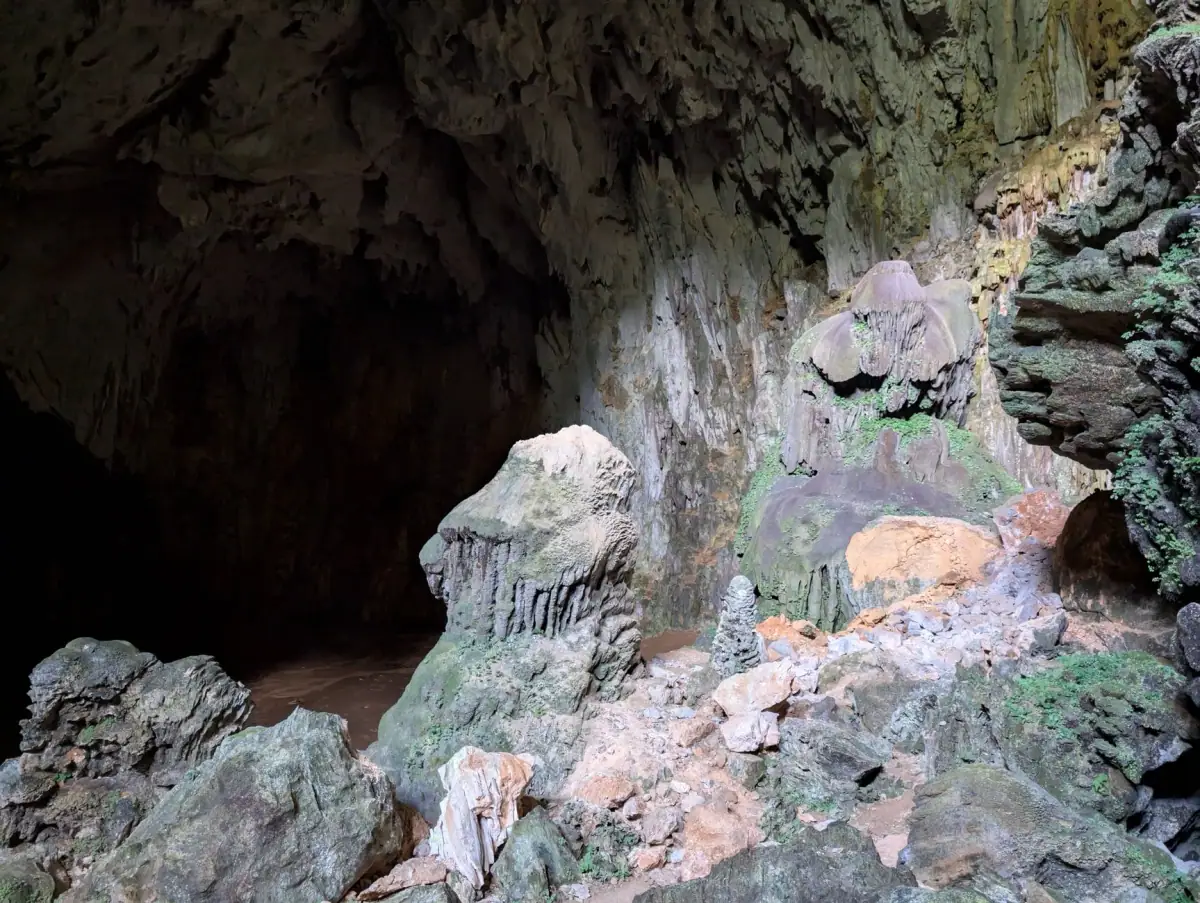
Tham Kong Lor is a river cave carved by the Nam Hin Bun (Nam Hin Boun) through the Phou Hin Boun limestone massif. The name “Kong Lor” comes from the neighboring village, not the watercourse. It runs about 7 to 7.5 km (4.3 to 4.7 mi) long depending on the source, which makes it one of the longest navigable caves in the world. The river runs through it entirely: you enter one side of the mountain by boat and come out the other, having literally crossed the massif from the inside.
The boat visit: the crossing must be made with local boatmen trained to navigate the galleries. Two flat-bottomed boats, narrow and low on the water, allow passage through the tightest sections. A personal headlamp is essential in addition to the torches provided: some galleries are completely dark and the rock formations are worth lighting up close.
The first few hundred meters pass through galleries of modest size, where the humidity is immediate and the temperature drops noticeably. Then the cave opens into chambers many tens of meters high, where stalactites and stalagmites form spectacular groupings in the beam of the lamps. The water on the floor of an intermediate underground chamber is shallow enough to allow a stop on foot on a natural sandbank.
The full round-trip crossing takes about two to three hours. Some choose to go through in one direction (east to west or the reverse), cross the mountain on foot by a path on the outer slope, and take the boat back from the other entrance.
Practical information for Kong Lor:
- The site is generally open from 8 am to 4 pm (approximate hours, check locally)
- Pay for the entry ticket and boat at the cave, at rates set by local authorities
- Bring clothes that can get wet: humidity and spray are unavoidable
- Wear sturdy shoes for stepping out of the boat onto the inner banks
- In the rainy season (July to September), the cave can close if the river is in flood
Accommodation in Thakhek
Colonial guesthouses, Mekong bungalows and budget options for your night before setting out on the Loop.
Kong Lor → Lak Sao: the wild heart of the Loop
After the morning crossing, take the road east toward Lak Sao (sometimes spelled Lak Xao). This stretch of the Loop is often the wildest: the road crosses the buffer zone of the Phou Hin Boun National Biodiversity Conservation Area, a zone of dense tropical forest where limestone cliffs rise on both sides of the track. Traffic is nearly nonexistent, and some dirt-track sections need attention.
Lak Sao is a small trading town near the Vietnamese border. It has no particular charm, but it has functional guesthouses, restaurants and gas stations to fill up before the second part of the Loop. It is the most practical stop for the second night.
Day 3: Lak Sao → Mahaxai → Thakhek (about 170 to 180 km / 106 to 112 mi)
The third day closes the circuit by heading south, running along the Vietnamese border and crossing the Mahaxai valley, known for its natural pools and caves reachable from the road.
The descent to Mahaxai: border and valleys
The return road from Lak Sao first follows the Vietnamese border along paved sections with open views of the mountains. The vegetation changes, forests thicken, and the road descends to the plains of the Nam Don river.
Tham Nang Aen: about 15 to 18 km (9 to 11 mi) east of Thakhek on Route 12, this cave is the first accessible stop. It opens onto an underground lake reached from the bank by a short crossing in a local boat. Light filtering into the first chambers creates a mirror reflection on the still water, particularly beautiful in mid-morning.
The caves of the Mahaxai valley: about 40 km (25 mi) east of Thakhek, the Mahaxai valley has other sites reachable along Route 12:
Tham Pha Chan is an ornamental cave reached from Route 12, with several chambers linked by a developed path. Limestone formations are abundant and entry is often free or at a modest fee.
The Nam Don natural pools: at Mahaxai, the Nam Don river forms natural basins in the limestone with perfectly transparent water. In the dry season, it is a perfect place for a cool swim after several days on the road. The water is remarkably clear, tinted blue-green by the dissolved limestone.
Back to Thakhek: from Mahaxai, Route 12 returns to Thakhek going up the river. The end of the route is flat and easy. It is a pleasure to be back at Fountain Square and the Mekong bank for a well-earned sunset.
Motorbike or car rental in Thakhek
Compare rental offers for your Loop: semi-automatic motorbikes, scooters or cars with a driver.
Option: the Loop in 4 days (recommended version)
The four-day version lets you stay longer at Kong Lor, do the full cave crossing both ways without rushing, and devote an entire half day to the Mahaxai natural pools and the valley caves on the way back.
Day 1: Thakhek → Kong Lor (175 to 180 km / 109 to 112 mi). Arrive in the late afternoon, settle in and have dinner in the village.
Day 2: Full crossing of Tham Kong Lor in the morning (two to three hours). Free afternoon in the village or a walk around the cliffs. Night in Kong Lor.
Day 3: Kong Lor → Lak Sao (about 100 to 110 km / 62 to 68 mi). Wild scenery of the Phou Hin Boun reserve. Night in Lak Sao.
Day 4: Lak Sao → Mahaxai → Thakhek (170 to 180 km / 106 to 112 mi). Swim at the Nam Don pools, visit Tham Nang Aen or Tham Pha Chan, back to Thakhek in the late afternoon.
Variants of the Thakhek Loop
The short Loop (2 days): a shortened version that loops through the Mahaxai caves without going all the way to Kong Lor. Less spectacular but accessible to beginner riders or travelers in a hurry.
The grand Loop with Nakai: some travelers add a stop at Nakai and the Nam Theun 2 reservoir, a vast artificial lake surrounded by forest. It is an extension that adds one to two days to the circuit and lets you explore a still little-visited area.
The Loop by bicycle: experienced travelers do the Loop on a touring bike, in five to seven days. The elevation changes are significant in the northwest section, and dirt tracks make it demanding.
The Loop by private car: several agencies in Thakhek offer turnkey packages with a driver, over three to four days. Ideal for families or anyone who does not ride.
Budget for the Thakhek Loop
The Loop is one of the most financially accessible experiences in Laos. Here are indicative ranges for a traveler going alone by motorbike:
| Item | Tight budget | Comfort |
|---|---|---|
| Motorbike rental (3-4 days) | 240,000-480,000 kip | 400,000-700,000 kip |
| Accommodation (per night) | 40,000-80,000 kip | 100,000-200,000 kip |
| Meals (per day) | 30,000-60,000 kip | 60,000-120,000 kip |
| Fuel (whole Loop) | about 60,000-100,000 kip | n/a |
| Kong Lor entry + boat | about 100,000-130,000 kip (rates vary by source, confirm locally) | n/a |
| Mahaxai caves | 10,000-30,000 kip | n/a |
| 4-day total | about $46-70 | about $93-140 |
Allow a cash safety margin for the unexpected (motorbike repair, minor medical costs, tolls).
The Laos budget guide gives all the ranges for planning your full trip.
Flights to Laos
Vientiane (Wattay International) is the most practical entry airport for reaching Thakhek by bus.
Fitting the Loop into your Laos itinerary
The Thakhek Loop fits naturally into a north-south trip through Laos. From Vientiane, Thakhek is about 330 to 350 km (205 to 217 mi) south on National Road 13, reachable by bus in six to eight hours.
Classic 15 to 20 day itinerary: Arrive in Vientiane (2 to 3 days) → Vang Vieng (2 to 3 days) → Thakhek + Loop (4 to 5 days) → Pakse (2 to 3 days) → Bolaven Plateau → 4,000 Islands (2 to 3 days) → exit via Cambodia or return to Vientiane.
10-day itinerary: Vientiane (2 days) → Thakhek + Loop in 3 days → Pakse + Bolavens (3 days) → 4,000 Islands (2 days).
See the complete circuit through Laos to plan the main stages of your trip.
If you want to know everything about the starting town, the guide to Thakhek covers the colonial center, the Mekong, the crossing to Thailand and lodging in town.
For cave lovers, the article on caves in Laos lists the country’s best caving sites, including Kong Lor and the Nam Don caves.
What to remember about the Thakhek Loop
The Thakhek Loop is not the easiest circuit in Laos, nor the most comfortable. The tracks can be rutted, lodging remains basic in places, and the isolation is real on some stretches. But that is exactly where its appeal lies.
In three to four days on the road, you cross a Laos that most travelers never see: karst landscapes of austere, powerful beauty, a nature still largely preserved, villages where life follows a rhythm that tourism has not yet altered, and an underground cave that ranks among the most striking natural experiences in Southeast Asia.
The Thakhek Loop is often cited as one of the strongest memories of a trip to Laos. Those who have done it understand why.
Frequently asked questions
How many days do you need for the Thakhek Loop?
The classic version takes 3 days at minimum, including a night in Kong Lor and a night in Lak Sao. The recommended version is 4 days, to fully enjoy Kong Lor Cave and the Mahaxai natural pools without rushing. An express 2-day version exists but does not let you visit Kong Lor in good conditions.
Do you need to know how to ride a motorbike to do the Thakhek Loop?
Prior experience on a motorbike or semi-automatic scooter is strongly recommended. Some sections of the Loop are dirt track, sometimes wet. Thakhek agencies also offer private car tours with a driver for those who do not ride. Check the driving-permit requirements for your own license with the official sources before you go.
When is the best time to do the Thakhek Loop?
The dry season, from November to April, is ideal: tracks are passable, rivers accessible and Kong Lor Cave is open. In the rainy season (May to October) some sections can be impassable and Kong Lor can close if there is a flood. November to January is the most pleasant in terms of temperature.
Where do you rent a motorbike for the Thakhek Loop?
Several agencies in central Thakhek, around Fountain Square, rent motorbikes of 100 to 150 cc. Check the bike's condition before setting out (tires, brakes, lights) and make sure you have the rental company's contact number in case of a breakdown on the road.
Are there ATMs on the Thakhek Loop?
No. You must carry enough kip in cash before leaving Thakhek. The villages along the Loop have no ATMs. Bring at least 3 to 4 days of budget (lodging, meals, fuel, entry fees) in cash.
Can Kong Lor Cave close?
Yes. In the rainy season, the underground river can rise to a level that makes navigation impossible or dangerous. The cave can close partly or completely from July to September. Check conditions with Thakhek guesthouses before setting out; they generally have up-to-date information on the state of the road and the cave.
Can you do the Thakhek Loop by car?
Yes. Thakhek agencies offer 4x4 or van packages with a driver. Some track sections are passable by car in the dry season, but not in the rainy season. A car is less flexible than a motorbike for stopping spontaneously, but suits families or travelers who do not ride.
More Laos guides
Keep reading
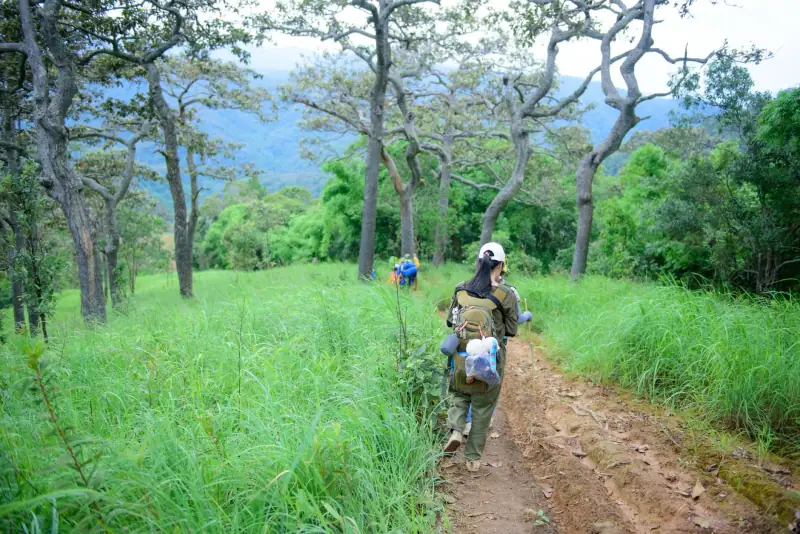
Hiking in Laos Without an Agency: Is It Legal, and What Does It Really Cost?
Can you trek alone in Laos without a guide? Permitted areas, required permit in national parks, UXO risk and agency vs independent price comparison.
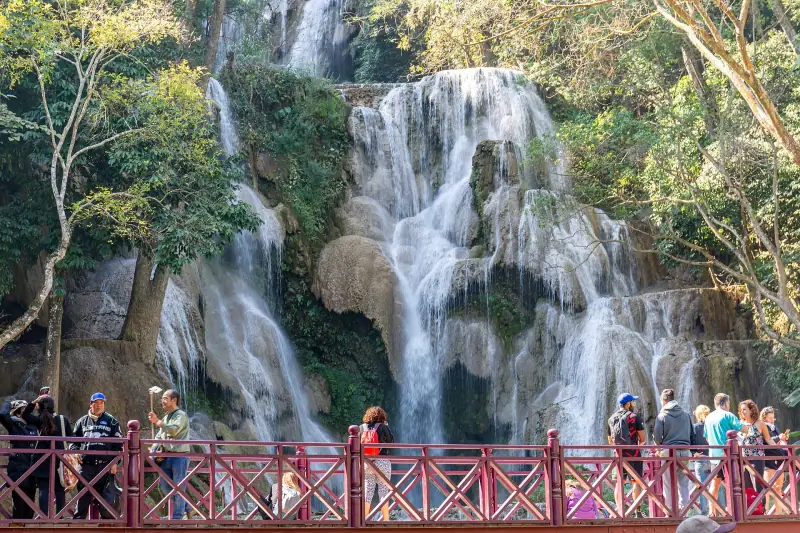
Kuang Si Waterfalls: Complete Guide for Your Visit
Everything about the Kuang Si waterfalls near Luang Prabang: access, fees, swimming, best time to visit and practical tips.
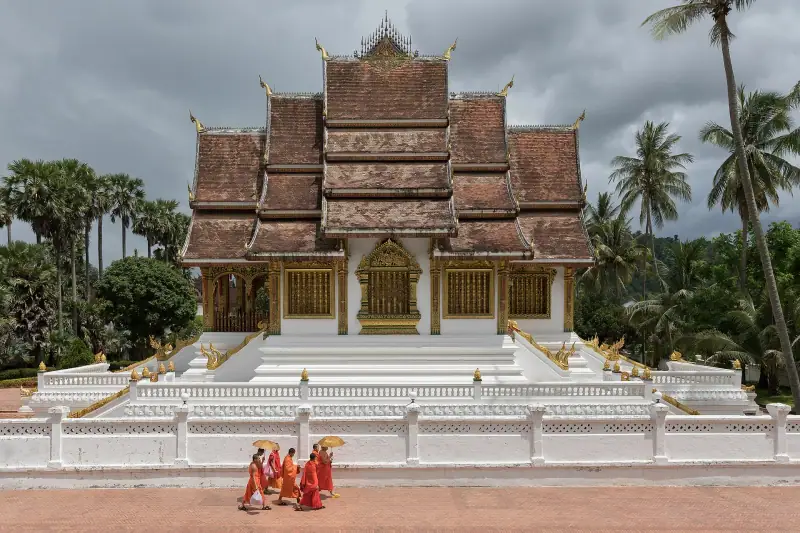
Luang Prabang: The 15 Must-Sees of Laos's Royal Town
What to see in Luang Prabang? The 15 top sights and activities of Laos's spiritual capital: temples, waterfalls, tak bat and markets.
Ready-made
Laos itineraries
7 days
Laos in 7 Days: A Complete Itinerary for an Unforgettable Week
VientianeVang ViengLuang Prabang
Can be adapted in the planner
10 days
Laos in 10 Days Without a Car: A Realistic Train and Bus Itinerary
VientianeVang ViengLuang PrabangNong Khiaw