What to see
Visiting the 4,000 Islands (Si Phan Don): Complete Guide to Southern Laos
We may earn a commission when you book through links on this page, at no extra cost to you. We don't visit or try the places we cover: we summarize published sources. How we work
In short
- Plan 3 to 5 days on Don Det and Don Khon; two days cover the essentials (waterfalls, bikes, sunsets).
- Irrawaddy dolphins have disappeared from Lao waters (last individual died in February 2022); about 113 remain in the Cambodian Mekong.
- Khon Phapheng falls, about 6 km (3.7 mi) south of Don Khon, are the widest in the world at 10.8 km (6.7 mi); entry is about 55,000 kip.
- From Pakse (130 km / 81 mi), allow 2.5 to 3 hours by shuttle, then a 5 to 10 minute boat; bring cash, as the nearest ATMs are in Pakse.
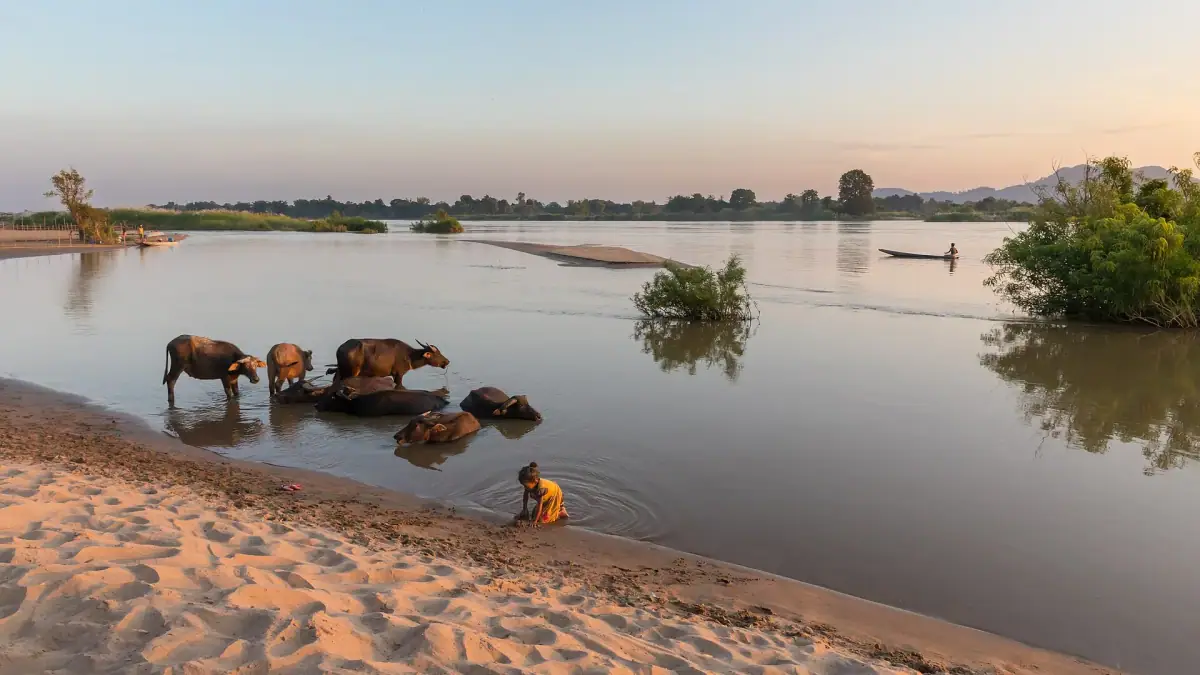
In southern Laos, a few kilometers from the Cambodian border, the Mekong breaks apart. The river, which runs 4,350 km (2,703 mi) from Tibet to the South China Sea, spreads here to a width of 14 km (8.7 mi) in the rainy season, dividing into dozens of channels around hundreds of islands and sandy islets. Laotians call them Si Phan Don: the Four Thousand Islands.
Two of them hold most of the tourism: Don Det and Don Khon. Linked by an old French colonial railway bridge, these two islands offer one of the most authentically peaceful stays in Southeast Asia. No airport, no urban bustle, hardly any motorized traffic. Just the Mekong, its orange reflections at dusk, the sound of dugout canoes and, if you get up at dawn, the mist on the waters where Irrawaddy dolphins once lived, now gone from the Lao side.
The 4,000 Islands are a perfect place to end a circuit of Laos before crossing into Cambodia. They are also one of the most effective places in the world to slow everything down: your itinerary, your days, and perhaps your way of traveling.
Don Det: the island of travelers and sunsets
Don Det is the smaller of the two main islands (about 4 km / 2.5 mi long) but the livelier. This is where the hammock guesthouses, the restaurants serving banana-chocolate crepes and the tables where backpackers have swapped travel stories since the 1990s are concentrated.
The infrastructure is basic but functional: dirt paths and bike tracks run along both banks, the east bank facing the calm arm of the Mekong, the west bank exposed to the main current and the spectacular sunsets. Between the two are a few rice fields, vegetable gardens, and the stilt houses of Lao families who have lived here for generations.
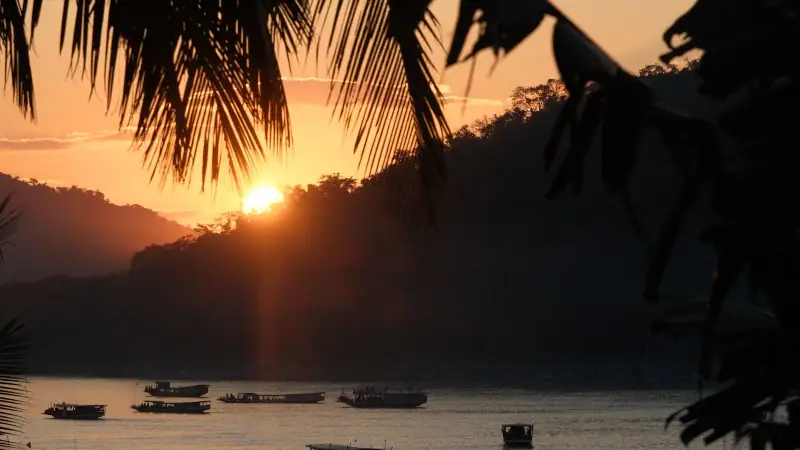
Don Det’s west bank is known for its sunsets. Settle into one of the waterside restaurants from 5:30 pm: the Mekong gradually turns orange, pink and purple as the dugout canoes return to the village. It is free, it happens daily, and it never gets old.
The east bank is quieter and less touristy. Lao families sleep here, and a few more discreet guesthouses offer lodging facing the rice fields. In the morning, fishermen cast their nets from wooden canoes a few meters from the bank, an unchanging scene that goes back centuries.
Don Det’s morning market (6 to 8 am) is where islanders buy vegetables, fresh fish and sticky rice. A local breakfast costs under 10,000 kip.
Stays in the 4,000 Islands
Stilt bungalows, hammocks and Mekong views, for every budget.
Don Khon: nature and colonial remains
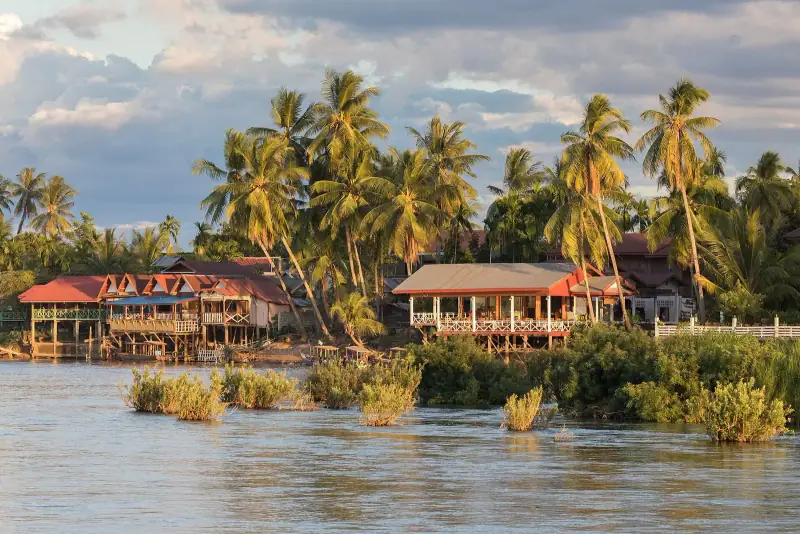
Don Khon is larger (about 4 to 5 km / 2.5 to 3 mi long and 3 km / 1.9 mi wide) and more residential than Don Det. It has a denser Lao population, a few schools and monasteries, and the most visible remains of the French colonial presence in the region.
The bridge and the old railway: in the 19th century the French built a railway line on the islands to bypass the Khon falls, which boats cannot pass, and to allow river trade between Indochina and Chinese Yunnan. The line ran from 1893 to 1940, with an attempt to restart it in 1945 under Japanese occupation. Today what remains is a riveted metal bridge, a few rusted steel pylons, and two steam locomotives abandoned in the vegetation: a free open-air museum, oddly photogenic.
Don Khon’s forest: the heart of the island is covered by relatively well-preserved secondary tropical forest. Informal paths let you venture in on foot or by bike. Birds, lizards and butterflies are everywhere. Local fishermen know isolated banks where you can swim in the calm arms of the Mekong, away from the tourist areas.
The village of Ban Khon: in the center of the island, this village is home to fishing families who have lived on the Mekong for generations. You can wander freely through its lanes, watch the net-weaving workshops and buy still-warm sticky rice from private houses that sell it by the portion in the morning.
The Khon Phapheng falls: the largest in Southeast Asia
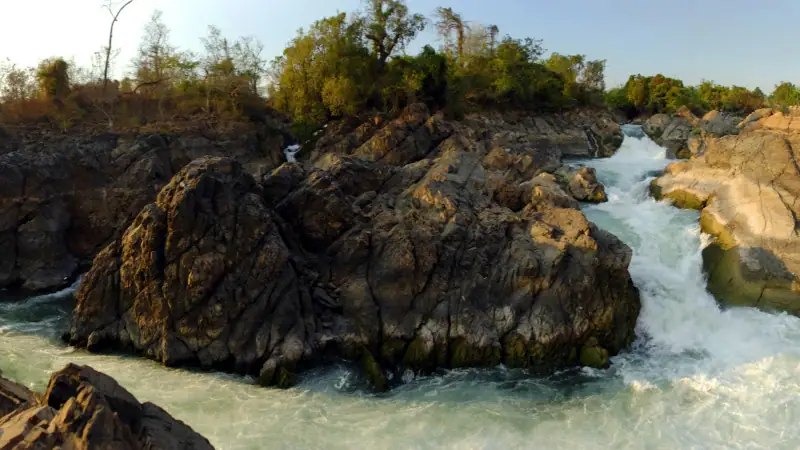
About 6 km (3.7 mi) south of Don Khon, the Khon Phapheng falls are one of the most impressive natural sites in Southeast Asia. The Mekong tumbles here across a width of 10.8 km (6.7 mi), the widest waterfall in the world, with a permanent roar that can be heard from more than a kilometer (0.6 mi) away.
Khon Phapheng is not the tallest waterfall, since the main drop measures about 15 to 21 m (49 to 69 ft) depending on the source, but it is the waterfall with the greatest water flow in Southeast Asia. In the rainy season (July to September), an estimated 11,000 m³ per second pass through this bottleneck, about 4 to 5 times the flow of Niagara Falls in low season.
Access is from the Don Khon bank, by boat (5,000 kip) to the mainland bank, then by tuk-tuk or on foot (2 km / 1.2 mi). Entry to the site costs about 55,000 kip (price to confirm locally). A wood and concrete walkway runs along the edge of the falls for several hundred meters, with successive viewpoints over the deluge of white water.
Tip: come early in the morning (before 9 am) or late in the afternoon (after 4 pm) to avoid groups of Lao tourists and the midday heat. The light is also much better for photos.
The Li Phi (Somphamit) falls: less spectacular in volume but more accessible from Don Khon (15 minutes by bike plus 10 minutes on foot), the Li Phi falls are a set of rapids and cascades in a particularly well-kept riverside forest setting. Entry costs 35,000 kip. In the dry season you can go down to the submerged rocks and swim in the shallow pools.
Excursions from the 4,000 Islands
Dolphins, waterfalls, kayaking and island tours with local guides.
Irrawaddy dolphins: a rare encounter
The most moving experience in the 4,000 Islands is still tied to the Irrawaddy dolphins (Orcaella brevirostris), even if their story here is tragic. These freshwater cetaceans, small, with a rounded forehead and no prominent beak, disappeared completely from Lao waters in 2022: the last recorded individual died in February 2022 in the border waters. About 113 individuals remain today in the Cambodian Mekong, according to the latest estimates (2025). That is all.
These dolphins live in fresh and brackish waters from the Ganges delta to the Mekong. Poaching, fishing nets and habitat degradation have reduced their total world population (all basins combined) to fewer than 250 individuals, a critically endangered species.
Can you still see them from the 4,000 Islands? Dugout canoe excursions offered from the southern tip of Don Khon can no longer guarantee a sighting in Lao territory. Boats sometimes cross into the nearby Cambodian waters, where appearances are possible, but sightings are no longer systematic. For a genuine encounter you need to go to Cambodia, the Kratie area (about 3 to 4 hours from Stung Treng). It is still worth visiting the site from Don Khon to understand the story of this extinction and the remarkable biodiversity of the Mekong at this spot.
Viewing rules to respect:
- Never touch the dolphins, even if they approach
- The engine must be switched off within 30 m (98 ft) of a dolphin
- Do not throw anything in the water
- Choose a guide certified by WWF-Laos (logo visible on the canoe)
On the Cambodian side, in the dry season, the best time is 6 to 7:30 am or 4 to 5 pm: the low water level concentrates the dolphins in a smaller area, making viewing easier.
Exploring the islands by bike
The bicycle is the best way to get around the 4,000 Islands. The terrain is flat, the paths are wide and little used, and the total distance of the Don Det + Don Khon loop (including the bridge crossing) does not exceed 20 to 25 km (12 to 16 mi), doable in 4 to 5 hours of easy pedaling with stops.
Suggested route (a full day):
- Leave Don Det’s east bank heading north (6:30 to 7 am, morning coolness)
- Circle the northern tip of Don Det
- Return along the west bank and cross the colonial bridge to Don Khon
- Stop at the abandoned locomotives
- Go down to the Li Phi falls (entry plus swimming)
- Return to the village of Ban Khon for lunch
- Afternoon: dugout canoe trip to the southern tip of Don Khon (the former dolphin-watching site, where none are seen on the Lao side)
- Return to Don Det across the bridge for sunset on the west bank
Bike rental: 15,000 to 20,000 kip a day for a simple bike, 25,000 to 40,000 kip for a bike with gears. Check the tires and brakes before leaving, as quality varies.
Fishing on the Mekong: an unchanging tradition
Fishing has been the economic backbone of the islands for millennia. The Mekong here is one of the world’s richest rivers in fish diversity, with more than 1,000 species recorded in its basin.
Si Phan Don fishermen use traditional techniques handed down from generation to generation: nets stretched across side channels, woven bamboo traps, and fish traps placed at the entrance to rapids. At dawn, dugout canoes crisscross the river in an organized ballet visible from the banks of Don Det or Don Khon.
Some guesthouses offer fishing trips with a local fisherman (50,000 to 80,000 kip per person, 2 to 3 hours). You come back with your catch, which the guesthouse restaurant cooks for dinner, the most local version possible of the “river to plate” concept.
Car rental from Pakse
To link Pakse to the 4,000 Islands at your own pace and visit the Bolaven Plateau on the way.
Where to stay in the 4,000 Islands
Lodging in the 4,000 Islands is geared exclusively toward eco-tourism and affordable travel. No international hotel, no elevator or pool, but stilt bungalows with Mekong views that have their own undeniable charm.
Don Det, east bank (the quietest): East bank guesthouses are calmer and often cheaper. The stilt bungalows sit directly over the arm of the Mekong, so you wake with water under your feet. Price: 60,000 to 150,000 kip (about $3 to $9) a night for a simple single or double room.
Don Det, west bank (sunset view): West bank guesthouses are slightly more expensive and livelier in the evening. The sunset view often justifies the 20,000 to 30,000 kip supplement.
Don Khon, a quieter stay: A few higher-quality guesthouses are on Don Khon, including teak guesthouses run by Lao families. Fewer in number, they often offer more space, more quiet and more personal service. Expect to pay 100,000 to 250,000 kip a night.
Camping: it is theoretically possible to camp on some deserted islands with the landowners’ agreement, but this practice is not organized and is only recommended for experienced travelers. Mosquitoes and night heat (30 °C+ / 86 °F+ in March-April) make the experience demanding.
To prepare your lodging across the whole circuit, the guide on where to stay in Vientiane covers the options for the starting stop.
Eating in the 4,000 Islands
The islands’ food is simple, genuine and centered on fish. Restaurants, often a wooden deck open to the Mekong with a few low tables and hammocks, serve at all hours.
Local dishes to try:
- Ping pa: Mekong fish grilled on a bamboo skewer, served with sticky rice and jeow sauce (grilled chili paste), the islands’ signature dish
- Tom yum pa: spicy fish soup with lemongrass, galangal and makrut lime leaves
- Khai penh: dried Mekong river weed, fried in oil and seasoned with sesame and fish sauce, a Si Phan Don specialty found nowhere else
- Laab pa: salad of chopped raw or cooked fish with fresh mint, chili and lime
Prices: local dishes cost 20,000 to 35,000 kip (about $1 to $2). “Farang dishes” (pizza, sandwiches, pasta for tourists) are offered at 40,000 to 80,000 kip. Eat local: it is better and a third of the price.
Breakfast: Lao bakeries have made baguettes since the colonial era. On Don Det a few stalls offer filled baguettes (10,000 to 15,000 kip) or bo banh mi (a Lao sandwich close to the Vietnamese bánh mì).
To learn more about the Lao specialties to discover across the country, see the guide to Lao food.
How to get to the 4,000 Islands
From Pakse (the nearest departure town, 130 km / 81 mi):
- Local bus from Pakse’s main bus station to Nakasong: 2 to 2.5 hours, 50,000 to 70,000 kip
- Direct shuttle (minibus plus boat included): 2.5 to 3 hours, 80,000 to 120,000 kip from Pakse travel agencies
- Private tuk-tuk from Pakse: 3 hours, 400,000 to 600,000 kip for the whole vehicle
From Vientiane:
- Night bus Vientiane to Pakse (10 to 12 hours), then a connection to the islands
- Domestic flight Vientiane to Pakse (1 hour, Lao Airlines, 400,000 to 700,000 kip depending on the season), then a shuttle
- The guide to circuits in Laos details north-south itineraries.
Crossing to the islands: At Nakasong (Ban Nakasong), wooden boats cross to Don Det in 5 to 10 minutes (5,000 to 10,000 kip with a bike). Boats run from 7 am to about 8 pm.
From Cambodia: The Don Kralor/Stung Treng border is 40 km (25 mi) to the south. Combined boat + bus shuttles arrive directly at Don Det from Phnom Penh or Siem Reap (8 to 12 hours depending on connections, 200,000 to 300,000 kip).
Budget in the 4,000 Islands
The 4,000 Islands are among the least expensive destinations in Laos:
| Item | Tight budget | Comfort |
|---|---|---|
| Accommodation | 60,000-100,000 kip | 150,000-300,000 kip |
| Meals (3 meals) | 40,000-70,000 kip | 80,000-150,000 kip |
| Activities | 50,000-120,000 kip | 200,000-400,000 kip |
| Local transport | 15,000-30,000 kip | 50,000-100,000 kip |
| Daily total | $12-17 | $29-58 |
The main expenses are the dugout canoe trip to the southern tip of Don Khon (about 100,000 kip, a price to negotiate), entry to the Khon Phapheng falls (about 55,000 kip) and optional activities. The Laos budget guide details costs across the whole country.
Practical information
Currency: the Lao kip (LAK) is the only legally accepted currency, but merchants often take Thai baht and US dollars (less favorable). The nearest ATMs are in Pakse, so come with enough cash.
Internet: slow Wi-Fi in most guesthouses. A Unitel or Lao Telecom SIM card is recommended for 4G (sold in Pakse or Nakasong, 30,000 to 50,000 kip with 1 GB of data), or check your carrier’s international plan or use a travel eSIM.
Health: there is no hospital on the islands. The nearest medical center is in Pakse. Bring a basic first-aid kit and insect repellent. Ask your doctor or a travel clinic about health precautions, and see the official travel health pages (CDC in the US, TravelHealthPro in the UK).
Electricity: 220 V, type A and C plugs. Outages are frequent on the islands, especially in the evening, so a headlamp is essential.
Water: never drink tap water. Bottled water costs 5,000 to 8,000 kip (about $0.30). Bring a filter bottle to reduce plastic waste.
The 4,000 Islands at a glance
| Info | Detail |
|---|---|
| Province | Champasak (southern Laos) |
| Main islands | Don Det, Don Khon, Don Khong |
| Size of Don Det | ~4 km (2.5 mi) long, ~2 km (1.2 mi) wide |
| Distance from Pakse | 130 km (81 mi), 2.5 to 3 hours |
| Cambodian border | 40 km (25 mi) to the south |
| Currency | Lao kip (LAK) |
| Connection | 4G available, slow guesthouse Wi-Fi |
Si Phan Don: the end of the world within reach of a hammock
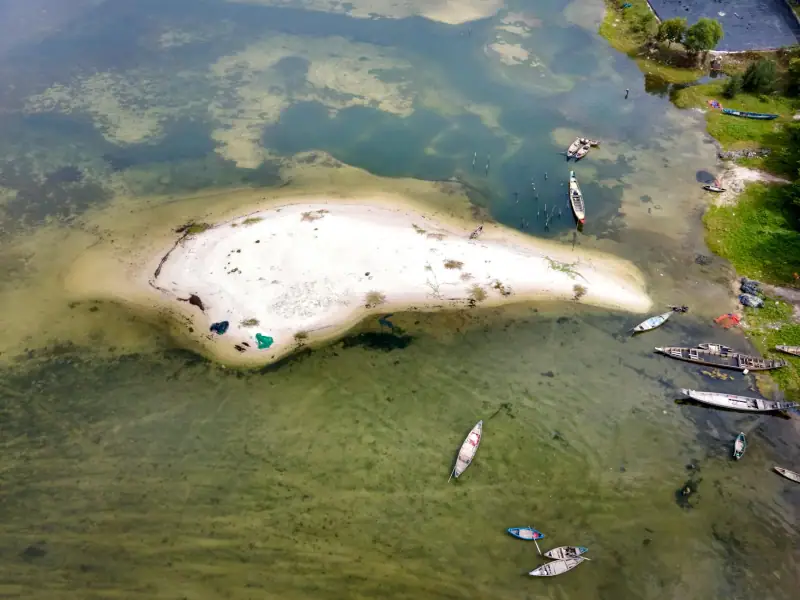
There are places in the world that do not try to impress you. The 4,000 Islands are one of them. Here the Mekong is not a tourist attraction but life itself. It feeds families, sets the rhythm of the days, and dictates the season. Dolphins swam here long before the first travelers set foot on the wooden banks.
Don Det and Don Khon will not offer you a five-star spa or a jet ski excursion. What they offer is rarer: the silence of nights without artificial light, mornings when mist covers the Mekong and fishermen glide soundlessly in their dugout canoes, sunsets that redden the whole sky without your having to do anything to earn them.
On a classic Lao itinerary (Luang Prabang, Vang Vieng, Vientiane, Pakse) the 4,000 Islands are often the last stop before Cambodia. And that is their secret magic: they make you not want to leave. To miss your bus. To stay one more night.
If you are in Laos for the first time and your itinerary includes the south, do not skip Si Phan Don to save time. It is where many travelers find their best memory of the country.
For a complete itinerary of Laos including the 4,000 Islands, see the guide to 7 days in Laos.
Flights to Pakse (southern gateway to Laos)
Pakse is the gateway town to the 4,000 Islands. Direct flights from Bangkok or Vientiane.
Frequently asked questions
How many days do you need to visit the 4,000 Islands?
3 to 5 days is the ideal length of stay to explore Don Det and Don Khon without rushing. Two days cover the essentials (waterfalls, cycling), but four days leave time to really slow down, catch sunrises on the Mekong and explore the quieter corners of nature. Some travelers stay a week and do not regret it.
How do you get to the 4,000 Islands from Pakse?
From Pakse, take a bus or minibus toward Nakasong (Ban Nakasong), the departure village for the boats to the islands; allow 2 to 2.5 hours on the road (about 100 km / 62 mi to Nakasong, about 130 km / 81 mi to Don Det). At Nakasong, local boats cross the Mekong to Don Det (5,000 to 10,000 kip, 10 minutes). Organized shuttles from Pakse go straight to the boat for about 80,000 to 100,000 kip per person.
Can you see Irrawaddy dolphins all year?
Irrawaddy dolphins disappeared completely from Lao waters in 2022 (the last individual died in February 2022). They now live only in the Cambodian Mekong, where about 113 individuals remain. Excursions offered from Don Khon therefore no longer guarantee a sighting in Lao territory. To see dolphins you need to cross into Cambodia (the Kratie or Stung Treng area). The best time is the dry season (November to April), when they concentrate in the deep pools.
Don Det or Don Khon: which island should you choose?
Don Det is livelier, with more lodging, restaurants and a social travel atmosphere. Most backpackers sleep there. Don Khon is calmer and more residential, with a few Lao families and fewer guesthouses that are often of better quality. The two islands are linked by an old French colonial railway bridge that you can cross on foot or by bike. For a first visit, start on Don Det for the atmosphere and explore Don Khon by day.
What is the best time to visit the 4,000 Islands?
The dry season (November to April) is ideal: the Mekong is navigable, roads are dry, and the weather is sunny and pleasant (25 to 32 °C / 77 to 90 °F). December to February is the most pleasant. Avoid March-April (up to 38 to 40 °C / 100 to 104 °F). In the rainy season (May to October) the islands turn spectacularly green and the Khon Phapheng falls are at full power, but some paths become impassable and boats are less frequent.
Do Wi-Fi and internet work in the 4,000 Islands?
Wi-Fi exists in most guesthouses and restaurants on Don Det, but the connection is slow and temperamental, with frequent drops, especially in the evening. 4G (Unitel or Lao Telecom) works correctly on Don Det and Don Khon with a Lao SIM card (15,000 to 30,000 kip a day for data). You can also check your carrier's international plan or use a travel eSIM. The 4,000 Islands are a place to learn to unplug, so embrace it.
How do you get from the 4,000 Islands to the Cambodian border?
The Laos-Cambodia land border at Don Kralor/Stung Treng is reachable from the 4,000 Islands. Most travelers take a combined bus/boat/bus ticket to Stung Treng or straight to Phnom Penh (organized shuttles from Don Det, 150,000 to 200,000 kip). The border crossing takes 1 to 2 hours depending on queues. Entry rules, visas and fees for Cambodia depend on your passport: check the official travel advice of your government before you go (travel.state.gov for the US, gov.uk/foreign-travel-advice for the UK, travel.gc.ca for Canada, smartraveller.gov.au for Australia; checked November 2026).
More Laos guides
Keep reading
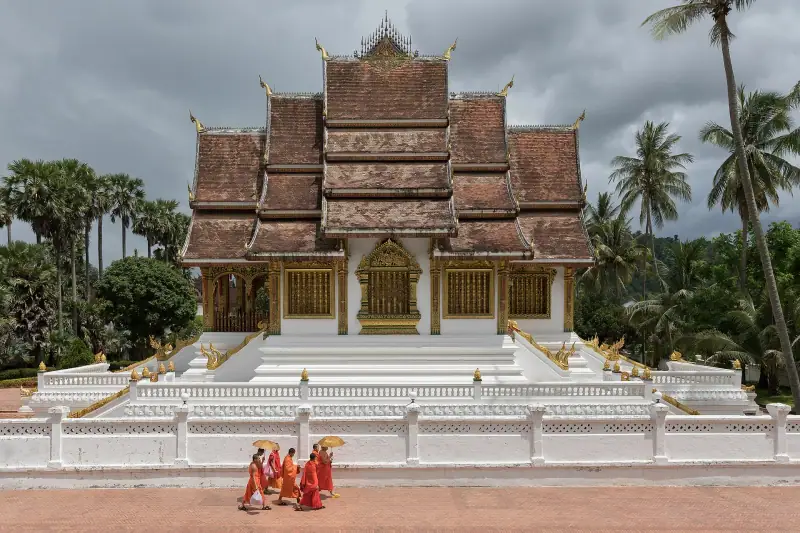
Luang Prabang: The 15 Must-Sees of Laos's Royal Town
What to see in Luang Prabang? The 15 top sights and activities of Laos's spiritual capital: temples, waterfalls, tak bat and markets.
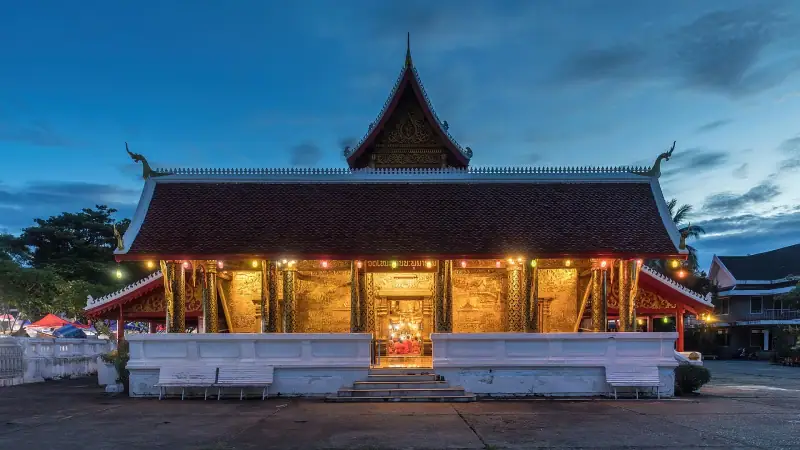
Visiting Luang Prabang: Complete Guide to Laos's Former Royal Capital
Complete guide to Luang Prabang: temples, tak bat, Kuang Si falls, Pak Ou, night market. Lodging, transport, budget and practical tips.
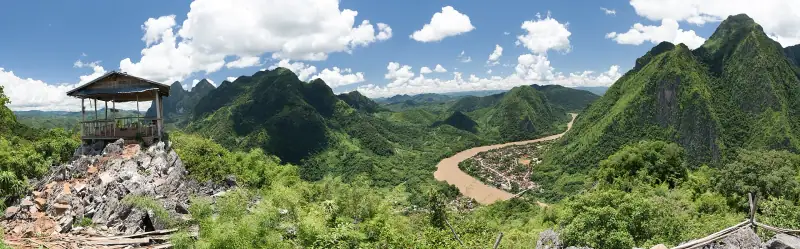
Visiting Nong Khiaw: Complete Guide to Northern Laos's Gem
Complete guide to Nong Khiaw: karst cliffs, Nam Ou, caves, village treks, Muang Ngoi. Lodging, transport and practical tips.
Ready-made
Laos itineraries
7 days
Laos in 7 Days: A Complete Itinerary for an Unforgettable Week
VientianeVang ViengLuang Prabang
Can be adapted in the planner
3 days
The Thakhek Loop: Complete Guide to Laos's Motorbike Circuit
Kong LorLak Sao
10 days
Laos in 10 Days Without a Car: A Realistic Train and Bus Itinerary
VientianeVang ViengLuang PrabangNong Khiaw