What to see
Visiting Luang Prabang: Complete Guide to Laos's Former Royal Capital
We may earn a commission when you book through links on this page, at no extra cost to you. We don't visit or try the places we cover: we summarize published sources. How we work
In short
- Plan 3 to 4 days at minimum (tak bat, temples, Kuang Si falls, Pak Ou caves); 5 to 7 days if you want to go deeper.
- The tak bat starts around 5:30 to 6 am; watch from a distance, no flash, shoulders and knees covered.
- Wat Xieng Thong costs 60,000 kip; Kuang Si is about 29 km (18 mi) away, 30,000 to 50,000 kip round trip by shared songthaew.
- The airport (LPQ) is about 4 km (2.5 mi) from the center; the Laos-China train station is about 12 to 15 km (7.5 to 9 mi) out.
Luang Prabang is, for many travelers, one of the most beautiful towns in Southeast Asia. On the UNESCO World Heritage list since 1995, this former royal capital of Laos spreads across a peninsula between the Mekong and the Nam Khan, in a setting of forested mountains. Its streets are lined with Buddhist temples with golden roofs, French colonial houses covered in bougainvillea and tropical gardens where time seems to have stopped.
The town is both spiritual and serene. Every morning at dawn, hundreds of monks in saffron robes file silently through the streets to receive offerings from the faithful. In the evening, the night market stretches along the main street, with Hmong and Khmu vendors laying out their embroidery, jewelry and lanterns under the soft light of bulbs. In between, the day flows from visits to century-old temples to the excursion to the turquoise Kuang Si falls and sunsets from Mount Phousi.
This complete guide gives you the keys to organize your stay in Luang Prabang: the main sights, excursions around town, practical tips on lodging, transport and budget, and the best times to go.
Wat Xieng Thong: the jewel of Luang Prabang’s temples
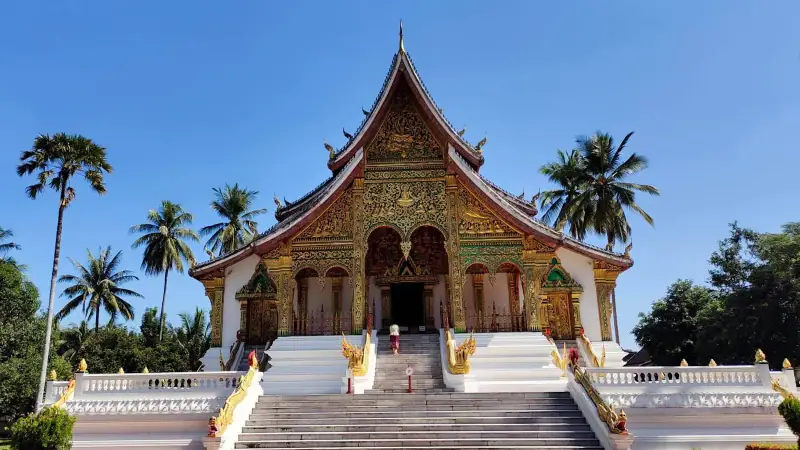
Among the fifty or so temples in Luang Prabang, Wat Xieng Thong is the most remarkable and, rightly, the most visited. Built between 1559 and 1560 under King Setthathirath, it has never been destroyed or moved in five centuries of history, which is exceptional for the region. It stands at the northern tip of the peninsula, on the Mekong.
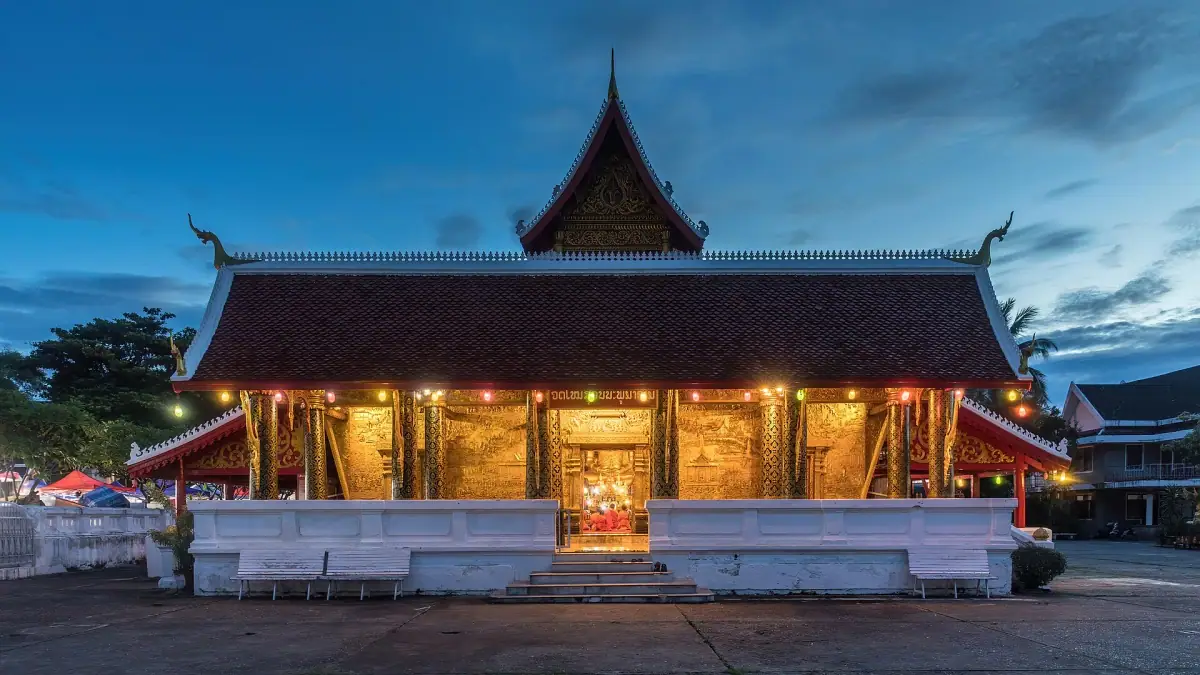
The architecture of Wat Xieng Thong illustrates what is called the Luang Prabang style: triple-sloped roofs that descend very low, almost to the ground, in successive waves that give the building a dynamic look despite its monumentality. The rear facade is decorated with a colored glass mosaic depicting the tree of life, one of the most famous works of art in Laos. Inside, columns painted with gold motifs on a red background frame the main Buddha.
The complex includes several secondary chapels, a royal funeral hall housing a carved ceremonial chariot used at the funerals of members of the royal family, and shaded gardens ideal for a break. The entry fee is 20,000 kip. Arrive early in the morning (before 9 am) to avoid organized groups.
Right nearby, a few minutes’ walk along the Mekong, Wat Xieng Mouane and several secondary chapels deserve a stop. They are less visited, and let you see monks going about their daily activities without a tourist crowd.
The guide to Luang Prabang’s top sights presents the main sights in town and its surroundings in detail.
Guided visits of Luang Prabang
Temple, tak bat and night market tours with guides. Book ahead in high season.
The tak bat: the offering ceremony at sunrise
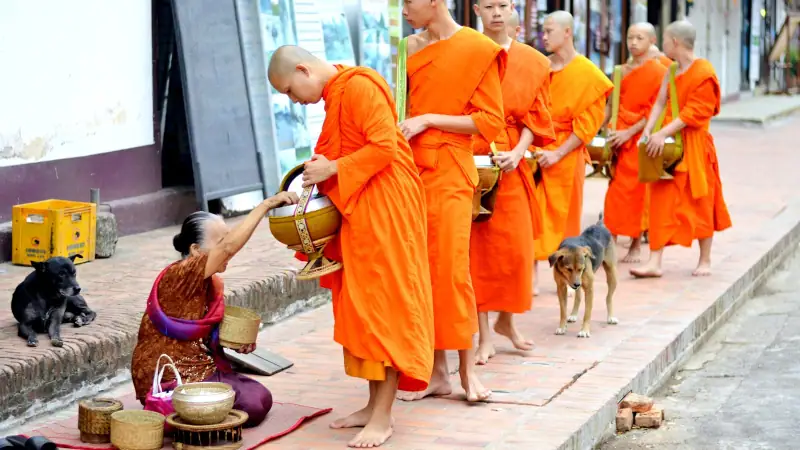
Every morning, before sunrise, hundreds of Buddhist monks, from the youngest six-year-old novice to the venerable elder in an ochre robe, leave their monasteries in silent file to collect their meals for the day from Lao worshippers. This practice, the tak bat (or binthabat), is one of the most moving moments Laos offers to travelers who get up early.
The procession begins around 5:30 to 6 am depending on the season. It takes place mainly along Sakkaline Road and the adjacent streets of the historic center. The faithful, mainly local residents, kneel along the road with their basket of sticky rice and cooked dishes, which they place in the large metal bowl of each passing monk.
How to attend the tak bat respectfully:
The tak bat is above all a religious practice, not a tourist show. Several rules of conduct apply:
- Stay at a distance and observe without getting between the monks and the faithful
- No flash, limit photos and do not push cameras into monks’ faces
- Dress modestly: shoulders and knees covered
- Do not touch the monks (women in particular must not touch monks)
- Agencies offering to let you “take part” by buying offerings are strongly discouraged; this commercial practice is criticized by local authorities and the monasteries themselves
The most authentic places to watch the tak bat without an excessive crowd are the side streets east of Sakkaline Road (between 6 and 6:30 am). The monks of Wat Xieng Thong are among the last to pass, around 6:30 to 6:45 am.
Mount Phousi: panorama over the town and the Mekong
At the geographic center of the peninsula, Mount Phousi rises about 100 m (328 ft) above the town. Its summit is crowned by a white and gold stupa, That Chomsi, from which the view over the confluence of the Mekong and the Nam Khan, the tiled temple roofs and the mountains of the eastern horizon is one of the finest in town.
The climb is by a staircase of 328 steps from the main entrance on Sisavangvong Street (paid entry, 60,000 kip according to recent sources). Another path climbs from the back, on the Phouvao Street side, slightly less steep and less busy. The climb takes between 15 and 25 minutes depending on your pace.
Best time to climb:
Sunset (between 5 and 6 pm depending on the season) attracts most visitors, who crowd onto the small summit platform. For the same view in peace, sunrise (5:30 to 6:30 am) is clearly preferable: the low light colors the Mekong orange and pink, morning mists still float over the valleys, and you will often be alone or nearly so. You can go straight on to the tak bat in the streets below.
On the way down, the middle path passes several shrines with stone Buddhas and votive niches filled with offerings, a nice way to cross the hill rather than going back down the same way.
The Kuang Si falls: the best excursion from Luang Prabang
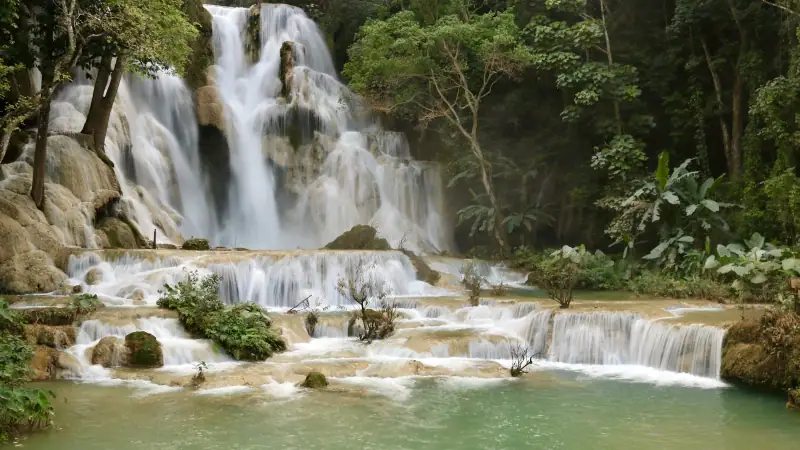
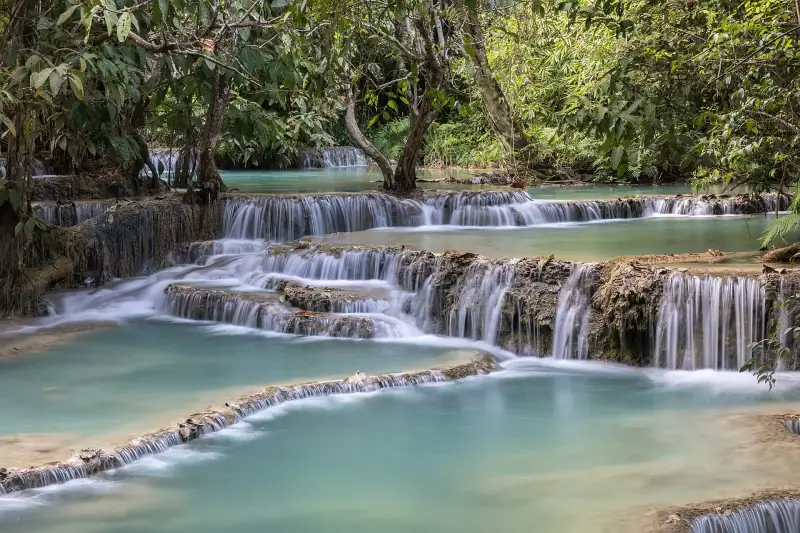
About 29 km (18 mi) southwest of Luang Prabang, the Kuang Si falls are the top excursion of any stay in town. The site combines several tiers of waterfalls tumbling through moss-covered limestone, feeding natural pools of an unreal turquoise color, due to the high calcite content of the water.
The main pool, downstream, is open for swimming: it is one of the most photographed swimming spots in Laos, and one of the most beautiful in Southeast Asia. Following the path that runs along the falls for about 800 m (0.5 mi), you reach the upper falls, taller and less visited.
At the park entrance is a rescue center run by a local NGO for Asiatic black bears and sun bears, victims of illegal hunting or the wildlife trade. The visit is included in the site’s entry fee.
Logistics for Kuang Si:
- How to get there: shared songthaews leave regularly from the parking area near the morning market (about 30,000 to 50,000 kip per person round trip); private tuk-tuks are available at negotiable prices; agencies offer excursions by minibus or by bike.
- Duration: allow half a day at minimum (3 to 4 hours there), a full day if you swim and climb to the upper falls.
- Best time: arrive before 10 am to beat the tour-operator groups. In the dry season (November to April), the water is more turquoise than in the rainy season.
- Entry: about 100,000 kip.
The dedicated article on the Kuang Si falls gives all the details on the falls, swimming, the bear center and routes to get there.
Accommodation in Luang Prabang
From guesthouses to luxury lodges on the Mekong, compare availability and book with free cancellation.
The Pak Ou caves: the Buddhas of the Mekong
About 25 km (16 mi) north of Luang Prabang by the Mekong, the Pak Ou caves, Tham Ting (the lower cave) and Tham Theung (the upper cave), open into a limestone cliff at the confluence of the Ou river and the Mekong. They shelter thousands of Buddha statuettes left there over the centuries by worshippers and royal families as a mark of devotion or in memory of the dead.
The atmosphere is deeply distinctive: in the natural dimness of the lower cave, Buddhas of all sizes and postures line shelves and limestone niches, some several hundred years old, others recent. The upper cave, reached by a steep staircase of about a hundred steps from the water’s edge, is darker and more mysterious. Do not forget a flashlight.
How to get there: the classic excursion is by boat from Luang Prabang, going up the Mekong to the north. The trip takes about 1.5 to 2 hours each way upstream, 1 hour on the return (favorable current). Local agencies offer excursions including stops in potters’ and weavers’ villages on the way. The guide to the Mekong cruise explains how to organize this day.
The Royal Palace and its museum
Built between 1904 and 1909 for King Sisavang Vong by the French colonial authorities, the Royal Palace (Haw Kham) stands at the center of the historic peninsula, a few meters from the foot of Mount Phousi. When the monarchy was abolished in 1975, it was turned into a national museum.
The interior is remarkably well preserved: the royal apartments are furnished with diplomatic state gifts (French furniture, porcelain, ivories), and the throne room has a set of glass mosaics on the floor and walls that many consider the finest in Laos. The museum also holds the Phra Bang, the most sacred gold-alloy Buddha statue in the country, which gave the town its name, although it is displayed in a separate chapel and sometimes replaced by a copy for conservation reasons.
Practical information: cameras and mobile phones must be left at the entrance (cloakroom service). Dress modestly. Closed on certain Lao public holidays, so check before you go.
The night market: crafts and street food
Every evening from 5 pm, the main street, Sisavangvong, is closed to traffic and turns into a long open-air market. Dozens of vendors, mainly Hmong, Khmu and Lao Theung women, spread their cloths on the sidewalks and present embroidery, indigo clothing, bags, silver jewelry, wood carvings and paper lanterns handmade in their villages.
At the end of the market is a food zone with fixed-price buffets of Lao dishes (around 20,000 to 30,000 kip for a loaded plate). It is a good chance to try local specialties, such as laap (a chopped meat salad with herbs), khao soi (a northern noodle soup), or the various grilled skewers, in a festive, friendly atmosphere.
Shopping tips: prices are fixed at most stalls (no aggressive haggling), but it is reasonable to ask for a small gesture on several purchases. Choose the stalls of direct producers over the permanent shops in the adjacent streets, whose prices are often higher for identical quality.
The guide to food in Luang Prabang presents the best places to eat in town, from breakfast to dinner.
Flights to Luang Prabang
Compare flights to Luang Prabang, with connections through Bangkok, Hanoi or Kuala Lumpur.
Where to stay in Luang Prabang
Luang Prabang offers every level of lodging, from a family guesthouse at $8 a night to luxury lodges at $300 with an infinity pool over the Mekong. Most tourist lodging is concentrated in the historic peninsula (the UNESCO area) and in the more modern district to the southeast.
Areas to stay:
- Historic peninsula (UNESCO area): ideal for being within walking distance of all the temples and the night market. There are many guesthouses, in traditional wood or brick houses. Noise at night is limited, since the town closes early.
- Ban Phonheuang / Nam Khan: on the bank of the Nam Khan, slightly off-center, this area has quieter and often cheaper lodging, with riverside restaurants that have terraces.
- Phonxay district (south): more commercial, less picturesque, but with a good concentration of affordable guesthouses and a good tuk-tuk link to the center.
The Luang Prabang accommodation guide compares the best places by area and by budget.
Budget in Luang Prabang
Luang Prabang is one of the most expensive towns in Laos, but remains very affordable by international standards.
| Item | Tight budget | Comfort | Luxury |
|---|---|---|---|
| Accommodation | 80,000-150,000 kip | 200,000-500,000 kip | 800,000 kip+ |
| Meals (local) | 15,000-30,000 kip | 40,000-80,000 kip | 100,000+ kip |
| Temples | 20,000 kip/visit | n/a | n/a |
| Kuang Si excursion | 30,000-50,000 kip (songthaew) | 80,000-150,000 kip (tuk-tuk) | n/a |
| Pak Ou (boat) | 60,000-100,000 kip | 120,000-200,000 kip | n/a |
| Daily total | $17-29 | $41-81 | $115+ |
High season (December-January) sees accommodation prices rise 20 to 40% over low season. Book ahead if you travel during Lao New Year (Pi Mai, mid-April) or the Festival of Lights (Boun Ok Phansa, October-November).
How to get to Luang Prabang
By air: Luang Prabang International Airport (LPQ) serves Bangkok, Hanoi, Vientiane, Chiang Mai and a few regional connections. The taxi between the airport and the town center costs about 60,000 to 80,000 kip (official fixed price posted), the tuk-tuk about 40,000 to 60,000 kip.
By bus from Vientiane: overnight VIP buses (about 10 to 11 hours, 130,000 to 200,000 kip) link Vientiane to Luang Prabang via National Road 13 North. There are several evening departures. VIP buses are air-conditioned with reclining seats.
By the Laos-China train: since the line linking Vientiane to the Chinese border (Boten) opened in December 2021, a station serves Luang Prabang about 12 to 15 km (7.5 to 9 mi) from the town center (Luang Prabang station, north side, about 30 minutes by tuk-tuk). The trip from Vientiane takes about 2 hours by train (versus 10 to 11 hours by bus). Tuk-tuks and shuttles link the station to the historic center.
By boat from Houayxai: the slow boat on the Mekong between Houayxai (on the Thai border) and Luang Prabang is one of the emblematic river journeys of Southeast Asia. Two days of sailing through mountain scenery, with a night in the little town of Pakbeng. Less comfortable than a bus, but unforgettable.
Car or scooter rental in Luang Prabang
To explore the surroundings at your own pace: Kuang Si, Hmong villages, the Pak Ou caves by road.
Luang Prabang in your Laos itinerary
Luang Prabang is naturally the start or end point of a circuit in northern Laos. It links easily with:
Luang Prabang → Nong Khiaw → Muang Ngoi: the classic northern itinerary. After 3 to 4 days in Luang Prabang, a minibus reaches Nong Khiaw in 3.5 to 5 hours, for 3 to 4 days in the karst scenery of the Nam Ou.
Luang Prabang → Vang Vieng → Vientiane: the classic Laos triangle, doable in 10 to 14 days. From Luang Prabang, the bus or train reaches Vang Vieng in 4 to 5 hours (bus) or about 2 hours (train).
Down the Mekong from the Thai border: arriving in Luang Prabang by slow boat from Houayxai, then continuing the circuit south, is one of the most memorable ways to approach Laos.
See the complete circuit through Laos for ready-made itineraries of 7 to 21 days.
What to remember about Luang Prabang
Luang Prabang is one of those rare towns where the beauty is everywhere: in the architectural proportions, in the morning light on the glazed tiles, in the silence of the monastic processions, in the turquoise color of the Kuang Si falls after a few hours on the road. It is not an open-air museum: it is a living town, where monks study the dhamma in schoolrooms open to the street, where children cycle between the temples, and where Hmong vendors prepare their embroidery at daybreak.
Three days are enough to see the essentials. A week may not be enough to tear yourself away.
Frequently asked questions
How many days should you plan in Luang Prabang?
Three to four days is the minimum to see the essentials: the tak bat ceremony, the main temples, a day at the Kuang Si falls and an excursion to the Pak Ou caves. Travelers who want to explore the region more deeply (repeat night markets, treks to Hmong villages, a Mekong cruise) give it five to seven days without getting bored.
How do you get to Luang Prabang?
Luang Prabang International Airport (LPQ) is about 4 km (2.5 mi) from the town center. The most common connections go through Bangkok (Bangkok Airways, Thai AirAsia) or Hanoi (Lao Airlines, Vietnam Airlines).
When is the best time to visit Luang Prabang?
High season runs from November to February: blue skies, pleasant temperatures (18 to 28 °C / 64 to 82 °F by day), clear rivers for the Kuang Si falls. March and April are hotter and drier, sometimes with smoke haze from agricultural burning. The rainy season (May to October) brings lush vegetation but the Kuang Si falls are often cloudy; November and December are generally the most beautiful months.
Is Luang Prabang a safe town for solo travelers?
Yes, Luang Prabang is one of the safest towns in Southeast Asia for solo travelers, including women traveling alone. Tourist-targeted crime is very low. The usual precautions apply: watch your belongings in markets, avoid riding a motorbike alone at night on mountain roads, and stay alert on the Mekong banks at night.
Do you need a visa to visit Laos?
Entry rules depend on your passport. Check the official travel advice of your government before you book: travel.state.gov (US), GOV.UK (UK), travel.gc.ca (Canada), Smartraveller (Australia) (checked November 2026). Also check the official Lao government e-visa portal for the current conditions.
Can you visit Luang Prabang on a limited budget?
Yes, as long as you avoid the luxury lodges. Comfortable guesthouses are available from $8 to $15 a night, meals in local restaurants cost $1.50 to $4, and the main temples charge 20,000 to 30,000 kip for entry. The tak bat ceremony is free (you attend as a respectful observer), and the night market is free. A day at the Kuang Si falls by shared songthaew is about 30,000 to 50,000 kip round trip.
Is Luang Prabang suitable for families?
Yes, it is one of the best destinations for traveling with children in Laos. The pace is slow, the town is small and easy to cover on foot, the temples are beautiful and accessible, and the Kuang Si falls, with their turquoise swimming pool, will delight children from age 4 or 5. The black bear and sun bear rescue center at the foot of the falls is also a stop families enjoy.
More Laos guides
Keep reading
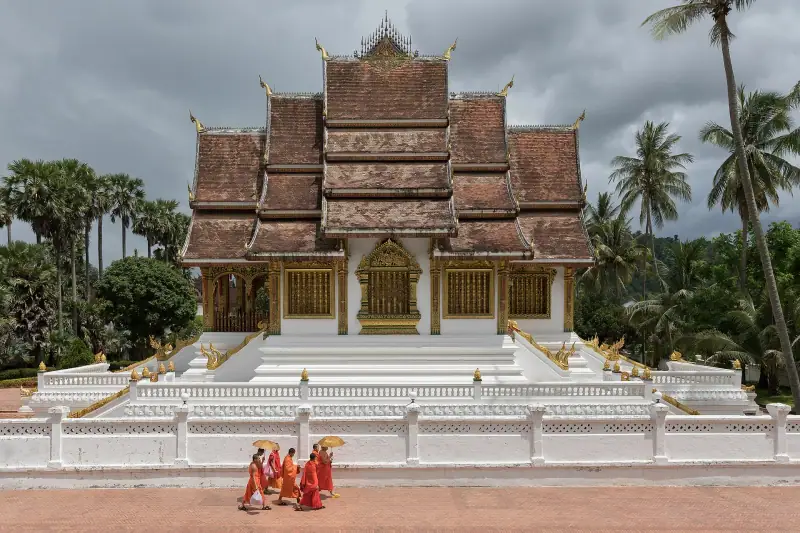
Luang Prabang: The 15 Must-Sees of Laos's Royal Town
What to see in Luang Prabang? The 15 top sights and activities of Laos's spiritual capital: temples, waterfalls, tak bat and markets.
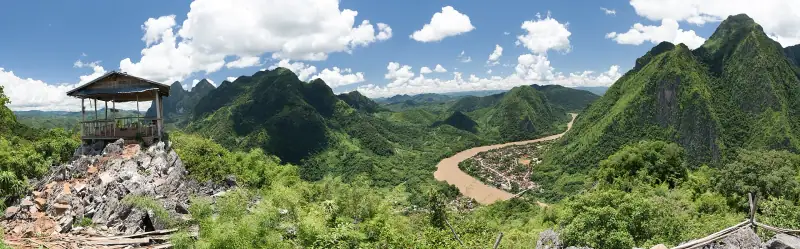
Visiting Nong Khiaw: Complete Guide to Northern Laos's Gem
Complete guide to Nong Khiaw: karst cliffs, Nam Ou, caves, village treks, Muang Ngoi. Lodging, transport and practical tips.
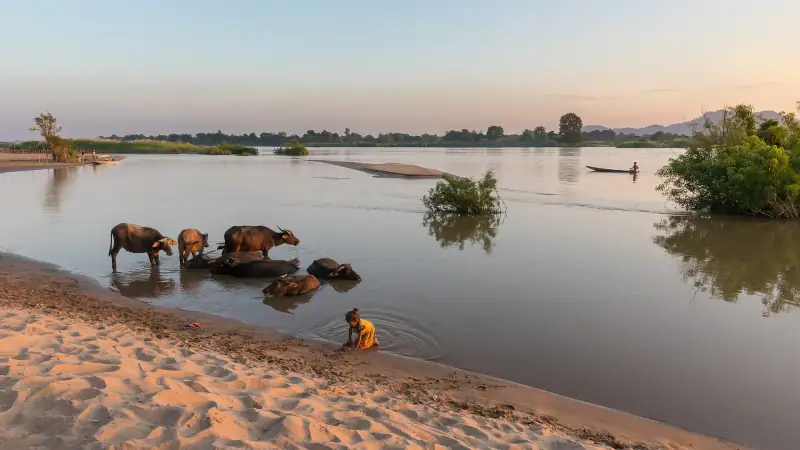
Visiting the 4,000 Islands (Si Phan Don): Complete Guide to Southern Laos
Complete guide to the 4,000 Islands (Si Phan Don): Don Det, Don Khon, Irrawaddy dolphins, Khon Phapheng falls, lodging and practical tips.
Ready-made
Laos itineraries
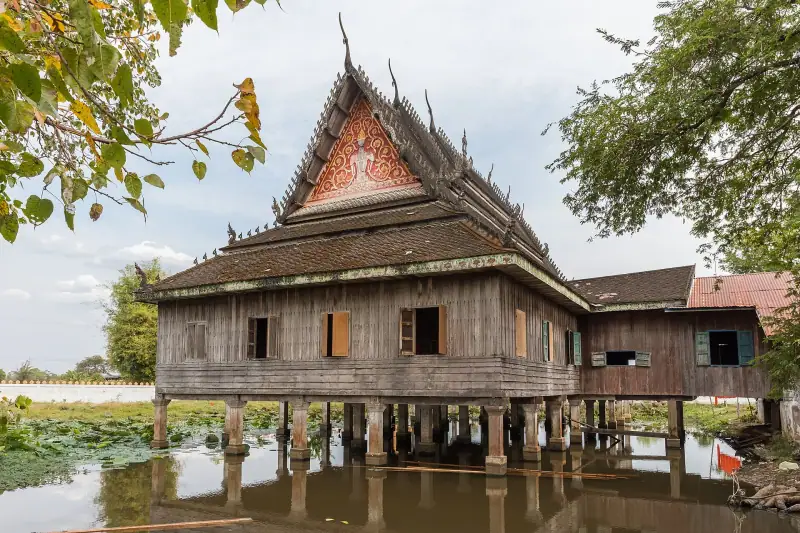
7 days
Laos in 7 Days: A Complete Itinerary for an Unforgettable Week
VientianeVang ViengLuang Prabang
Can be adapted in the planner
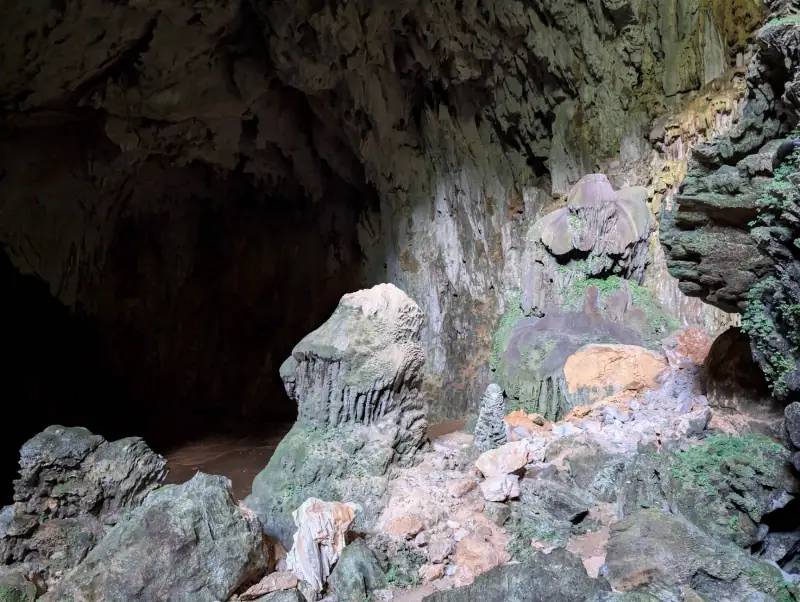
3 days
The Thakhek Loop: Complete Guide to Laos's Motorbike Circuit
Kong LorLak Sao
10 days
Laos in 10 Days Without a Car: A Realistic Train and Bus Itinerary
VientianeVang ViengLuang PrabangNong Khiaw