What to see
Visiting Split: complete guide to the Dalmatian capital
We may earn a commission when you book through links on this page, at no extra cost to you. We don't visit or try the places we cover: we summarize published sources. How we work
In short
- Two full days cover Diocletian's Palace, the Riva, Marjan hill and the main beaches; three days let you add Trogir, Klis or an island day trip to Brač or Hvar.
- Entering the palace area is free, 24 hours a day; the cellars (Podrumi), baptistery, St. Domnius Cathedral and bell tower are paid separately, with a combined pass available.
- Split airport (SPU) is about 25 km (16 mi) from the center; buses reach the ferry terminal in 30-40 minutes.
- June and September are ideal. Expect €70-130 (~$81-150) a night for an old-town apartment in high season.
Split is a city that lives inside a palace. Not a metaphor: Split’s old town literally grew within the walls of a 1,700-year-old Roman imperial residence, Diocletian’s Palace, a UNESCO World Heritage Site. Families have lived there since the Middle Ages, restaurants have settled into former guardrooms, and craftspeople work under Roman vaults. Nowhere else in Europe is daily life so intertwined with Antiquity.
With 170,000 inhabitants, Split is Croatia’s second-largest city and the unofficial capital of Dalmatia. Its geographic position, at the center of the Adriatic coast, halfway between Zadar to the north and Dubrovnik to the south, makes it the region’s logistics hub: international airport, one of the busiest ferry ports in the eastern Mediterranean, bus terminus for the whole coast. But that would reduce Split to a mere crossroads. The city has its own intense and proud identity: a football culture (the legendary Hajduk Split), one of the most assertive Dalmatian cuisines in Croatia, a wooded hill within reach of hiking shoes and beaches that rank among the finest urban beaches in Europe.
Diocletian’s Palace: the heart of Split
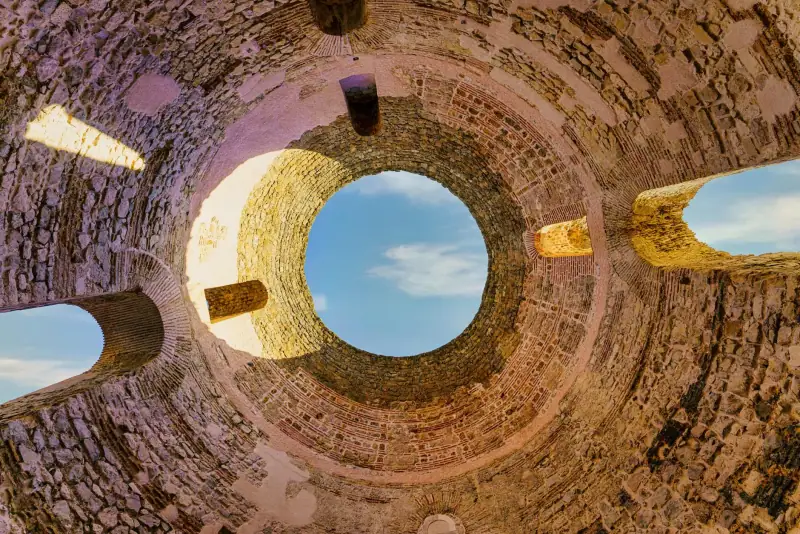
The Roman emperor Diocletian, born in Salona (today’s Solin, a few kilometers north of Split), had a retirement residence built on the Dalmatian coast between AD 295 and 305. The result is a palace-fortress measuring 215 by 180 meters (705 by 591 ft), lined with 16 towers and fitted with four monumental gates. After Diocletian’s death around December 3, AD 311, the palace was gradually occupied by refugees fleeing the Avar and Slavic invasions, then by medieval communities who turned it into a town in its own right.
Today the palace still houses 3,000 permanent residents and hundreds of shops, restaurants, galleries and hotels. Walking its lanes at dawn, before the tourist influx, is a timeless experience: the stone slabs leading to the central Peristyle, arches nested into one another, medieval facades built on Roman walls visible at mid-height.
The Peristyle and St. Domnius Cathedral
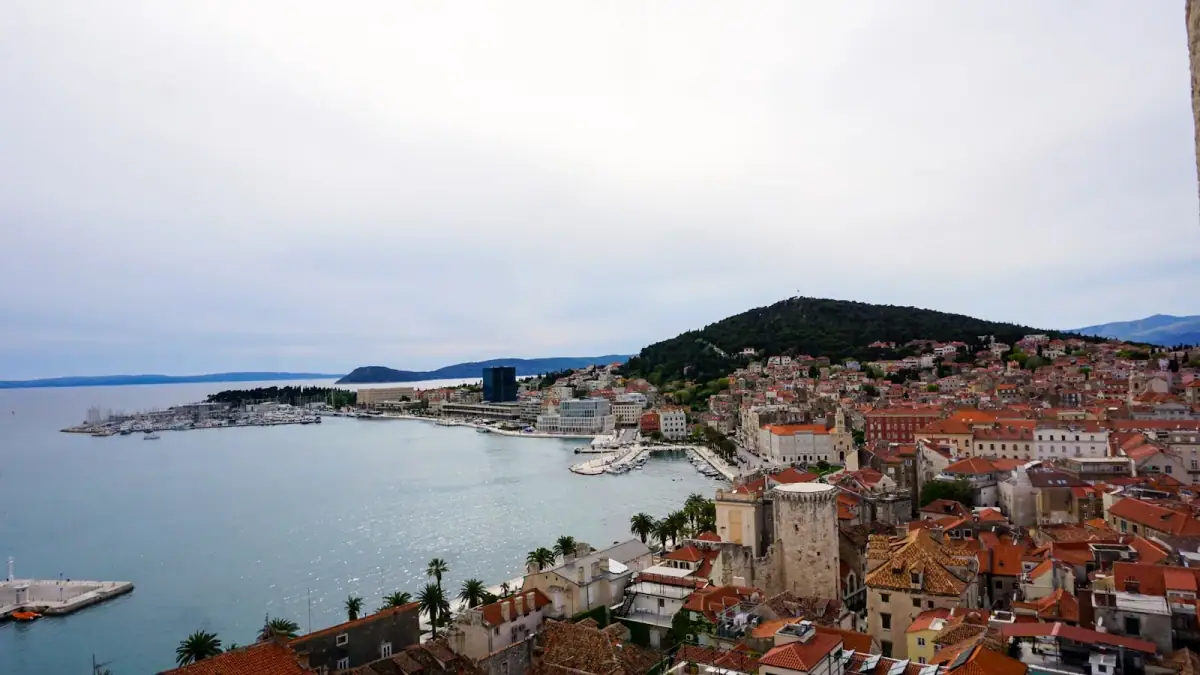
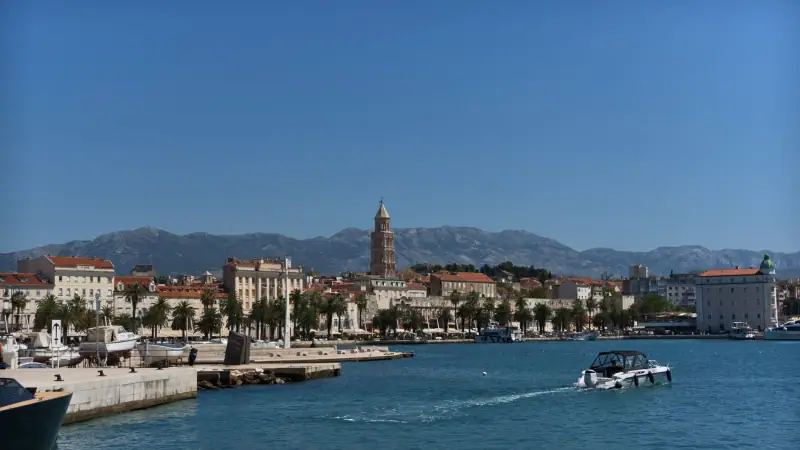
The Peristyle (Peristil) is the central square of the palace, a rectangle of Corinthian columns that once formed the antechamber of the imperial vestibule. Today it is the beating heart of the old town: tourists take photos, locals read their newspapers on the steps, musicians rehearse in the evening. St. Domnius Cathedral (Katedrala Sv. Duje), one of the most beautiful in Croatia, occupies the octagonal mausoleum Diocletian had built for himself, one of history’s many ironies, since Diocletian had ordered persecutions of Christians, and a church was founded in his own tomb. The bell tower, added in the 13th century, offers from its top a stunning view over the rooftops of the old town and the Adriatic Sea.
The Cellars (Podrumi): the Roman imprint
The palace cellars (Podrumi), reached from the Riva, are the space that best reveals the original structure. These vaulted halls, which served as storage and as foundations for the imperial apartments, were gradually cleared of medieval refuse during the 20th century. You can still make out the layout of the ground-floor apartments from the perfect symmetry with the plan of the rooms above. A play of light in the brick and stone vaults gives a striking idea of the palace’s original splendor.
Where to stay in Split
Old-town apartments, hotels facing the Riva, accommodation with views of the Adriatic.
The Riva and the neighborhoods around the palace
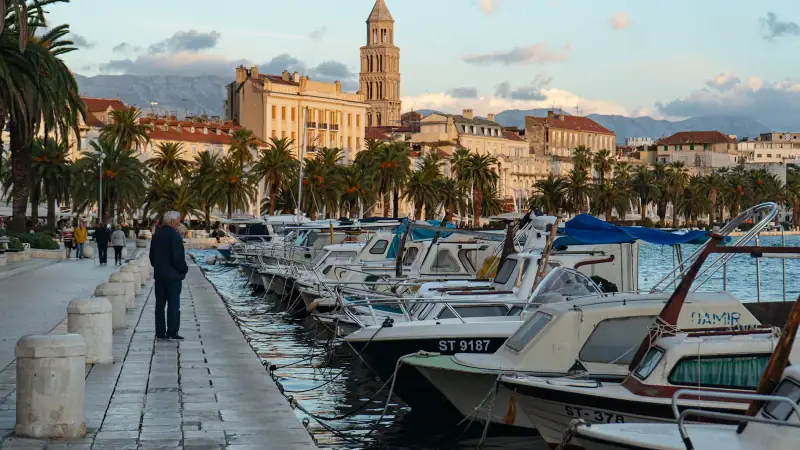
The Riva (Obala Hrvatskog narodnog preporoda) is Split’s seafront promenade, 450 meters (1,476 ft) long along the waterfront, lined with palm trees and outdoor cafés. It is the city’s social artery: locals meet there for the evening passeggiata, children play near the fountains, fishermen sell their catch at the morning auction. The Riva runs directly along the south wall of Diocletian’s Palace; the café tables face the Adriatic and, in the distance, the island of Brač, whose mountains vanish into the blue.
The Veli Varoš district, west of the old town, is the most authentic in Split. Its steep lanes climb toward Marjan hill through stone houses with painted shutters, terraced gardens and small squares shaded by fig trees. This is where Split families have lived for generations, far from the bustle of the palace, in the atmosphere of a preserved Mediterranean village.
The Manuš district is Split’s bohemian corner: art galleries, wine bars, craft workshops and designer markets enliven its lanes on summer evenings. Split’s central market (Pazar), held every morning outside the east wall of the palace, is the liveliest place in the city at dawn: flowers, vegetables from the hinterland gardens, Pag cheeses, cured meats.
Marjan hill: Split’s green lung
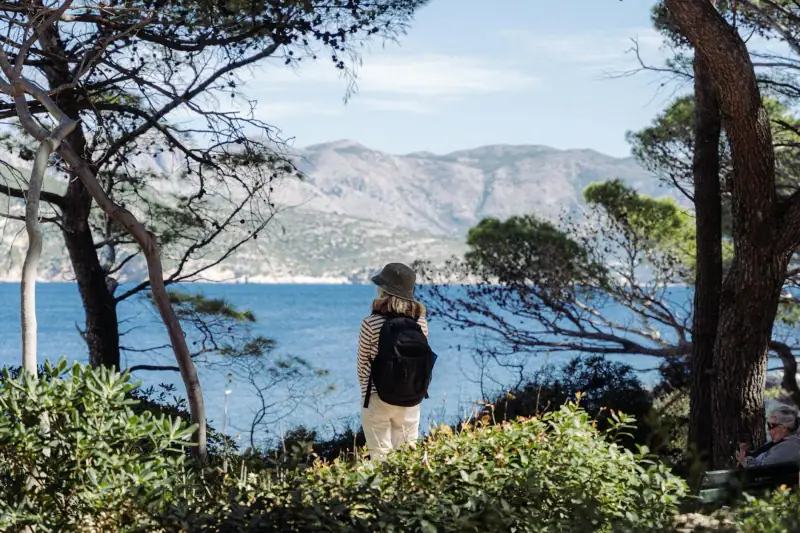
Marjan is the wooded peninsula forming Split’s western arm. Covered with Aleppo pines, cypresses and scrubland, it peaks at 178 meters (584 ft) and is the natural breathing space of the locals. You climb it from the Veli Varoš district by a stone staircase and a series of marked trails.
At the top or on the slopes of Marjan, several viewpoints offer 360-degree panoramas: the old town with the cathedral bell tower, the harbor and the ferries, the island of Šolta to the south, Biokovo in the background to the east. The sunset from the Telegrin viewpoint, at the summit, is one of the most beautiful in all of Dalmatia.
Marjan is also home to the Meštrović Gallery (Galerija Meštrović), the former residence of the sculptor Ivan Meštrović (1883-1962), considered one of the greatest sculptors of the 20th century. The neoclassical villa and its garden are filled with his monumental works. Nearby, the Kaštelet shrine preserves a cycle of wooden bas-reliefs depicting the life of Christ, a major work by Meštrović.
Marjan’s seaward slopes descend to several coves and wild beaches reached by trails, intimate swimming spots favored by locals who want to avoid the crowds.
Activities and guided tours in Split
Palace tours, boat excursions to the islands, sea kayaking, sunset kayak tours.
Split’s beaches
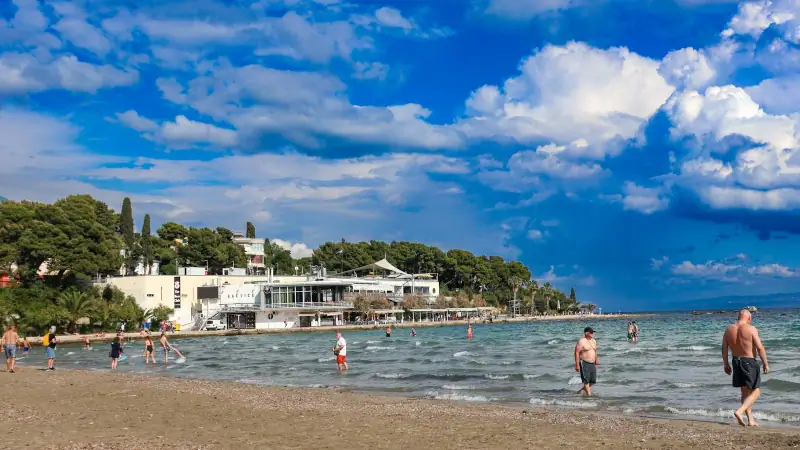
Split is one of the few large Mediterranean cities with beautiful beaches right in town or a few minutes from the center.
Bačvice: the locals’ beach and picigin
Bačvice is Split’s emblematic beach, ten minutes on foot from the harbor. Its fine sand and shallow sea over a long distance make it an ideal swimming spot for families. But Bačvice is above all famous for picigin, a traditional Split sport played standing in shallow water: players take turns hitting a ball (a small rubber ball) to keep it from touching the water, with increasingly elaborate acrobatic moves. Picigin has been on Croatia’s intangible cultural heritage list provisionally since 2008, with definitive confirmation in 2013. Watching a game of picigin on Bačvice on a Sunday morning, with the regular players, often middle-aged men with pinpoint moves, is an unforgettable moment of local culture.
Kaštelet and Bene: the Marjan beaches
On the Marjan peninsula, Bene beach is Split’s most popular natural beach. Reached on foot from the top of Marjan or by boat from the harbor (seasonal service), it consists of small pebble and rock coves surrounded by pines. The sea is very clear, the bottom is rocky but clean, and the shade of the pines makes up for the lack of sand. Perfect for snorkelers.
Beaches north and south of Split
For less crowded beaches, the Kaštela peninsula to the north (reached by bus or car) has fine pebble beaches between the medieval villages of Kaštel. To the south, the municipality of Podstrana, 8 km (5 mi) from the center, has good-quality pebble beaches with views of the islands of Brač and Šolta.
Excursions from Split
Split is ideally placed for branching out to some of the region’s most remarkable sites.
Trogir: the medieval island town (27 km / 17 mi)
About 27 km (17 mi) west of Split, Trogir is a medieval town built on a tiny island linked to the mainland by a bridge. Its historic center, a UNESCO World Heritage Site, is a condensed mix of Romanesque, Gothic and Venetian architecture in a perimeter you can cross in ten minutes. St. Lawrence Cathedral and its Romanesque portal (13th century), a masterpiece of the sculptor Radovan, is one of the great medieval works of art on the Adriatic. Half a day is enough to get lost in Trogir’s lanes and have lunch facing the canal. Reachable by bus from Split’s bus terminal, or by boat (seasonal service).
Klis Fortress: the symbol of Croatian resistance (13 km / 8 mi)
Perched about 13 km (8 mi) northeast of Split, at 360 meters (1,181 ft) of altitude, Klis Fortress commands the only natural passage between the Dalmatian coast and the interior. It was defended by the Croats against the Ottomans from about 1513 to 1537 under the command of Petar Kružić, a little over a quarter-century of resistance that is legendary in the national memory. Fans of the series Game of Thrones will recognize it as the slave city of Meereen in seasons 4 and 5. The panorama from the ramparts over Split, the islands and the Brač channel is exceptional. Reachable by local bus from Split (line to Klis-Megdan).
Salona (Solin): the ruins of the ancient Roman capital (6 km / 3.7 mi)
6 km (3.7 mi) north of Split, Salona (Solin in Croatian) is the most extensive archaeological site in Croatia. The former capital of the Roman province of Dalmatia, Salona had about 60,000 inhabitants in the 4th century and was one of the most important cities of the Empire. The ruins cover several hectares: amphitheater, forum, baths, necropolises, early Christian basilicas, a site little visited by tourists that offers a totally different experience from Split’s bustle. This is where the emperor Diocletian was born.
The islands from Split
Split is the most convenient departure port for several Dalmatian islands:
- Brač: 50 minutes by ferry from Split to Supetar. The main attraction is Zlatni Rat beach at Bol, famous for its tongue of sand that shifts with the currents, one of the most photographed beaches in Croatia. Reachable in a day from Split.
- Hvar: fast catamaran to Hvar Town in about 1 hour. Our Hvar guide details the island’s points of interest, its coves and its nightlife.
- Šolta: the most discreet and least visited of the islands near Split, 1 hour by ferry. Beekeeping, olive groves, stone villages: Dalmatia without filters.
- Vis: 2 hours 25 minutes by ferry from Split. With the Blue Cave and Stiniva beach (among the most beautiful coves in Europe), Vis is best with a night there.
Car rental in Split
Explore Dalmatia at your own pace: Trogir, Klis, Salona, Brač beaches.
Food in Split
Split’s cuisine is resolutely Dalmatian: grilled fish, seafood, lamb and meats prepared under the peka, cheeses from the hinterland and wines from the islands. Here is what to taste.
The peka: the oven under the embers
The peka is the quintessential traditional Dalmatian cooking technique. A terracotta or cast-iron dish containing lamb, veal or octopus with vegetables (potatoes, onions, tomatoes, capers) is placed in the hearth and covered with a domed lid (the peka) on which embers are piled. Slow cooking, two to three hours, produces meat or octopus of incomparable tenderness, slow-cooked in its own juices. Good konobe (konoba), traditional taverns, offer peka as a dish of the day; you often have to order the day before because the preparation takes several hours.
Octopus risotto (rižot od hobotnice)
Octopus risotto is one of the emblematic dishes of the Dalmatian coast. Cooked in olive oil and white wine with onions, tomatoes and herbs, the octopus releases its ink, which colors the rice a deep brown-black. The result is rich, briny and slightly smoky, different from the creamier Italian risottos: more austere and more marine.
Island wines
The Dalmatian islands produce red wines of rare originality. The plavac mali of the island of Hvar and the Pelješac peninsula is often dense, tannic and high in alcohol, to be served with meats in sauce or aged cheese. The pošip of Korčula is a dry white of nice freshness. On the island of Vis, vugava is a rare, almost obscure white worth seeking out. To learn more about Croatian wines, our article on Croatian wines is a good starting point.
Where to eat in Split
Avoid restaurants that display menus translated into ten languages with laminated photos on the doorstep; they cater to passing tourists, and the traditional konobe two streets from the Riva do better at half the price. The morning Pazar market, just outside the palace’s Silver Gate, is the best place to buy fresh produce, cheeses and local cured meats.
Practical information
How to get to Split
By air: Split-Kaštela airport (SPU), about 25 km (16 mi) from the city center. A bus service links the airport to the ferry terminal (Trajektna luka) in 30-40 minutes. Taxis and ride-hailing services (Bolt) cost more but take 20-35 minutes depending on traffic.
By ferry from Italy: Jadrolinija and other companies run regular services from Ancona (9-11 hours depending on the crossing) and other Italian ports. An interesting option for fitting Split into a Europe circuit.
By bus: bus lines link Split to Zagreb (5 h 30), Dubrovnik (3 h 30-4 h), Zadar (2 h 30) and other Croatian cities. The bus terminal is 300 meters (985 ft) from the ferry terminal.
Getting around Split and the area
Split is pleasant on foot in the old town and nearby neighborhoods. For farther excursions (Klis, Salona, Trogir), renting a car is the most flexible solution. Local buses link most of the surrounding sites. Ferries and catamarans to the islands leave from the ferry terminal, reachable in 10 minutes on foot from the Peristyle.
Currency and budget
Croatia has used the euro since January 2023. Split is cheaper than Dubrovnik but more expensive than Zadar: expect €70-130 (~$81-150) a night for an old-town apartment in high season and €15-30 (~$17-35) for a full meal in an authentic konoba. Cultural entrance fees (cellars, museums) are priced separately but remain reasonable.
Before planning your stay, see our guide to the budget for Croatia and our selection of cheap hotels in Croatia to keep your spending down.
Flights to Split
Compare low-cost fares and find the best price for your flight to Split.
Final advice
Split is a city that gives itself up gradually. On the first evening, the Peristyle and the Riva are enough to understand why millions of visitors come back every year. But the real Split is discovered the next morning, at the Pazar market, in the lanes of Veli Varoš before the shops open, on the steps of Marjan at the hour when locals jog facing the Adriatic.
Give Split at least two nights rather than making it a simple stopover. Plan a day for the islands; even a round trip to Brač transforms the stay. And if you are planning your trip to Dalmatia, our road trip along the Dalmatian coast will give you a complete itinerary to link Split with Zadar, Dubrovnik and the most beautiful islands in the region.
Croatia has many unofficial capitals. But for Dalmatia, there is only one: Split.
Frequently asked questions
How many days do you need to visit Split?
Two full days are enough to explore Diocletian's Palace, the old town, the Riva, Marjan hill and the main beaches. Three days let you add an excursion to Trogir or Klis, or a day trip to the island of Brač or Hvar. To combine Split with several islands, allow a week at minimum.
How do you get to Split?
Split international airport (SPU) is about 25 km (16 mi) from the city center; buses link the terminal to the ferry terminal in 30-40 minutes for a few euros. Check current flight schedules with the airport and airlines.
What is the best time to visit Split?
June and September are the ideal months: the sea is warm and swimmable, the crowds are far smaller than in July-August, and prices are more reasonable. July-August offers maximum buzz but the palace streets can be very crowded. April-May and October are excellent for heritage and hikes on Marjan; swimming is still cool. Winter is mild and very quiet, perfect for exploring the old town without crowds.
Can you visit the islands as a day trip from Split?
Yes. Brač (Zlatni Rat beach in Bol) is about 50 minutes by ferry from Split harbor; the last evening ferry allows a full day. Hvar Town is 1 hour away by fast catamaran. Vis, farther away, takes 2 h 25 by ferry: a short day but doable. For several islands, it is better to rent an apartment on an island and branch out from there.
Is Diocletian's Palace paid?
Entering the palace area, which is an inhabited neighborhood, is completely free and possible 24 hours a day. However, some cellars (Podrumi), the baptistery, St. Domnius Cathedral and the bell tower climb are paid separately. A combined pass is available at the cellar entrance and is the best value for seeing everything.
Is Split a good base for exploring Dalmatia?
It is one of the best. Split has an international ferry and catamaran port serving dozens of islands (Brač, Hvar, Šolta, Vis, Korčula), an international airport, buses to Dubrovnik, Zadar and Zagreb, and the A1 motorway. Its accommodation is more varied and cheaper than in Dubrovnik. For a two-week Dalmatia circuit, Split is naturally the home port.
More Croatia guides
Keep reading
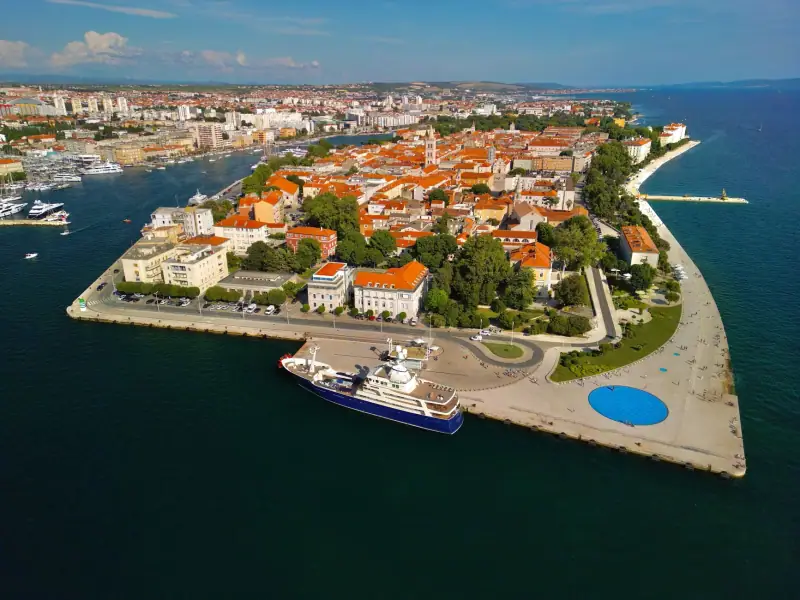
Visiting Zadar: complete guide to the Dalmatian city
Complete guide to visiting Zadar: Sea Organ, Roman old town, beaches, Kornati and Paklenica excursions. Everything for a successful stay in Dalmatia.
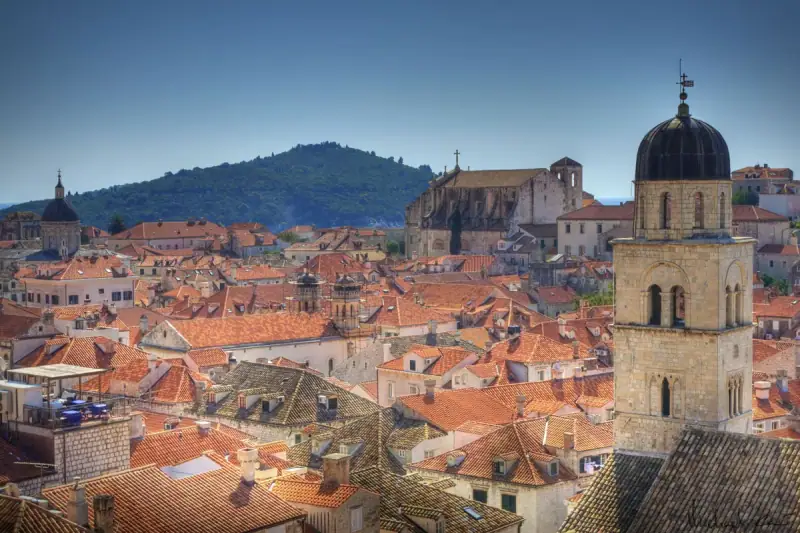
Dubrovnik: the 10 must-see sights
The 10 top sights of Dubrovnik: city walls, Stradun, Sponza Palace, cable car, Lokrum island. Practical guide to visiting Dubrovnik in 1 or 2 days.
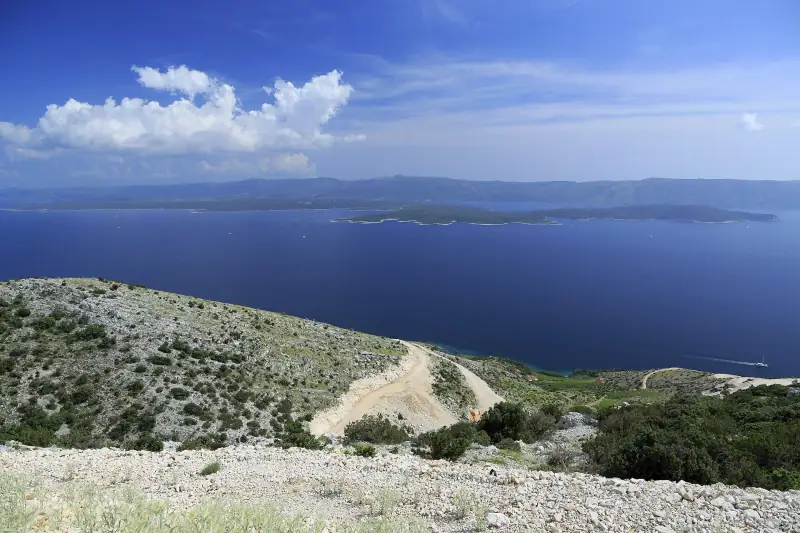
Visiting Hvar: complete guide to the Dalmatian island
Complete guide to visiting Hvar: Hvar Town, Pakleni Islands, Stari Grad, lavender, beaches, wines and the ferry from Split.
Ready-made
Croatia itineraries
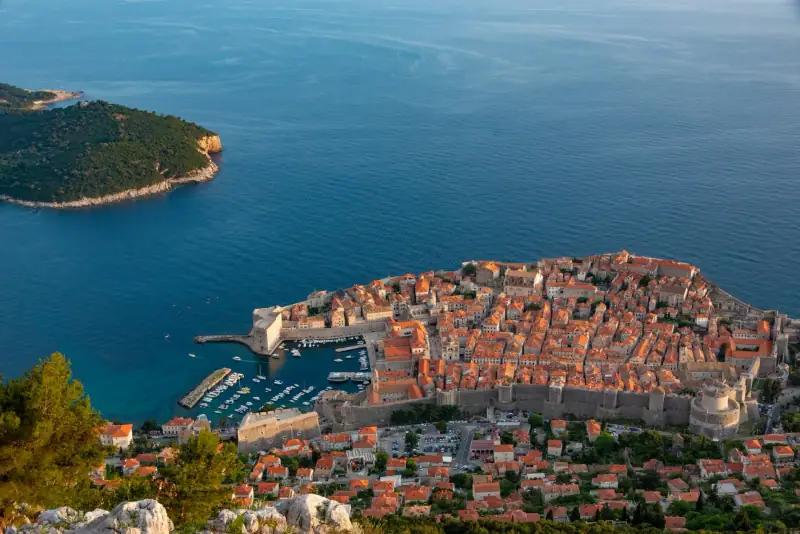
Croatia road trip: the coastal route from Zagreb to Dubrovnik
The ultimate Croatian coastal road trip from Zagreb to Dubrovnik via Split, Zadar and the national parks. 10-14 day route with stops and tips.
7 days
Croatia in 7 days: the perfect one-week itinerary
Detailed itinerary to visit Croatia in 7 days: Split, the Dalmatian islands, Dubrovnik and Plitvice. Day-by-day plan with practical tips.
10 days
Croatia in 10 days without a car: a realistic bus and ferry itinerary
ZagrebZadarSplitHvar TownDubrovnik