What to see
Visiting Corse-du-Sud: a complete guide to the south of the Island of Beauty
We may earn a commission when you book through links on this page, at no extra cost to you. We don't visit or try the places we cover: we summarize published sources. How we work
In short
- Corse-du-Sud is the southern half of the island, with Ajaccio as its prefecture. Two airports serve it: Ajaccio (AJA) and Figari (FSC), the better choice for Bonifacio and Porto-Vecchio.
- A car is essential; public transport is limited. Book it as soon as your flight is confirmed, since July-August stock runs out as early as May.
- The best beaches cluster around Porto-Vecchio (Palombaggia, Santa Giulia, Rondinara). Arrive before 9 am in July-August.
- May-June and September-October are the ideal periods; July-August concentrates 70% of annual tourism.
Corse-du-Sud is the Mediterranean at its most spectacular. On one side, beaches whose fame reaches far beyond France: Palombaggia with its umbrella pines leaning over golden sand, Santa Giulia and its almost unreal blue lagoon, Rondinara and its crescent cove that looks drawn for a postcard. On the other, a wild and mountainous hinterland (the Bavella Needles, the granite villages of the Alta Rocca, the laricio pine forests) that you do not expect to find an hour from the packed beaches.
The department of Corse-du-Sud, whose prefecture is Ajaccio, covers the southern half of the island. It brings together towns as different as Napoleonic Ajaccio, impregnable Bonifacio on its white cliffs, cosmopolitan Porto-Vecchio and Sartène, which Prosper Mérimée called “the most Corsican of Corsican towns”. It is the most touristy department in Corsica, with peak crowds in July-August that turn roads into queues and coves into improvised beach clubs. All the more reason to prepare your trip well: choose the right season, know the essential sites, and above all know how to leave the beaten tracks to find the postcard Corsica we all dream of.
This complete guide takes you through the essentials and secrets of Corse-du-Sud, from the Gulf of Ajaccio to the cliffs of Bonifacio, from the beaches of Porto-Vecchio to the peaks of the Alta Rocca.
Ajaccio, the Napoleonic capital
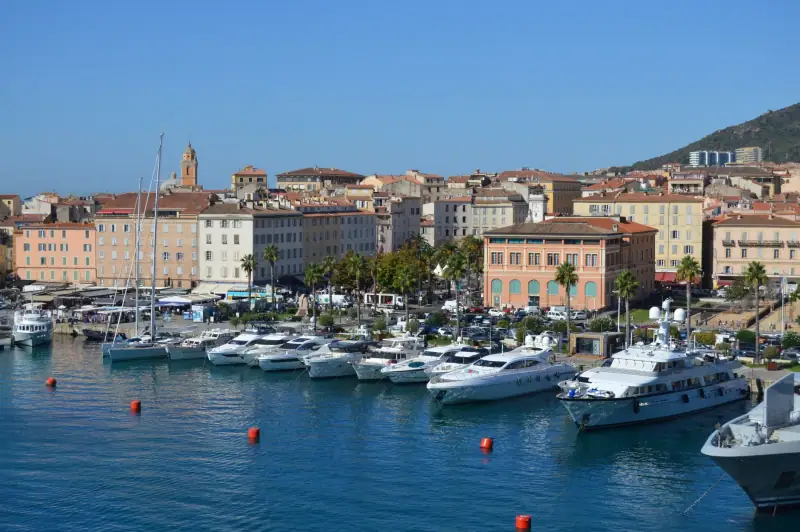
Ajaccio is much more than Napoleon Bonaparte’s birthplace. Capital of Corse-du-Sud and prefecture of the Collectivité de Corse, it is a Mediterranean city with a strong personality: a long palm-lined promenade, an old quarter of fragrant lanes, lively markets, and everywhere the omnipresence of the Emperor: statues, museums, street names.
The city can be visited on foot in one full day. The old Ajaccio quarter (Quartier des Banques and Place du Diamant) keeps an authentic atmosphere, with its ocher-faced houses and small neighborhood restaurants. The central market, open in the morning, is the ideal place to get acquainted with Corsican products: cured meats, cheeses, maquis honey, jams.
To understand the city, the Fesch Museum is the place to start. Founded by Cardinal Fesch, Napoleon’s uncle, it houses the second French collection of Italian paintings (448 paintings) after the Louvre, with works from the 14th to the 19th century. A short walk away, the Maison Bonaparte (the Emperor’s birthplace, a listed historic monument) lets you plunge back into the Bonaparte family history. Visit outside peak holiday periods to avoid queues.
The Gulf of Ajaccio itself offers fine beaches reachable by car or bus: the beaches of Marinella, Barbicaja and above all the long beach of Capo di Feno, wilder and windier, are reachable in under half an hour from the center.
Places to stay in Ajaccio
From the historic center to the seafront, Ajaccio offers a wide choice of hotels, apartments and guesthouses for all budgets.
Porto-Vecchio and its legendary beaches
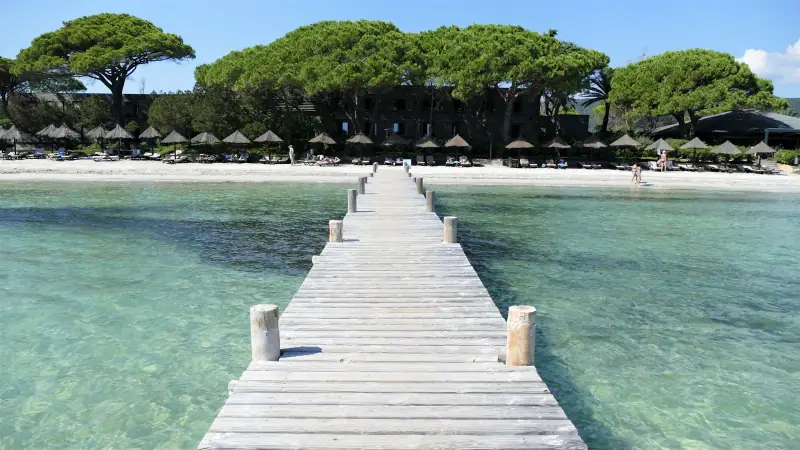
Porto-Vecchio is the seaside capital of Corse-du-Sud. The town itself, with its Genoese citadel perched on a rocky promontory and its shopping lanes, deserves a stroll, especially in the evening when golden light lingers on the granite facades. But it is its beaches that make its worldwide reputation, and for good reason.
Palombaggia is often cited among the most beautiful beaches in Europe. Its fine, warm golden sand borders turquoise water of exceptional clarity. The umbrella pines overhanging the beach add a touch of classic Mediterranean. In July-August the crowds are intense and you must arrive early (before 9 am) to find a place. In May-June or September, the same beach becomes almost intimate. It is about 10-12 km (6-7.5 mi) south of the Porto-Vecchio town center by the D768.
Santa Giulia, about 13 km (8 mi) south of Porto-Vecchio, lies south of Palombaggia, so farther from Porto-Vecchio than Palombaggia, not between the two. It is a natural lagoon protected by a strip of white sand. The shallow, sheltered water makes it the ideal beach for families with children. Kitesurfing and paddleboard schools operate there in season.
Rondinara, about 18 km (11 mi) south of Porto-Vecchio toward Bonifacio (D859), is a perfect cove: white sand, translucent water, surrounded by pines and maquis. The walk down from the car park (a few minutes on foot) helps preserve it. It is one of the most photographed beaches in Corsica and one of the most recognizable from the sky thanks to its crescent shape.
For kitesurfing and windsurfing fans, the bay of Pinarellu (toward Sainte-Lucie-de-Porto-Vecchio, about 11-13 km / 7-8 mi north-northeast of Porto-Vecchio) offers regular conditions and reliable afternoon winds. Our complete guide to Porto-Vecchio details all the neighborhoods and activities.
Water activities in Porto-Vecchio
Diving, sea kayaking, boat trips to the Cerbicale Islands or the sea caves: dozens of activities available from Porto-Vecchio.
Bonifacio, the citadel on the cliffs
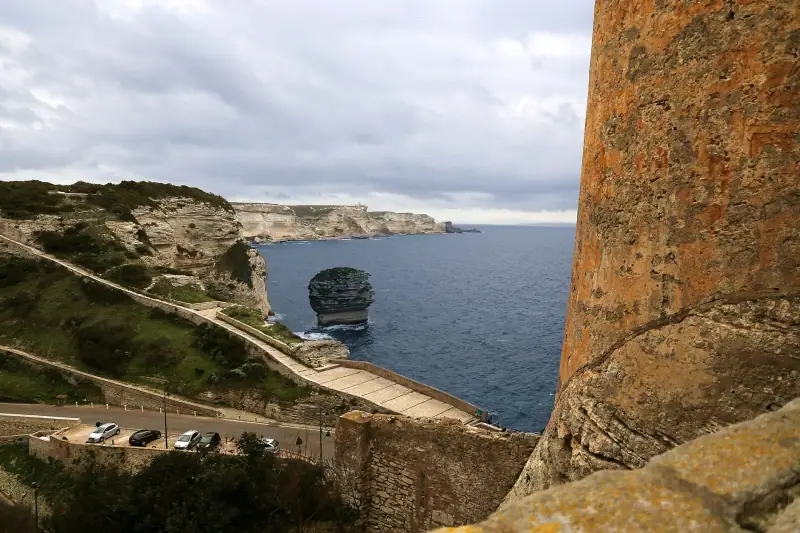
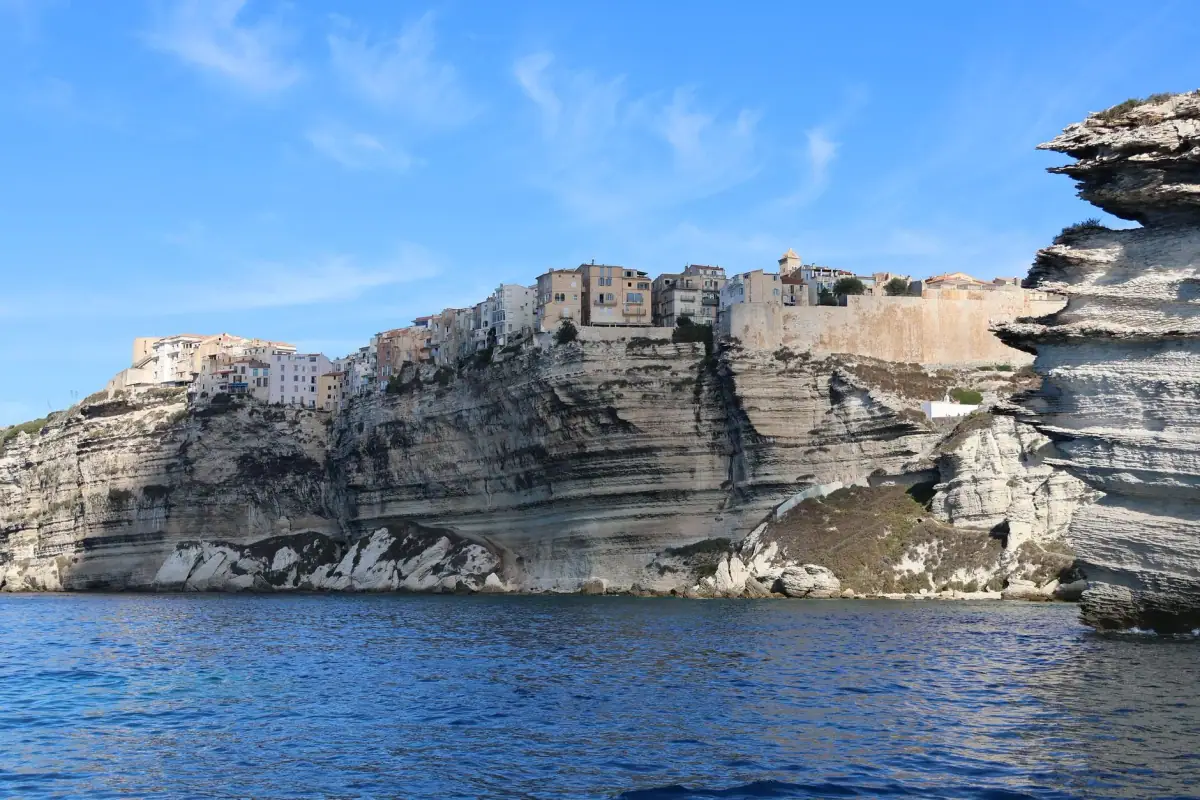
Bonifacio is one of the most spectacular towns in the Mediterranean. Perched at the far south of Corsica on white limestone cliffs that plunge straight into the sea, the fortified old town floats like a stone ship above the turquoise waters of the Strait of Bonifacio, which separates Corsica from Sardinia by about 11 to 12 km (7 mi) of sea.
The upper town, reached on foot by the King of Aragon’s staircase (a staircase cut into the cliff, according to local tradition, in a single night) or by the Montée Ruscino from the marina, is a labyrinth of narrow medieval lanes lined with houses with low doors and vine pergolas. The Genoese ramparts offer vertiginous views of the sea and of the cliffs pierced with caves. Below, Bonifacio’s marina is lively all season: restaurants, ice cream shops, boat excursion departures.
Bonifacio’s sea caves, reachable only by sea, are one of the most popular excursions in Corse-du-Sud. The Sdragonato cave is famous for a natural opening in its vault that, seen from inside, draws a silhouette evoking the map of Corsica, especially visible when the light falls vertically (around noon), a geological coincidence that has fed many legends. Boat excursions from the marina offer this circuit in about 1 h 30.
Outside the ramparts, the Lavezzi Islands, about 10 km (6 mi) southeast of Bonifacio and reachable by boat, form a nature reserve (the Bouches de Bonifacio nature reserve) of wild, preserved beauty: crystal-clear water, polished granite rocks and abundant marine life. Our guide to Bonifacio presents all the points of interest in detail.
Boat trips from Bonifacio
Sea caves, Lavezzi Islands, Sardinia, sunset on the cliffs: the excursions from Bonifacio are among the most beautiful in the Mediterranean.
The Alta Rocca and the mountainous interior
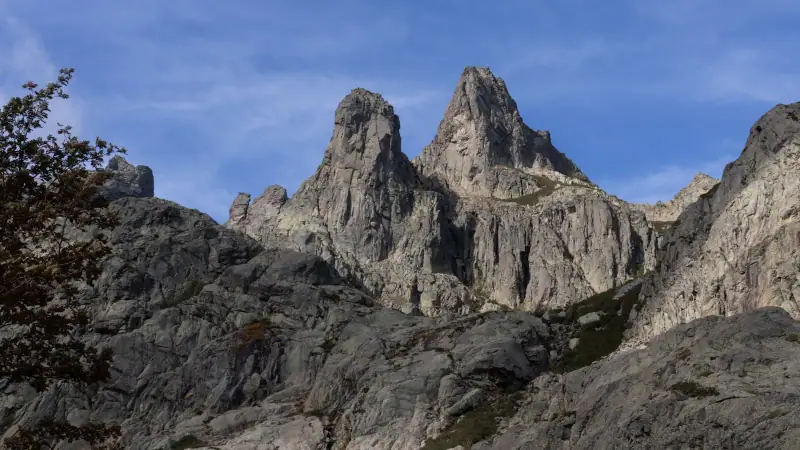
Corse-du-Sud is not limited to its coastline. The interior of the department holds big surprises for those willing to leave the beach and gain altitude.
The Alta Rocca is the emblematic mountain region of the south of the island. Centered on the village of Zonza (at about 780 m / 2,560 ft of altitude) and the Bavella pass (about 1,218 m / 3,996 ft), it offers high-mountain landscapes radically different from the coast: laricio pine forests, orange granite needles, glacial torrents and gray stone villages. The Bavella pass is one of the most photographed panoramas in Corsica, and its hiking trails, including a section of the GR20, attract walkers from around the world.
Halfway between the coast and the mountains, the Ospedale forest and the artificial Lake Ospedale (about 19-20 km / 12 mi from Porto-Vecchio by the D368, heading north/inland) offer a welcome stop for families. The Piscia di Ghjaddu waterfall, an hour’s hike from the lake, is one of the most beautiful waterfalls in Corsica with a drop of about 80 meters (260 ft).
Further west, Sartène is a key stop for understanding deep Corsica. Perched on a plateau overlooking the Rizzanese, this gray granite village has kept an austere, authentic atmosphere that counterbalances coastal tourism. The Museum of Corsican Prehistory and Archaeology presents remarkable collections on the island’s history. Our complete guide to the Alta Rocca details hikes, villages and itineraries.
Food of the south: the flavors of Corse-du-Sud
Corse-du-Sud is a department with a strong culinary identity, inherited from both the pastoral mountains and the Mediterranean coast.
Charcuterie, cheeses and local products
Corsican charcuterie is the culinary pride of the island: prisuttu (Corsican PDO ham aged a minimum of 12 months), lonzu (dried pork loin), coppa (neck) and figatellu (smoked liver sausage). Lonzu and prisuttu have had a Protected Designation of Origin (PDO, AOP) since 2012, Corsican coppa since 2013; figatellu has had a Protected Geographical Indication (PGI, IGP) since 2023. All are made from black Corsican pigs raised semi-free in the maquis and chestnut groves.
Brocciu is the only cheese PDO of Corsica. This fresh sheep or goat cheese, made from whey, is the base of many Corsican recipes: brocciu fritters, omelets, cakes (fiadone) and baked cannelloni. It is found in all the markets in season.
Corsican wines are another local pride. The department has several AOC appellations: Figari (centered on the commune of Figari, about 15 km / 9 mi north of Bonifacio), Porto-Vecchio and Sartène. Local wines are dominated by Mediterranean Corsican grapes (nielluccio, sciaccarellu) and produce full-bodied reds, fresh whites and rosés suited to the sun. Our guide to Corsican wines presents the best estates to visit.
Markets and local delicatessens
The weekly markets of the towns of Corse-du-Sud are the ideal place to discover local producers. Ajaccio has a central market active every morning except Monday. Porto-Vecchio and Bonifacio host markets in high season on their main squares. This is where you buy artisan charcuterie, farm cheeses, maquis and strawberry-tree honey, jams, olive oils and myrtle liqueurs.
For a complete introduction to Corsican cuisine, see our guide to Corsican food.
7-day itinerary in Corse-du-Sud
A 7-day stay lets you combine coast and mountains in the south of the island without rushing.
Day 1: Arrival in Ajaccio Land at Ajaccio-Napoleon-Bonaparte, pick up the rental vehicle, settle into the city. Evening stroll on the Cours Napoléon and the port.
Day 2: Discovering Ajaccio Fesch Museum in the morning, central market, old town, citadel. Free afternoon by the sea or swimming at a beach near the Gulf of Ajaccio.
Day 3: Road to Propriano and Sartène Leave for Propriano (about 60-68 km / 37-42 mi from Ajaccio by the N196), swim in the Gulf of Valinco. Afternoon in Sartène for the Prehistory museum and wandering the lanes. Stay in Propriano or head to Bonifacio (60 km / 37 mi more).
Day 4: Bonifacio Full day in Bonifacio: citadel in the morning, marina, Sdragonato cave or Lavezzi Islands by boat in the afternoon. Lodging in Bonifacio or Porto-Vecchio.
Day 5: Porto-Vecchio beaches Palombaggia in the morning (arrive before 9 am to find a place), Santa Giulia in the afternoon. Evening in the old town of Porto-Vecchio. For all visiting tips, see our guide to Porto-Vecchio.
Day 6: Alta Rocca and Bavella Climb to Zonza and the Bavella pass by the D368 then D268. Hike in the laricio pine forest, swim in a natural pool if conditions allow. Return to Porto-Vecchio at the end of the day by the same road or via the Ospedale. For more details on the region, read our guide to the Alta Rocca.
Day 7: Return Free morning, then head to Figari airport or to Porto-Vecchio for the ferry.
For a longer stay including Haute-Corse, our 10-day Corsica itinerary offers suitable variants.
How to get to and around Corse-du-Sud
By plane
Two airports serve Corse-du-Sud:
- Ajaccio-Napoleon-Bonaparte (AJA): the main airport of the department, for Ajaccio and the west and central part.
- Figari-Sud Corse (FSC): in the south of the department, about 19 km (12 mi) from Porto-Vecchio and 15 km (9 mi) from Bonifacio. It is the most convenient for stays centered on the south (Bonifacio, Porto-Vecchio).
Scheduled flights are offered in season by many airlines.
By boat
Corse-du-Sud is linked to the mainland by ferry from:
- Ajaccio: services from Marseille (Corsica Linea, La Méridionale) and Toulon (Corsica Ferries); the Nice line is seasonal (only in August in 2026, according to Visit Corsica). Check the calendar with the operators.
- Porto-Vecchio: seasonal services (mainly in summer) to Marseille, Nice and Genoa (Corsica Ferries, Grimaldi Lines).
The ferry is especially useful if you bring your own vehicle, since a car is essential on the island.
Getting around: a car is a must
There is no dense public transport network in Corse-du-Sud. Bus lines link Ajaccio to the main towns (Bonifacio, Porto-Vecchio, Propriano) but with limited frequencies and schedules unsuited to sightseeing. A rental car is essential to freely explore the secluded beaches, the villages of the Alta Rocca and the interior of the department.
Practical tip: book your rental car as soon as your flight is confirmed, especially for July-August. The agencies at Figari airport and in Porto-Vecchio are often full from May.
Car rental in Corse-du-Sud
Compare rates in Ajaccio, Figari, Porto-Vecchio. Book early to secure a vehicle in high season.
When to go to Corse-du-Sud
| Period | Advantages | Drawbacks |
|---|---|---|
| May – June | Few people, reasonable prices, sea already good (21-23 °C / 70-73 °F) | Some lodging not yet open |
| July – August | Everything open, warm sea (25-27 °C / 77-81 °F), entertainment | Crowds on beaches, saturated roads, high prices |
| September – October | Sea still warm, crowds gone, magnificent light | Some facilities close in mid-October |
| November – April | Absolute calm, mountains accessible from May | Many hotels closed on the coast |
The recommendation: if your priority is beaches, aim for June or September. If you combine coast and mountains, May-June is optimal: the sea already reaches 21-22 °C (70-72 °F) around the Porto-Vecchio beaches and the Alta Rocca trails are passable without the crowds. Our guide to the best time to visit Corsica refines this advice according to your traveler profile.
Corse-du-Sud alone concentrates the reasons why the Island of Beauty has won an international reputation: some of the most beautiful beaches in the Mediterranean, a medieval citadel perched on breathtaking cliffs, a wild and preserved mountain an hour from the coast, and a deeply Corsican gastronomic and cultural identity. It is a department you have to earn: by choosing the right season, booking well in advance, and being willing to leave the most beaten tracks to find the Corsica you have carried within you since you first heard of it.
Frequently asked questions
What is Corse-du-Sud?
Corse-du-Sud is one of the two departments of Corsica (with Haute-Corse). Its prefecture is Ajaccio, the birthplace of Napoleon Bonaparte. The department includes emblematic destinations: the beaches of Porto-Vecchio, the cliffs of Bonifacio, the regional natural park and the mountain massifs of the Alta Rocca and the central Corsican range. It is the most touristy part of the island.
How do you get to Corse-du-Sud?
Corse-du-Sud is served by two airports: Ajaccio-Napoleon-Bonaparte (AJA) for the north and west of the department, and Figari-Sud Corse (FSC) for the south (Porto-Vecchio and Bonifacio). Ferries link Ajaccio and Porto-Vecchio to the mainland (Marseille, Nice, Toulon, Genoa), with more frequent service in summer. If you want to bring your own vehicle, the ferry remains the ideal solution.
What are the most beautiful beaches in Corse-du-Sud?
The best-known beaches of Corse-du-Sud are concentrated around Porto-Vecchio: Palombaggia (golden sand, turquoise water, umbrella pines) and Santa Giulia (a protected lagoon, ideal for families) regularly appear in European rankings. Rondinara, further south toward Bonifacio, is a crescent-shaped cove of remarkable beauty. Around Ajaccio, the beaches of Isolella, Porticcio and the Gulf of Valinco (Propriano) are 30 to 45 minutes away.
What is the best time to visit Corse-du-Sud?
May-June and September-October are the ideal periods: the sea is warm, the crowds are gone and prices fall noticeably. July-August concentrates 70% of annual tourism: beaches are packed, traffic on the roads is heavy and lodging prices peak. Outside the season, from November to April, Corse-du-Sud remains practicable, and mountain hikes (Alta Rocca, GR20) are possible from May.
Do you need a car in Corse-du-Sud?
Yes, a car is essential to explore Corse-du-Sud freely. Public transport is limited: a few bus lines link Ajaccio to the main towns, but the secluded beaches, Alta Rocca villages and natural sites are accessible only by car. Book your rental as early as possible, since availability runs out from May-June for the high season.
Can you visit Bonifacio from Porto-Vecchio?
Yes. Bonifacio is about 28-30 km (17-19 mi) south of Porto-Vecchio by the N198, roughly 35 to 45 minutes by car outside peak times. The excursion is easy in a day from Porto-Vecchio. In high season, arrive in Bonifacio early in the morning to visit the citadel and old town before the groups arrive in late morning.
More Corsica guides
Keep reading
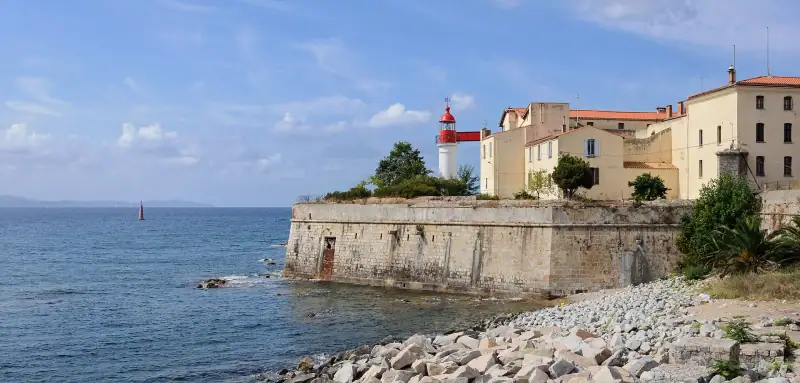
Visiting Ajaccio: a complete guide to the capital of Corsica
Everything to visit Ajaccio: Maison Bonaparte, Fesch Museum, Sanguinaires Islands, old harbor and beaches. A practical guide to Corsica's capital.
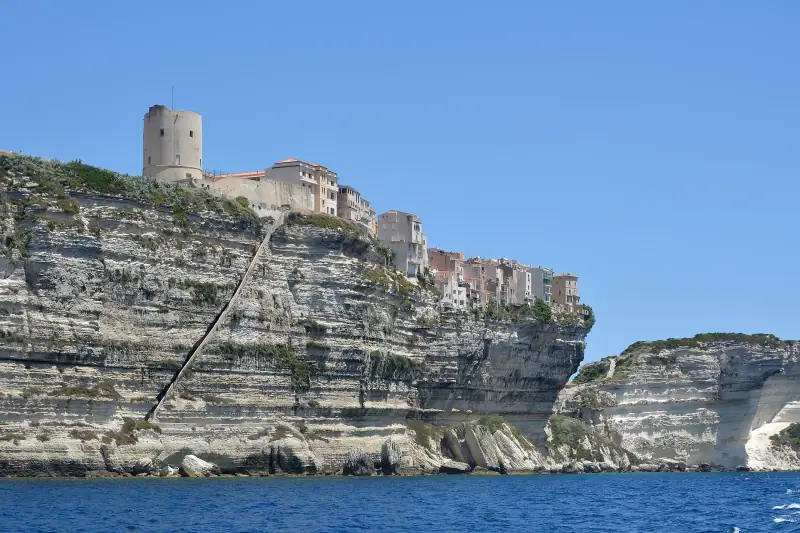
Visiting Bonifacio: a complete guide to the city of the cliffs
Genoese citadel, white cliffs, sea caves and the Lavezzi Islands: a complete guide to visiting Bonifacio, Corsica's most spectacular town.
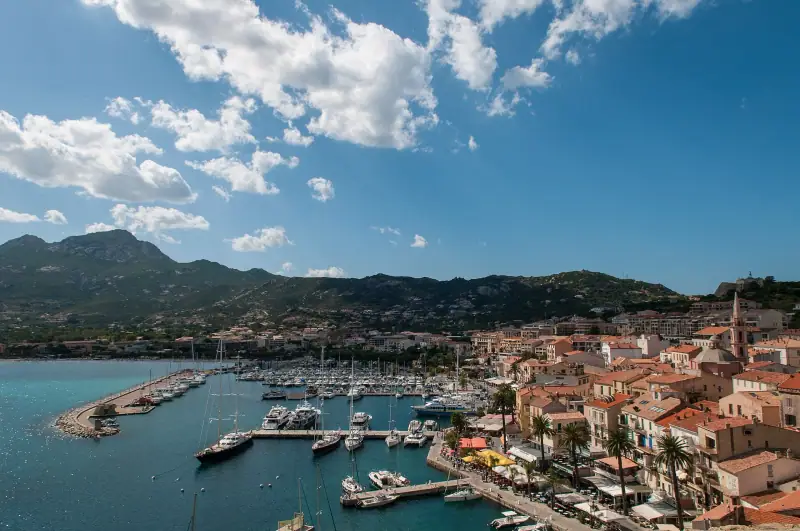
Visiting Calvi: a complete guide to the pearl of Balagne
Visit Calvi: Genoese citadel, 4.5 km beach, Revellata, the beach train and the GR20. A complete practical guide for staying in Calvi, Corsica.
Ready-made
Corsica itineraries
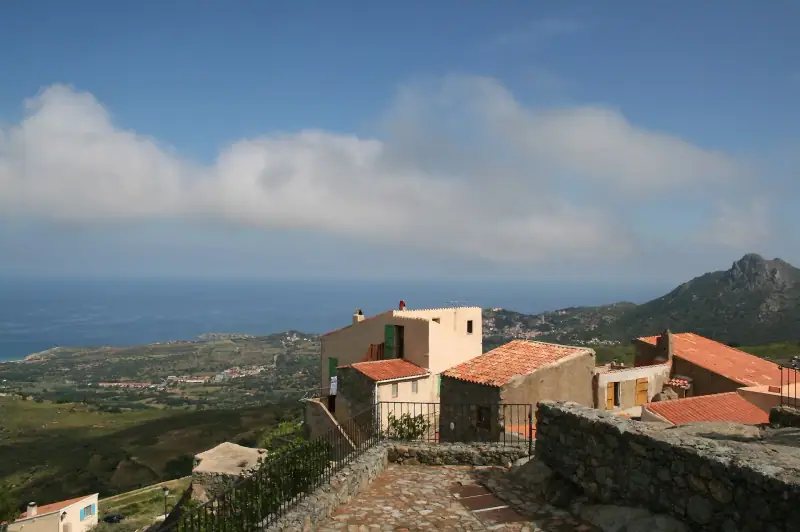
5 days
5 days in Balagne: Calvi, L'Île-Rousse and the perched villages
5-day Balagne itinerary: Calvi, L'Île-Rousse, Sant'Antonino, Pigna. Perched villages, beaches, olive oil and the beach train. A complete guide.
10 days
Corsica in 10 days: a complete itinerary around the Island of Beauty
A 10-day Corsica itinerary around the whole island: Bastia, Cap Corse, Balagne, Ajaccio, Bonifacio, Porto-Vecchio and the mountains.
14 days
Corsica road trip: a 10 to 14 day itinerary to see it all
The ultimate Corsica road trip in 10 to 14 days: the best route through the island's beaches, villages, mountains and food.