What to see
Visiting Kampot: a complete guide to Cambodia's most romantic town
We may earn a commission when you book through links on this page, at no extra cost to you. We don't visit or try the places we cover: we summarize published sources. How we work
In short
- Two to three days is ideal: a day in town and on the river, a day for the Phnom Chhnork caves or Bokor, and a half day on a kayak or bike trip to the pepper farms.
- From Phnom Penh, the bus takes 2.5 to 3 hours (about $5-8); a shared taxi takes about 2 hours ($10-15 per person). Kampot has no airport.
- The dry season, November to April, is the best time, with 28-33 °C (82-91 °F) days from December to February.
- Kep is 25 km (16 mi) away, an easy day trip for the crab market. Budget about $30-50 a day.
There are towns you visit. And there are towns where you settle in. Kampot belongs to the second category. On the bank of a quiet river, in the shadow of Elephant Mountain, this small town in southern Cambodia has an irresistible charm that few places in Southeast Asia can claim: colonial lanes bathed in golden light, cafés and restaurants tucked into restored French villas, the smell of pepper in the air, and a slow rhythm that makes you miss your bus and congratulates you for it. This complete guide tells you everything you need to know to visit Kampot.
Why visit Kampot?
Kampot (in Khmer: កំពត) is the capital of the province of the same name, in southern Cambodia, 148 km (92 mi) south of Phnom Penh and 25 km (16 mi) west of Kep. The Preaek Tuek Chhu River, which everyone simply calls “the Kampot River,” runs through the town before flowing into the Gulf of Thailand.
With about 50,000 inhabitants, Kampot is still human-scaled. It has not seen the mass tourism development that transformed Siem Reap or disfigured Sihanoukville. Here, tourism has stayed bohemian, backpacker in the good sense of the word, drawing travelers who look for authenticity rather than resort hotels.
Good reasons to come to Kampot:
- The best-preserved colonial atmosphere in southern Cambodia
- The world-famous pepper plantations
- The river, ideal for kayaking, boat cruises and swimming
- The Phnom Chhnork caves and Bokor National Park
- An authentic food scene at reasonable prices
- Serenity, a perfect antidote to the crowded temples of Angkor
Wandering Kampot: intact colonial charm
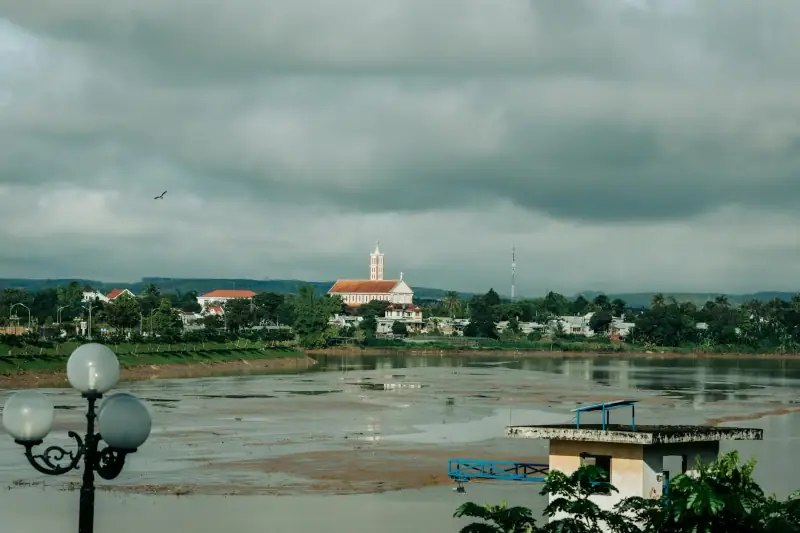
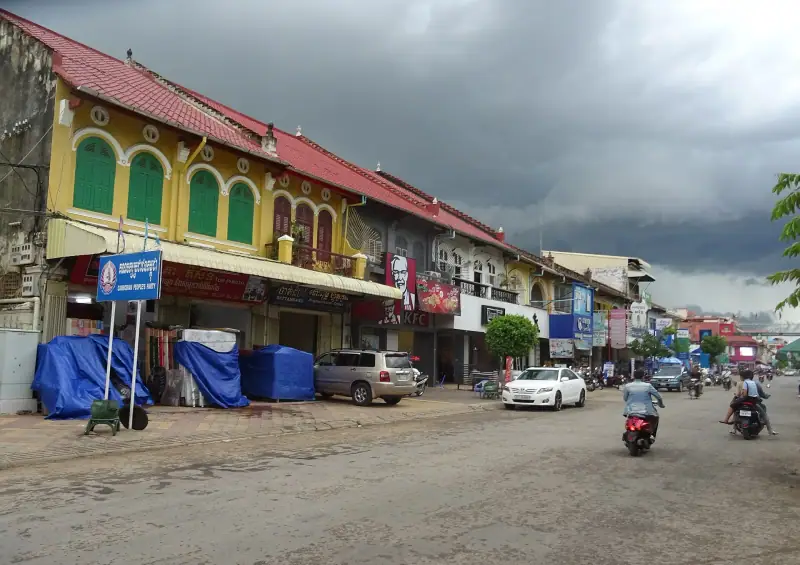
Old colonial Kampot is organized around a main axis running along the river. The French facades from the 1920s-1940s, yellowed, slightly decrepit, wearing their scars with elegance, now house guesthouses, trendy cafés and international restaurants without having lost their Cambodian soul.
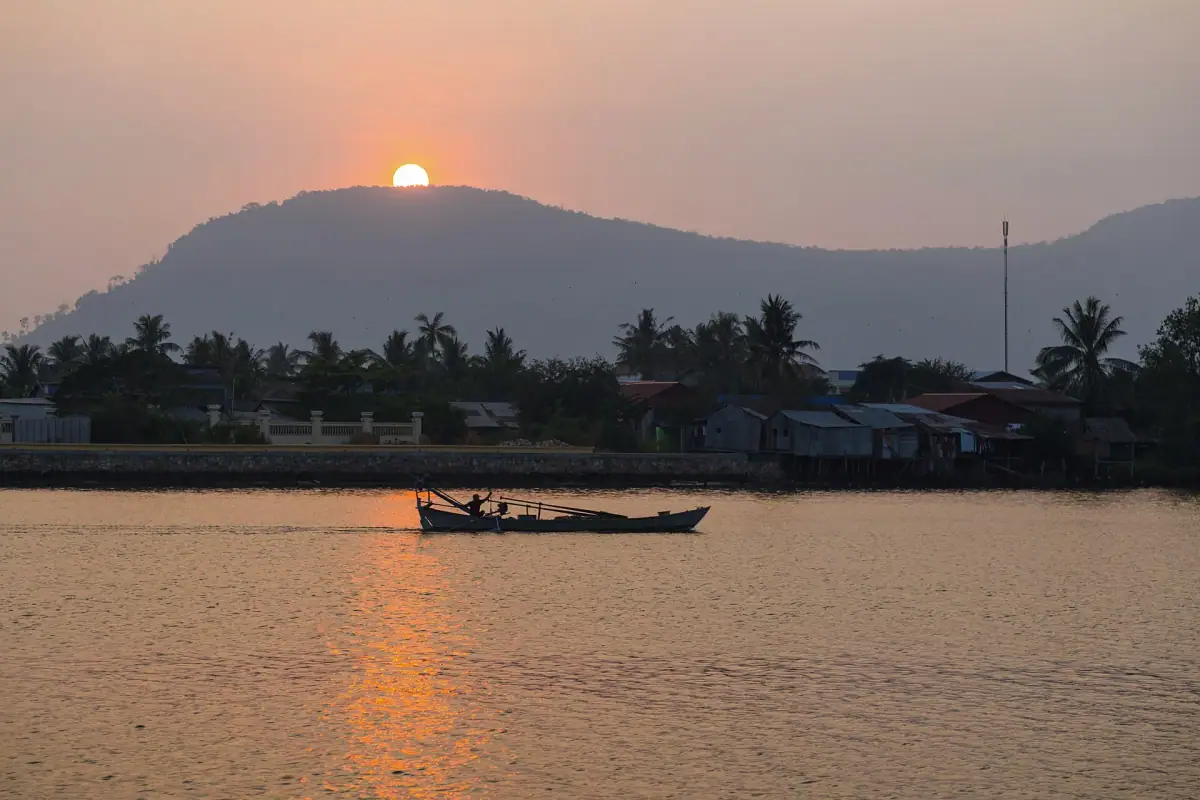
The riverside: This is the living heart of Kampot. In the evening, the terraces come alive, musicians play and travelers from around the world meet over a glass of Angkor beer or a lemongrass cocktail. The promenade is pleasant on foot, dotted with old colonial houses and fishing boats moored at the water’s edge.
The Durian Roundabout: In the center of Kampot sits a roundabout topped with a giant durian, the region’s emblematic fruit. More quirky than beautiful, this monument has become the landmark of the whole town. Every visitor to Kampot ends up at some point photographing this concrete durian, several meters tall.
The old market (Phsar Leu): Kampot’s central market is the ideal place to take the pulse of local life. Spices, tropical fruit, fresh fish from the gulf, aromatic herbs and, of course, Kampot pepper in all its varieties (black, red, white, green), a sensory explosion that smells of authentic Asia.
The old quarter: A few streets from the riverfront, Kampot’s urban fabric reveals quieter streets, Buddhist temples (including the magnificent Wat Sampov Pram), artisan shops and cafés hidden in inner courtyards. This is where Kampot shows its most soothing side.
Hotels in Kampot
Colonial boutique hotels, riverside guesthouses: book with free cancellation.
Kampot pepper: Cambodia’s green gold
Kampot is inseparable from its pepper. Reputed among the best in the world, Kampot pepper has had Protected Geographical Indication (PGI) status since 2010, a rare recognition for an Asian agricultural product.
The secret lies in the region’s unique geography: the mineral-rich volcanic soils at the foot of the Elephant range, the humidity brought by the nearby sea, and traditional growing methods handed down over centuries. The berries ripen slowly, developing complex floral and fruity aromas, with a heat on the palate that is different from industrial pepper.
The four varieties of Kampot pepper:
- Black pepper: Red berries picked at maturity, sun-dried. The most common, with intense, woody aromas
- White pepper: Black berries soaked and hulled. Milder, slightly fermented, ideal for sauces
- Red pepper: Red berries picked at full ripeness and dried. Rare and fruity, the one chefs like best
- Fresh green pepper: Unripe green berries. Herbal, peppery aroma, used directly in cooking, the essential local specialty with Kep crab
Visiting a plantation: Several farms can be reached by bike from central Kampot (10-15 km / 6-9 mi). The best known are La Plantation, Farmlink and Sothy’s Pepper Farm. Visits are generally free or low-cost, include an explanation of the growing process and let you buy direct from the farm. An instructive and delicious afternoon.
The Phnom Chhnork caves
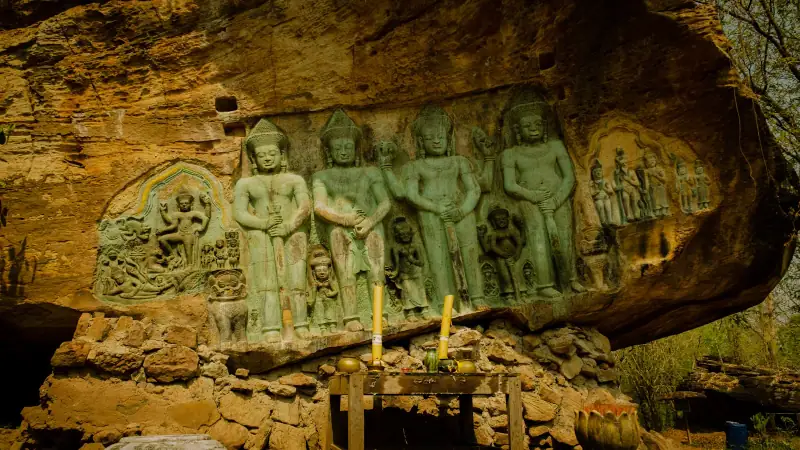
8 km (5 mi) east of central Kampot, the Phnom Chhnork cave site is one of the most impressive natural and religious attractions in the region. The limestone hill holds a cave system inhabited since antiquity, with spectacular stalactite formations and a 7th-century Khmer temple preserved inside the main cavity itself.
The main cave opens onto a natural cathedral where light filters in from a rock shaft, creating a mystical atmosphere that locals consider sacred. A small shrine dedicated to Shiva has been set into the rock for 1,400 years. The secondary caves go deeper into the hill, and exploring them requires a flashlight.
Practical information:
- How to get there: By tuk-tuk ($8-10 round trip) or by motorbike/scooter on your own
- Admission: $2 per person
- Hours: 7:30 am-5:30 pm
- Visit time: 1 to 1.5 hours
- Tip: Wear closed shoes in the caves, as the floor can be slippery
The site is run by local caretakers who can act as informal guides. Cambodian families come on pilgrimage, adding to the authenticity of the visit.
Activities and excursions in Kampot
Kayaking, caves, pepper plantations, Bokor: book your activities in advance.
Bokor National Park: the ghost mountain
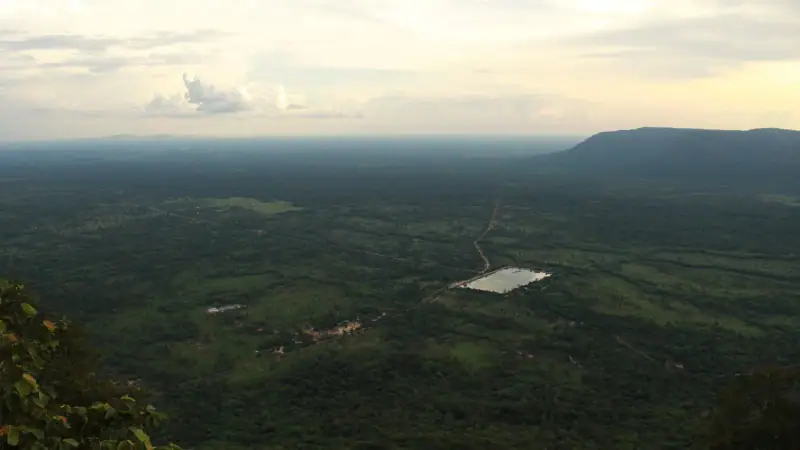
42 km (26 mi) from Kampot rises Bokor Mountain (Phnom Bokor), which peaks at 1,080 meters (3,543 ft). On its summit plateau, the French built a hill station in the 1920s to escape the heat of the plain: a casino, a hotel and a church. Abandoned after Cambodia’s independence in 1953, then battered by the Khmer Rouge, these ghostly colonial buildings emerge from the clouds with a strange, melancholy charm.
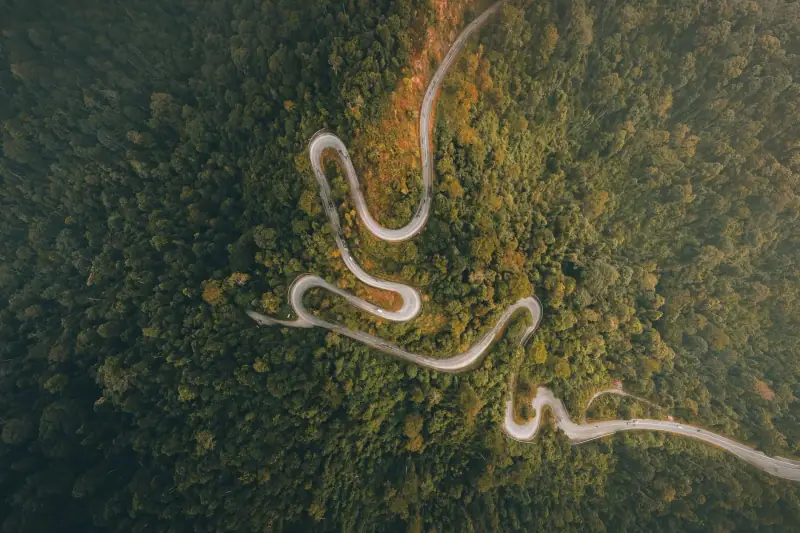
The ride up by motorbike or tuk-tuk on the paved road (1.5 hours from Kampot) is already a show: the vegetation changes radically with altitude, going from coastal coconut palms to dense, misty forest. The panorama from the top over the plain, the Gulf of Thailand and the islands in the distance is breathtaking, when the clouds deign to clear.
What you find at the top of Bokor:
- The ruins of the old Bokor Palace casino: A haunted, magnetic Art Deco building, partly restored (interior access sometimes possible)
- Saint Michael’s Church: An abandoned Catholic chapel whose facade has withstood decades of tropical monsoon
- Wiang Karan Hotel: A grand abandoned hotel built for French colonists, now partly overgrown with vegetation
- Popokvil Waterfall: 2 km (1.2 mi) past the summit, a trail descends to this two-tier waterfall in the forest, cool and green
Practical info:
- National park admission: $5 per person
- By rented motorbike/scooter: the road is passable but requires experience
- By tuk-tuk or organized tour: $20-30 per person from Kampot, full day
Bokor is an essential excursion from Kampot. For hiking fans, trails cross the national park.
The Kampot River: kayaking, sunset and floating villages
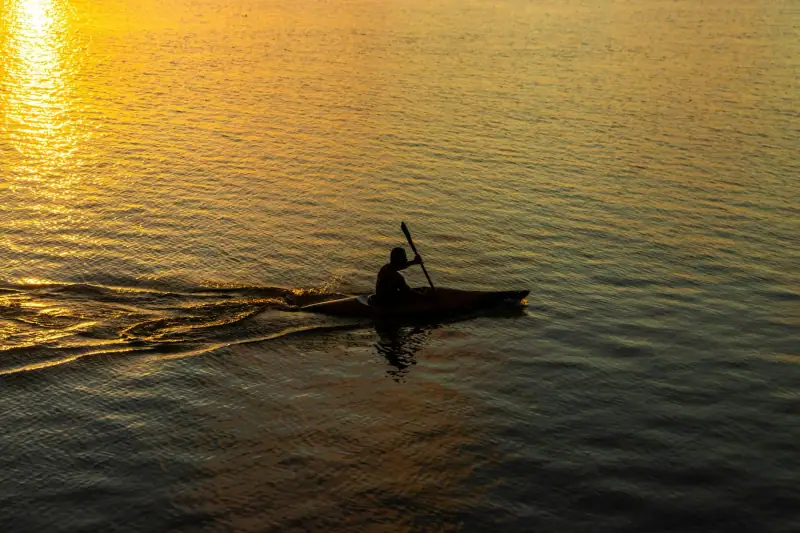
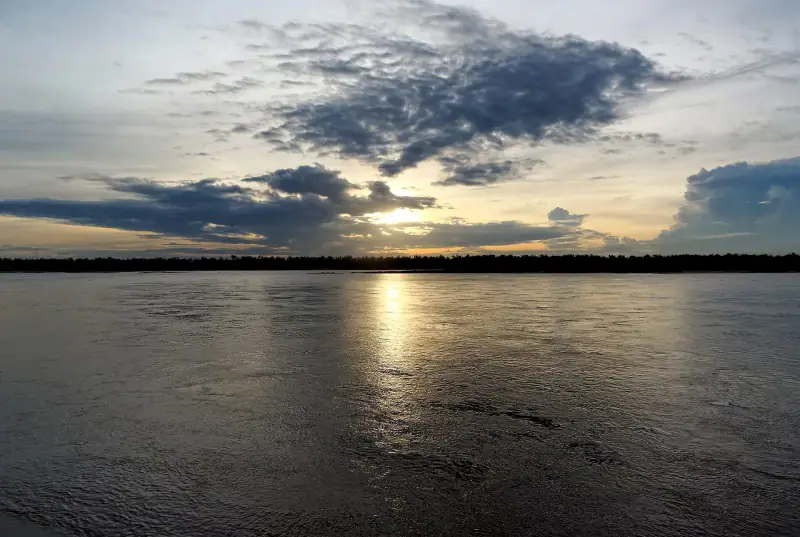
The river that gives the town its name is one of the great pleasures of Kampot. Peaceful, lined with mangroves and rice fields, crossed by colorful fishing boats, it stretches for kilometers between Kampot and the Gulf of Thailand.
Kayaking: This is Kampot’s flagship activity. Many operators rent kayaks and offer guided outings on the river. The paddle from the hills toward the coastal mangrove lets you spot tropical birds, macaque monkeys on the banks and sometimes river (Irrawaddy) dolphins in the calmest stretches.
Sunset cruises: Every evening, boats run a 1.5 to 2 hour cruise on the river to watch the sun set over Elephant Mountain. A magical moment, often with drinks and light music. Expect $8-15 per person.
Floating villages: On the lower part of the river, several floating villages are home to fishing families, mostly of Vietnamese origin. A boat or kayak trip lets you glide past these amphibious communities and watch their daily life on the water.
Scooter or car rental in Kampot
Explore the plantations, the caves and Bokor at your own pace with a rental vehicle.
Food in Kampot: eating well for cheap
Kampot has a surprisingly developed food scene for a town of this size. The flow of international travelers has encouraged quality restaurants to emerge, while local Khmer and Vietnamese kitchens remain affordable and authentic.
The absolute specialty: crab with Kampot green pepper The region’s signature dish is Gulf of Thailand crab cooked with fresh Kampot green pepper. A land-and-sea pairing of remarkable intensity, offered by most restaurants in Kampot. For the freshest version, the trip to the crab market in Kep (25 km / 16 mi) is a must; see our guide to activities in Kampot and Kep.
Other dishes to try:
- Fish amok: Cambodian steamed curry in a banana leaf, a national signature
- Lok lak: Stir-fried beef in pepper sauce on a bed of rice or fries; Kampot pepper adds an extra dimension here
- Kuy teav: Cambodian rice noodle soup, perfect as a market breakfast
- Banh chao: Cambodian crepe filled with bean sprouts, shrimp and pork
Good places to eat:
- Resto Rikitikitavi: Riverside terrace, excellent fusion food and pizzas. Moderate prices.
- Epic Arts Café: A social project employing people with disabilities. Delicious breakfast and lunch in a lovely inner courtyard.
- Noodle Soup Restaurant: A local institution with no official name, at the morning market. Kuy teav for $1.50, served from 6 am.
- The Rusty Keyhole: A popular riverside bar-restaurant, relaxed mood, decent international food.
Where to stay in Kampot: every budget
Kampot has a varied range of accommodation, from backpacker dorms at $6 a night to colonial boutique hotels at $80 a night. The great majority of travelers stay in the $15-50 a night range, with excellent value.
Where to sleep in Kampot:
Recommended area: The riverside is ideal for travelers who want to be in the middle of the action and walk to restaurants and cafés. The old colonial quarter is quieter. A few guesthouses are set on boats or floating platforms, an original experience.
Budget ($6-20 a night): There is no shortage of dorms and simple rooms. Several historic Kampot guesthouses offer double rooms with a fan or air conditioning for $12-18 a night.
Midrange ($25-60 a night): Well-renovated colonial boutique hotels offer comfortable rooms, a pool and breakfast for a price below Siem Reap standards. The best value in the category.
Upscale ($60-120 a night): Several eco-lodges and resorts are set in the countryside around Kampot, with pools facing the mountains and views over the rice fields. A splendid option for a romantic stay.
To plan your trip, see our guide to the best time to visit Cambodia.
Kampot and Kep: the winning combination
Kampot and Kep (25 km / 16 mi away) form a natural pair that most travelers explore together. The road linking them follows the coast and crosses fishing villages, salt pans and pepper plantations, a 30-minute ride that is already worth the detour.
Why sleep in Kampot and do Kep as an excursion: Kampot offers a far wider choice of lodging, restaurants and activities than Kep. Most travelers use Kampot as a base to explore the region, with one day devoted to Kep for its crab market, its beaches and Kep National Park. To learn all about both destinations, read our complete guide to activities in Kampot and Kep.
The salt pan road: Between Kampot and Kep, the salt pans of the south coast are active from January to May. Pyramids of gleaming white salt against a blue sky and green mountain make for an unexpected, photogenic landscape. Stop to watch the salt workers at their job.
Kampot practicalities
How to get to Kampot:
- From Phnom Penh: Direct bus (3-4 hours, $5-8) or shared taxi (2.5 hours, $10-15 per person). Several departures a day from Phnom Penh. A Royal Railway train also runs (about 3 hours 40 minutes, check schedules).
- From Sihanoukville: Bus or minibus (2 hours, $5-8) or tuk-tuk (1.5 hours).
- From Kep: Tuk-tuk or motorbike taxi (25 km / 16 mi, 30-40 min, $8-12).
- From Siem Reap: No direct connection. Go through Phnom Penh.
Getting around Kampot:
- Bike: The ideal way around the town center and nearby plantations ($2-4 a day)
- Scooter: For excursions to Bokor, the caves and Kep ($8-12 a day). An international driving permit is recommended.
- Tuk-tuk: Handy for combined excursions ($15-25 for a half day)
- Remork: For groups or Bokor ($25-35 for the day)
Currency and budget: Both the US dollar and the Cambodian riel are accepted. A budget of $30-50 a day comfortably covers midrange lodging, local meals and one or two activities. Kampot is clearly cheaper than Siem Reap or Phnom Penh for the same level of comfort.
Internet and phone: Wi-Fi is available in all lodgings and cafés. A local SIM (Smart or Metfone, $5-10 with data included) is recommended for rural excursions.
Safety: Kampot is a very safe town. Bag snatching from motorbikes is rare but does happen, so carry your bag across your body on the side away from the street in busy areas. The Bokor road can be slippery in the rain.
Kampot has the precious quality that the best destinations share: it doesn’t reveal itself in a day. Travelers who make only a quick stop leave feeling that something essential was left to grasp. Those who stay three days or more understand: Kampot has to be tamed. The river, the pepper, the mountain, the early-morning cafés, all of it settles in slowly, like a spice left to steep. To fit Kampot into a wider route, see our guide to the full Cambodia circuit.
Frequently asked questions
How many days do you need to visit Kampot?
Two to three days are ideal to enjoy Kampot: one day to wander the town and walk along the river, one day for the Phnom Chhnork caves or Bokor, and a half day for a kayak or bike trip to the pepper plantations. Travelers looking for calm sometimes stay a whole week.
Is Kampot worth the detour compared with Kep?
Kampot and Kep complement each other and are only 25 km (16 mi) apart, so it is easy to combine the two. Kampot is a lively town with cafés, restaurants and a quiet nightlife, ideal as a base. Kep is smaller and focused on the sea and crab. Many travelers sleep in Kampot and make a day trip to Kep.
How do you get from Phnom Penh to Kampot?
The Phnom Penh to Kampot trip takes 2.5 to 3 hours by bus (about $5-8) or 2 hours by shared taxi ($10-15 per person). Several bus companies serve Kampot from the Phnom Penh terminal. A train (Royal Railway) also links Phnom Penh to Kampot in about 3 hours 40 minutes (around $10): check days and schedules before you go. There is no airport in Kampot.
What is the best time to visit Kampot?
The dry season from November to April is the best time. From December to February, the climate is delightful: 28-33 °C (82-91 °F) by day, a slight coolness in the evening. In the rainy season (May to October), the landscapes are lush and pepper is harvested, but tropical rains can limit some outdoor activities.
Is Kampot pepper really that different?
Yes, Kampot pepper is considered one of the best in the world. The combination of the region's volcanic soils, the microclimate between the sea and Elephant Mountain, and traditional growing methods produces a pepper with exceptional floral aromas. It has had Protected Geographical Indication (PGI) status since 2010. Fresh green Kampot pepper is especially sought after.
Can you visit the pepper plantations on your own?
Yes, several plantations can be reached by bike from Kampot (10-15 km / 6-9 mi). La Plantation, Farmlink and Sothy's Pepper Farm welcome visitors, offer free or low-cost guided visits, and sell their produce directly. A half-day bike or scooter trip is enough to visit one or two plantations.
More Cambodia guides
Keep reading
Eastern Cambodia: Kratie, Ratanakiri and Mondulkiri, the wild east
Exploring eastern Cambodia: Mekong dolphins at Kratie, Yeak Loam lake in Ratanakiri, ethical elephant experiences in Mondulkiri. A practical guide.
Visiting Battambang: a complete guide to Cambodia's northwest pearl
Complete guide to visiting Battambang: bamboo train, colonial architecture, Phare circus, bat cave and where to stay.
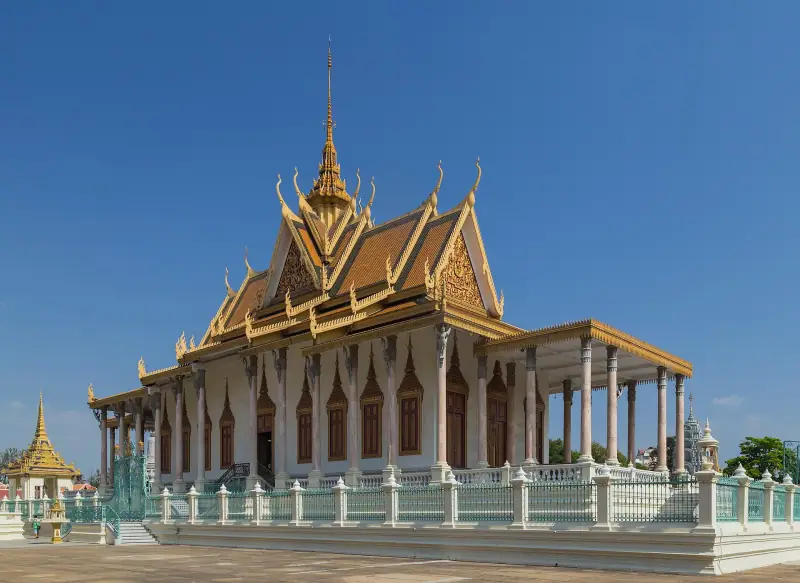
Phnom Penh essentials: the 10 things to do
The 10 essential things to do in Phnom Penh: Royal Palace, Tuol Sleng, Choeung Ek, Central Market, Riverside. A complete guide to Cambodia's capital.
Ready-made
Cambodia itineraries
12 days
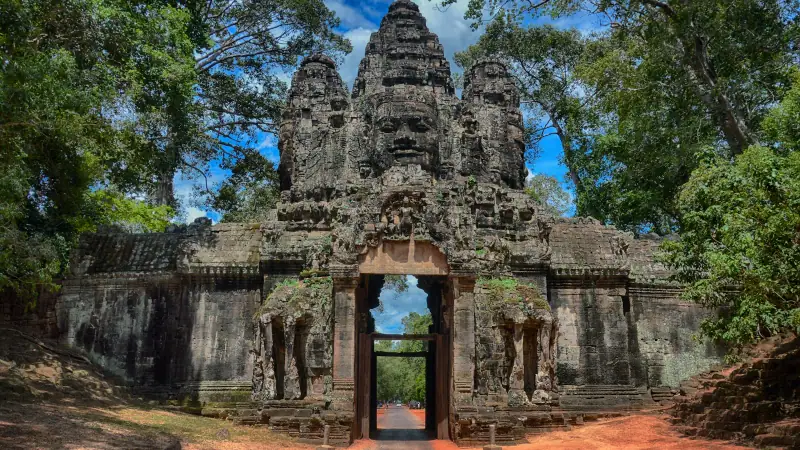
Cambodia in 12 Days with Kids: Stops, Distances and a Realistic Pace
Siem ReapPhnom PenhKampotKoh Rong Samloem
7 days
Cambodia in 7 Days: The Perfect One-Week Itinerary
Phnom PenhSiem Reap
Can be adapted in the planner
4 days
Road Trip in Northwest Cambodia: Battambang and Around in 4 Days
4-day road trip itinerary in northwest Cambodia: bamboo train, rice paddies, Phnom Sampeau bats and Angkorian temples away from the crowds.
Can be adapted in the planner