Itineraries
Road Trip in Northwest Cambodia: Battambang and Around in 4 Days
We may earn a commission when you book through links on this page, at no extra cost to you. We don't visit or try the places we cover: we summarize published sources. How we work
Day by day
- Day 1Arrive in Battambang, colonial center, Sangkae riverside, Phsar Nat
- Day 2Bamboo train, Phnom Sampeau bat exodus at sunset
- Day 3Bike to Wat Ek Phnom, pottery villages, Wat Kor
- Day 4Boat to Siem Reap or bus to Phnom Penh
Where to sleep
- Battambang3 nights
Opens the trip planner with these stops and nights already filled in. Add a stop, drop one or change the nights.
In short
- Four days is ideal: two for the town (norry, Phnom Sampeau, colonial architecture) and two for the countryside by bike, temples and an optional Pailin trip.
- The bamboo train (norry) costs about $15-20 USD per platform; Phnom Sampeau's bat exodus starts at sunset, so arrive 45 minutes early.
- Siem Reap to Battambang takes 3 to 4 hours by bus ($3-6 USD); the slow boat takes 4 to 8 hours ($20-25 USD) but does not always run in the dry season.
- Best season is November to April; the Poipet land border with Thailand has been closed or heavily disrupted since June 2025, so check its status first.
Northwest Cambodia is the destination hurried travelers never see. Too busy hopping between Angkor and Phnom Penh, they miss a region that holds some of the country’s most authentic experiences: a bamboo train that speeds along colonial-era rails, millions of bats rising at dusk, rice paddies as far as the eye can see that you ride through by bike, and a town, Battambang, whose preserved French architecture is the finest in Cambodia.
This four-day road trip in the Battambang region takes you away from the packaged circuits. No crowds, no pushy souvenir sellers, no temple under permanent reconstruction. Just rural Cambodia, slow and generous, as it has always been.
Why choose northwest Cambodia?
The Battambang region, in northwest Cambodia, is often described as the country’s rice bowl. The alluvial plain around the town produces a large share of Cambodian rice, and the farming landscapes, with paddies in shades of green and gold depending on the season, potters’ villages and longan orchards, are soothingly beautiful.
But the northwest also has a particularly dense history. The last Khmer Rouge stronghold until 1999, the region took longer than the rest of the country to open to tourism. That difficult past, combined with an economy that long stayed on the sidelines, has protected Battambang and its surroundings from overly rapid modernization. The colonial streets are intact, the villages have not been “touristified,” and locals welcome travelers with unscripted warmth.
What this road trip offers:
- The norry experience, one of the last bamboo trains in the world
- The Phnom Sampeau bat cave and its breathtaking natural show
- Bike loops through the Battambang countryside
- The ruins of the Angkorian temple of Wat Ek Phnom, without Angkor’s crowds
- The option of a detour to Pailin, a mining town in wooded hills
- A boat trip down the Tonle Sap to Siem Reap
Day 1: Arrive in Battambang and explore the colonial center
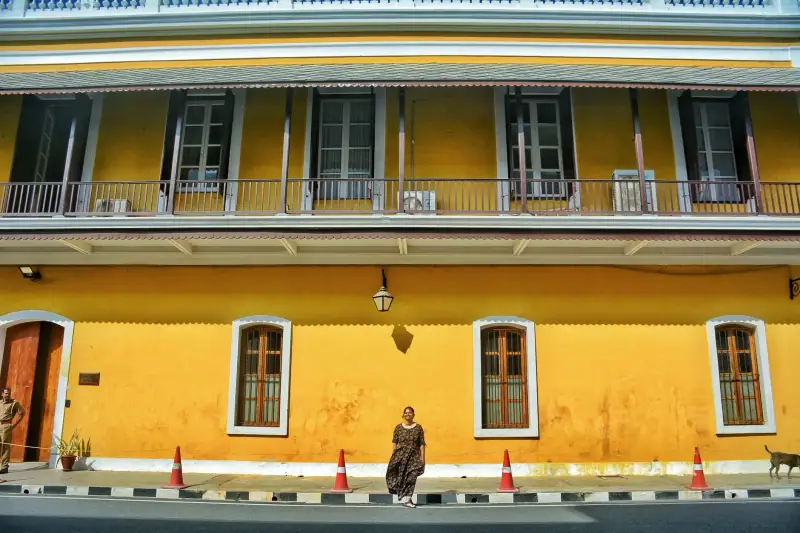
Arrive in Battambang in late morning, ideally by boat from Siem Reap if you take an early departure (7 am). Crossing the Tonle Sap is an unforgettable experience in itself. If you arrive by bus from Phnom Penh (about 4 to 5 hours) or Siem Reap (about 3 to 4 hours), you will be in town before noon.
Afternoon strolling around town:
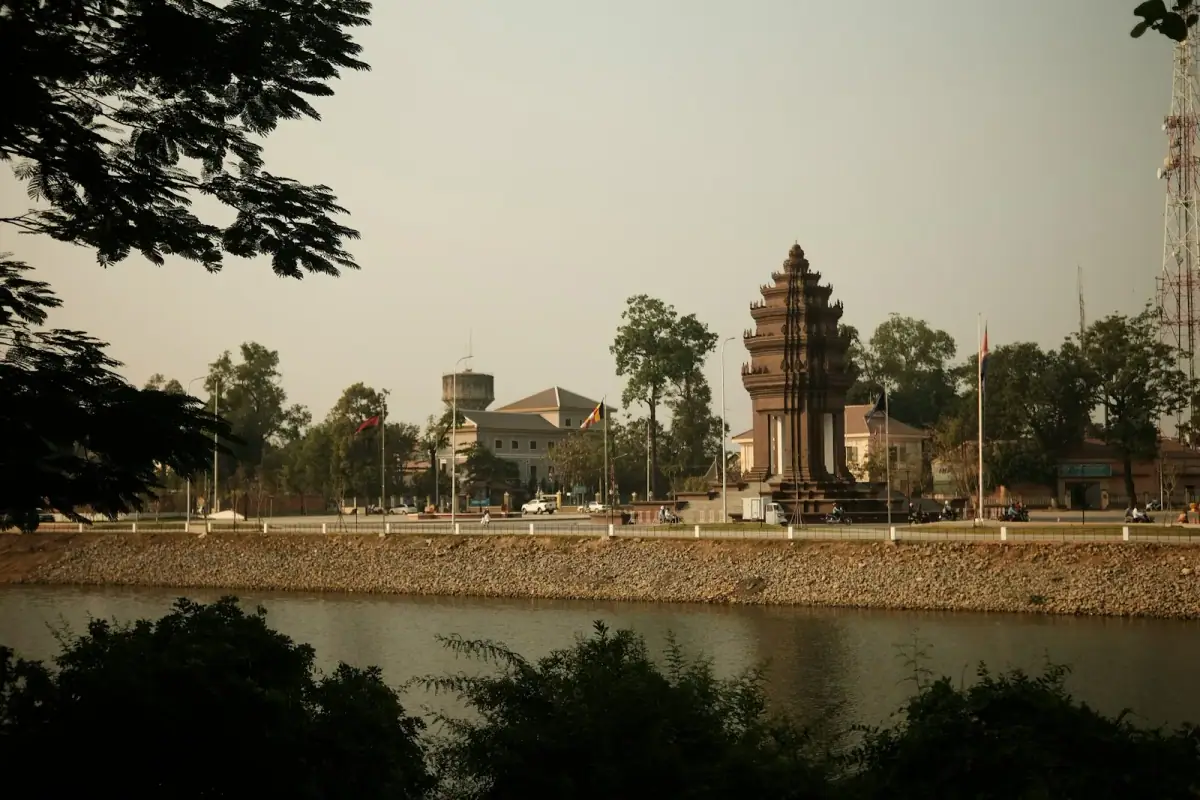
After dropping your bags, spend the afternoon exploring the historic center on foot. Battambang has the best-preserved French colonial architecture in Cambodia, and the walk along the Sangkae River is one of the highlights of any stay in the country.
The Sangkae riverside: The street along the river is lined with colonial villas with colorful shutters, now home to trendy cafés and restaurants. Sit on a terrace to watch the town come to life and recover from the journey.
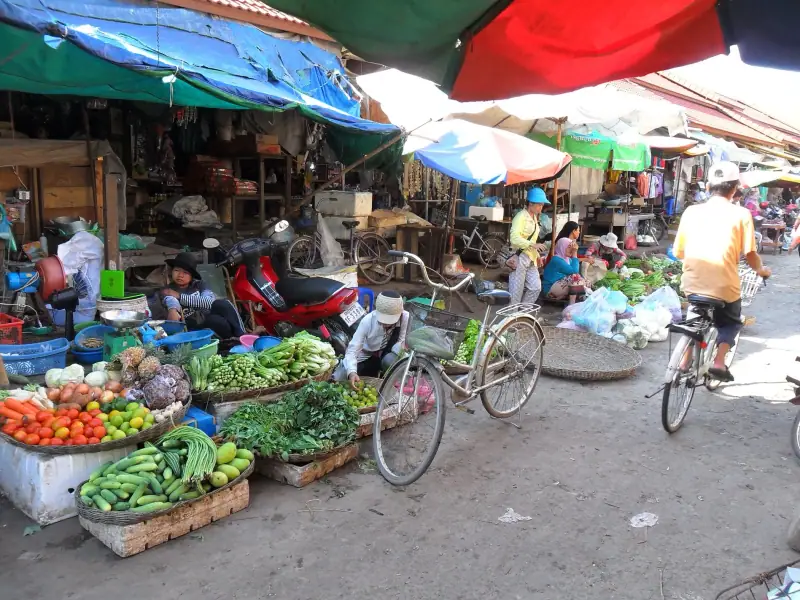
Phsar Nat market: This colonial market hall, built in the 1930s, is still the daily market for Battambang residents. You will find spices, vegetables, fresh fish from the Tonle Sap and local crafts. It is the ideal place to see everyday Cambodian life unfiltered, far from Siem Reap’s souvenir markets.
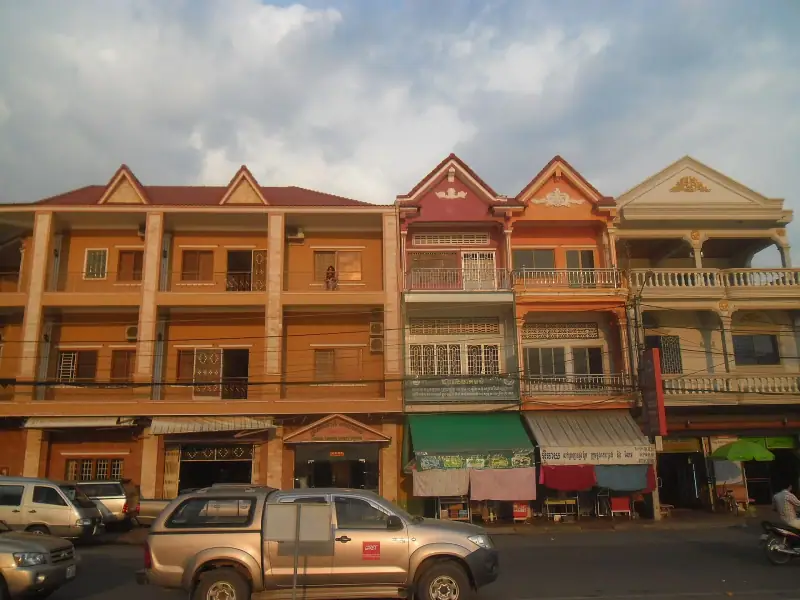
Street 2.5: This central avenue has the finest examples of Art Deco architecture. The pale yellow and white facades, wrought-iron balconies and shaded arcades have barely changed since the 1940s. Wat Damrey Sar (the White Elephant temple) and Wat Kandal are worth a stop.
Evening: Head to the riverside restaurant district for dinner. Battambang’s food scene is one of the most pleasant in Cambodia, with authentic Khmer dishes at prices well below Siem Reap’s. If you want a memorable first evening in Battambang, check the schedule of the Phare Ponleu Selpak circus (shows generally at 7:30 pm, about $18-22 USD), but feel free to move it to the evening of your choice depending on the schedule.
Hotels in Battambang
From family guesthouses to colonial boutique hotels, book with free cancellation.
Day 2: The bamboo train and the Phnom Sampeau bats
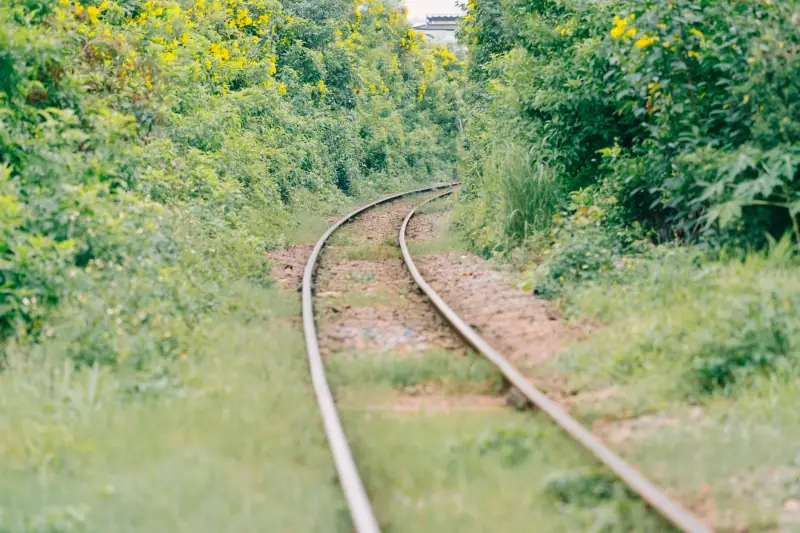
The signature day of your northwest road trip.
Morning: the norry, the one-of-a-kind bamboo train
Set out early (departure around 8 am) for the norry site (ask your accommodation which site is operating, and allow 15 to 30 minutes by tuk-tuk). The norry, or bamboo train, is a bamboo platform set on two metal axles, powered by a small secondhand engine, gliding over rails inherited from the French colonial railway line. These rails wind through the rice paddies and farming villages of the plain.
What makes the experience both comical and fascinating: the track is single. When two norries meet, one is completely taken apart in seconds, with the platform lifted off and the axles set aside, to let the other pass, then reassembled right away. It is a hilarious, perfectly rehearsed ballet that the operators carry out with total nonchalance.
Norry practical info:
- Location: the site has changed in recent years (formerly near O Dambong, now also a developed tourist line on the Banan side); confirm the current location and hours there
- Ride length: 30 to 45 minutes round trip through the rice paddies
- Price: about $15-20 USD per platform (2 to 4 people)
- Hours: generally 7 am to 5:30 pm, daily
- The ride stops at a village halfway where local artisans sell souvenirs
Plan to be back around 11 am for lunch in town, then take a nap during the hottest hours of the afternoon (1-3:30 pm).
Late afternoon: Phnom Sampeau and the bat exodus
Phnom Sampeau is a limestone hill about 12 km (7 mi) southwest of Battambang. It holds several Buddhist temples, some built right into the caves, and sites that bear witness to the region’s painful past under the Khmer Rouge.
But the highlight happens every evening at sunset: millions of bats (estimated at several million) pour out of the hill’s caves for their night hunt. This continuous stream of creatures spiraling into the pink evening sky, a winding ribbon that unfurls for more than an hour, is one of Southeast Asia’s great natural spectacles.
Tips for Phnom Sampeau:
- Arrive 45 minutes before sunset (between 5 and 5:30 pm depending on the season)
- The climb on foot takes about 20 minutes; motorbike drivers offer to take you up for a few dollars
- Small restaurants and drink sellers are there
- Combine the visit with the climb to the summit for the panorama over the plain
To reach Phnom Sampeau, negotiate a round-trip tuk-tuk from the center, with waiting time: expect about $12-18 USD depending on the duration.
Day 3: Cycling the countryside and satellite temples
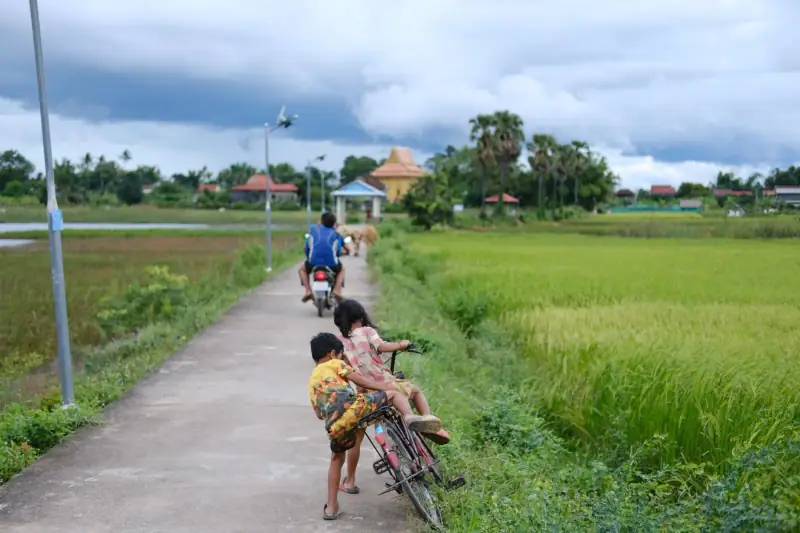
The gentlest and most immersive day of the road trip.
Rent a bike first thing in the morning
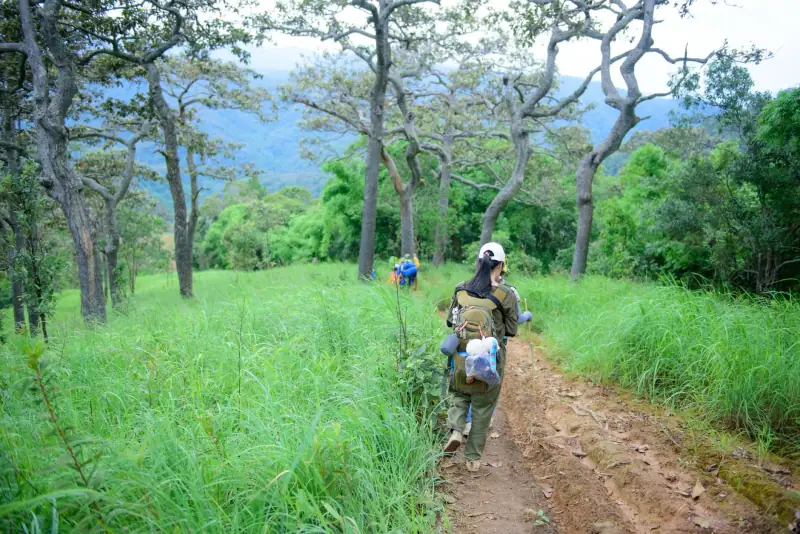
Almost all guesthouses and many rental shops in town offer bikes for $2-4 USD a day, or electric bikes for $5-8 USD a day. Set out early (before 8 am) to enjoy the cool morning and the golden light on the rice paddies.
Wat Ek Phnom: an Angkorian temple without the crowds
Thirteen km (8 mi) north of Battambang, the ruins of Wat Ek Phnom (11th century, from the time of King Suryavarman I) are absolutely worth the detour. The temple, built in the classical Angkorian tradition in pink sandstone, is partly in ruins but very beautiful. A modern, still-active wat was built nearby. The coexistence of these two buildings, a thousand years apart, gives a striking image of the continuity of Cambodian religious life.
The road there passes through farming villages, rice paddies and longan orchards. The bike ride (45 to 60 minutes depending on your pace) is as enjoyable as the destination itself. Few tourists venture out here, so you can explore the site in peace.
Guided tours in northwest Cambodia
Guided excursions by bike, boat or tuk-tuk around Battambang. Book ahead in high season.
Rice paddies and potters’ villages
On the way back toward Battambang, detour through the villages of Kampong Plouk or the traditional pottery workshops scattered across the Battambang countryside. These villages have lived from rice growing and crafts for generations, and stopping in a workshop to watch clay being worked on the potter’s wheel is an off-the-beaten-path experience.
Afternoon: Wat Kor and traditional wooden houses
On the way back to Battambang, stop at Wat Kor, a few kilometers south of the town center. This village keeps some very fine traditional Khmer wooden houses, built with ancestral techniques on stilts, with carved verandas and multi-tiered roofs. It is a rare chance to see Cambodian vernacular architecture in an intact rural setting.
Evening: Phare circus or dinner on the river
If you have not yet seen the Phare Ponleu Selpak show (Battambang’s social circus school, whose graduates include some who joined Cirque du Soleil), tonight is the night. The acrobatics, theater and dance performances last about an hour and draw on themes from Khmer history. Not to be missed.
Option: half day in Pailin from Battambang
For travelers who want to go even further off the beaten path, a trip to Pailin is worth the detour. This small town, about 83 km (52 mi) west of Battambang, was one of the Khmer Rouge strongholds. Ieng Sary’s faction in Pailin formally joined the royal government in 1997, before the organization’s final collapse in 1998-1999. Today a quiet border town, it is known for its ruby and sapphire mines, its gemstone markets and its landscape of wooded hills very different from the Battambang plain.
What you can do there:
- Climb Wat Phnom Yat for the view over the hills and the Thai border
- Visit the gemstone market (raw gems to buy directly from local dealers)
- Have lunch at a local restaurant in a town still little visited by tourists
How to get there:
- By scooter rented in Battambang: about 2 hours each way, on a decent main road
- By shared taxi or local bus from the Battambang bus station: about 2 h 30 to 3 hours
- By tuk-tuk: possible but tiring for this distance, best left to thrill-seekers
This excursion fits easily into day 3 if you leave early (depart 6:30-7 am, back in Battambang around 4-5 pm), or becomes a full day of its own if you prefer to take your time.
Day 4: On to Siem Reap or Phnom Penh
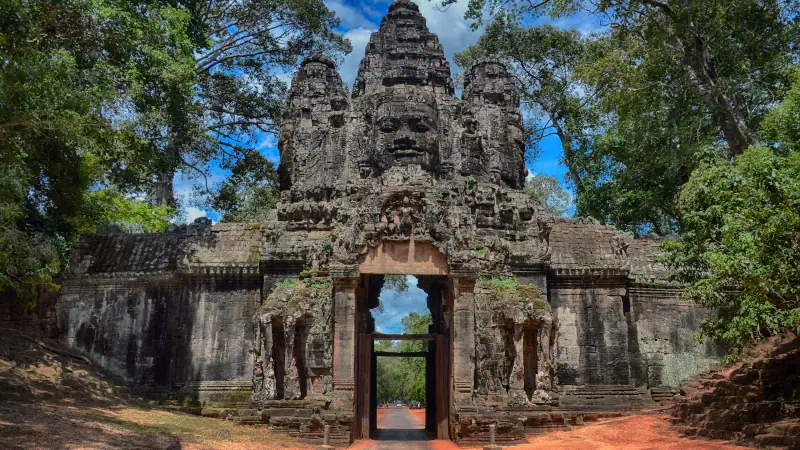
Your last morning in Battambang, depending on where you go next.
Option A: The boat to Siem Reap (highly recommended in the high-water season)
Note: in the dry season, the Sangkae is too low and the boat often does not run all the way to Battambang. Check the service with your accommodation and plan on the bus as a fallback.
The boat trip from Battambang to Siem Reap via the Sangkae River and Tonle Sap lake is one of the most memorable travel experiences in Cambodia. The boat leaves the Battambang pier around 7-7:30 am, and the trip usually takes between 6 and 8 hours depending on the season and water level (longer in the dry season when shallows slow progress).
The route first crosses the Sangkae through dense riverside forest, then opens onto the vastness of the Tonle Sap, the largest lake in Southeast Asia, before reaching Siem Reap. Stilt villages, net fishers and flocks of waterbirds punctuate the trip. It is the gentlest and most beautiful way to link the two towns.
Boat practical info:
- Departure: generally 7-7:30 am from the Battambang pier
- Duration: 6 to 8 hours (varies with season and water level)
- Price: about $20-25 USD per person
- Booking: through your guesthouse or at the pier the day before
- Bring: sunscreen, hat, water, a snack
Option B: Direct bus to Phnom Penh
If your next stop is the capital, several bus companies link Battambang to Phnom Penh directly (about 4 to 5 hours, $5-10 USD). One last coffee on the Sangkae riverfront, and you are on your way.
See our full Cambodia circuit and our 10-day itinerary to fit this road trip into a longer stay.
Practical info for this road trip
Getting to Battambang
- From Siem Reap: Bus (3 to 4 h, $3-6 USD) or slow boat (4 to 6 h, $20-25 USD, recommended)
- From Phnom Penh: Direct bus (4 to 5 h, $5-10 USD) or shared taxi (3 to 4 h)
- From Thailand (Bangkok): the Poipet land border has been closed or heavily disrupted since June 2025 (Thai-Cambodian conflict); check with the authorities whether it has reopened before planning this route. If it reopens, the local Poipet-Battambang bus takes about 2 hours
Getting around
- Tuk-tuk: Perfect for short excursions (norry, Phnom Sampeau). Negotiate the half-day or full-day rate in advance: $15-30 USD depending on the program
- Bicycle: Ideal for the countryside and nearby temples ($2-4 USD a day to rent)
- Scooter: Needed for Pailin and more distant sites ($8-12 USD a day)
- Taxi with driver: The most comfortable way to cover the region with family or a group ($35-50 USD a day)
Approximate budget
For this 4-day road trip, expect roughly:
- Accommodation: $15-60 USD a night depending on standard (guesthouse to colonial boutique hotel)
- Meals: $5-15 USD a day (local Khmer food is very affordable)
- Activities: $40-80 USD over 4 days (norry, tuk-tuk, Phare if you wish, admissions)
- Local transport: $20-40 USD a day (bus + tuk-tuk)
Battambang and the region remain noticeably cheaper than Siem Reap for a comparable level of comfort.
Best time to go
The dry season, from November to April, is the most comfortable for this road trip. From December to February, temperatures are mildest (25 to 30 °C / 77 to 86 °F) and skies are clear. In the rainy season (May to October), the rice paddies are magnificent but some rural paths can be hard going by bike.
For a full analysis of Cambodia’s seasons, see our best time to visit guide.
Car rental in Cambodia
Explore the Battambang region at your own pace with a vehicle and driver.
What you will remember
A road trip in northwest Cambodia is above all a series of moments that stay with you: the sound of the norry’s engine gliding silently into the rice paddies, the thrill of watching millions of bats rise in a ribbon into an orange sky, the gentleness of a morning pedaling between villages where no one is trying to sell you anything.
This is Cambodia without filters, as it presents itself to those who take the time to step away from the packaged circuits. After Angkor and Phnom Penh, Battambang and its hinterland may be the most genuine thing the country has to offer.
To prepare your trip, see our complete guide to Battambang, our selection of the best places to stay in Battambang and our visa and formalities guide for Cambodia.
Frequently asked questions
How many days do I need to explore northwest Cambodia?
Four days is ideal for a road trip around Battambang: two days for the town's main attractions (norry, Phnom Sampeau, colonial architecture) and two days for the surrounding countryside by bike, the satellite temples and possibly a trip to Pailin. With five or six days, you can add a boat trip down the Tonle Sap to Siem Reap.
Do I need to rent a car or scooter for this road trip?
Most sites around Battambang can be reached by tuk-tuk (bamboo train, Phnom Sampeau) or by bike (countryside, Wat Ek Phnom). A scooter rented for $8-12 USD a day is useful for Pailin (83 km / 52 mi) or more distant villages. A rental car with driver ($35-50 USD a day) is comfortable for covering the whole region in two days.
How do I get to Battambang from Siem Reap?
From Siem Reap, the bus takes about 3 to 4 hours to reach Battambang ($3-6 USD). The slow boat via the Tonle Sap takes 4 to 8 hours ($20-25 USD) and offers extraordinary scenery, but it generally only runs in the high-water season (check with your accommodation). It is the option preferred by travelers who are not in a hurry. By shared taxi, expect about 2 h 30 to 3 hours ($8-12 USD per person).
When is the best season for this northwest road trip?
The dry season, from November to April, is the most pleasant for getting around: passable roads, rural tracks open to cyclists, moderate temperatures (25 to 32 °C / 77 to 90 °F). From December to February the weather is at its best. The rainy season (May to October) makes the countryside exceptionally green and the rice paddies spectacular, but some rural paths can be muddy.
Can I combine this road trip with a visit to Angkor?
Absolutely. The classic route is to arrive in Siem Reap, visit Angkor (2 to 3 days), then reach Battambang by bus or boat for this northwest road trip (4 days), before heading back to Phnom Penh. The land crossing to Thailand via Poipet has been closed or heavily disrupted since June 2025: check its status before making any plans. It makes the best 10- to 12-day itinerary for seeing northern Cambodia.
What is there to see in Pailin from Battambang?
Pailin, a former Khmer Rouge town turned border and mining town, deserves a half day from Battambang (83 km / 52 mi, about 2 hours by road). You can visit Wat Phnom Yat (a hilltop temple with views of the Thai border) and gemstone markets (rubies, sapphires), and cross a landscape of wooded hills very different from Battambang's farming plain.
More Cambodia guides
Keep reading
Cambodia Travel Budget: How Much Does a Trip Cost in 2026?
How much does a trip to Cambodia cost? Daily budgets, hotel prices, transport, meals and activities so you can plan your stay without surprises.
Eastern Cambodia: Kratie, Ratanakiri and Mondulkiri, the wild east
Exploring eastern Cambodia: Mekong dolphins at Kratie, Yeak Loam lake in Ratanakiri, ethical elephant experiences in Mondulkiri. A practical guide.
Where to Stay in Kratie: In Town or on Koh Trong Island?
Stay in Kratie or on Koh Trong island? Areas, lodging types, getting to the Mekong dolphins and tips for choosing based on your trip.
Ready-made
Cambodia itineraries
12 days
Cambodia in 12 Days with Kids: Stops, Distances and a Realistic Pace
Siem ReapPhnom PenhKampotKoh Rong Samloem
7 days
Cambodia in 7 Days: The Perfect One-Week Itinerary
Phnom PenhSiem Reap
Can be adapted in the planner
16 days
Cambodia Itinerary for 2 to 3 Weeks: The Complete Route
The best route through Cambodia in 2 to 3 weeks: Phnom Penh, Angkor, Battambang, Kampot, Kep and the islands. A complete day-by-day itinerary.