Where to stay
Where to Stay in Florianópolis: Neighborhoods and Types of Lodging
We may earn a commission when you book through links on this page, at no extra cost to you. We don't visit or try the places we cover: we summarize published sources. How we work
In short
- Lagoa da Conceição is the most versatile base for a first stay: restaurants, bars, water sports and fairly quick access to the east-coast beaches.
- Families often choose the north of the island (Jurerê, Canasvieiras, Ingleses) for its more sheltered beaches; the south suits those who want quiet.
- The center is practical for a transit night but is far from the ocean beaches and empties in the evening.
- Book long ahead for December, January, February and Carnival; four to five nights cover the essentials of the island.
Florianópolis is not a city where you choose a hotel, but an island where you choose a mood. Stretching about fifty kilometers (31 mi) from north to south, the island of Santa Catarina gathers golden-sand beaches, a large lagoon, fishing villages and an urban center linked to the mainland by bridges. Depending on where you drop your bags, your stay will be family-oriented, festive, sporty or almost wild. This guide compares the areas, the types of lodging and the precautions to take before booking. To know what to see once there, read the article visiting Florianópolis: what to see and do.
How to choose where to stay in Florianópolis
The first difficulty comes from geography. On a map, distances seem modest; on the ground, they are measured in travel time. In summer, traffic is dense, the island’s roads are often saturated at peak hours and parking near beaches is complicated. Changing area every day can quickly become tiring. It is better to choose a base and radiate out from it.
Four criteria help decide:
- The type of beach. The beaches of the north are generally more sheltered and calmer. Those of the east and south, facing the ocean, are prized by surfers, with sometimes powerful waves and currents.
- The level of activity. Lagoa da Conceição and some northern beaches are very lively in the evening in high season; the south and the fishing villages are clearly quieter.
- Getting around. Without a car, favor a compact area where you can do everything on foot or by ride-hailing. With a car, the south and the coves open up.
- The season. The guide when to go to Brazil details the climate. From December to March, the island is hot, very busy and expensive; in the shoulder season, prices are lower and the atmosphere more pleasant.
Hercílio Luz airport is in the south of the city, and the city center is on the island part facing the mainland. Depending on your arrival time, a first night near the airport or in the area of your stay avoids a long tiring trip.
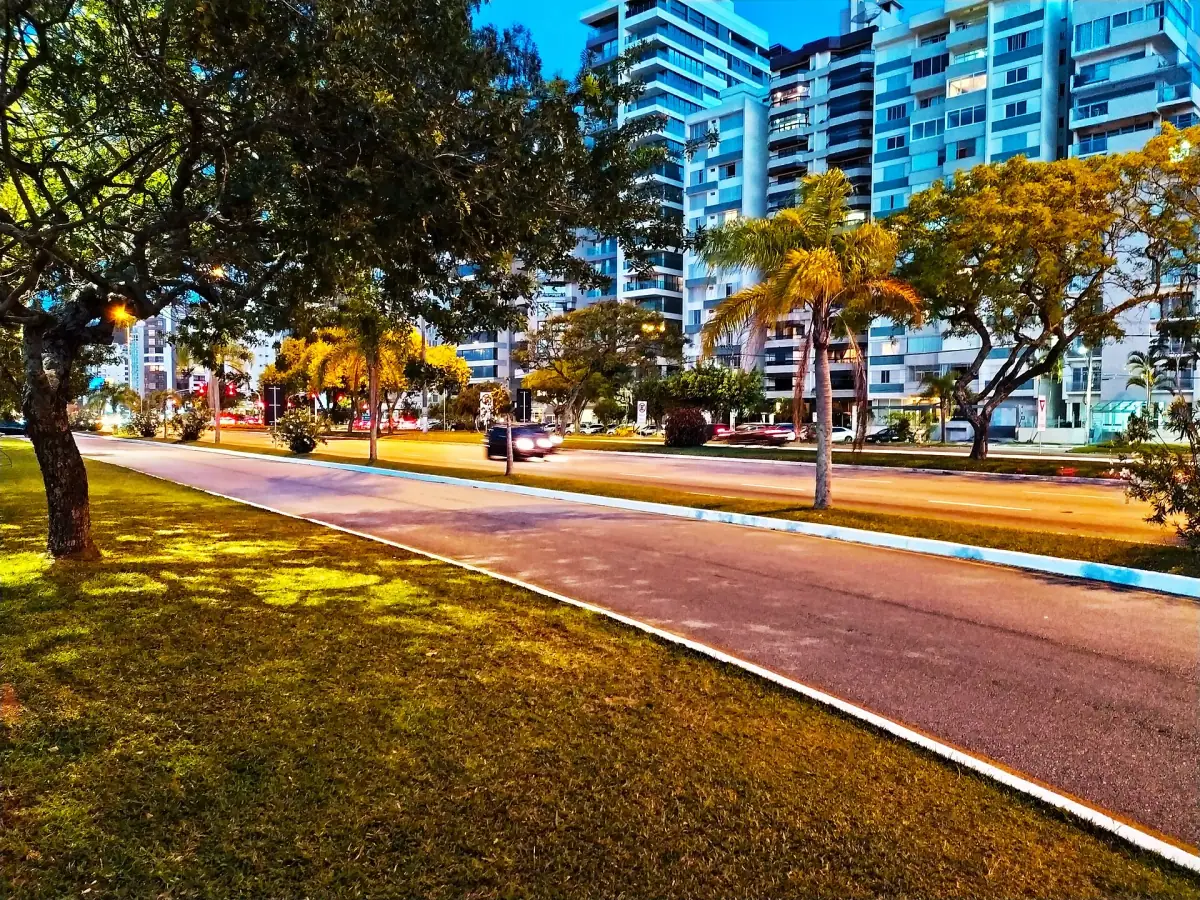
The center (Centro): practical for a night, rarely for a stay
The historic center brings together the Hercílio Luz Bridge, the cathedral, Praça XV de Novembro and the covered market. It is the area best served by the buses that radiate to the rest of the island, and the one where you find classic city hotels, often more geared to business clients than vacationers.
Its advantages: easy access to transport, a varied hotel offer and rates sometimes lower than on the beaches in high season. It suits a transit night, a tight budget or a heritage-focused stay.
Its limits are clear. The ocean beaches are thirty minutes or more away by car depending on traffic, and the bay is not really suited to swimming. Above all, the center is busy by day but empties in the evening and on weekends. Government travel advice recommends vigilance in Brazilian city centers after dark. If you sleep there, choose a hotel on a busy street, avoid walking alone in empty streets in the evening and go back by ride-hailing app or taxi.
Hotels and pousadas in Florianópolis
Compare accommodation in the center, Lagoa da Conceição and the beaches for your dates, with recent traveler reviews.
Lagoa da Conceição: the most versatile area
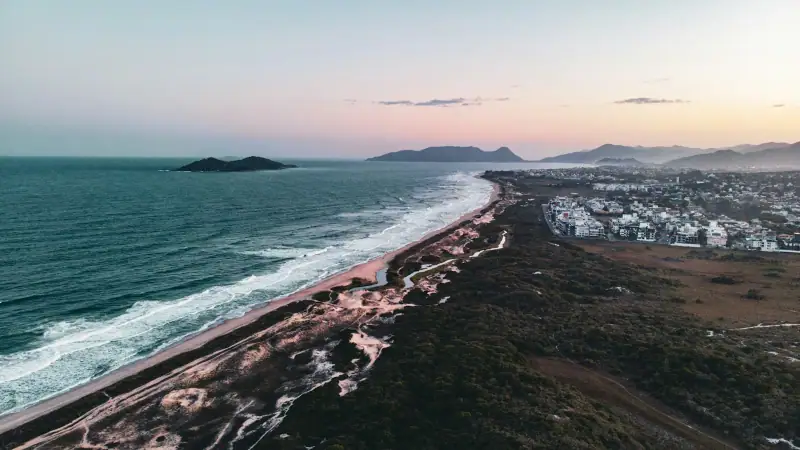
Surrounded by hills and dunes, Lagoa da Conceição is the heart of the island’s leisure life. It has many restaurants, bars, shops, watersports schools and viewpoints. The neighborhood attracts a young, international crowd, and the lodging offer is very wide: hostels, pousadas, small hotels and apartments.
It is the base that suits most first stays. You can walk to dinner, reach the east beaches (Joaquina, Mole, Barra da Lagoa) in a few dozen minutes by ride-hailing or car depending on traffic, and enjoy the atmosphere without depending entirely on a vehicle. Solo travelers easily meet other people there, notably in the hostels.
Two precautions. First, noise: in high season, nightlife runs late, and a room overlooking a bar can disturb your sleep. Ask for a room at the back or higher up. Second, traffic: access roads to the Lagoa are known to be congested in summer and at peak hours. Allow a margin for departures to the airport.
On the lagoon, some lodgings are at the water’s edge with a view, others on the heights with a panorama but a steeper walk. Check on the map the real distance to the lively center and the type of access road, which can be steep.
The east: Barra da Lagoa, Joaquina and Mole
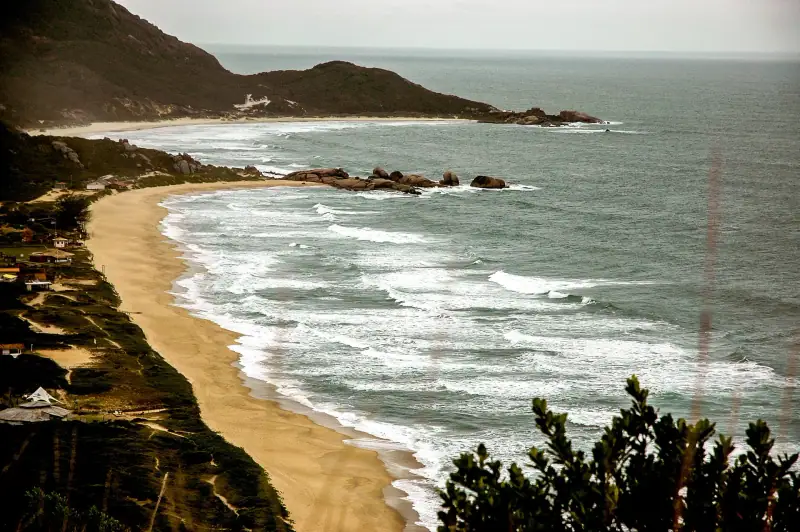
Barra da Lagoa, where the lagoon meets the ocean, has kept the look of a fishing village with its colorful houses and fish restaurants. It is a good compromise for those who want a village atmosphere while staying close to the beach and the departures of boat trips. Lodgings there are mostly pousadas and small apartments.
Joaquina and Praia Mole are the emblematic surfers’ beaches. They are famous for their waves, dunes and relaxed atmosphere, but have fewer lodgings right at the water’s edge. People often sleep at the Lagoa or at Barra da Lagoa and reach these beaches during the day.
For beaches exposed to the ocean, stay cautious: powerful waves and currents can surprise. Swim only in the marked zones, respect the flags and lifeguards’ instructions, and do not hesitate to ask your host about the day’s sea conditions. Leave valuables at your lodging: thefts on the beach exist.
The north: Jurerê, Canasvieiras and Ingleses
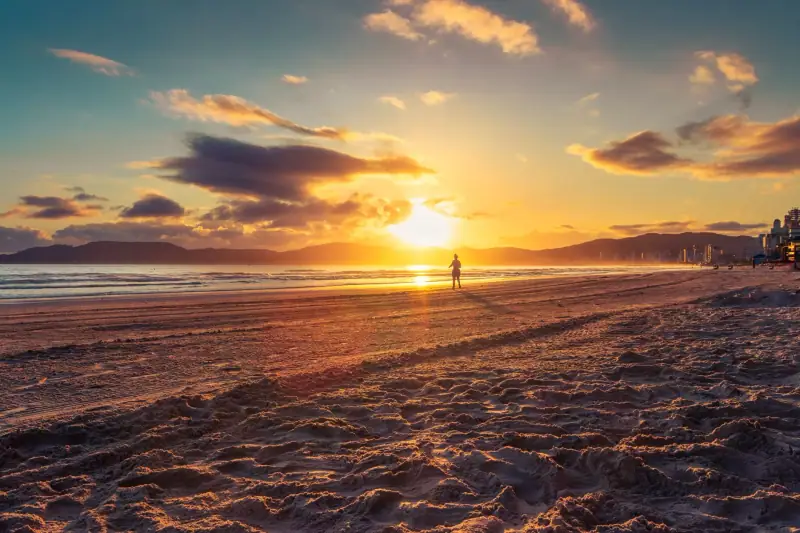
The north of the island is the most beach-oriented area and the busiest in summer. The beaches are wider, the sea generally calmer and services (supermarkets, restaurants, rentals) are very numerous. It is the area many families choose.
Jurerê Internacional is known for its beach clubs and chic atmosphere; lodgings there are more upscale and rates reflect it. Canasvieiras and Ingleses attract a more popular clientele, with many South American travelers, and offer more apartments, simple hotels and pousadas at more accessible rates.
The weak point of the north is saturation in January and February: very full beaches, traffic jams and expensive lodging. If you travel then, book long ahead. In the shoulder season, the area is much more pleasant. Note also that it is farther from the surf beaches and the dunes of the east, which lengthens trips if you want to see them.
With young children, favor lodging close to the beach, with a pool if possible, and check the real walking distance when booking, because some places advertised as “seafront” are separated from the beach by a road.
The south: Campeche, Armação, Pântano do Sul
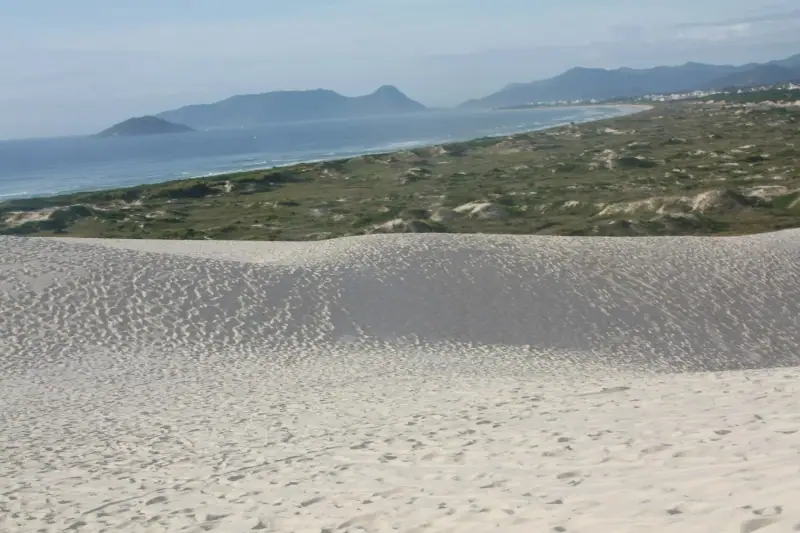
The south is the wildest face of Florianópolis. Campeche Beach is a long beach appreciated by surfers and walkers, facing the island of the same name. Farther south, Armação, Matadeiro and Pântano do Sul have kept a fishing-village atmosphere, with simple restaurants and boats pulled up on the sand.
Sleeping in the south means choosing calm, proximity to trails and less crowded beaches. The Campeche area is livelier, with more shops; Armação and Pântano do Sul are more rustic. It is also a good base for a boat trip to Campeche Island (Ilha do Campeche), whose access is managed to protect the site: book ahead in high season.
The trade-offs: a more limited restaurant offer in the evening, greater distances to the other areas, and a car that is almost essential to make the most of the region. Since the airport is in the south of the island, this base is practical for a late arrival or an early departure.
Rent a car in Florianópolis
To reach the southern beaches and trails from your lodging, compare rental companies.
Santo Antônio de Lisboa and the west coast: Azorean charm
In the 18th century, families from the Azores settled the island and left it a heritage still visible. Santo Antônio de Lisboa, on the west coast, and Ribeirão da Ilha, in the southwest, keep colonial houses with colorful facades, small churches and a peaceful atmosphere, with views over the bay.
There you find charming pousadas and guesthouses, ideal for a romantic or quiet stay. It is also the area where you taste oysters, a specialty of the island. On the other hand, these villages are not beach resorts: the bay water is calm but the beach atmosphere is limited, and the ocean beaches are several dozen minutes away by road. A car or ride-hailing is necessary.
This base suits a two- or three-night stay in addition to a livelier stop, for example after Lagoa da Conceição.
Which type of lodging to choose in Florianópolis
Pousadas. The most common formula on the island: a small guesthouse or boutique-size hotel, often with breakfast, a garden or a pool. Quality ranges from simple and welcoming to very refined; read recent reviews.
Hotels. More numerous in the center and in some beach areas of the north, they offer more services (restaurant, pool, parking, late reception).
Hostels. Very present at Lagoa da Conceição and near the surf beaches, they offer dorms and private rooms at reduced prices. They suit solo travelers and young people, with an easy social life.
Apartments and vacation rentals. Very common, notably in the north and the south, they suit families and stays of several days: equipped kitchen, more space, sometimes a shared pool. Check parking, distance to the beach, key-handover conditions and the security of the residence. Beware of listings that look too good to be true and use a platform that protects payment.
Campgrounds. There are campgrounds for self-reliant travelers, notably near some beaches. Find out about the security of the site and the weather before pitching a tent.
Budget. Prices vary strongly with the season, the area and the standard. They rise clearly from December to February and during Carnival. To build your overall budget, see the budget for a trip to Brazil and compare up-to-date offers rather than relying on a fixed rate.
Safety: good practices for sleeping in Florianópolis
Florianópolis is reputed to be calmer than the country’s big metropolises, but caution remains in order, as government travel advice notes for Brazil as a whole. Home break-ins and thefts from cars are reported, especially in high season. A few habits:
- choose lodging whose recent reviews mention neighborhood safety and the quality of locks, gates and windows;
- leave no object visible in a car and prefer a closed or supervised car park;
- keep your passport, money and valuable devices at the lodging when going to the beach, and take the bare minimum;
- use ride-hailing apps or licensed taxis to return in the evening rather than walking on poorly lit roads;
- ask your host which areas to avoid at night and which taxi company to call;
- in a rental, check that the French doors are closed and do not leave the house open when you are on the terrace or at the pool.
Details of general precautions are in the guide visa, health and safety in Brazil. Travel insurance with medical assistance and repatriation is strongly advised, especially if you plan surfing, boating or hiking.
How many nights, and how to split your stay
Three nights: a single base is enough. Choose Lagoa da Conceição for a first stay, or the north if you travel with children.
Four to five nights: the right format to see the essentials. You can stay on one base or combine two: for example two nights at the Lagoa for the activity and two nights in the south for calm and the outing to Campeche Island.
A week or more: add a charming stop on the west coast, at Santo Antônio de Lisboa, or a rental in the north for a relaxing stay. Changing base limits long daily trips.
For children and people with reduced mobility, check stairs, the slope of access roads and the distance to the beach. To combine the island with other stops in the South, see the two-week itinerary in Brazil. If you are also preparing Paraty, read where to stay in Paraty, and for the country’s biggest metropolis, where to stay in São Paulo.
One last tip: keep a margin on departure day. Traffic to the airport can be dense in summer and on weekends; do not schedule an international flight too tightly.
Check your carrier’s international plan or use a travel eSIM. Saily offers plans in more than 150 countries; check the offer for Brazil.
Stay connected in Brazil
An eSIM saves you from hunting for a SIM card on arrival. Saily offers plans in more than 150 countries: check the offer for Brazil.
A connection is valuable for ride-hailing apps, offline maps and checking sea conditions. The article on the SIM card and eSIM in Brazil compares the options.
Bottom line: which lodging for which traveler?
- First stay, atmosphere and nights out: Lagoa da Conceição, for versatility and life around you.
- Family with children: the north of the island, for the more sheltered beaches and services, booking early in high season.
- Surfers and nature lovers: Barra da Lagoa or the south, depending on whether you prefer the village or seclusion.
- Couple looking for charm: a pousada in Santo Antônio de Lisboa, or a quiet address in the south.
- Small budget: a hostel at the Lagoa or a simple apartment outside high season.
- A transit night: the center or the airport area, depending on your schedule.
Whatever you choose, book early for December, January, February and Carnival, check recent reviews and keep in mind that Florianópolis is best discovered with a well-chosen base and a quiet pace rather than rushing from beach to beach.
Frequently asked questions
What is the best area to stay in Florianópolis for a first visit?
Lagoa da Conceição is the most versatile choice: restaurants, bars, water sports and fairly quick access to the east beaches. Families will lean toward the north of the island, with more sheltered beaches, and those who like quiet toward the south.
Should you stay in the center of Florianópolis?
Rarely for a beach stay. The center is practical for business, connections and heritage sights, but it is far from the ocean beaches and empties in the evening. It mainly suits a transit night or a tight budget.
Do you need to rent a car to stay in Florianópolis?
It depends on your base. In a compact area such as Lagoa da Conceição or the north, you can get by with ride-hailing, taxis and buses. To explore several beaches, notably in the south, a car is more comfortable, but traffic is dense in summer and parking is hard near beaches.
When should you book lodging in Florianópolis?
Book long ahead for December, January, February and the Carnival period, because the island is then very busy and rates rise. Outside high season, a few weeks is generally enough. Favor free-cancellation offers when they exist.
Is Florianópolis safe to stay in?
It has a reputation as one of the calmest capitals in the country, but pickpocketing, thefts from cars and home break-ins exist, especially in high season. Check your government's travel advice before leaving, read recent reviews on neighborhood safety and check the locks.
How many nights should you plan in Florianópolis?
Four to five nights let you see the essentials of the island. With three nights, limit yourself to one or two areas, because journeys are long in summer. For a change of mood, you can split the stay between two bases, for example the Lagoa and the south.
Where to stay in Florianópolis with children?
The north of the island (Jurerê, Canasvieiras, Ingleses) is often preferred by families for its more sheltered beaches and many services. When booking, check the distance to the beach, whether there is a pool and, for ocean beaches, the swimming conditions.
More Brazil guides
Keep reading
Where to Stay in Fortaleza: Neighborhoods and Types of Lodging
Where to stay in Fortaleza? Meireles, Praia de Iracema, Mucuripe, Praia do Futuro, Aldeota: pros, limits, safety and lodging types to choose well.
Where to Stay in Recife: Neighborhoods and Types of Lodging
Where to stay in Recife? Boa Viagem, Pina, Recife Antigo, Olinda: pros, limits, safety and shark risk to choose your neighborhood and lodging.
Where to Stay in Manaus: Neighborhoods and Types of Lodging
Where to stay in Manaus? Historic center, Ponta Negra, Adrianópolis, Vieiralves or a forest lodge: pros, limits and safety tips to choose well.
Ready-made
Brazil itineraries
15 days
2-Week Brazil Itinerary: Rio, Paraty, Iguaçu and Salvador
Rio de JaneiroParatyFoz do IguaçuSalvador de Bahia