What to see
Visiting Oban: A Complete Guide to the Gateway to the Isles
We may earn a commission when you book through links on this page, at no extra cost to you. We don't visit or try the places we cover: we summarize published sources. How we work
In short
- One day covers the town center, McCaig's Tower and the distillery; allow 2 to 3 days to add a ferry trip to Mull and Iona or the Argyll area.
- From Glasgow, the West Highland Line takes about 3 hours; by car, about 2 hr 30 min via the A82 and A85.
- Iona in a day is possible but long: CalMac ferry to Mull, about 1 hour across Mull, then the 10-minute ferry from Fionnphort.
- Book the distillery tour and, with a vehicle, the CalMac ferries ahead of time, especially in summer.
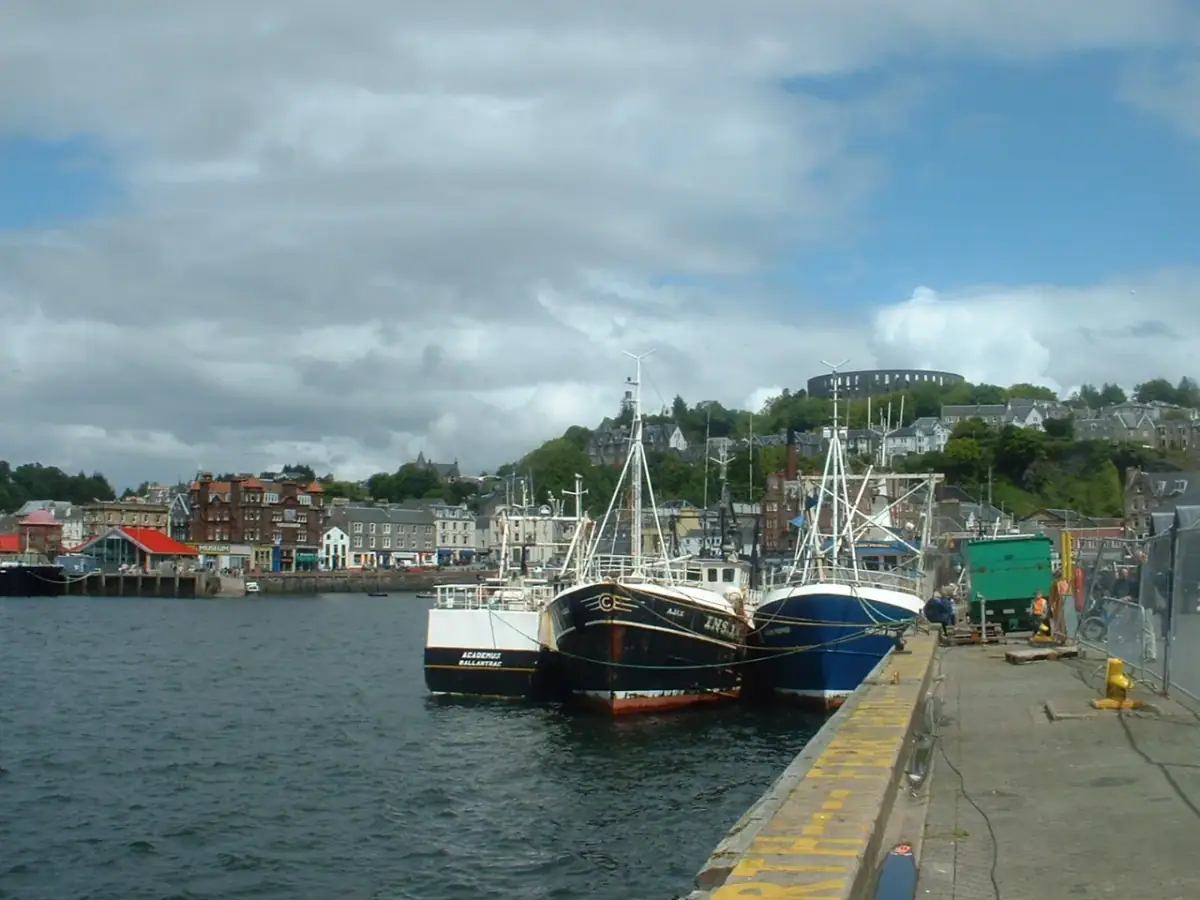
Oban is a small coastal town of about 8,500 people tucked into a sheltered bay on Scotland’s west coast, in the Argyll and Bute region. Nicknamed the “Gateway to the Isles,” it is the main departure port for ferries to the Inner and Outer Hebrides: Mull, Iona, Colonsay, Coll, Tiree, Barra, South Uist and more. But Oban is more than a simple jetty. The town has real personality, with its busy harbor of trawlers and ferries, its historic distillery tucked among the lanes, the romantic ruin of McCaig’s Tower on the hill and a food scene built on exceptionally fresh seafood. It is one of the most endearing stops on a trip to Scotland, whether you spend one night or a whole week.
Getting your bearings in Oban
Oban is a compact town that is easy to cover on foot. The center is organized around the waterfront, the George Street promenade, and a few parallel streets climbing the hill. The harbor fills Oban Bay, sheltered by the island of Kerrera to the west, which gives it a protected, almost Mediterranean feel in its geography, even if the Scottish climate is anything but Mediterranean.
The waterfront: This is the beating heart of the town. CalMac ferries leave from the harbor terminal, seafood restaurants line the street, and the bay buzzes with fishing boats, sailboats and cruise ships. The train station (the end of the West Highland Line from Glasgow) and the tourist office are here too.
The hill and McCaig’s Tower: Climbing up from the center, you quickly reach the heights above the bay. McCaig’s Tower is visible from almost everywhere in town and is Oban’s most immediate landmark.
The surroundings: Within an hour’s drive, Oban gives access to varied landscapes: the islands to the west by ferry, the lochs and forests of Argyll to the south and east, the Highlands to the north toward Fort William. This geographic versatility makes it an ideal base for exploring western Scotland.
McCaig’s Tower: the Scottish Colosseum
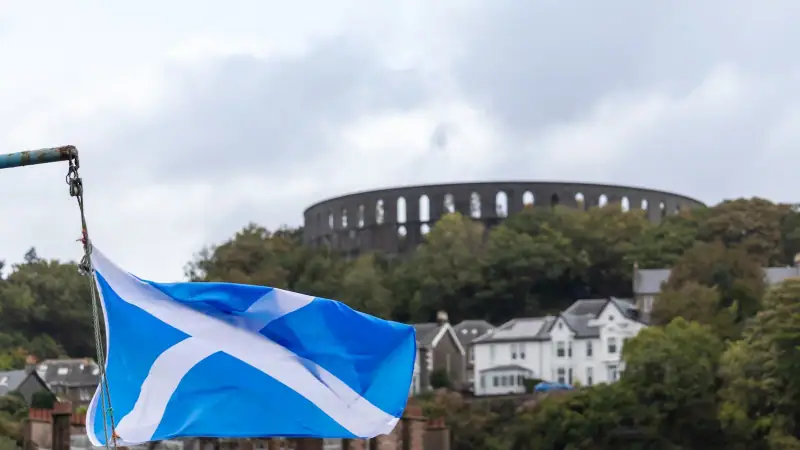
This is Oban’s most recognizable image: a round granite tower that looks like a Roman Colosseum, perched on Battery Hill above the whole bay. McCaig’s Tower was built starting in 1895 under the direction of John Stuart McCaig, a wealthy local banker and philanthropist. His aim was twofold: to give work to local stonemasons during the winter months and to create a family monument meant to hold statues of his relatives. The project was never finished (McCaig died on June 29, 1902, before the interior was fitted out), but the outer wall was completed and today offers one of the most striking views in Scotland.
The inside of the tower is now a flower-filled public garden, open to everyone year round and free. The climb from the town center takes about 10 to 15 minutes on foot along a well-marked pedestrian path. The view from the ramparts is outstanding: Oban Bay with its islands, the green hills of Kerrera in the foreground, the mountains of Mull on the horizon in clear weather, and the CalMac ferries maneuvering slowly in the harbor below.
The tower is especially beautiful at sunset, when golden light tints the granite and the bay fills with reflections. It is a meeting place for photographers and couples, and one of the spots where you immediately understand why Oban is so loved by its residents.
Hotels in Oban
Characterful B&B with bay views, waterfront hotels or quiet guesthouses: find your ideal lodging in Oban.
The Oban distillery: whisky in the heart of town
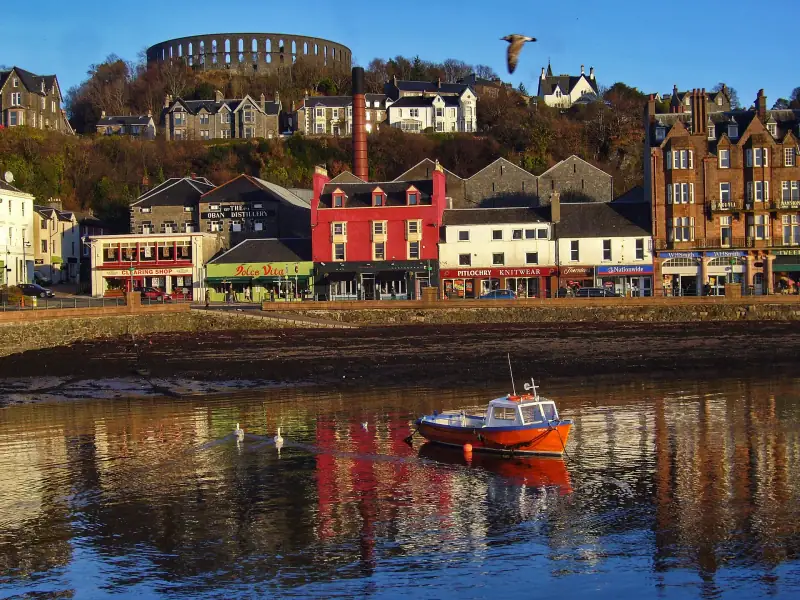
The Oban distillery is a curiosity in itself: founded in 1794, it is one of the oldest in Scotland, and its setting is absolutely unique. It sits literally in the town center, squeezed between a rock cliff and the shopping streets. You can almost touch it from the sidewalk. This urban location, very rare among malt distilleries, gives it an especially intimate atmosphere.
The distillery produces a West Highland-style single malt, lightly peated, with characteristic marine and fruity notes. Its flagship, the 14-year-old, is recognized as one of the most representative whiskies of Scotland’s west coast. Rarer expressions are available only at the distillery.
Guided distillery tours run all year, with different options including a simple or in-depth tasting. Booking ahead is strongly advised, particularly in summer, because slots are limited by the size of the premises. Check current hours and prices directly on the distillery’s website before your visit. To learn more about Scotch whisky culture, see our guide to whisky in Scotland.
The harbor and ferries to the Hebrides
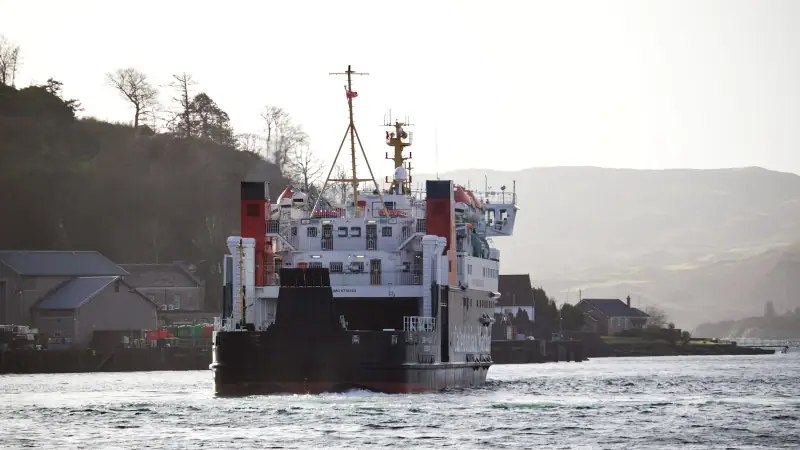
Oban’s harbor is one of the busiest on Scotland’s west coast. CalMac (Caledonian MacBrayne) ferries serve about a dozen islands from the terminal, making Oban the essential hub for exploring the Inner and Outer Hebrides.
The main routes from Oban:
- Mull (Craignure): The most frequent crossing from Oban, about 45 to 60 minutes depending on the ship. It is the gateway to the largest of the Inner Hebrides, with its wild landscapes, Duart Castle and access to Iona.
- Staffa: For Fingal’s Cave, see our guide to the excursion to Staffa from Oban or Mull (season, prices, booking).
- Iona: Reached from Fionnphort (west coast of Mull), the sacred island of Iona is the cradle of Christianity in Scotland. It has a remarkable medieval abbey and a unique atmosphere of reflection. The crossing from Fionnphort takes about 10 minutes (CalMac service).
- Lismore: A small, fertile island just a 50-minute crossing from Oban, much less visited than Mull and ideal for a quiet day of walking.
- Colonsay, Coll, Tiree: Less frequent services to these more remote islands, for travelers looking for an island Scotland truly away from the crowds.
- Barra and South Uist (Outer Hebrides): Long crossings (about 4 hr 45 min to 5 hours for direct services, longer for combined routes) that reach the islands farthest from the coast.
Ferry schedules and frequencies vary by season. In summer (June to August) there are more departures, and booking ahead is strongly advised, especially if you travel with a vehicle. The CalMac website lets you check schedules in real time and make reservations.
Tours from Oban
Guided trips to Mull, Iona, Argyll's castles and prehistoric sites: explore the region without worrying about logistics.
Dunollie Castle: the ruins above the bay
About a 15-minute walk north of central Oban, along the coastal path, the ruins of Dunollie Castle stand on a rocky promontory with an open view over the bay. This 15th-century medieval tower house is the most visible remnant of a much older fortification. The site has been occupied since at least the 8th century, first as part of the kingdom of Dál Riata, before the MacDougalls, lords of Lorn, took possession from the 12th century.
Only part of the castle itself is accessible, but the path leading to it is pleasant and offers fine views of Oban Bay, the island of Kerrera and the mountains of Mull on the horizon. Nearby is Dunollie House, the historic home of the MacDougall clan, which now holds a museum on the history of the clan and the region (Dunollie Museum, Castle and Grounds, paid admission). The site is open in season, from mid-March to roughly the end of October, Tuesday to Sunday: check the hours on the Dunollie website before you go.
If you are interested in Scottish castles, our guide to Scotland’s castles lists the essential fortresses across the country.
Food in Oban: the seafood capital
Oban is known throughout Scotland for the quality of its seafood. Its direct proximity to the cold, deep waters of the Firth of Lorn guarantees impeccable freshness for the langoustines, crab, oysters, scallops and prawns that come straight from local fishing boats.
The harbor seafood hut: Oban’s most emblematic address is a simple street counter on the quay selling fresh seafood to take away (langoustines, prawns, oysters, whelks) served with buttered bread. The place is known across Scotland and draws foodies as much as tourists. Arrive early, because the stock sells out quickly in season.
Waterfront restaurants: George Street and the adjoining streets hold several restaurants specializing in seafood in every form: traditional fish and chips, creamy chowder, tasting plates or fine-dining menus. Prices reflect the quality of the produce, but the value is generally excellent.
Local whisky: With the Oban distillery in town, the local single malt is of course a must. Bars in the center often offer selections of regional whiskies, letting you compare Argyll styles with those of the Highlands or the Isle of Mull.
Kerrera and the nearby islands: nature within rowing distance
The island of Kerrera is visible from Oban’s waterfront, so close it seems almost within reach. That is an illusion: you have to take the small ferry from Gallanach, south of Oban, to reach this island of about 13 km² (5 sq mi) where only a few dozen people live year-round. The crossing itself takes only a few minutes.
On Kerrera, a trail circles the island in 4 to 5 hours, with fine views of Oban, Mull and the Argyll hills. The ruins of Gylen Castle (16th century), at the southern tip of the island, are the main point of interest. The island is ideal for a half day of quiet walking, far from any crowds, in almost untouched nature.
For those with more time, the island of Seil, reached by a bridge from the mainland about 15 km (9 mi) south of Oban, opens onto the Slate Islands archipelago and Easdale, one of the smallest inhabited islands of the Inner Hebrides. Abandoned slate quarries, coves and fishermen’s houses make a picture of singular beauty.
Kilchurn Castle and Loch Awe: the castle on the loch
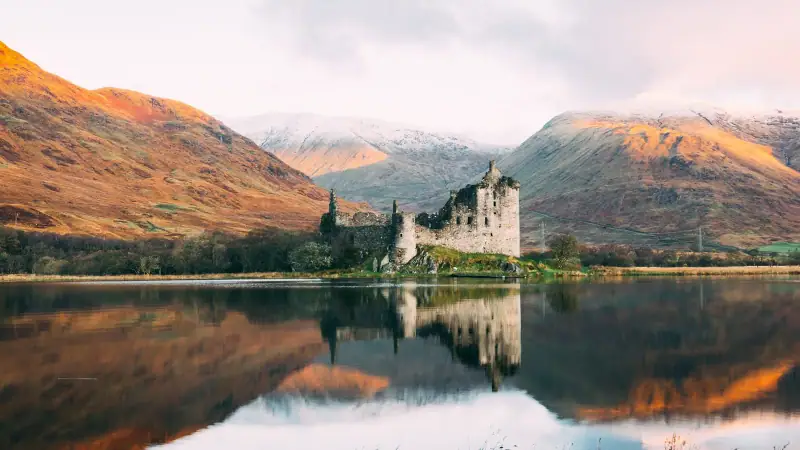
About 34 to 37 km (21 to 23 mi) east of Oban by road (roughly 35 to 45 minutes by car via the A85, stopping about 4 km / 2.5 mi west of the village of Dalmally), the ruins of Kilchurn Castle on Loch Awe make one of the most photographed images in Scotland. This 15th-century castle, built by the Campbell clan, stands on a rocky peninsula at the north end of Loch Awe, the longest freshwater loch in Scotland (about 41 km / 25 mi long).
The combination of the ruined castle, the huge loch and the Highland mountains behind it makes an outstanding view, especially early in the morning when a light mist hangs over the water. The castle is managed by Historic Environment Scotland. The interior of the ruins is currently closed for conservation work: you can walk around it and photograph it from the outside. Check access conditions on the Historic Environment Scotland website before your visit.
On the way from Oban you pass through the village of Dalmally and run along the north shore of Loch Awe, with constant views of the loch and the surrounding forests. It makes a day trip that combines easily with a visit to Inveraray (the Campbells’ castle, about 60 km / 37 mi south of Oban, via the south shore of Loch Awe).
Car rental in Oban
Essential for Kilchurn Castle, the Argyll coast and getting to the island ferries: compare offers from Oban or Glasgow.
How to get to Oban
By train from Glasgow: The West Highland Line is one of the most spectacular in Europe. It links Glasgow Queen Street to Oban in about 3 hours, through landscapes of lochs, moorland and wooded hills. The ride is an attraction in itself: the section between Crianlarich and Oban, with Loch Awe and the Cruachan viaduct, is especially striking. Regular departures run throughout the day from Glasgow.
By car from Glasgow: The most direct route takes the A82 north (Dumbarton, Loch Lomond, Crianlarich) and then the A85 to Oban. Allow about 2 hr 30 min from central Glasgow, depending on traffic. A longer but very scenic variation goes through Glencoe and Fort William before heading back down to Oban on the A828, adding about 30 to 40 minutes.
From Edinburgh: From Edinburgh, most people drive to Oban via Stirling and Crianlarich (about 2 hr 45 min to 3 hours). You can also take the train from Edinburgh to Glasgow Queen Street, then connect to the West Highland Line for Oban.
From the Highlands: From Fort William, Oban is about 71 km (44 mi) south via the A82 and then the A828, roughly 1 hour to 1 hr 10 min by road. It is a natural stop on a road trip in Scotland between Edinburgh, the Highlands and the west coast.
A sample plan for visiting Oban
Day 1: The town center and the bay
- Morning: walk along the waterfront, fish market or the harbor seafood counter
- Mid-morning: visit the Oban distillery (booking recommended)
- Lunch: seafood restaurant on the waterfront
- Afternoon: climb to McCaig’s Tower, walk to the ruins of Dunollie Castle
- Evening: sunset from McCaig’s Tower, dinner in the center
Day 2: Excursion to Mull and Iona
- Very early morning: CalMac ferry from Oban to Craignure, Isle of Mull (about 45 to 60 min depending on the ship)
- Morning: cross Mull by car or bus to Fionnphort (about 1 hour)
- Late morning / lunch: crossing to Iona (about 10 min), visit Iona Abbey
- Afternoon: back to Fionnphort, then Craignure and the return ferry to Oban
- Evening: back in Oban
Day 3 (optional): Kilchurn Castle and Loch Awe
- Morning: drive to Loch Awe, visit Kilchurn Castle as the mist lifts
- Lunch: village of Dalmally or a picnic by the loch
- Afternoon: drive to Inveraray to visit the Campbell clan’s Gothic Revival castle (about 60 km / 37 mi from Oban), then return along the coast to Oban
For a wider itinerary that fits Oban into a full tour of Scotland, see our guide to the Isle of Skye, reachable in about 3 hr 30 min to 4 hours from Oban via Fort William, and our article on the Highlands in 7 days.
Oban in practice
Lodging: Oban has a wide choice for a town its size, from family B&Bs to upscale hotels with bay views. In high season (July and August), lodging fills up quickly, so book several weeks ahead, especially if you arrive on a weekend or during a festival.
Getting around town: Central Oban is fully walkable. For excursions outside town (Kilchurn, Kerrera, Seil), a car is recommended, although local transport exists for some destinations.
Weather: As everywhere in Scotland, the weather in Oban is changeable and unpredictable. Rain jackets and water-resistant shoes are essential in any season. In return, the shifting light, the rainbows over the bay and the dramatic clouds above the islands are part of the particular beauty of the west coast.
Ferries: Always book ahead on the CalMac website if you are traveling with a vehicle, especially in summer. Foot passengers can generally board more easily, but it is best to check availability for the longer crossings.
Frequently asked questions
How many days do you need to visit Oban?
One day is enough to see the town center, McCaig's Tower and the distillery. Allow 2 to 3 days if you want to include a ferry trip to the Isle of Mull and Iona, or explore the surrounding area (Kilchurn Castle, the Argyll coast).
How do you get to Oban from Glasgow?
By train, the West Highland Line links Glasgow Queen Street to Oban in about 3 hours, with spectacular views of lochs and moorland. By car from Glasgow, allow about 2 hr 30 min via the A82 and then the A85, depending on traffic.
Can you visit Iona from Oban in a day?
Yes, it is doable but intense. Take the CalMac ferry from Oban to Craignure on the Isle of Mull (about 45 to 60 min depending on the ship), cross Mull by bus or car (about 1 hour), then take the short ferry from Fionnphort to Iona (10 min per CalMac). Plan a full day, roughly 7 am to 8 pm.
Is the Oban distillery worth a visit?
Absolutely. The Oban distillery is one of the smallest and oldest in Scotland (founded in 1794), and its location in the middle of town is unique. Guided tours run all year, but booking ahead is recommended, especially in high season.
When is the best time to visit Oban?
From May to September the days are long and the ferries run at full capacity. July and August are high season: expect more people, especially at the harbor. May, June and September are a good compromise between pleasant weather and moderate crowds. In winter, Oban is quiet but some ferry services are reduced.
Is Oban a good base for exploring the region?
Yes, it is an excellent base. Oban sits at the crossroads of the routes to the southern Highlands, the Kintyre peninsula and the western islands. With a car, you can reach Fort William in under an hour, Inveraray in 45 minutes and the Isle of Skye in about 3 hr 30 min to 4 hours via Glencoe and Fort William.
More Scotland guides
Keep reading
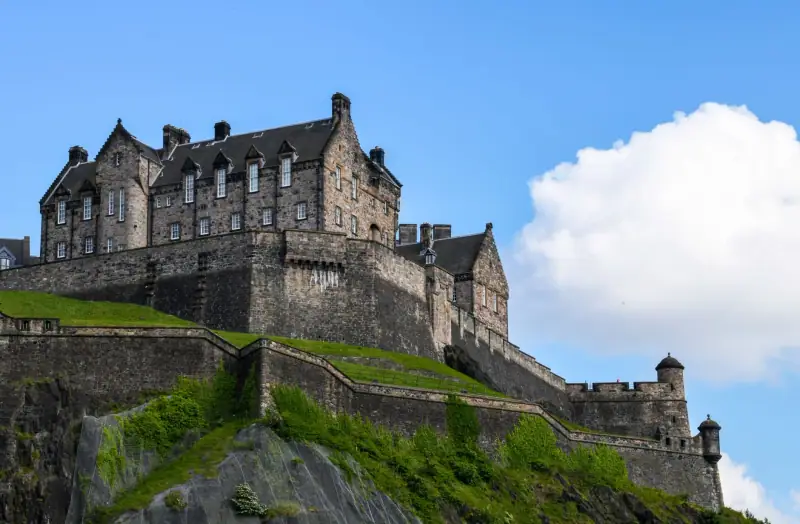
Edinburgh top sights: what to see and do in the capital
Edinburgh's top sights: the castle, Royal Mile, Arthur's Seat, free museums, Old Town and New Town. A complete guide so you miss nothing.
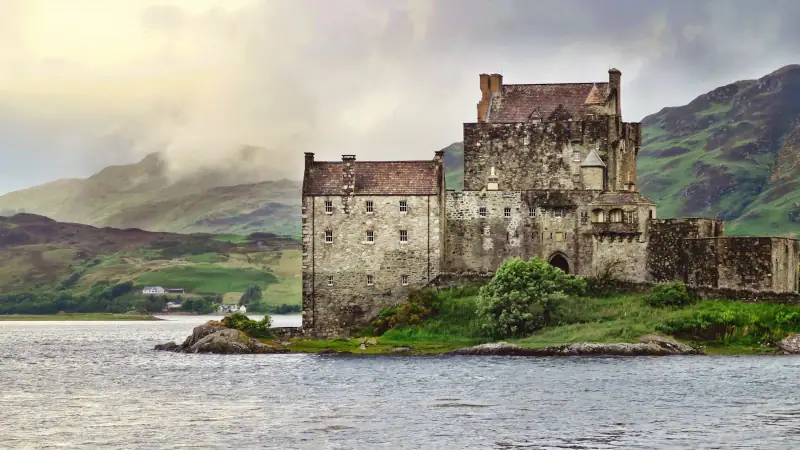
Visiting Fort William: a complete guide to Scotland's outdoor capital
What to see and do in Fort William: Ben Nevis, Jacobite Steam Train, Glenfinnan, Glencoe. A complete guide to plan your Highlands trip.
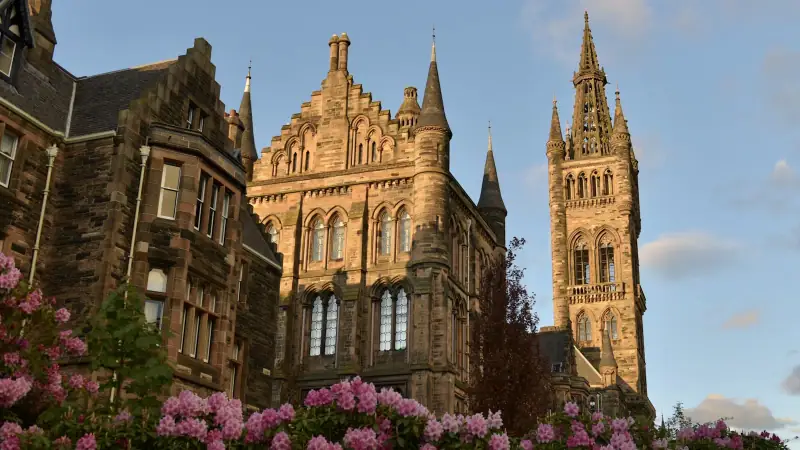
Visiting Glasgow: a complete guide to Scotland's largest city
What to see and do in Glasgow: Kelvingrove, Mackintosh, Merchant City, West End, free museums. A complete guide to plan your Glasgow trip.
Ready-made
Scotland itineraries

7 days
Scotland in 7 days: the perfect one-week itinerary
EdinburghFort WilliamInvernessPortree
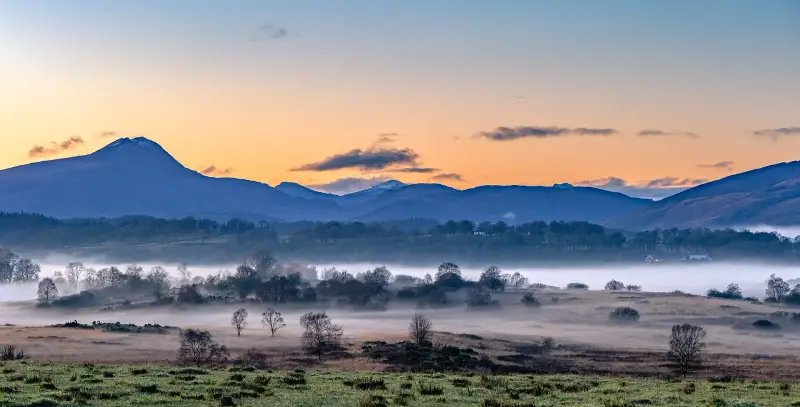
14 days
Scotland road trip: the complete 2-week guide
Plan a 14-day Scotland road trip: full itinerary from the Lowlands to the far north, with logistics, places to stay and sights.
6 days
Scotland road trip in October: 6-day itinerary, roads and daylight hours
PitlochryInvernessPortreeFort William