What to see
Visiting Glasgow: a complete guide to Scotland's largest city
We may earn a commission when you book through links on this page, at no extra cost to you. We don't visit or try the places we cover: we summarize published sources. How we work
In short
- Two days cover the essentials (Kelvingrove, Merchant City, West End, cathedral); three days let you add the Burrell Collection or a countryside outing.
- Kelvingrove, Riverside Museum, the Burrell Collection, GoMA and Glasgow Cathedral are all free.
- Glasgow is 50 minutes from Edinburgh by train, with trains every 15-30 minutes (about £15 one way in advance).
- The Subway loops through 15 stations; a day ticket costs about £4.50.
Glasgow is Scotland’s largest city and one of the most dynamic metropolises in the UK. Long overshadowed by the elegance of Edinburgh, it has undergone a spectacular cultural renaissance since the 1990s. Today the city draws visitors with its world-class free museums, its Victorian and Art Nouveau architecture by Charles Rennie Mackintosh, its trendy neighborhoods and one of the liveliest music and arts scenes in the country. This complete guide helps you plan your visit to Glasgow.
Getting your bearings in Glasgow
Glasgow spreads along both banks of the Clyde, but most tourism is concentrated on the north bank, in a few well-defined neighborhoods:
City Centre: The shopping and administrative heart, around George Square and the main streets Buchanan Street, Sauchiehall Street and Argyle Street. This is where most hotels and transport connections are.
Merchant City: East of the center, this district of former merchants’ warehouses converted into apartments, restaurants and art galleries is the heart of Glasgow’s trendy life. Cobbled streets, Georgian facades and lively terraces on weekends.
West End: Around the University of Glasgow and Byres Road, this is the bohemian, residential district. It is home to the Kelvingrove Art Gallery, the city’s biggest museum, as well as Hillhead and many independent cafés.
East End: Less touristy but authentically Glaswegian, with Glasgow Green (the oldest public park in Britain) and the city’s working-class pride.
To get from one neighborhood to another, the Subway (nicknamed the “Clockwork Orange” for the orange color of its trains) loops through 15 stations. A day ticket costs about £4.50.
Kelvingrove Art Gallery and Museum: Glasgow’s free treasure
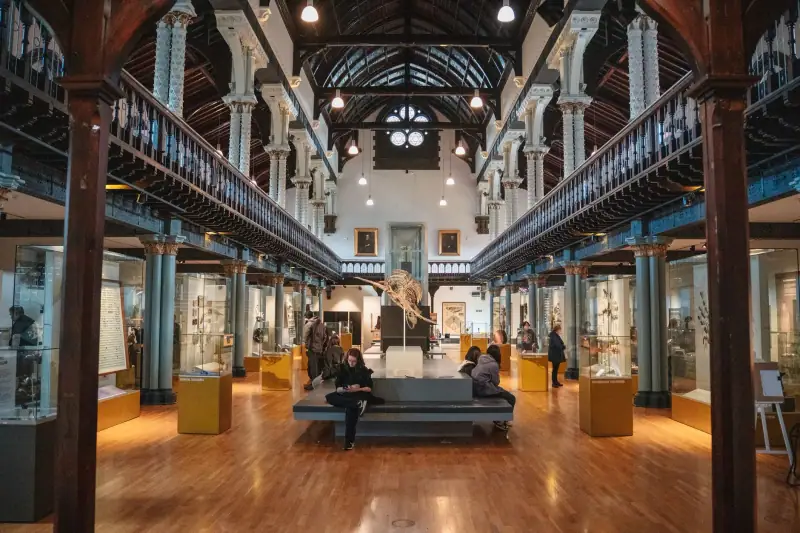
Kelvingrove Art Gallery and Museum is Glasgow’s top must-see. Housed in a red Spanish Baroque building from 1901 in the heart of Kelvingrove Park, it welcomes more than a million visitors a year and is completely free.
The collection is staggering in its variety: Flemish, Impressionist and modern paintings sit alongside medieval armor, a diplodocus skeleton, a Spitfire fighter plane hanging in the main hall, and ancient Egyptian artifacts. The section devoted to Charles Rennie Mackintosh is especially beautiful.
Highlights:
- Christ of Saint John of the Cross by Salvador Dalí, one of the most famous paintings in Scotland
- The “Scottish Identity in Art” section, to understand the country’s culture and history
- The grand central hall, spectacular at sunrise
- The pipe organ, which plays several times a week at lunchtime
Tip: Allow at least 2 to 3 hours. The museum café overlooking the gardens is a pleasant place for a break.
Hotels in Glasgow
West End, City Centre or Merchant City: find your ideal base.
Charles Rennie Mackintosh: the architectural soul of Glasgow
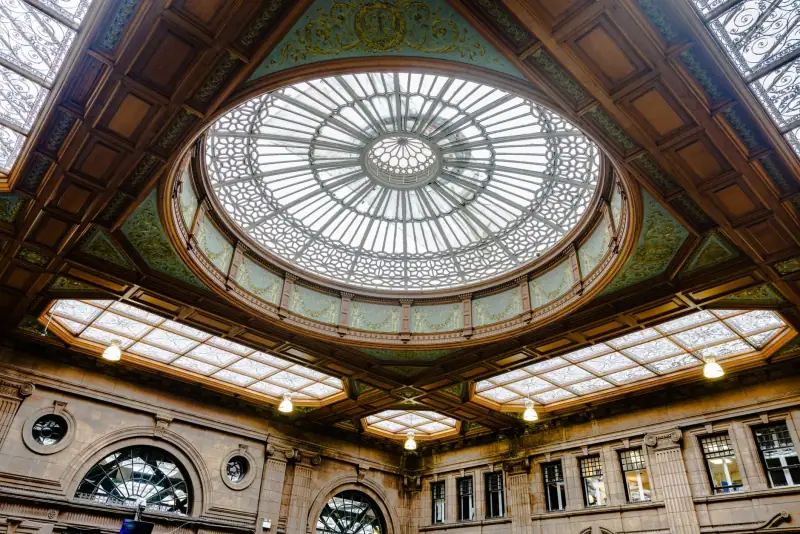
Charles Rennie Mackintosh (1868-1928) is Scotland’s most famous architect and designer, and Glasgow owes much of its visual identity to him. His unique style blends Art Nouveau, Japonisme and a very personal geometry.
Glasgow School of Art: His masterpiece, sadly ravaged by two fires in 2014 and 2018, is being restored. The exterior facades can be seen from Renfrew Street.
The Mackintosh House (Hunterian Museum): The faithful reconstruction of the interior of Mackintosh’s home, built into the University of Glasgow museum, is one of the best ways to understand his genius. Paid admission (about £10 full price), while the rest of the museum is free.
Willow Tea Rooms: The tea rooms redesigned by Mackintosh in 1903 for owner Kate Cranston are at 217 Sauchiehall Street (reopened in 2018 as “Mackintosh at the Willow,” renamed “The Mackintosh Tearooms” in early 2026, in a building owned by the National Trust for Scotland). The name “Willow” comes from the Gaelic word behind “Sauchiehall” (avenue of willows). Reservations are recommended for high tea.
House for an Art Lover (Bellahouston Park): This house designed by Mackintosh in 1901 (but never built in his lifetime) was erected in the 1990s from his original plans. It is about 5 km (3 mi) southwest of the center.
Glasgow Cathedral and the Necropolis: a thousand years of history
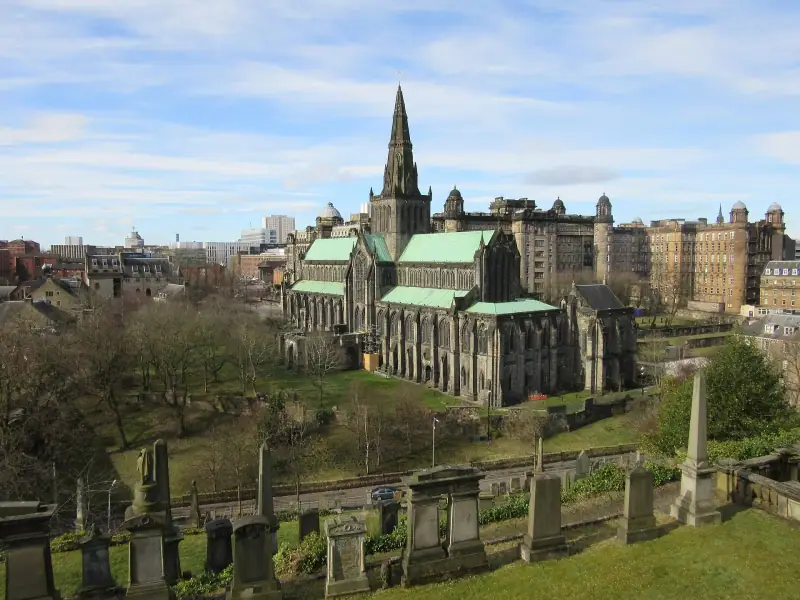
Glasgow Cathedral is one of the few medieval cathedrals in Scotland to have survived the 16th-century Protestant Reformation essentially intact. Founded in the 12th century on the site of the tomb of St Mungo (the patron saint of Glasgow), it is considered one of the finest Gothic cathedrals in the UK.
Don’t miss:
- The crypt (13th century), where St Mungo’s tomb lies
- The contemporary stained glass in the side chapels
- The gray sandstone exterior, austere and majestic
Just behind the cathedral, the Glasgow Necropolis is a Victorian cemetery laid out on a hill, with panoramic views of the cathedral and the city’s rooftops. Opened in 1833 on the model of Paris’s Père-Lachaise, it has about 3,500 monuments for some 50,000 people buried there. A fascinating and free walk among obelisks, cherubs and mausoleums.
A short walk away, the St Mungo’s Museum of Religious Life and Art (free admission) presents sacred works from all the world’s religions (Buddhism, Islam, Christianity, Hinduism) in a comparative setting unique in Europe.
Guided tours in Glasgow
Architecture, whisky, street art, history: passionate local guides.
Merchant City: Glasgow’s trendy heart
Merchant City is Glasgow’s liveliest district for restaurants, bars and nightlife. In the 18th and 19th centuries this area held the warehouses and homes of the tobacco and sugar merchants who had made their fortunes from the American colonies, and it has been transformed since the 1980s.
What to do in Merchant City:
- Stroll along Ingram Street, Wilson Street and Candleriggs
- Visit the Gallery of Modern Art (GoMA), a contemporary art collection in an imposing neoclassical building from 1778, with the famous statue of Wellington topped by a traffic cone (an irreverent popular symbol)
- Have dinner at one of the many Italian, Indian or international restaurants
- Have a drink in one of the district’s historic bars
GoMA: Free admission, open all week. The statue of the Duke of Wellington with its orange cone is one of Glasgow’s most shared photos; the city gave up regularly removing the cone after residents protested.
Kelvingrove Park and the West End
The West End is Glasgow’s residential and university district, around Byres Road and the University of Glasgow campus. This is where Glaswegians come on weekends to have brunch, cycle in the park or have a coffee at the many independent spots.
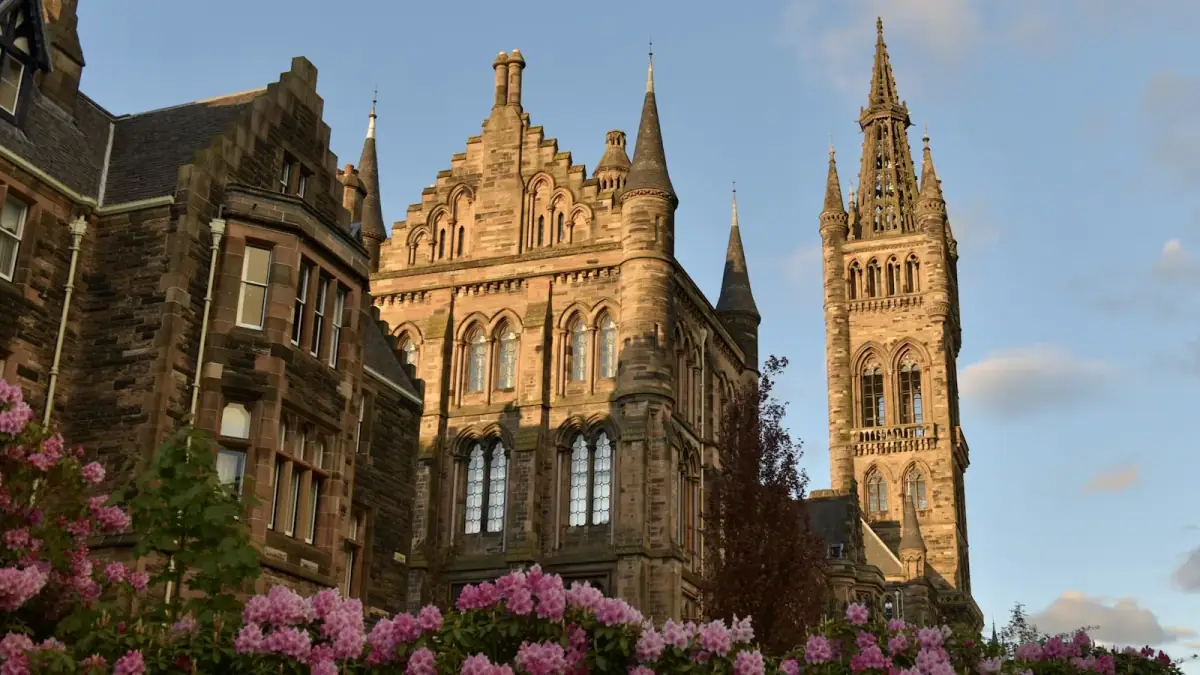
University of Glasgow: Founded in 1451, it is the fourth oldest in the English-speaking world. The campus, with its gray sandstone neo-Gothic towers, looks like a scene from a fantasy film. Visiting is open and free; the main quadrangle is especially photogenic.
Kelvingrove Park: The large public park on the River Kelvin is ideal for a break. In summer Glaswegians picnic, play tennis and gather around its Victorian fountains. The park is also the starting point for walking to the Riverside Museum.
Botanic Gardens: Just north of Byres Road, these free botanic gardens hold wrought-iron Victorian glasshouses (the Kibble Palace), themed gardens and plant species from around the world.
Riverside Museum: the finest transport collection in the world
The Riverside Museum, opened in 2011 in a building designed by star architect Zaha Hadid on the banks of the Clyde, is one of the most remarkable transport museums in Europe. Completely free, it displays Glasgow’s municipal transport history collection.
Highlights:
- A collection of 3,000 objects including steam locomotives, vintage cars, motorcycles, trams and subway cars
- An outdoor quay with the Tall Ship Glenlee (1896), the only large steel-hulled sailing ship built on the Clyde still afloat in the UK
- Reconstructions of Glasgow shopping streets from the early 20th century
- The section on the Clyde shipyards, which built more than half the world’s fleet in the 19th century
The building itself is a work of art: its zinc facade with sharp angles reflects the waters of the Clyde.
The Burrell Collection: an exceptional personal treasure
About 5 km (3 mi) south of the center, in Pollok Country Park, the Burrell Collection is one of the most original museums in Britain. Completely free and fully renovated in 2022, it houses the personal art collection gathered by shipowner William Burrell (1861-1958), who donated it to the city of Glasgow.
The result is an eclectic collection of about 9,000 objects: medieval tapestries, Chinese and Islamic ceramics, ancient Egyptian sculptures, armor, medieval stained glass, Impressionist paintings (Degas, Cézanne), porcelain, Persian rugs… The variety is dizzying.
Practical tip: Take the bus to the Burrell (route 57 from the center), then walk through Pollok Country Park. The park is also home to Pollok House, an 18th-century manor with a fine collection of Spanish paintings (El Greco, Goya), open for a modest fee.
Glasgow’s music scene and pubs
Glasgow is Scotland’s music capital, and one of the most important cities in the UK for concerts. Glaswegians are legendary for their warm welcome in pubs.
Legendary venues:
- King Tut’s Wah Wah Hut (St Vincent Street): a legendary small venue where Oasis was discovered in 1993
- The OVO Hydro: the 14,300-seat arena on the Clyde, one of the busiest in Europe
- Barrowland Ballroom: a historic 1930s hall with its famous wooden dance floor, a Glasgow institution
Pub districts:
- Merchant City for designer bars and cocktails
- West End (Byres Road) for friendly neighborhood pubs
- East End (Duke Street) for the most authentically Glaswegian atmosphere
Tip: Ask for a pint of 70 Shilling (abbreviated “70/-”), Scotland’s traditional amber ale, in any pub. You won’t pay more than £4-5 and you will almost always strike up a conversation with your neighbors at the bar.
Sample 2-day plan in Glasgow
Day 1: Museums and architecture
- Morning: Kelvingrove Art Gallery (2-3 hours)
- Lunch: café in the West End, around Byres Road
- Afternoon: University of Glasgow, Botanic Gardens, walk through Kelvingrove Park
- Evening: dinner in Merchant City, drink at the GoMA Bar
Day 2: History and living culture
- Morning: Glasgow Cathedral, Necropolis, St Mungo’s Museum
- Lunch: Merchant City (international cuisine)
- Afternoon: Riverside Museum and the Tall Ship, walk along the Clyde
- Evening: concert or live pub session in a West End bar
For visitors who want more context on the differences between Glasgow and Edinburgh, our article Edinburgh vs Glasgow will help you choose. If Glasgow is your starting point for discovering Scotland, see our Scotland road trip guide and our article on the budget for visiting Scotland.
How to get to Glasgow
By air and from London:
- By plane: Glasgow Airport (GLA) is the main airport. Glasgow Prestwick (PIK) is a low-cost option 45 km (28 mi) southwest (bus shuttle to the center)
- From London: Avanti West Coast trains run from London Euston to Glasgow Central (about 4 h 30, around £70-100 booked in advance)
From Edinburgh:
- By train: Glasgow Queen Street is 50 minutes from Edinburgh Waverley with ScotRail. Trains every 15-30 minutes. About £15 one way (advance ticket)
- By bus: Citylink coaches make the trip in about 1 h 10 for less than £10
Train stations in Glasgow:
- Glasgow Central: trains to the south (London, Manchester) and the Ayrshire coast
- Glasgow Queen Street: trains to Edinburgh, the Highlands and eastern Scotland
Frequently asked questions
How many days do I need to visit Glasgow?
Two days are enough to see the essentials (Kelvingrove, Merchant City, West End, the cathedral). Three days let you explore the neighborhoods in depth and include the Burrell Collection or an outing to the countryside.
Is Glasgow worth the detour if I'm already in Edinburgh?
Absolutely. Glasgow is 50 minutes from Edinburgh by train and the atmosphere is radically different: more working-class, trendier, more artistic. The two cities complement each other perfectly and a day round trip is easy.
Are the museums free in Glasgow?
Yes. Kelvingrove, the Riverside Museum, the Burrell Collection, GoMA and Glasgow Cathedral are all free. It is one of the city's great strengths.
What is the best area to stay in Glasgow?
The City Centre (near George Square and Buchanan Street) is the most convenient. The West End (around Byres Road and the university) is quieter and trendy. Merchant City is ideal for access to restaurants and nightlife.
Is Glasgow dangerous?
Glasgow long had a rough reputation, but the city has changed profoundly since the 1990s. The tourist center is very safe. As in any big city, avoid isolated alleys at night and keep an eye on your belongings on public transport.
How do I get around Glasgow?
The Subway (the third oldest in the world, nicknamed the 'Clockwork Orange') serves a circle of 15 stations. Buses complete the network. The center is compact enough to explore on foot between the main neighborhoods.
More Scotland guides
Keep reading
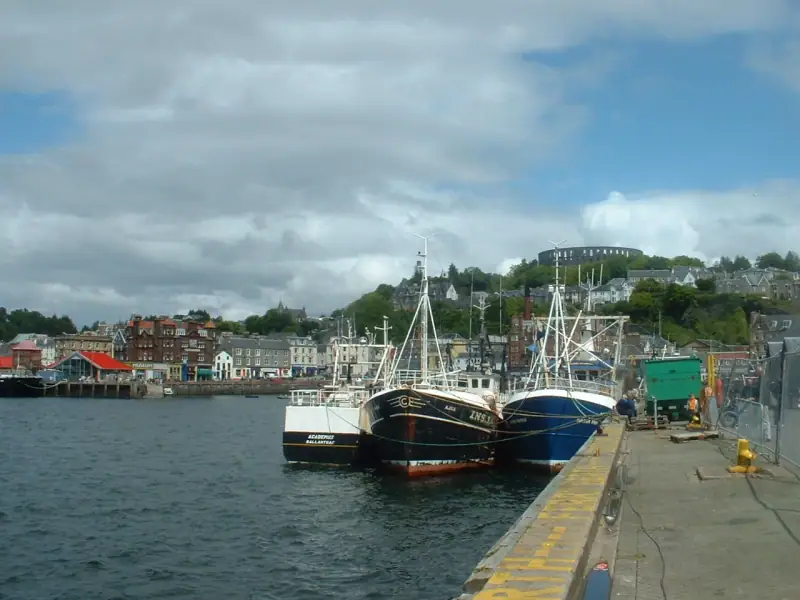
Visiting Oban: A Complete Guide to the Gateway to the Isles
What to see and do in Oban: McCaig's Tower, the distillery, ferries to the Hebrides, Mull and Iona. A complete guide to plan your stay in Scotland.
Edinburgh top sights: what to see and do in the capital
Edinburgh's top sights: the castle, Royal Mile, Arthur's Seat, free museums, Old Town and New Town. A complete guide so you miss nothing.
Visiting Fort William: a complete guide to Scotland's outdoor capital
What to see and do in Fort William: Ben Nevis, Jacobite Steam Train, Glenfinnan, Glencoe. A complete guide to plan your Highlands trip.
Ready-made
Scotland itineraries
7 days
Scotland in 7 days: the perfect one-week itinerary
EdinburghFort WilliamInvernessPortree
14 days
Scotland road trip: the complete 2-week guide
Plan a 14-day Scotland road trip: full itinerary from the Lowlands to the far north, with logistics, places to stay and sights.

6 days
Scotland road trip in October: 6-day itinerary, roads and daylight hours
PitlochryInvernessPortreeFort William