Things to do
Volcanoes National Park, Rwanda: complete guide 2026
We may earn a commission when you book through links on this page, at no extra cost to you. We don't visit or try the places we cover: we summarize published sources. How we work
In short
- A gorilla permit costs USD 1,500 per person (briefing at Kinigi at 7 am, groups of 8, one hour with the family); book 3 to 6 months ahead.
- Without a gorilla permit: golden monkeys (USD 100), Bisoke (USD 75), Sabyinyo (USD 75), Karisoke and the Fossey grave (USD 75), Karisimbi (about USD 400 for 2 days).
- Kinigi headquarters is about 110 to 120 km (68 to 75 mi) from Kigali, 2 h to 2 h 30 by road; most visitors sleep in Musanze the night before.
- The dry season (June to September) is the best; children under 15 are not allowed on the gorilla trek; no permit is sold at the gate.
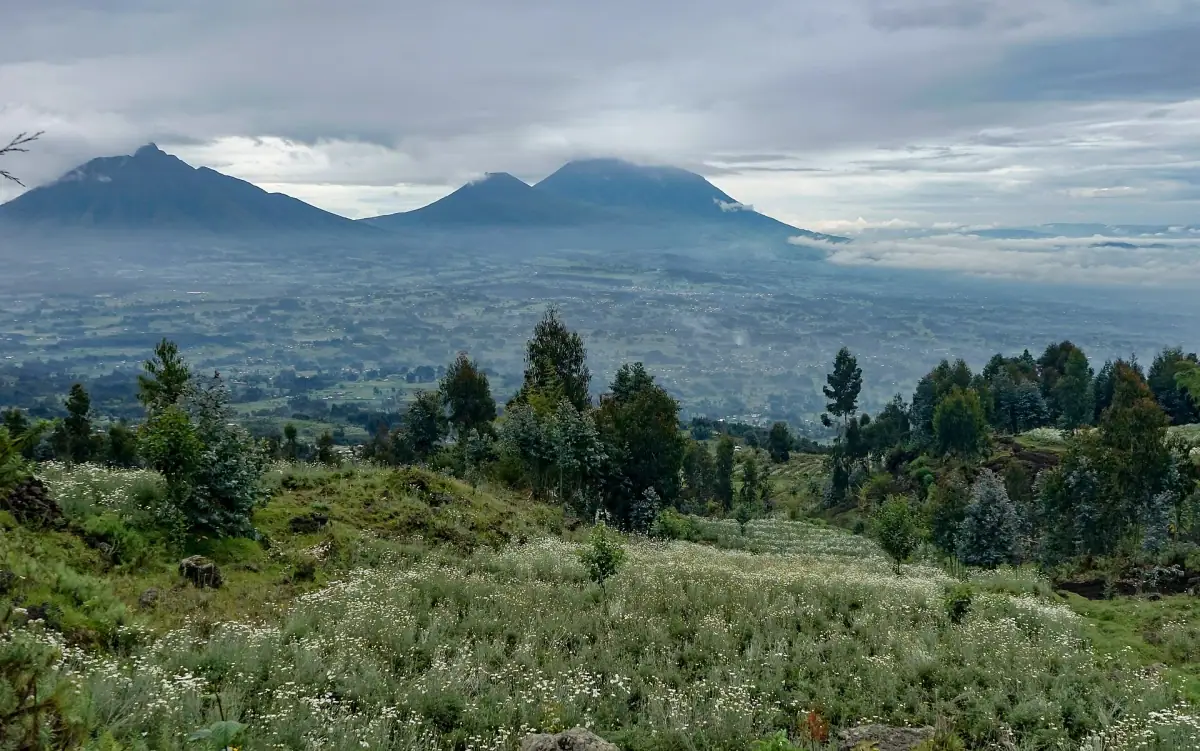
In northwestern Rwanda, where the hills of the land of a thousand hills climb to meet the Virunga volcanic chain, Volcanoes National Park is one of the most extraordinary nature reserves in Africa. Its 160 km² (62 sq mi) of mountain forest, bamboo groves and high-altitude meadows protect one of the largest populations of mountain gorillas in the world, a species that nearly disappeared and whose survival owes much to this Rwandan park and to conservation efforts since the 1970s.
But Volcanoes National Park is much more than a gorilla reserve. It is a spectacular volcanic area with five climbable peaks (including Karisimbi at 4,507 m / 14,787 ft, Rwanda’s highest point), a primary forest that is also home to the golden monkeys endemic to the Virunga, and the lasting memory of the primatologist Dian Fossey, murdered in 1985 after devoting her life to protecting mountain gorillas.
This complete guide gives you all the information to plan your visit: the activities available, exact rates, logistics, practical tips and the best times to come.
Gorilla trekking: the experience of a lifetime
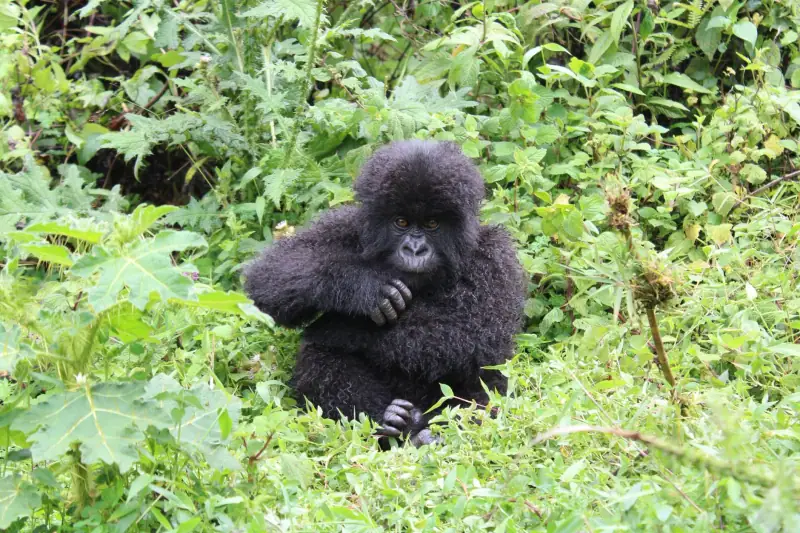
Mountain gorilla trekking is the main reason tens of thousands of travelers come to Rwanda each year, and more precisely to this park. The Virunga forest is home to about 300 mountain gorillas (Gorilla beringei beringei) on the Rwandan side, spread across several “habituated” families, meaning accustomed to human presence after years of gradual contact supervised by rangers.
The world population of mountain gorillas is estimated at about 1,100 individuals, spread across Rwanda, Uganda and the Democratic Republic of the Congo. It is a species whose status has moved from “critically endangered” to “endangered”, a significant improvement largely credited to conservation programs of which Rwanda is a recognized model.
How the trek works
On the day, you report to park headquarters in Kinigi at 7 am for a briefing of about 30 minutes. Groups have a maximum of 8 people per gorilla family. A lead ranger, trackers who located the family at dawn and porters (optional) accompany each group.
The trek’s length varies with where the gorillas are in the forest that day: from 1 hour for families near the edge to 6 hours for those that have moved up in altitude. Once the family is located, you have exactly one hour in its company. This strict rule exists to minimize stress on the animals and the risk of transmitting human diseases; gorillas are genetically close to humans and vulnerable to our respiratory viruses.
The rules require staying at least 7 meters (23 ft) from the gorillas and wearing a surgical mask. In practice the gorillas often come closer themselves: a silverback settling two meters (6.6 ft) from you to scratch, or a mother nursing her baby while watching you with dark, intelligent eyes, are images that are not forgotten.
The gorilla permit: price and booking
The trekking permit costs USD 1,500 per person. This price, one of the highest in the world for a wildlife activity, contributes directly to the park’s conservation revenue and to community projects in neighboring villages. Part of the revenue is redistributed to local communities through the Revenue Sharing program (10% of park revenue).
Booking is done:
- Directly through the Rwanda Development Board (rdb.rw)
- Through a specialized travel agency (often more practical for individual travelers)
- Through your hotel or lodge in Musanze (for last-minute availability, rare but existing)
Book 3 to 6 months ahead in high season (June to September). In low season, availability sometimes exists at 4 to 8 weeks.
Book your activities in Volcanoes National Park
Gorilla trekking, golden monkeys, volcano hikes: compare offers from certified agencies to organize your stay in Volcanoes National Park.
Golden monkey tracking: an accessible alternative
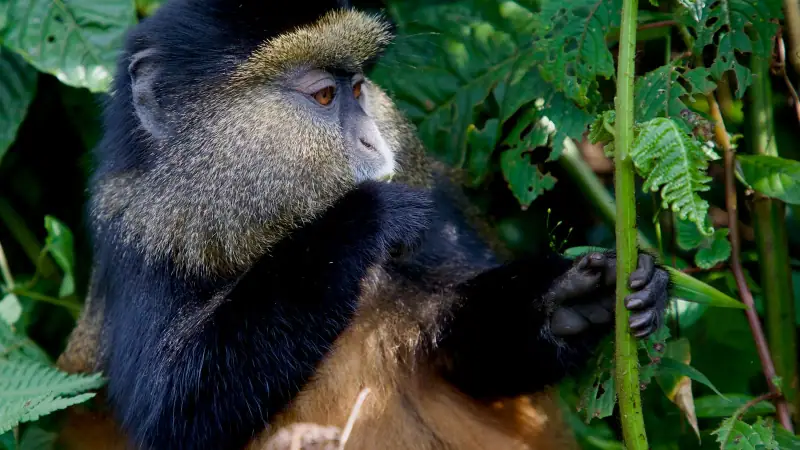
Less publicized than their gorilla cousins, golden monkeys (Cercopithecus mitis kandti) are a species endemic to the Virunga mountain forests, listed as vulnerable on the IUCN red list. Lively, curious and remarkably colorful (their fur is a mix of gold, orange and black), they live in troops of several dozen in the park’s bamboo groves.
The golden monkey tracking permit costs USD 100 per person, fifteen times less than the gorilla permit. The activity follows a similar format: briefing at Kinigi at 7 am, a forest trek with rangers and trackers, then one hour with the group of animals. The trek is generally shorter (1 to 3 hours) and the monkeys, active and leaping from bamboo to bamboo, put on a show of unforgettable liveliness.
For travelers who did not get a gorilla permit or who want to combine both experiences over two days, golden monkey tracking is a remarkable option, and often easier to book at short notice. The guide to seeing golden monkeys without an agency details permits, minimum age and how the morning unfolds.
Hikes on the Virunga volcanoes
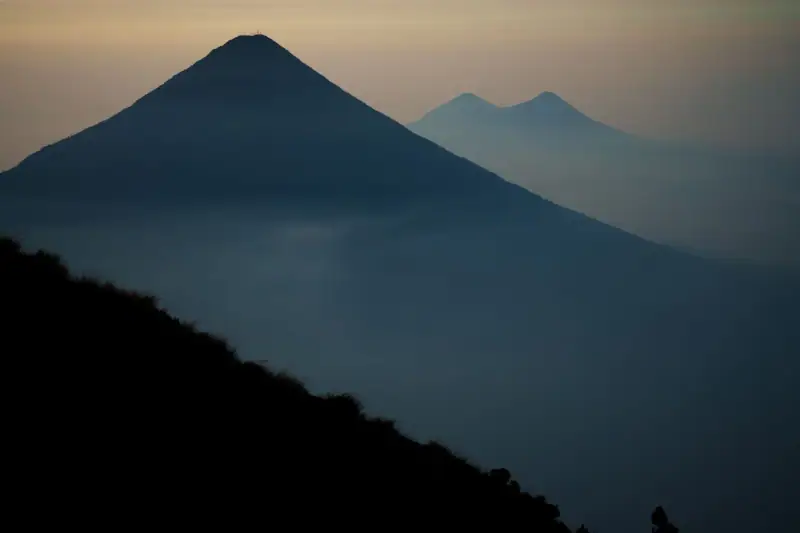
Volcanoes National Park spans five Rwandan volcanoes of the Virunga chain: Karisimbi (4,507 m / 14,787 ft), Muhabura (4,127 m / 13,540 ft), Bisoke (3,711 m / 12,175 ft), Sabyinyo (3,669 m / 12,037 ft) and Gahinga (3,474 m / 11,398 ft). All can be hiked, with distinct difficulty levels and permits.
Bisoke hike (3,711 m / 12,175 ft): the most popular
Bisoke is the park’s most-hiked volcano, for a good reason: its summit crater holds a deep blue-green caldera lake, and on a clear day the view takes in the other Virunga volcanoes and, in the distance, Lakes Ruhondo and Burera.
The climb starts from park headquarters in Kinigi and rises through mountain forest and high-altitude meadows to the crater rim in 3 to 5 hours depending on pace. The descent takes 2 to 3 hours. The trail is well marked but can be very slippery in the wet season; waterproof shoes and walking sticks are strongly advised.
Bisoke permit: USD 75 per person, mandatory guide included. Start at 7 am from Kinigi.
Karisimbi climb (4,507 m / 14,787 ft): the 2-day adventure
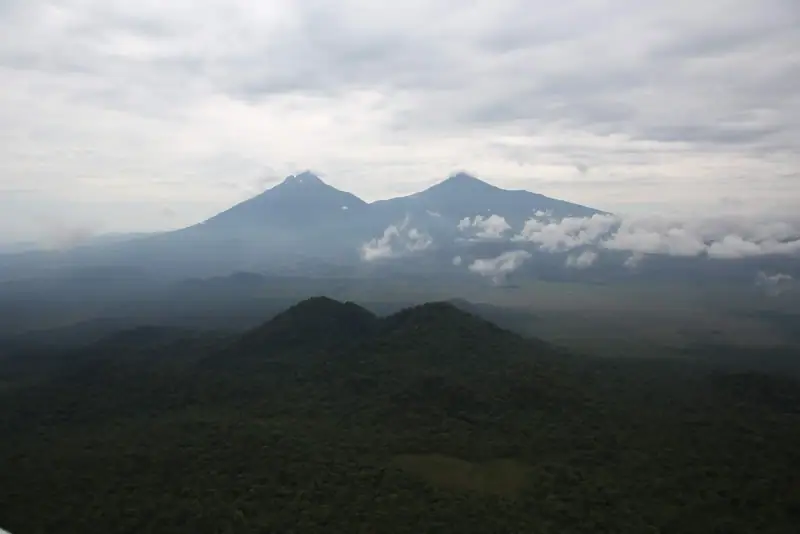
Karisimbi is Rwanda’s highest peak and one of the highest in the Great Lakes region. The climb spreads over two days with a night at a high-altitude camp at about 3,700 m (12,140 ft). The first day climbs through bamboo forest and mountain forest to the camp. On the second day, a night start around 2 to 3 am lets you reach the snowy summit at sunrise, for one of Rwanda’s most spectacular panoramas.
Karisimbi permit: about USD 400 for the 2 days (sources differ: confirm the rate and what is included with the RDB). Also check what camping equipment (tents, sleeping bags) is provided. A guide, porters and an armed ranger accompany the group. Good physical fitness is essential. Ask your doctor or a travel clinic about altitude, and see the official travel health pages (CDC in the US, TravelHealthPro in the UK).
Sabyinyo (3,669 m / 12,037 ft): the three-country border
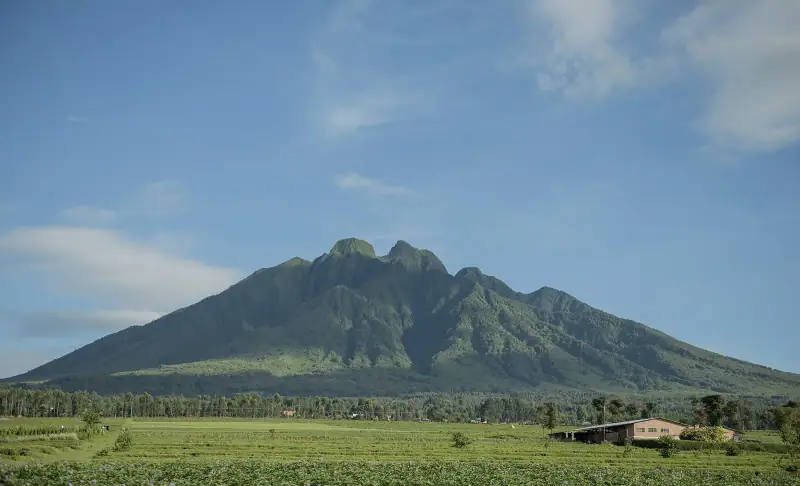
Sabyinyo volcano is especially interesting for its geographic symbolism: its summit marks the meeting point of the borders of Rwanda, Uganda and the Democratic Republic of the Congo. The hike takes about 5 to 6 hours round trip from Kinigi, with an exposed trail in the upper part. The panorama over the three countries is exceptional on a clear day.
Sabyinyo permit: USD 75 per person.
Rent a car to explore Volcanoes National Park
The freedom to move between Kigali, Musanze and Kinigi headquarters with your own vehicle makes gorilla trekking logistics much easier.
The Karisoke Research Center and Dian Fossey
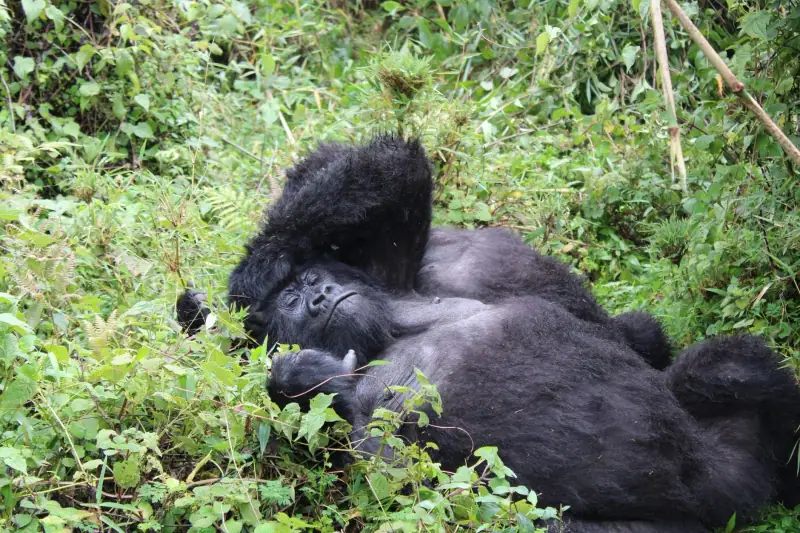
Inside the park, in the valley between the Bisoke and Karisimbi volcanoes, lies the Karisoke Research Center, one of the most history-laden sites on the African continent for primatology. It was here that the American zoologist Dian Fossey set up her research camp in 1967, for what would become a landmark study of mountain gorillas in the wild.
Fossey spent nearly 18 years in this forest, documenting mountain gorillas’ social behavior for the first time and actively fighting poaching. Her research brought gorillas to the attention of the general public, notably thanks to her book Gorillas in the Mist and the film of the same name (1988) that gave her an international face. She was found murdered in her cabin in December 1985. The investigation remained unsolved.
The site visit gives access to the Dian Fossey memorial and the cemetery of gorillas killed by poachers. This deeply moving place remains one of Rwanda’s most striking. Access is by a 2 to 3-hour hike from Kinigi.
Karisoke permit: USD 75 per person. Part of the revenue supports the work of the Dian Fossey Gorilla Fund International, which continues research on the Virunga gorillas.
Biodiversity and ecology of the park
Volcanoes National Park is part of the Virunga Conservation Area (VCA), a transboundary area shared with Virunga National Park (DRC) and Mgahinga Gorilla National Park (Uganda). Together these parks form one of the most important biological corridors in Central Africa.
The Rwandan park’s vegetation changes with altitude: dense bamboo groves between 2,500 and 2,900 m (8,200 to 9,515 ft), mountain forest between 2,900 and 3,500 m (9,515 to 11,480 ft), and subalpine meadows and ericaceous heath above 3,500 m. This diversity of habitats supports remarkable wildlife beyond the gorillas and golden monkeys: forest buffalo, spotted hyenas, genets, many bird species including the rare Rwenzori turaco, and a unique alpine flora.
The park has benefited from some of Africa’s most ambitious conservation programs. The mountain gorilla population in the Virunga is the only large great ape population whose numbers are increasing, an international conservation success.
Stays near Volcanoes National Park
Lodges at the forest edge or guesthouses in Musanze: find where to sleep before your gorilla trek or volcano hike.
Practical information
Getting to the park
Volcanoes National Park headquarters is at Kinigi, about 13-15 km (8-9 mi) west of Musanze (Ruhengeri) on a paved road. From Kigali the distance is about 110-120 km (68-75 mi) by the national road. By car from Kigali, allow 2 h to 2 h 30 depending on traffic.
The vast majority of visitors sleep in Musanze the night before the trek: the briefing starts at 7 am in Kinigi, and a night departure from Kigali is exhausting. The guide to lodging in Musanze lists the best options near the park.
Rules and behavior in the park
- Keep at least 7 m (23 ft) from gorillas and golden monkeys
- Wear a surgical mask for the whole time in contact with primates
- Do not eat or smoke in the park
- No flash when taking photos
- Maximum 8 visitors per gorilla family per day
- If you feel ill (fever, cough, cold), tell the ranger; your trek may be postponed
- Children under 15 are not allowed on the gorilla trek
What to bring
- Waterproof hiking shoes with good grip
- Layered clothing (the forest is cool, altitude can be cold)
- A poncho or light waterproof jacket
- Gardening gloves (protection against giant nettles)
- Walking sticks (strongly recommended)
- Water (at least 1.5 L / about 50 oz per person)
- A small personal first-aid kit, sunscreen
- A camera (zoom recommended, batteries charged)
Gorilla trekking tips
- Book your permit at least 6 months ahead for high season (July to August)
- Tell your hotel to arrange the transfer to Kinigi (recommended departure at 6:30 am)
- Have tips ready for the ranger, porters and trackers (established custom, in USD or RWF)
- Choose your gorilla family according to your fitness: some families are closer to Kinigi, others need hours of walking
- Trekking runs all year, and even in the wet season it keeps its magic
Preparing your trip
Volcanoes National Park fits ideally into a 7 or 10-day Rwanda circuit. The 7-day Rwanda itinerary includes Kigali, the park and Lake Kivu. For more depth, the 10-day Rwanda circuit lets you add Akagera National Park and Nyungwe.
Entry rules depend on your passport. Check the official travel advice of your government before you book: travel.state.gov (US), GOV.UK (UK), travel.gc.ca (Canada), Smartraveller (Australia) (checked November 2026).
When to visit Volcanoes National Park
High season (June to September) is the ideal period: dry trails, maximum visibility over the Virunga summits, limited risk of rain in the forest. It is also the most expensive and busiest period. Gorilla permits are snapped up months ahead.
The second dry season (December to January) is also excellent, with lower attendance than in summer and often better lodging rates.
The wet seasons (mid-February to May and October to mid-November) should not put you off: gorilla trekking is offered all year and the wet forest has a spectacular atmosphere. The trails to Bisoke and Karisimbi are, however, more slippery and difficult. Vegetation is at its greenest, and photographers appreciate the diffuse light and clouds clinging to the summits.
For a full analysis of the seasons and events in Rwanda, the guide to the best time to visit Rwanda gives all the details month by month.
Frequently asked questions
How much does the gorilla trekking permit cost in Volcanoes National Park?
The gorilla trekking permit costs USD 1,500 per person. The price includes the briefing at park headquarters in Kinigi, accompaniment by a ranger and a tracker, and a guaranteed hour with a gorilla family. Booking is through the Rwanda Development Board (rdb.rw) or a specialized agency. Book at least 3 to 6 months ahead in high season.
What hikes can you do in Volcanoes National Park without a gorilla permit?
Several activities are offered besides gorilla trekking: the hike to the summit of Bisoke volcano (3,711 m / 12,175 ft, USD 75), the Karisimbi climb (4,507 m / 14,787 ft, about USD 400 for 2 days with a night at a high-altitude camp; rate to be confirmed with the RDB), a visit to the Karisoke Research Center and the Dian Fossey memorial (USD 75), and golden monkey tracking (USD 100). The park thus offers many alternatives at different prices.
How do you get to Volcanoes National Park from Kigali?
Park headquarters is at Kinigi, about 110 to 120 km (68 to 75 mi) north of Kigali. By rental car or taxi, the national road via Musanze takes about 2 h to 2 h 30. By bus, several companies (Volcano Express, Virunga Express) link Kigali to Musanze (Nyabugogo station) in 2 h to 2 h 30. From Musanze it is another 15-20 minutes by car to Kinigi. The vast majority of travelers sleep in Musanze the night before the trek.
What is the best season to visit Volcanoes National Park?
The best period is the dry season from June to September: passable trails, visibility over the volcanoes, clear skies for high-altitude hikes. The short dry season from December to January is also favorable. In the rainy season (March to May and October to November), gorilla trekking remains possible but trails are muddy and the hikes up Bisoke and Karisimbi are harder. Gorilla trekking runs all year.
Is gorilla trekking physically difficult?
Gorilla trekking varies in difficulty depending on where the family is in the forest that day. Allow 1 to 6 hours of walking round trip, with an elevation gain that can exceed 500 m (1,640 ft), on muddy and sometimes steep trails. Good basic fitness is recommended, but you do not need to be a seasoned hiker. The park offers porters (about USD 10-15) and rangers adapt the pace to the group. The terrain is hard for people with reduced mobility: ask the RDB or an agency about possible access solutions.
Can you enter the park without a prior booking?
No. All activities in Volcanoes National Park require a booking and a permit bought in advance. No gorilla permit is sold at the gate on the day. Permits for golden monkey trekking and volcano hikes are easier to get at short notice, but booking ahead through the Rwanda Development Board (rdb.rw) or your lodging is always recommended.
More Rwanda guides
Keep reading
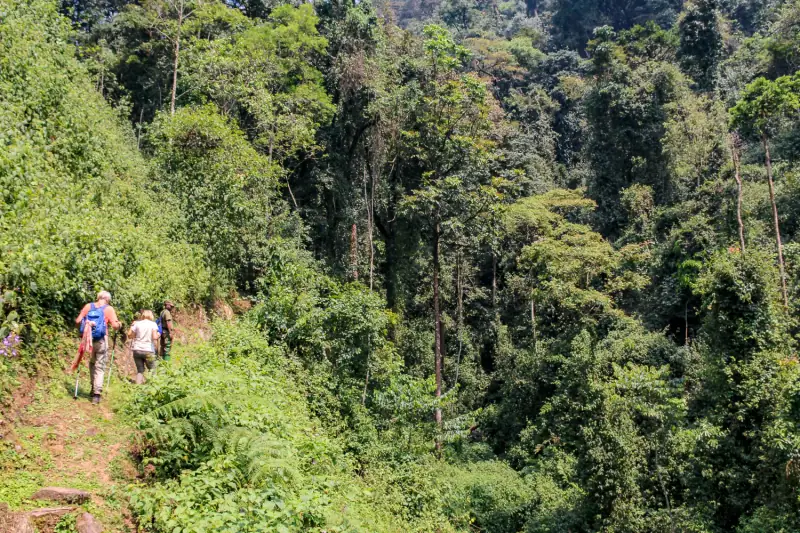
Hiking in Rwanda: the best treks from the volcanoes to Nyungwe
Complete guide to hiking in Rwanda: Bisoke volcano, Karisimbi, Dian Fossey's grave, Nyungwe canopy walk, Congo Nile Trail. Levels, rates, preparation.
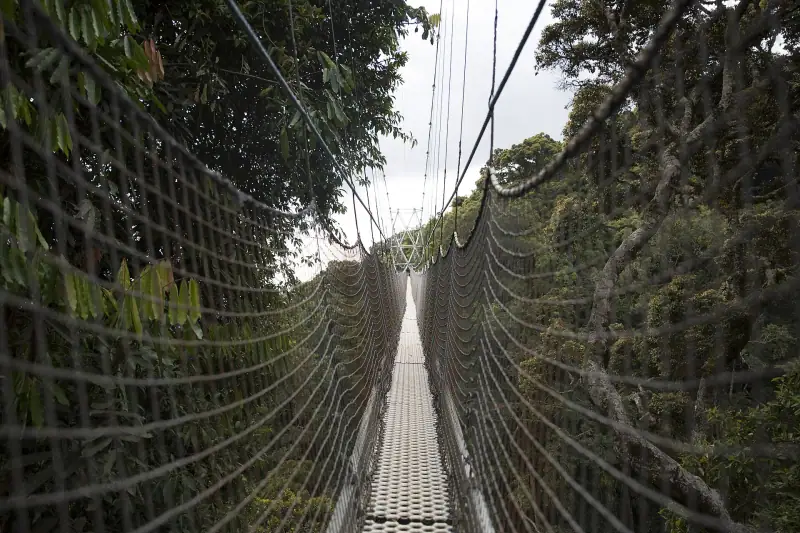
Nyungwe canopy walk: price, booking, hours and minimum age
Nyungwe canopy walk in Rwanda: USD 40 or 60 depending on the source, slots from 8 am to 3 pm, minimum age 6, online booking and vertigo.
Visiting Huye (Butare): complete guide to Rwanda's cultural capital
Huye (Butare), Rwanda's cultural capital: National Museum, Nyanza Royal Palace, gateway to Nyungwe. A complete guide to visiting the town.
Ready-made
Rwanda itineraries
10 days
Rwanda in 10 days: complete itinerary with gorillas, safari, Lake Kivu and Nyungwe
KigaliAkagera National ParkMusanzeRubavu (Gisenyi)Nyungwe
7 days
Rwanda in 7 days: complete itinerary and practical tips
KigaliMusanzeGisenyi (Rubavu)
Can be adapted in the planner
3 days
Lake Kivu road trip: from Rubavu to Karongi along the Rwandan shore
Rubavu (Gisenyi)Karongi (Kibuye)