Things to do
Northern Lights in Norway: Where and When to See Them
We may earn a commission when you book through links on this page, at no extra cost to you. We don't visit or try the places we cover: we summarize published sources. How we work
In short
- The aurora season runs from mid-September to late March in northern Norway; November to January has the longest nights.
- Tromsø (69°N) sits under the auroral oval; at Kp 3 or higher you can see the lights there with a clear sky.
- Plan at least 3 to 4 nights in an aurora destination, because clouds block the view.
- Tromsø minibus tours run about 1,300-2,600 NOK; the Lofoten Islands and Alta are good alternatives.
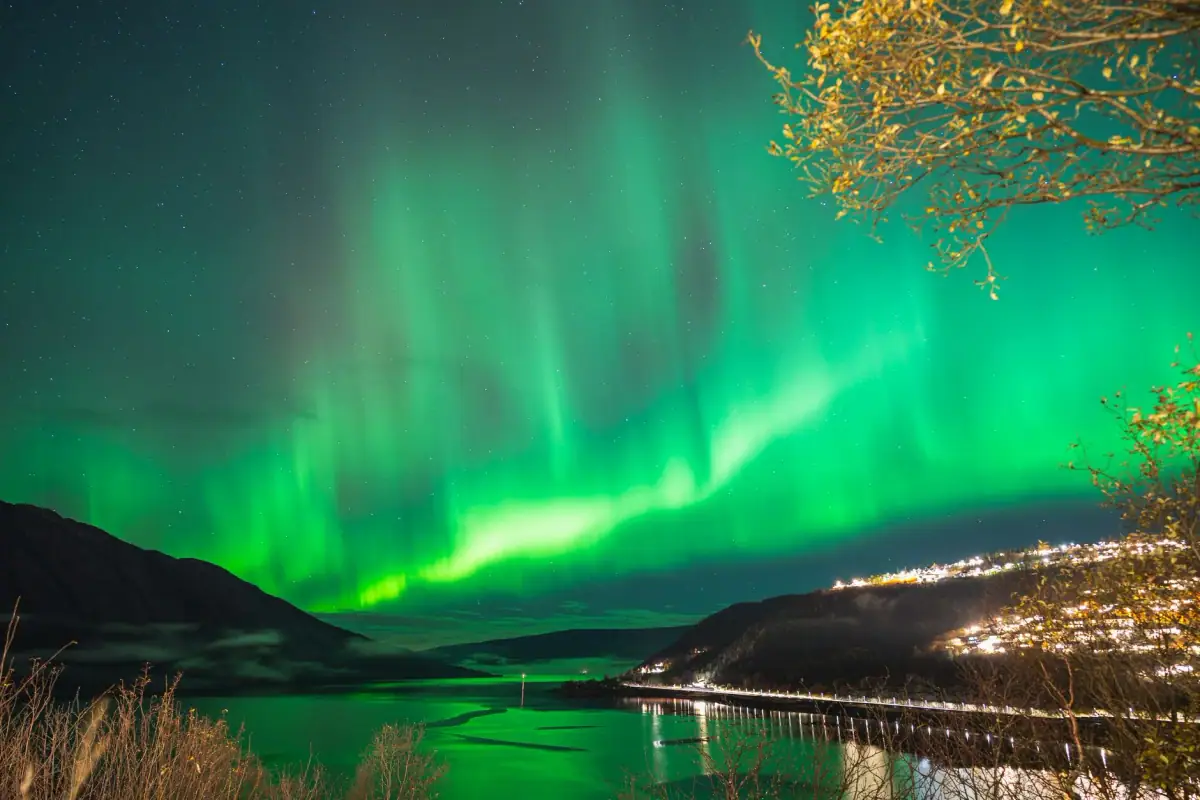
Seeing the northern lights is one of the most moving experiences a person can have. Those ribbons of light rippling across the night sky, in green, pink, violet and white, are hypnotic and almost mystical. Nordic cultures explained them with legends: in Norway they were the reflections of the shields of the Valkyries, Odin’s messengers. Today we know they are charged particles from the sun striking Earth’s atmosphere at the magnetic poles. The spectacle is no less impressive for it.
Norway is one of the best places in the world to see this phenomenon. Here is what you need to know to maximize your chances.
How do the northern lights form?
To understand when and where to see them, it helps to understand what creates them.
The northern lights (Nordlyset in Norwegian) result from the interaction between the solar wind, a constant stream of charged particles emitted by the sun, and Earth’s magnetic field. When these particles reach the atmosphere at the magnetic poles, they collide with oxygen and nitrogen molecules, which release energy as light.
Colors correspond to different gases and altitudes:
- Green (90% of auroras): oxygen at 100-150 km (62-93 mi) altitude
- Red: oxygen at 200+ km (125+ mi) altitude (rare, very spectacular)
- Blue/violet: nitrogen at low altitude
- Pink: a mix of nitrogen and oxygen in the lower atmosphere
Aurora intensity is measured by the Kp index (0 to 9). A Kp of 3-4 is enough to see auroras from Tromsø. A Kp of 5-6 brings auroras visible from southern Norway. A Kp of 7+ creates spectacular auroras visible from all of Scandinavia.
When to go to see the northern lights
The aurora season
The northern lights require:
- A sufficiently dark night (impossible in summer with the midnight sun)
- A clear sky (clouds block the view)
- Enough solar activity (Kp index 3 or higher)
The aurora season runs from mid-September to late March in northern Norway. The best periods are:
November-January: The nights are longest (polar night in Tromsø from November 26 to January 15). The most chances to see them. The auroras can be visible from 3:30 pm.
December-January: Auroral activity often peaks around the magnetic equinoxes (March and September), but December remains excellent. The Christmas atmosphere in Norwegian towns adds to the magic.
March: A favored time for several reasons: auroras are still excellent, the sun is returning (beautiful bright atmosphere), and weather is often more stable than in deep winter. It is also a good month to combine auroras and skiing in Norway.
September-October: First auroras of the season. Not yet very cold. Fall colors by day.
Where to see the northern lights in Norway
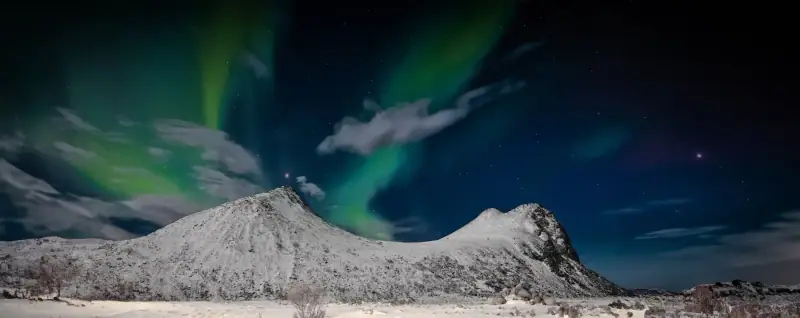
Tromsø: the aurora capital
Tromsø (69°N) is the ideal place to watch the northern lights in Norway. Several factors combine:
- Position under the auroral oval: the zone of maximum activity passes directly overhead
- Developed tourist infrastructure: dozens of agencies run aurora tours every night
- Easy access: good international connections
- Alternatives when it is cloudy: local guides know how to move to find clear skies
Excursions from Tromsø:
- Minibus tour (3-4 h): transport to areas without light pollution, a guide, hot drinks. Price: about 1,300-2,600 NOK depending on the operator and season.
- Night dog sledding safari under the auroras: about 2,500-5,500 NOK depending on the package (check with the operator)
- Boat trip on the fjord: boats can head to areas with clear sky
- Aurora camp stay: a cabin in the wilderness, comfortable viewing over several nights
To combine auroras, sledding and whales, see our prices and booking tips for Tromsø in winter.
Northern lights excursions in Tromsø
Guided minibus tours, dog sledding and boat trips from Tromsø.
The Lofoten Islands: wild nature and auroras
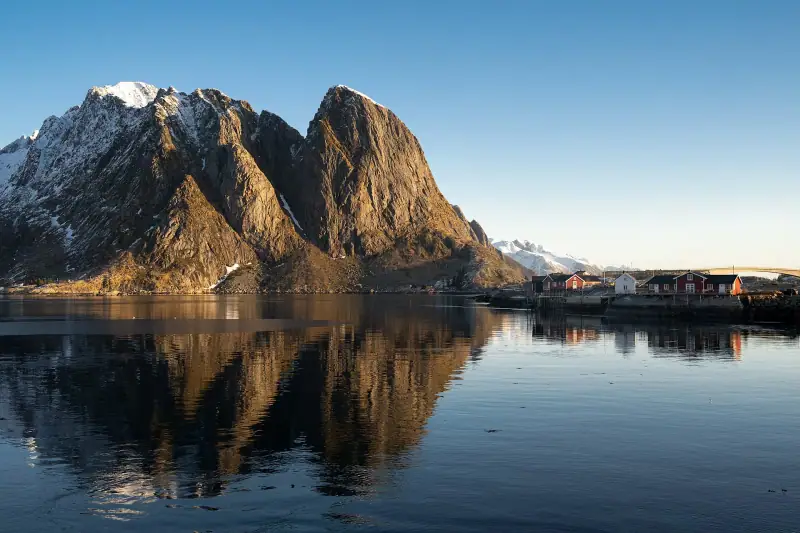
The Lofoten Islands may be the most romantic place to watch the northern lights. The landscape has a dramatic beauty: black peaks plunging into the sea, fishing villages on the water, and the auroras dancing above it all. There is no organized tour infrastructure like Tromsø’s, but you get more isolation and authenticity.
Recommended base: Svolvær, Henningsvær or Reine. Look for a rorbu with a fjord view so you can watch from your warm cabin.
Our guide to where to stay in the Lofoten Islands helps you find the best lodging for aurora watching.
Alta: the cathedral of the northern lights
Alta (70°N) is even farther north than Tromsø. The town has the Northern Lights Cathedral, which houses the Borealis Alta exhibition on the phenomenon. It is also an excellent place to watch the auroras from the ground, with fewer tourists than Tromsø.
Svalbard (Spitsbergen): the extreme
For the ultimate viewing, Svalbard (78°N) has the longest polar night (4 months) and the most intense auroras. But getting there is expensive and conditions can be extreme.
Forecasting the auroras: essential tools
Kp index and forecasts
Apps and sites:
- SpaceWeatherLive.com: the go-to tool for auroral activity (27-day forecasts)
- Aurora Forecast (app): push alerts when the Kp index rises
- Yr.no: precise local weather (clouds = no auroras)
- NOAA Space Weather: scientific forecasts
How to read the forecasts:
- Kp 3 or higher: auroras from Tromsø (clear sky required)
- Kp 4 or higher: good auroras from Tromsø, starting to show from the Lofoten Islands
- Kp 5 or higher: excellent auroras, visible farther south
- Kp 7 or higher: spectacular auroras, visible from Oslo in clear weather
The 3-night rule
Auroras can only be seen when the sky is clear. Plan at least 3 to 4 nights in an aurora destination for a reasonable chance of clear sky. Many travelers who stay 1-2 nights leave disappointed because of clouds.
Places to stay in Tromsø
Hotels, lodges and cabins for your northern lights stay.
Photographing the northern lights
Recommended settings (camera)
- Mode: Manual (M)
- Lens: Wide angle (14-24 mm), aperture f/1.8 to f/2.8
- ISO: 1600 to 3200 (experiment to find the right noise level)
- Shutter speed: 5 to 15 seconds (slow auroras: 15 s, fast ones: 5 s)
- Focus: manual, set to infinity (∞)
- Tripod: essential (long exposure = blur if handheld)
- Remote or self-timer: to avoid vibration when you press the shutter
With a smartphone
Recent high-end smartphones (iPhone Pro, Samsung Galaxy S Ultra) have very capable night modes for auroras. Use a mini tripod, turn on Pro mode (manual control), and set a high ISO plus a long exposure.
Composition for the best photos
- Include a foreground: an illuminated rorbu, a village, mountains, the fjord water
- Avoid flash (it ruins your eyes’ adaptation to the dark)
- Wait for dynamic shapes: ribbon or curtain auroras are more beautiful than diffuse patches
- Shoot in RAW for maximum latitude in post-processing
Practical tips for watching the auroras
Dress accordingly. You will stand still outside for hours at -10 to -20 °C (14 to -4 °F). Wear multiple layers: thermal underwear, fleece, a heavy winter coat, waterproof overpants, boots with traction, a hat, a balaclava, warm gloves with mittens over them. Warm feet are critical.
Get away from artificial light. Auroras show best away from cities. Guides know the best spots. If you are on your own, drive 20-30 km (12-19 mi) out of town in a direction where the sky is clear.
Let your eyes adapt. It takes 20-30 minutes in complete darkness for your eyes to adjust and pick out faint auroras. Avoid looking at your phone (use minimum brightness, red mode if available).
Be patient. The auroras can appear 5 minutes after you arrive, or 3 hours. Patience is the first quality of an aurora chaser.
Frequently asked questions
Which city in Norway is best for seeing the northern lights?
Tromsø is the world capital of the northern lights. It sits right in the auroral zone, has many organized excursions and is easy to reach even in winter. The Lofoten Islands and Alta are excellent alternatives.
What time do the northern lights appear?
The northern lights appear when the sky is dark enough, generally between 6 pm and 2 am. Activity often peaks around midnight, but they can show up at any time. Check aurora forecasts (SpaceWeather, Aurora Forecast).
How do you photograph the northern lights?
Use a camera with manual mode, a tripod, a wide lens (24 mm or less), an aperture of f/2.8 or wider, ISO 1600-3200 and a 5-15 second exposure. Recent high-end smartphones (iPhone Pro, Samsung Galaxy S Ultra) have capable night modes for auroras.
How likely are you to see the northern lights in Tromsø?
The odds are high: Tromsø lies directly under the auroral oval. With normal activity (Kp 3 or higher), auroras show on 3 to 4 nights out of 7. With strong activity (Kp 5 or higher), they are visible almost every clear night.
Can you see the northern lights from Oslo?
Rarely. Oslo is too far south to see the northern lights regularly. With exceptionally strong activity (Kp 7-8 or higher), they can be visible from southern Norway, but that remains rare.
More Norway guides
Keep reading
Trolltunga and Preikestolen: Guide to Norway's Two Iconic Hikes
All about Trolltunga and Preikestolen: access, difficulty, season, logistics. Norway's two most spectacular hikes explained in detail.
Cruising the Norwegian Fjords: Complete Guide 2026
All about Norwegian fjord cruises: Hurtigruten, fjord cruises, day trips from Bergen. Prices, routes and practical tips.
Norway Trip Budget: How Much Does a Trip Cost in 2026?
How much to budget for a trip to Norway? Detailed prices for lodging, food, transport and activities, plus tips to save money.
Ready-made
Norway itineraries

7 days
Norway in 7 Days: Complete Itinerary for Oslo, Bergen and the Fjords
OsloBergen
Can be adapted in the planner
Road Trip Through the Norwegian Fjords: Itinerary and Tips
Complete guide to a fjords road trip in Norway: scenic routes, Geirangerfjord, Nærøyfjord, stops and practical driving tips.
7 days
Lofoten and Tromsø in one week: doable or too ambitious?
Combining Lofoten and Tromsø in 7 days: real distances, travel times, a day-by-day plan and alternatives if the pace is too tight.