Itineraries
Road Trip Through the Norwegian Fjords: Itinerary and Tips
We may earn a commission when you book through links on this page, at no extra cost to you. We don't visit or try the places we cover: we summarize published sources. How we work
In short
- Plan at least 5 days for the classic Bergen and western fjords loop; 7 to 10 days if you add Geirangerfjord and the Trollstigen.
- A standard car is fine in summer; choose an SUV or all-wheel drive in spring and winter, with winter tires or chains on snowy roads.
- Rental cars run €60 to €120 a day (about $70 to $140); tolls add €40 to €80 (about $46 to $93) over 7 to 10 days; fuel is about €2.10/L.
- Book lodging ahead in July and August: some villages have a single hotel and the next one can be 50 km (31 mi) away.
A road trip through Norway’s fjords is one of the most memorable travel experiences in Europe. Roads wind between rock walls that plunge straight into emerald water of startling clarity, waterfalls appear at every bend, and fishing villages cling to the slopes as if defying gravity. It is a trip for the eyes as much as for the soul.
Here is the complete guide to planning your Norwegian fjords road trip, from renting a car to the main stops, including the official scenic routes and some lesser-known places.
Preparing your fjords road trip
Renting a car in Norway
A car gives the most freedom in the fjords. Ferries, buses and trains serve the main sights, but a car lets you stop at an unnamed waterfall, take a side road to an isolated viewpoint or reach a village before the tour groups.
Rental tips:
- Compare rental companies online for the best prices
- Choose full coverage (zero excess): fjord roads, with their bends and wet surfaces, justify the cost
- In summer: any type of car will do
- Off season: an SUV or a high-clearance car is recommended (some minor roads are not cleared of snow quickly)
- Fill the tank whenever you can in rural areas: gas stations can be rare
The National Tourist Routes (Nasjonale Turistveger)
Norway has selected 18 official scenic routes (Nasjonale Turistveger) across the country. These routes combine exceptional natural beauty with quality infrastructure (viewpoints, toilets, picnic areas). For a fjords road trip, the most important are:
- Aurlandsfjellet (Bjørgavegen): from Flåm to Aurland, a high-altitude road with a sweeping view over the Sognefjord
- Hardangerfjord: the road follows the fjord’s shores through orchards and villages
- Sognefjellet: the highest mountain road in Scandinavia (1,434 m / 4,705 ft), between Lom and Skjolden
- Geiranger-Trollstigen: two of Norway’s most iconic landscapes on a single route
- Atlanterhavsveien (Atlantic Road): a road across small islands linked by bridges, right out in the Atlantic
Important driving rules
- Drive on the right (same as in the US)
- Headlights on at all times (even in daytime, mandatory)
- Alcohol: near-zero tolerance (0.2 g/L, about 0.02% BAC)
- Speed: 80 km/h (50 mph) on roads, 50 km/h (31 mph) in towns, 90 km/h (56 mph) on highways
- Ferries: many crossings are needed on some routes (schedule them ahead, especially in high season)
- Pedestrian priority: very strictly respected in Norway
The classic fjords itinerary (7-10 days)
Start: Bergen
Bergen is the natural starting point for a fjords road trip. Pick up your car at the airport or in town, and begin by exploring the city (see our guide to where to stay in Bergen).
Stage 1: Bergen → Hardangerfjord (1 h 30)
Take the E16, then the RV7 east to reach the Hardangerfjord. It is the second longest fjord in Norway (179 km / 111 mi) and one of the gentlest and most accessible.
Don’t miss:
- Steinsdalsfossen: a waterfall you can walk behind the curtain of water (free access from a parking lot)
- Eidfjord: a pretty village at the head of the fjord, starting point for Hardangervidda National Park
- The orchards in bloom (May): the shores of the Hardangerfjord are lined with cherry, apple and pear trees. In spring, the landscape turns a lovely pastel pink.
- Vøringsfossen: one of Norway’s highest waterfalls (182 m / 597 ft free fall), reached from Eidfjord
Stage 2: Hardangerfjord → Voss → Flåm (3 h)
Continue to Voss, an extreme sports town (skydiving, kayaking, skiing), then drop down to Flåm on the Sognefjord.
In Flåm:
- Flåm Railway (Flåmsbana): 20 km (12 mi) of track over an 864 m (2,835 ft) elevation change. One of the most spectacular train journeys in the world. Price: about 400-600 NOK one way depending on the season (check vy.no or flamsbana.no). A highlight.
- Kayaking on the Nærøyfjord: kayak rentals in Flåm to explore the narrowest fjord in Europe (250 m / 820 ft wide in places, 500 m / 1,640 ft high)
Stage 3: Nærøyfjord and Sognefjord (full day)
The Nærøyfjord, a UNESCO World Heritage Site, is the high point of the western fjords. You can see it from the Flåm train, from a ferry or from a kayak.
The Sognefjord (204 km / 127 mi long, 1,308 m / 4,291 ft deep) is the longest and deepest fjord in Norway. The ferry crossing from Kaupanger to Gudvangen lets you see a good stretch of it.
Recommended overnight stop: Flåm, Undredal (a village that produces a third of Norway’s goat cheese) or Aurland.
Places to stay in the fjords
From Flåm to Geiranger, find the right place to stay.
Stage 4: The road to Geiranger (3-4 h)
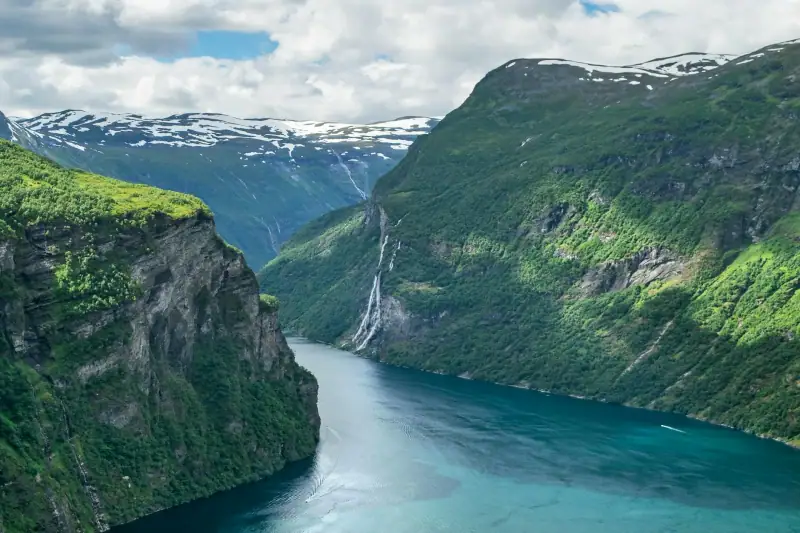
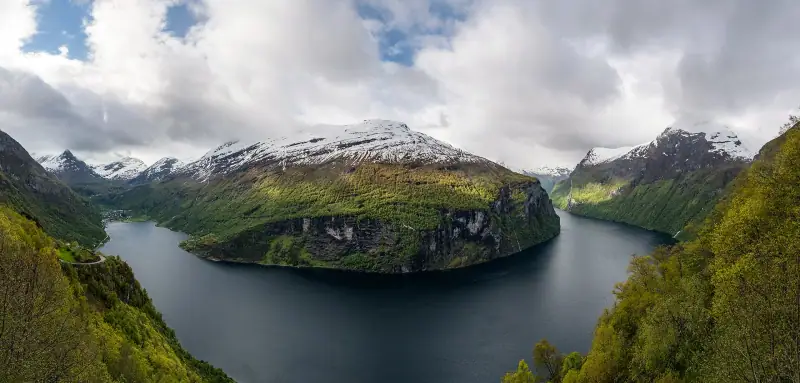
Cross the mountains to reach the Geirangerfjord, Norway’s other great UNESCO-listed jewel. The approach from the north on the Trollstigen (Troll Road) is spectacular: 11 hairpin bends on a 9% grade, with a waterfall that drops right next to the road.
Alternative: if the Trollstigen is closed (November to May), take the Ørnesvingen (Eagle Road), which drops 620 m (2,034 ft) in 11 bends toward Geiranger.
In Geiranger:
- Cruise on the Geirangerfjord: views of the Seven Sisters (a waterfall with seven jets), the Bridal Veil (the waterfall that answers), and the farms perched on the cliffs
- Dalsnibba viewpoint (1,500 m / 4,921 ft, paid access): a sweeping view of the fjord from the summit
- Hike to the abandoned farms of Skageflå or Knivsflå on the fjord walls
Stage 5: Ålesund and back to Bergen (4-5 h)
Ålesund is a remarkable town, rebuilt entirely in Art Nouveau style after a fire in 1904, which gives it a unique architectural coherence. The view from Mount Aksla (418 steps) over the archipelago around the town is beautiful.
Return to Bergen via the RV15 or by ferry from Molde.
Viewpoints not to miss
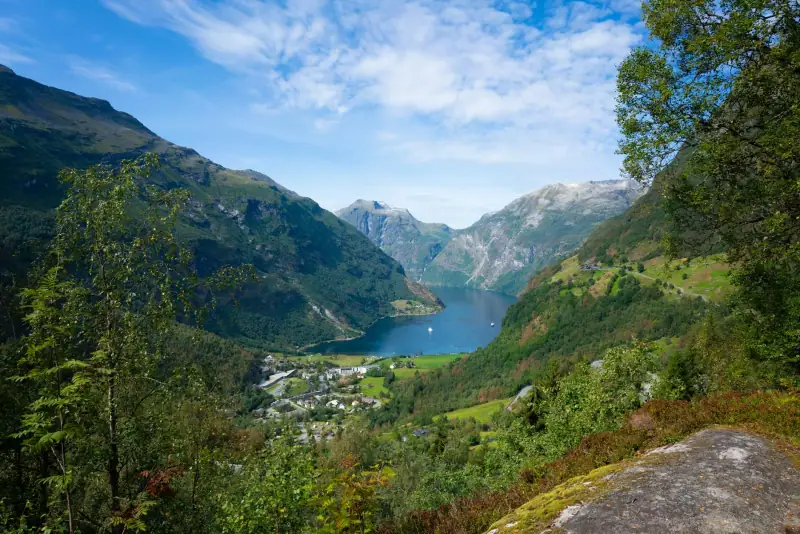
- Stegastein (Aurlandsvangen): a steel viewing platform over the Aurlandsfjord, 650 m (2,133 ft) up
- Dalsnibba: a sweeping view of the Geirangerfjord from 1,500 m (4,921 ft)
- Ørnesvingen: 11 hairpin bends overlooking Geiranger
- Trollstigen: the Troll Road with the steel viewing platform facing the waterfalls
- Utsikten (Gaularfjellet): a panoramic view over the fjords of central Norway
Fuel and tolls: what to know
Fuel: Gas stations are rarer in remote areas. Never let the tank drop below a quarter. Prices are fairly uniform across Norway: about €2.10 per liter (about $2.44/L, or $9.20 per US gallon).
Tolls (AutoPASS): Many tunnels and bridges charge tolls. The rental car is registered in the system, and tolls are billed automatically to the associated bank card (sometimes several weeks later). For a 7 to 10 day fjords circuit, plan €40 to €80 (about $46 to $93) in tolls.
Ferries: Ferry crossings are very well organized. Prices vary with distance and whether you bring your car (€20 to €80 per car crossing, about $23 to $93). Some crossings are paid by card directly on board. Details on payment methods (FerryPay, AutoPASS) are in our guide to ferries in Norway with a car.
Frequently asked questions
Do you need a special car for the fjord roads in Norway?
A standard car is enough in summer. An SUV or all-wheel-drive car is recommended in spring (roads still snowy) and winter (slippery mountain roads). Winter tires (or chains) are required whenever the road is snowy or icy; rental companies equip their cars in season.
How many days do you need for a fjords road trip?
Plan at least 5 days for the classic Bergen, western fjords and back to Bergen loop. To include Geirangerfjord and the Trollstigen (Troll Road), allow 7 to 10 days.
Are the fjord roads hard to drive?
Some roads are narrow with tight bends (especially the access roads to the most remote fjords). The Trollstigen is impressive but perfectly drivable in a normal car. Driving slowly and respecting right of way is essential.
How much does a rental car cost for a fjords road trip?
Plan €60 to €120 a day (about $70 to $140) for a compact car or SUV depending on the season. Fuel costs about €2 per liter. Tolls (tunnels, bridges) add €30 to €70 (about $35 to $80) on a 7 to 10 day circuit.
Can you do the fjords road trip without booking lodging in advance?
Outside July and August, last-minute lodging is possible. In high season, book ahead. Some villages have only one hotel or rorbu, and if it is full, the next village can be 50 km (31 mi) away.
More Norway guides
Keep reading
Norway Trip Budget: How Much Does a Trip Cost in 2026?
How much to budget for a trip to Norway? Detailed prices for lodging, food, transport and activities, plus tips to save money.
Trolltunga and Preikestolen: Guide to Norway's Two Iconic Hikes
All about Trolltunga and Preikestolen: access, difficulty, season, logistics. Norway's two most spectacular hikes explained in detail.

Where to Stay in Bergen: Best Neighborhoods and Hotels
Complete guide to where to stay in Bergen: historic Bryggen, the city center, Nordnes. Hotels, hostels and rentals for every budget.
Ready-made
Norway itineraries

7 days
Norway in 7 Days: Complete Itinerary for Oslo, Bergen and the Fjords
OsloBergen
Can be adapted in the planner
7 days
Lofoten and Tromsø in one week: doable or too ambitious?
Combining Lofoten and Tromsø in 7 days: real distances, travel times, a day-by-day plan and alternatives if the pace is too tight.
10 days
Norway in 10 Days Without a Car: A Realistic Train and Boat Itinerary
OsloFlåmVossBergenTrondheim
Can be adapted in the planner