Itineraries
Maldives in 10 days: a complete itinerary to explore the atolls
We may earn a commission when you book through links on this page, at no extra cost to you. We don't visit or try the places we cover: we summarize published sources. How we work
Day by day
- Days 1-2Malé: markets, Friday Mosque, museum; then Hulhumalé beach
- Days 3-5Maafushi: snorkeling, dolphin trip, diving, sandbank
- Days 6-7Thulusdhoo: surf, local life, Coca-Cola factory island
- Days 8-9Ari Atoll via Rasdhoo: diving, whale sharks, snorkeling
- Day 10Return to Malé and the airport
In short
- Ten days cover Malé and Hulhumalé (days 1-2), Maafushi (3-5), Thulusdhoo (6-7) and Ari Atoll via Rasdhoo (8-10).
- Guesthouse-only budget: €720-1,390 per person (about $835-1,610), international flights excluded.
- Public ferries cost under $2; speedboats run $25-80 per person and seaplanes $100-250 per person each way.
- Book speedboat and seaplane transfers ahead, especially in the December-March high season, and keep 2 spare days.
Ten days in the Maldives is the ideal format to go beyond the postcard image of the overwater-villa resort and see the real diversity of the archipelago. In a week and a half, you can stroll through the capital Malé, settle into a guesthouse on a local island, dive in remarkably clear lagoons, surf a renowned wave and, if the budget allows, finish in a more remote atoll. Here is a structured itinerary, adapted to different budgets, with transport, travel times and the highlights of each stage.
Before you go: preparing your 10-day stay
Logistics basics
International flights land at Velana International Airport (MLE), on the island of Hulhulé, a few minutes by water taxi from Malé. Many itineraries stop over in Dubai, Doha, Abu Dhabi, Colombo or Kuala Lumpur.
Entry rules depend on your passport. Check the official travel advice of your government before you book: travel.state.gov (US), GOV.UK (UK), travel.gc.ca (Canada), Smartraveller (Australia) (checked November 2026). As of October 2026, our source describes a free 30-day tourist visa granted on arrival at immigration, with no prior application. The only online formality is the IMUGA declaration (Traveller Declaration), free, to be completed within 96 hours before arrival at imuga.immigration.gov.mv. Present your passport, a return ticket and your accommodation booking.
Choosing between a resort and a guesthouse
This is the defining decision of your stay. Resorts (on private islands, from €400-600 per night, about $465-695) offer total immersion, alcohol and a full range of services. Guesthouses on local islands (€30-120 per night, about $35-140) let you meet locals, take the public ferries and book excursions on demand. For a 10-day stay, many travelers opt for a mix: guesthouses most of the time, and one or two nights in a resort for the overwater bungalow experience.
For a detailed comparison of the two options, see our guide to resorts vs guesthouses in the Maldives.
Flights to Malé
Compare the best flight deals with a stopover to Velana Airport (MLE).
Days 1-2: Malé and Hulhumalé
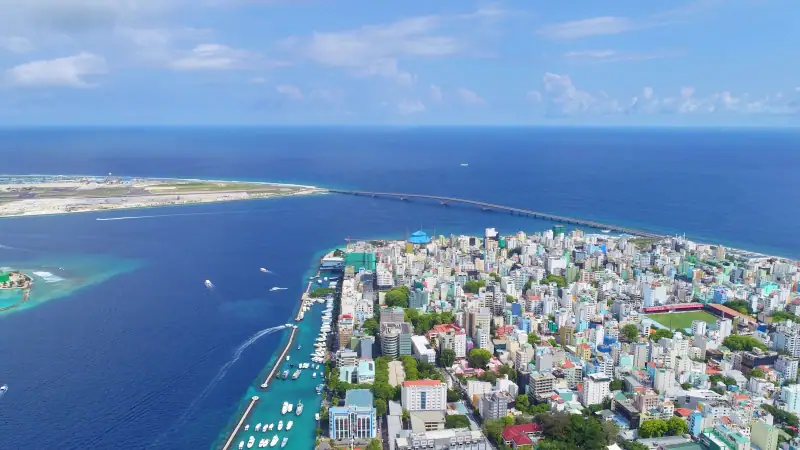
Day 1: arrival and discovering Malé
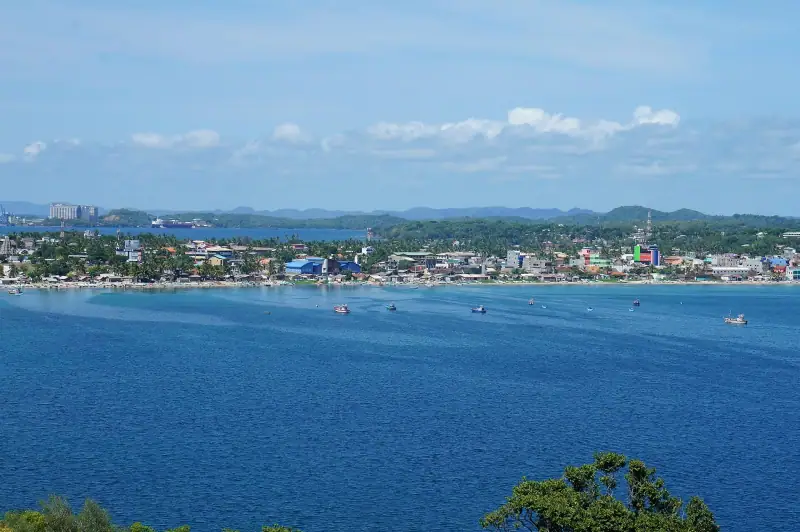
Your first contact with the Maldives is Malé, one of the most densely populated capitals in the world. About 212,000 people live on roughly 2 km² (0.8 sq mi, the area of the main island). This density gives the city a unique energy: busy shopping streets, white mosques, fish markets, and an authentic local life that most travelers do not suspect.
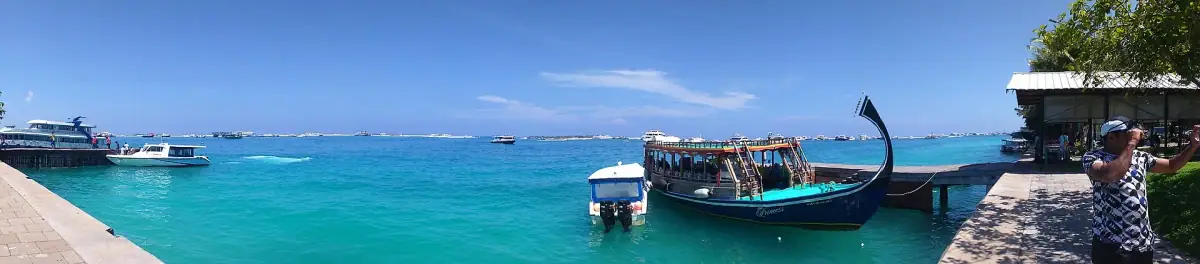
After arrival formalities, get to your accommodation in Malé by water taxi (about 10 minutes from the airport, around $10-15 depending on negotiation) or by public ferry (cheaper but less frequent). Most guesthouses can arrange your airport transfer.
Spend your first afternoon exploring the city on foot: the fish market (busiest in late morning), the local market, and the Grand Mosque (Masjid al-Sultan Muhammad Thakurufaanu al-Auzam), visible from across the city with its golden dome. End at the waterfront (Rasfannu Recreational Park) to watch the sunset over the lagoon.
Day 2: Malé and Hulhumalé
In the morning, visit a few essential sites in Malé: the Maldives National Museum in Sultan Park (modest entrance fee, collections on the archipelago’s pre-Islamic history) and the Hukuru Miskiy (the historic Friday Mosque, built of coral in 1658, one of the oldest in the country).
In the early afternoon, cross the Sinamalé Bridge (1.39 km / 0.86 mi, opened August 30, 2018) on foot, by taxi or by local bus to reach Hulhumalé. This artificial island, created by land reclamation, is a striking contrast to Malé: wide streets, modern buildings, and a long, accessible beach (a rarity in the capital). Velana Airport sits on the neighboring island of Hulhulé; the two islands are distinct but connected, and often confused. An evening walk on the beach, with a view of the Indian Ocean horizon, is a nice start to the stay.
To go deeper on the capital, our article Malé: the capital’s highlights details all the visits.
Days 3-5: Maafushi and South Malé Atoll
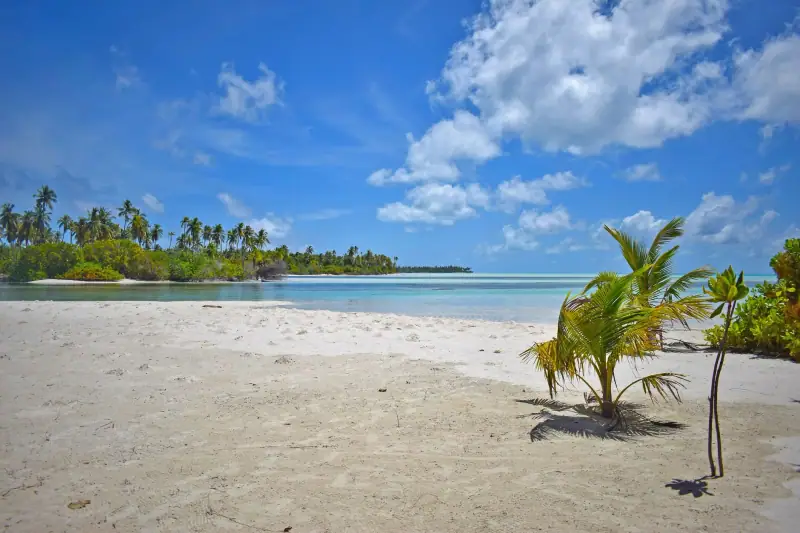
How to get to Maafushi
Maafushi is the most accessible local island from Malé and one of the most developed for guesthouse tourism. It lies in Kaafu Atoll (South Malé Atoll), about 26 km (16 mi) south of Malé.
Two transport options:
- Public ferry: departs from the Malé ferry terminal, about 1.5 to 2 hours, under $2. Limited frequency (one or two departures a day according to the official schedule, to be checked locally).
- Private speedboat: 30 to 45 minutes, $25-40 per person. Offered by most guesthouses, often included in some packages.
Guesthouses in Maafushi
Find the best guesthouses with lagoon views, breakfast included.
What to do in Maafushi (days 3, 4, 5)
Maafushi is an inhabited island of about 3,000 people, less than 1 km (0.6 mi) long. Its proximity to Malé makes it the ideal base for budget travelers who want to enjoy marine life without paying resort rates.
Excursions to organize from Maafushi:
-
Snorkeling in the local lagoon: the coral reefs around Maafushi are a few minutes away, whether you swim or take a boat. Sea turtles, parrotfish and stingrays are frequently seen. Most guesthouses rent fins and masks ($5-10 per day) and offer guided sessions in the morning.
-
Sunset dolphin trip: one of the most popular activities in the archipelago. Boats leave in the late afternoon for areas where dolphins pass (often spinner dolphins or bottlenose dolphins). The trip lasts about 2 hours and costs $25-40 per person depending on the operator.
-
Diving the atoll’s reefs: South Malé Atoll has many dive sites reachable from Maafushi, notably kandu (channels) where currents attract reef sharks, groupers and rays. Guesthouse dive centers offer two-dive outings ($60-90 for 2 dives with equipment).
-
Sandbank: several excursions go to sandbanks that are submerged at high tide and exposed at low tide. An hour by boat round trip to end up on a strip of white sand surrounded by turquoise water. Price: $25-40 depending on distance.
For more on underwater activities, read our guide to diving in the Maldives.
Days 6-7: Thulusdhoo, the surfers’ island
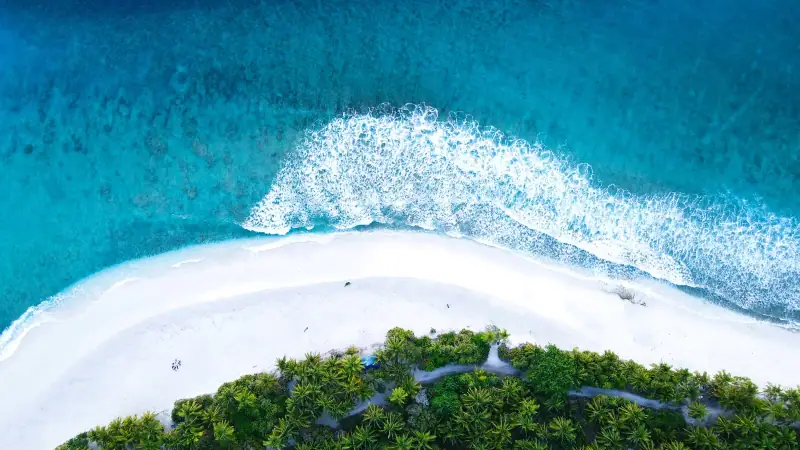
Getting to Thulusdhoo from Maafushi
Thulusdhoo is in North Malé Atoll (Kaafu Atoll), about 27 km (17 mi) northeast of Malé. From Maafushi, you first need to return to Malé (ferry or speedboat), then take another ferry or speedboat to Thulusdhoo (about 1 hour from Malé, under $2 by public ferry).
Thulusdhoo: surf, Coca-Cola bottling and local life
Thulusdhoo is known mainly for two things: its world-class waves and… its Coca-Cola bottling plant, the only one in the whole archipelago.
Surfing in Thulusdhoo:
The “Cola” (or “Coke”) surf spot, a few minutes by boat from the island, is considered one of the best spots in the Indian Ocean for intermediate to advanced surfers. The spot works mainly from April to October (wet season), with steady west-southwest swells. Guesthouses offer surf packages (boat shuttle plus access to the spot for $15-25 per day).
If you do not surf, the island is pleasant to explore on foot. Its modest size (fewer than 1,500 residents) means you can cross it in 20 minutes. The bikini beach is clean and quiet, and the sunset from the waterfront is especially beautiful.
Surf lessons and water activities
Book your surf sessions or guided snorkeling in the Maldives.
Days 8-10: Ari Atoll
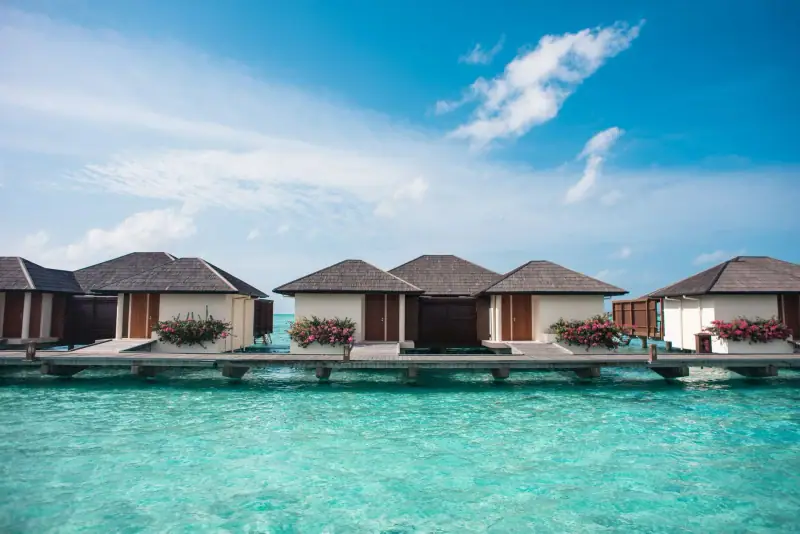
Why go to Ari Atoll
Ari Atoll (administratively divided into Alif Alif in the north and Alif Dhaal in the south) is a paradise for divers and marine megafauna fans. It is one of the best places in the world to swim with whale sharks (present year-round in the South Ari Marine Protected Area, with a sighting rate of 70-90% whatever the season) and to see manta rays (year-round at some sites).
The atoll also has particularly clear lagoons, many resorts on private islands, and a few local islands (including Rasdhoo) that allow a guesthouse stay at a reasonable price.
How to get to Ari Atoll
From Malé, two options:
- Seaplane: about 25 minutes of spectacular flight with a bird’s-eye view of the atolls. Indicative price: $100-250 per person each way depending on the exact destination in the atoll. Advance booking is mandatory.
- Speedboat: 2 to 3 hours depending on the destination in the atoll, $40-80 per person. Cheaper but longer.
Rasdhoo: the local gateway to Ari Atoll
Rasdhoo is a small inhabited island in its own atoll (Rasdhoo Atoll), adjacent to the northeast of Ari Atoll but geographically distinct from it. It is reachable in about 2 hours by speedboat from Malé. It is an ideal guesthouse base for exploring the atoll’s dive sites without paying resort rates.
The dive sites around Rasdhoo are known for hammerheads, sometimes seen in schools at night or early in the morning in the deep channels. Local dive centers run “hammerhead sunrise dives” from 5:30 am to take advantage of the best sighting window.
For non-divers, snorkeling excursions let you see turtles, rays and many species of tropical fish on the shallow reefs.
Our detailed guide to visiting Ari Atoll gives all the information on sites and accommodation.
Day 10: back to Malé and the airport
Plan your last night in Hulhumalé or Malé to be close to the airport. If your flight leaves early in the morning, it is a good idea to pre-book a transfer or to stay directly in Hulhumalé or Hulhulé (right next to Velana Airport). Many guesthouses and hotels in various categories are available in this area.
Stays in Hulhumalé near the airport
Guesthouses and hotels close to Velana Airport for your last night.
Estimated budget for 10 days
Here is an estimate by traveler profile (international flights excluded):
All-guesthouse option (budget)
- Accommodation: €40-80 per night (about $45-95) × 9 nights = €360-720 (about $420-835)
- Meals: €15-25 per day (about $17-29) × 10 days = €150-250 (about $175-290)
- Inter-island transport: €60-120 (about $70-140) (ferries + speedboats)
- Excursions: €150-300 (about $175-350) (snorkeling, dolphins, diving, sandbank)
- Estimated total per person: €720-1,390 (about $835-1,610)
Mixed option (guesthouse + a few resort nights)
- Accommodation: a mix of guesthouse (€50-80 per night, about $58-93) and resort (€200-400 per night, about $230-465, for 2 nights)
- Estimated total per person: €1,400-2,200 (about $1,625-2,550)
For every detail on keeping your budget under control, our Maldives budget guide gives precise benchmarks.
Tips to optimize your 10-day itinerary
Book speedboats and seaplanes in advance. Transfers can sell out in high season (December-March) if you wait until the last minute. Contact your guesthouse when you book to organize inter-island transfers.
Keep 2 spare days. Weather can make some speedboat crossings uncomfortable (or impossible) in the wet season. A bit of flexibility in your schedule will save you stress.
Plan your stay around the tides for sandbanks. Sandbanks are only visible at low tide. Your guesthouse knows the tide times and can advise on the best moment for this excursion.
Bring cash. While ATMs in Malé and Maafushi work fine, more isolated islands do not always have them. Bring enough USD (or euros, accepted in many places) for excursions and meals on your days in remote atolls.
Respect dress codes on local islands. As the Maldives is an Islamic country, inhabited islands require modest dress outside the designated “bikini beaches”. A sarong or a T-shirt within reach is essential.
Variations to customize your itinerary
If you are an experienced diver
Replace Thulusdhoo with Fuvahmulah, an isolated atoll in the south of the archipelago known for encounters with tiger sharks, hammerheads and rays of all kinds. The trip from Malé is long (domestic flight plus boat), but the experience is unique in the world.
If you are traveling with family
Focus on Malé + Maafushi + Rasdhoo and favor snorkeling in shallow lagoons over diving. Dolphin trips and sandbank outings are a big hit with children. Avoid long speedboat rides with young children.
If you have a high budget
Add a night or two in a resort with an overwater bungalow in Ari or Baa Atoll. Book directly by contacting the resorts (or through Booking.com) for the best last-minute offers in the off-season.
To plan a full week in the Maldives, our Maldives in 7 days itinerary is a good alternative reference.
Sources
- Visit Maldives: practical information
- Visit Maldives: guesthouse culture
- Maldives Immigration: figures checked November 2026
Frequently asked questions
Is 10 days in the Maldives enough?
Yes, 10 days let you see the essentials: the capital Malé, one or two local islands in South Malé Atoll, a surf or diving island, and possibly Ari Atoll. It is an ideal format for mixing culture, diving and downtime without rushing.
What budget should you plan for 10 days in the Maldives?
In guesthouses on local islands: €720-1,390 per person (about $835-1,610), flights excluded. Combining guesthouses with one or two resort nights: €1,400-2,200 (about $1,625-2,550). Luxury resorts only: €5,000 (about $5,800) and up. Most of the budget goes to accommodation and excursions.
How do you get around between islands in 10 days?
Public ferries (under €2, about $2.30, per trip) serve the islands near Malé: Maafushi, Thulusdhoo, Hulhumalé. For farther atolls such as Ari or Baa, take a speedboat ($25-80 per person depending on distance) or a seaplane ($100-250 per person each way).
What is the best season for a 10-day stay in the Maldives?
The dry season (November to April) offers the best conditions: clear skies, calm seas, excellent underwater visibility. December-March is high season (higher prices). The wet season (May-October) can suit tight budgets, and whale sharks are present year-round in the south of Ari Atoll.
Can you do the Maldives without a resort in 10 days?
Absolutely. The archipelago has many inhabited local islands where comfortable guesthouses offer rooms with lagoon views, excursions and breakfast, for a budget well below resorts. Maafushi, Thulusdhoo, Rasdhoo and Fuvahmulah are popular bases for this kind of stay.
Do you need a visa to go to the Maldives?
Entry rules depend on your passport. Check the official travel advice of your government before you book: travel.state.gov (US), GOV.UK (UK), travel.gc.ca (Canada), Smartraveller (Australia) (checked November 2026). As of October 2026, our source describes a free 30-day tourist visa on arrival, a machine-readable passport valid on arrival (Maldivian immigration states at least 1 month; some airlines require 6, so check with yours), a return ticket, proof of accommodation and the free online IMUGA declaration, to be filled in within 96 hours before arrival.
More Maldives guides
Keep reading
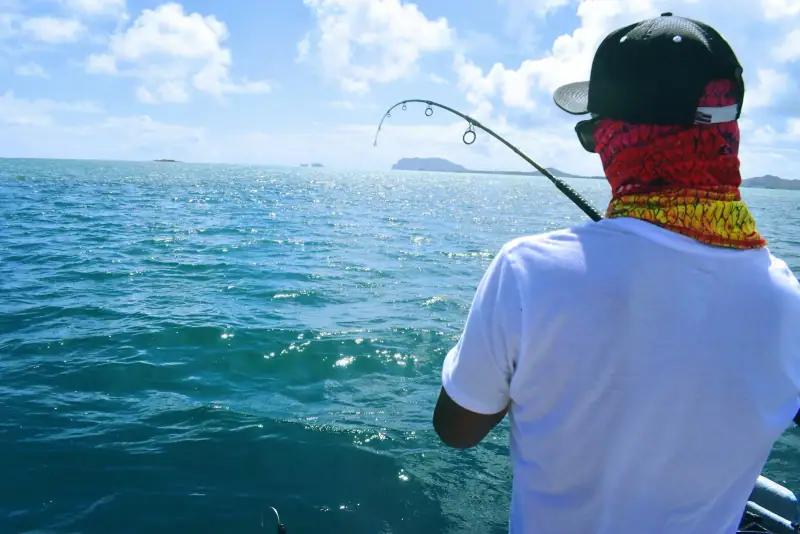
Sunset and night fishing in the Maldives from a local island: prices, booking, rules
Hand-line fishing by dhoni at sunset or night from a guesthouse: realistic prices, booking on the spot, fish cooked at dinner and the rules.
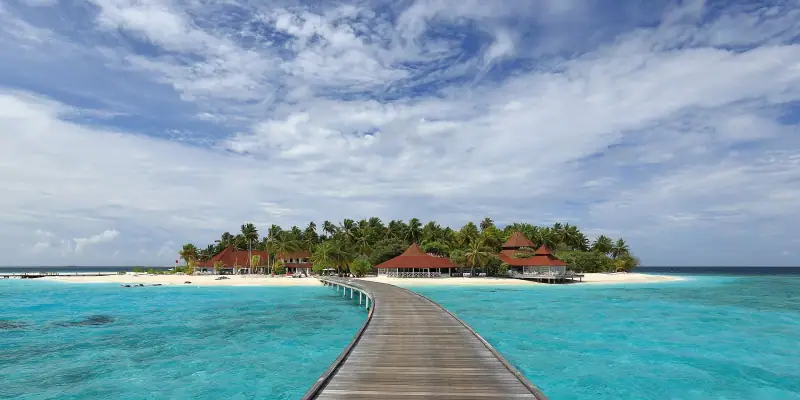
Visiting Ari Atoll: a complete guide to the whale shark paradise
Ari Atoll, Maldives: whale sharks year-round, Maaya Thila, Dhigurah and guesthouses. Complete 2026 guide to this exceptional atoll.
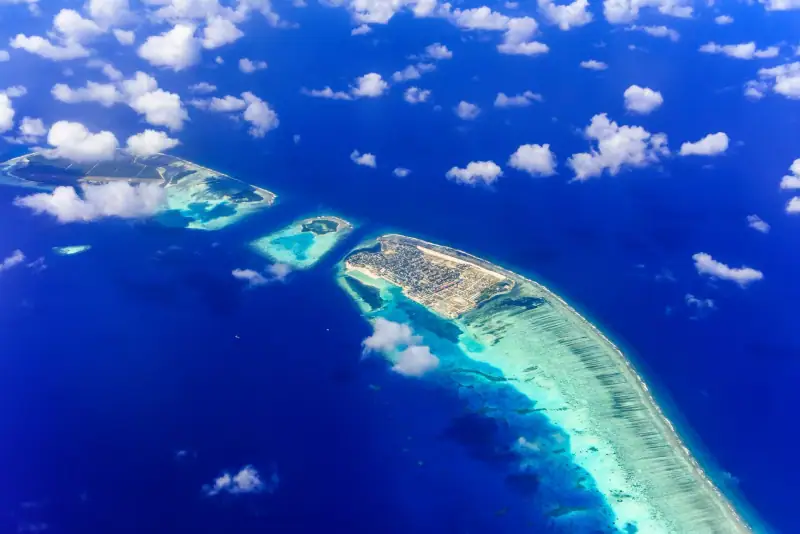
Visiting Addu Atoll: a complete guide to the Maldivian end of the world
Addu Atoll, Maldives: diving the British Loyalty wreck, a unique causeway, Addu City and preserved nature. Complete 2026 guide to the southernmost atoll.
Ready-made
Maldives itineraries
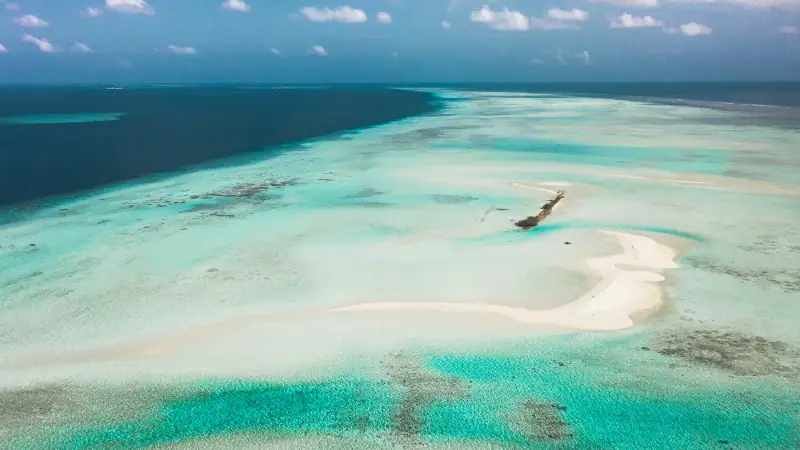
7 days
Maldives in 7 days: the ideal full-week itinerary
Complete itinerary to visit the Maldives in 7 days: Malé, Maafushi, island hopping and resort option. Day-by-day plan with practical tips.
5 days
Maldives in 5 days without a seaplane: a realistic local-island itinerary
MaafushiThulusdhoo