What to see
Visiting Arrecife: A Complete Guide to Lanzarote's Capital
We may earn a commission when you book through links on this page, at no extra cost to you. We don't visit or try the places we cover: we summarize published sources. How we work
In short
- Arrecife is about 6 km (3.7 mi) from Lanzarote airport; the old center (Charco de San Ginés, Castillo de San Gabriel, Reducto beach) is walkable.
- The Castillo de San José, home of the MIAC contemporary art museum, is about 3 km (1.9 mi) from the center: take a car or taxi.
- Arrecife works as a base: Timanfaya is about 33 km (20 mi) away, La Geria 20 km (12 mi), the northern caves 30 km (19 mi) and Playa Blanca 35 km (22 mi).
- A local lunch menu costs about €10-14 (~$12-16); a 3-star hotel about €60-120 (~$70-140) per night.
Arrecife is not a destination that travel agencies promote. Most tourists who land at Lanzarote airport head straight to Puerto del Carmen or Playa Blanca, catching only a glimpse of the capital from the highway. That is a mistake.
A city of some 70,000 people on Lanzarote’s east coast, Arrecife hides one of the most beautiful urban lagoons in the Canary Islands, two historic castles, a contemporary art museum set in an 18th-century fort by César Manrique himself, and an authentic Spanish neighborhood life that the beach resorts simply cannot reproduce.
This complete guide gives you everything you need to enjoy Arrecife, whether you have a day between flights or want to make it your base for exploring Lanzarote.
The Charco de San Ginés: the beating heart of Arrecife
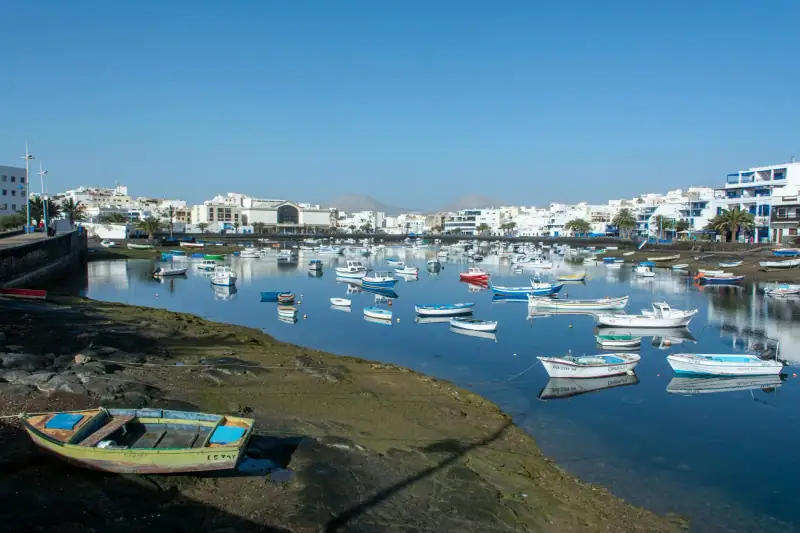
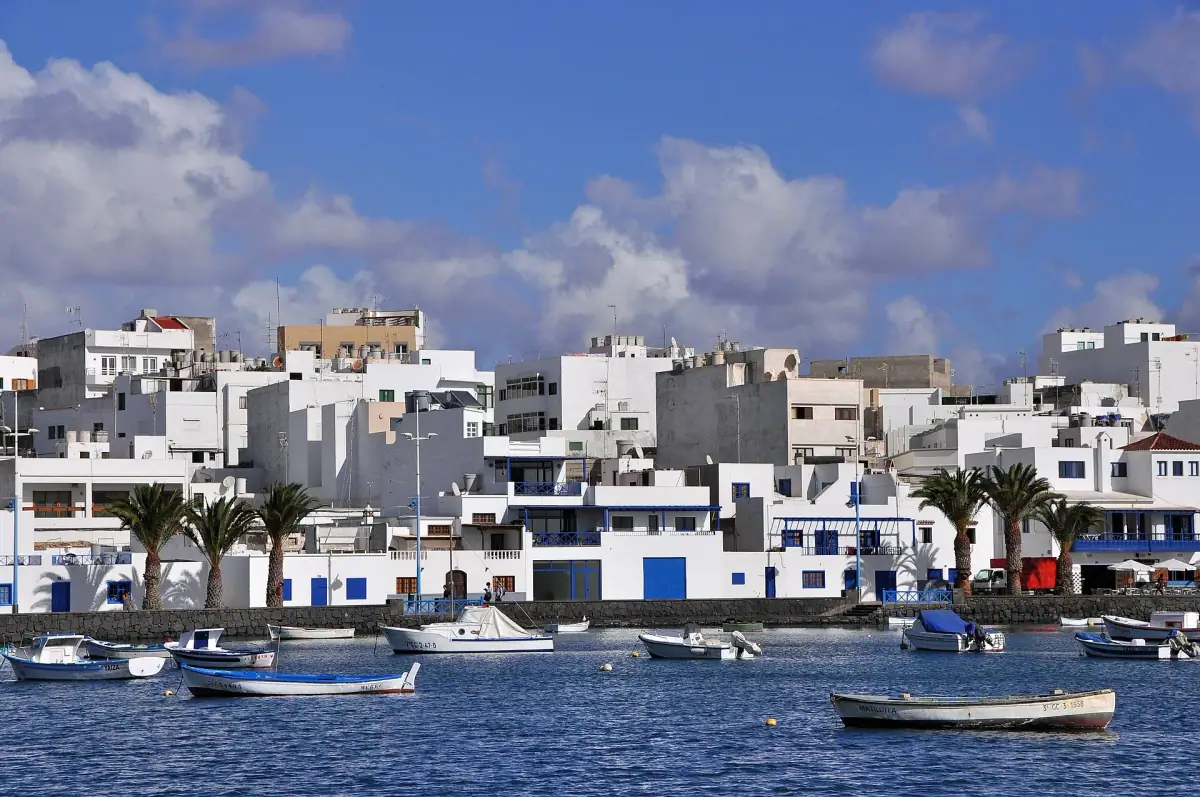
If Arrecife has a postcard, it is the Charco de San Ginés. This natural saltwater lagoon sits in the city’s historic center, lined on one side with white houses with colorful shutters and on the other with fishing boats painted blue and yellow. Connected to the ocean by a channel to the north, the Charco partly empties at low tide, revealing its sandy bottom and the wooden hulls of the small boats.
The Paseo de San Ginés, which rings the lagoon, is the favorite promenade of Arrecife’s residents. At sunset, families, retirees and young couples gather there, a scene of local life far more pleasant than the island’s tourist seafronts. Benches, palm trees and a few café terraces let you linger without feeling like an intruder.
San Ginés church
At the end of the Charco, the Iglesia de San Ginés is Arrecife’s patron church. Built between the 17th and 19th centuries, it has a plain three-door facade typical of religious architecture in the Canary Islands. The interior is surprisingly bright, with wooden vaults and a modest baroque altar. The plaza in front of the church is shaded and quiet, a good starting point for exploring the historic district.
Plaza de Las Palmas and the old town
A few steps from the church, Plaza de Las Palmas is the living room of the old quarter. Surrounded by houses with carved wooden balconies and a few traditional shops, it has a colonial charm found in the best-preserved town centers of the Canary Islands. Take time to wander the neighboring lanes to see the low, whitewashed houses.
Hotels in Arrecife and Lanzarote
Stay in town for authenticity, or on the coast for the beaches. Find the best rate for your trip.
Castillo de San Gabriel: a sentinel on the water
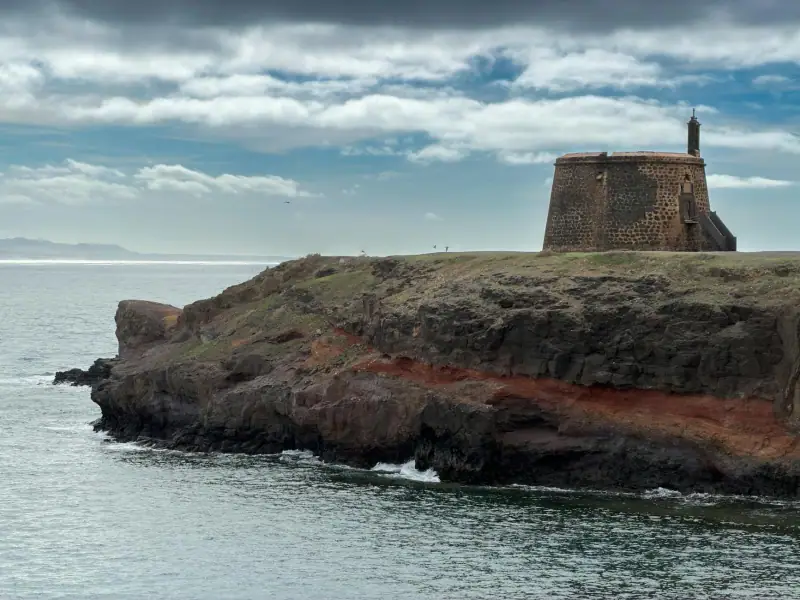
At the eastern end of downtown, the Castillo de San Gabriel is perhaps Arrecife’s most picturesque monument. This 16th-century castle is built on a small rocky islet in the sea, linked to the shore by a stone drawbridge and then an arched bridge, the Puente de las Bolas, with two cannonballs set on it as guard posts.
Built to defend the town from the Barbary pirate raids that ravaged the Canarian coasts, the castle was reworked several times before being abandoned and finally restored in the 20th century. Today it houses the Museo Arqueológico de Lanzarote (officially the Museo de Historia de Arrecife since 2014), small but interesting: pre-Hispanic remains of the Majos (Lanzarote’s first inhabitants), ancient pottery, obsidian tools and reconstructions of island life before the Castilian conquest.
The view from the ramparts over Arrecife bay and the fishing harbor is superb in late afternoon, when the golden light tints the white facades.
Getting there: From the center of Arrecife, allow 10-15 minutes on foot along the seafront. Admission is cheap (about €3 / about $3). Check opening hours before you visit, as they can vary by season.
Castillo de San José and the MIAC: César Manrique at his best
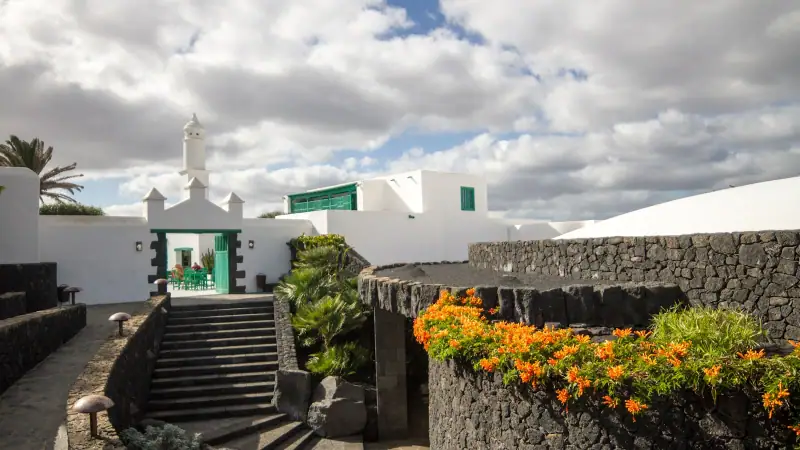
About 3 km (1.9 mi) north of the center, toward the industrial port, the Castillo de San José is a visit that any art or architecture lover should put on their Lanzarote list.
This 18th-century fort, built under the reign of Charles III to protect Arrecife’s port and to give work to residents during a severe famine, was completely renovated in the 1970s by César Manrique, the great artist and architect born in Arrecife in 1919. Manrique turned the black lava vaulted rooms into a setting for the Museo Internacional de Arte Contemporáneo (MIAC).
The MIAC collection
The permanent collection brings together works by 20th-century masters (Miró, Picasso, Millares) as well as several major pieces by Manrique himself. What stands out more than the individual works is the coherence of the whole: the art talks to the lava architecture, the play of filtered light and the view of the port. Manrique rejected the idea of the black-box museum; here, every room is a composition in its own right.
The panoramic restaurant
On the ground floor of the castle, a panoramic restaurant has a spectacular view of Arrecife’s industrial port and the sea. Unlikely on paper, this contrast between the beauty of the natural setting and the movement of fishing and cargo boats is exactly the kind of paradox Manrique sought to elevate. It is an ideal place for lunch or a drink before or after the visit.
Getting there: By car or taxi from the center (10 min). On foot, about 40 minutes along the coast. Check opening hours and admission prices on site or on the castle’s official website before you go.
Tours and guided visits in Lanzarote
César Manrique Foundation, Timanfaya, Jameos del Agua: book your tours in advance for the most popular sites.
Reducto beach: Arrecife’s city beach
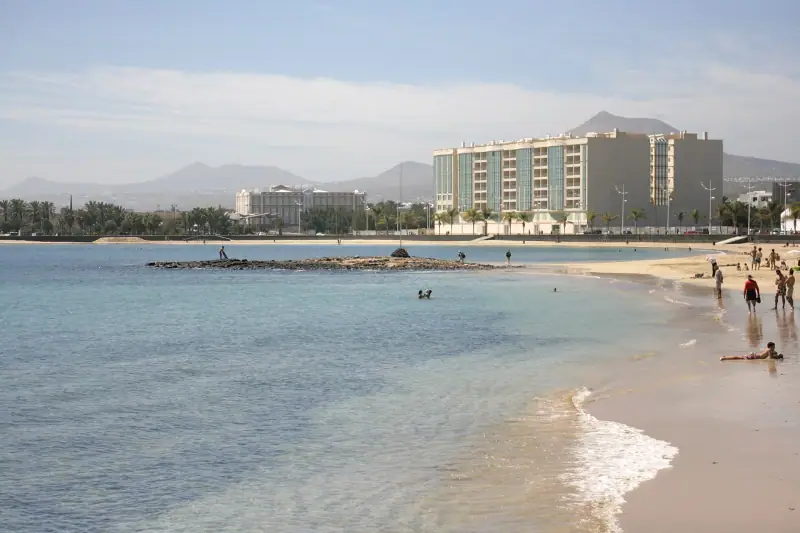
Steps from downtown, Playa del Reducto is Arrecife’s main beach. About 1.2 kilometers (0.75 mi) long, it runs along Avenida Generalísimo Franco with its palm trees and terraces. The sand is fine and golden, and the sea is generally calm thanks to the orientation of the bay, which makes it perfect for swimming with the family.
It is not the wildest or most secret beach in Lanzarote, but it is the one where you will meet Arrecife’s residents, not just tourists. In the morning, locals jog or swim there before work. In the evening, strollers walk the seafront until nightfall.
Facilities: Showers, sunbed rental, a few snack bars. Swimming flags are enforced by lifeguards in high season.
Nearby: The avenue along the beach has hotels, seafood restaurants and car rental agencies, which is handy on arrival.
César Manrique, son of Arrecife: understanding his legacy
You can’t spend a day in Arrecife without thinking of César Manrique (1919-1992). Born in Lanzarote’s capital, this painter, sculptor and architect devoted his life to protecting his island’s volcanic identity from mass tourism. His influence shows everywhere, and not only in the buildings he designed.
Manrique imposed on Lanzarote an aesthetic code built on three rules: no billboards (he had them all removed), architecture blended into the landscape (no skyscrapers, white and black colors like the lava), and enhancing the natural heritage rather than destroying it. Lanzarote was named a UNESCO World Biosphere Reserve in 1993, a year after his death, largely thanks to his fight.
Sites to see around Arrecife
The César Manrique Foundation is housed in Manrique’s former home and studio in Tahíche, about 6 to 7 km (4 mi) north of Arrecife. Built in and around five volcanic bubbles, it is at once a museum, a work of art and a statement of architectural intent. The visit is essential to understand the artist’s approach.
About 30 km (19 mi) to the north, the Jameos del Agua (a volcanic cave and underground lake) and the Cueva de los Verdes (a 6 km / 3.7 mi lava tunnel) are two more sites developed by Manrique. Our 5-day Lanzarote itinerary includes these stops in a full circuit from Arrecife.
Eating in Arrecife: like a local
Arrecife is the ideal place to discover authentic Canarian cuisine, without the inflated prices of the tourist areas.
Specialties to try
Papas arrugadas con mojo: The national dish of the Canary Islands. Small potatoes cooked in very salty water until the skin wrinkles and crystallizes, served with mojo rojo (garlic, chili and cumin sauce) or mojo verde (with cilantro and green pepper). Simple, good and found throughout the Canary Islands.
Pescado fresco: Arrecife is an active fishing port. Restaurants around the harbor and the Charco serve the fish of the day (vieja, or parrotfish; cherne, or grouper; sama, or sea bream; atún, or tuna), usually grilled over embers or in mojo. Look for small places without photo menus at the entrance.
Gofio: Toasted grain flour, a staple of Canarian food for centuries. You’ll find it in soups, sauces, desserts or simply mixed with milk. A little unusual the first time, and worth trying.
Queso majorero and queso lanzaroteño: PDO goat cheeses from Fuerteventura and Lanzarote. Often served as a starter, sometimes rubbed with mojo, sometimes grilled. Pair with a glass of Lanzarote Malvasía (local white wine from the La Geria vineyards).
Where to eat in Arrecife
The Charco district has the best local spots: look for restaurants that are busy at lunchtime (1:30 to 3:30 pm), where residents eat the set menu of the day for €10-13 (about $12-15). In the evening, the seafront near the Castillo de San Gabriel has terraces overlooking the bay.
Arrecife’s municipal market, downtown, is open weekday mornings and Saturday, with fresh local produce, vegetables, fish from the auction, and cheeses. A useful stop if you have a kitchen.
What to avoid: Restaurants right around the airport and places with giant multilingual signs, which generally offer disappointing value for money.
Car rental in Lanzarote
Essential for exploring Timanfaya, La Geria and the north of the island from Arrecife.
Arrecife as a base: the best trips from the capital
Arrecife sits in the middle of Lanzarote’s east coast, which makes it an excellent base for day trips around the island.
Timanfaya National Park (about 33 km / 20 mi)
Timanfaya National Park, better known as the Montañas del Fuego (Fire Mountains), is Lanzarote’s most spectacular attraction. This black lava national park, created by volcanic eruptions between 1730 and 1736 and again in 1824, looks like the surface of Mars. The Ruta de los Volcanes crosses it by guided bus (guided access only, from the Mancha Blanca parking lot).
From Arrecife, allow about 33 km (20 mi) and 40 minutes by car on the LZ-67 heading west.
La Geria and the lava vineyards (about 20 km / 12 mi)
The La Geria region, in south-central Lanzarote, is one of the most unusual wine landscapes in the world. The vines grow at the bottom of small hollows dug into the rock (the hoyos), protected from the wind by half-moon walls called zocos. Canarian Malvasía wines have been exported since the 15th-16th century, but La Geria’s wine landscape, with its hoyos dug into volcanic ash, was born after the Timanfaya eruptions of 1730-1736.
From Arrecife, La Geria is about 20 to 25 minutes by car on the LZ-30 heading west. Several bodegas offer tastings without a reservation.
The northern caves: Jameos del Agua and Cueva de los Verdes (about 30 km / 19 mi)
About 30 km (19 mi) north of Arrecife, the Corona Volcano volcanic complex holds two underground wonders. The Cueva de los Verdes is a 6 km (3.7 mi) lava tunnel, visited on a guided tour (about 1 km / 0.6 mi of it). The Jameos del Agua combine a volcanic cave with an underground lake that is home to the jameito (Munidopsis polymorpha), a blind endemic crustacean. Manrique installed a tropical garden and an underground auditorium there.
Allow 30-40 minutes from Arrecife on the LZ-1 heading north.
Playa Blanca and the south of the island (about 35 km / 22 mi)
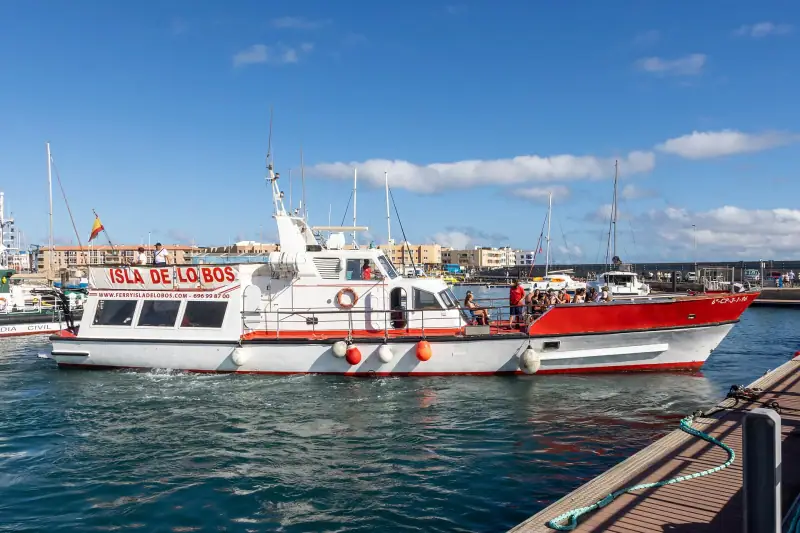
The big white sand beaches of southern Lanzarote (Playa Flamingo, Playa Dorada and the fabulous Papagayo beaches in a protected natural area) are about 35-40 minutes from Arrecife on the LZ-2 heading south. Playa Blanca is the departure point for the ferry to Corralejo (Fuerteventura), 30 minutes away. Our article on the best beaches in the Canary Islands compares the options by preference.
Where to stay in Arrecife
Arrecife is often overlooked as a place to stay, unfairly. Staying in town gives a radically different experience from the beach resorts.
Advantages of staying in town
- Walking access to the Charco, San Ginés church, local restaurants and the market
- Close to the airport (6 km / 3.7 mi, handy for late arrivals or early departures)
- Prices generally 20-40% lower than seafront hotels
- Authentic neighborhood life you can’t find in Puerto del Carmen
Types of lodging available
Hotels with sea views: Several 3 and 4-star hotels sit on the seafront, facing Playa del Reducto. Open views, direct beach access.
Apartments and short-term rentals: Ideal for families or stays of several days. Downtown apartments around the Charco offer the best balance of authenticity and comfort.
Central hotels: For travelers who want everything on foot: the beach, the Charco, restaurants and museums.
Tip: Arrecife is Lanzarote’s logistical base. If you plan to tour the island by car, it is more practical to stay here and make day trips than to move between different coastal hotels.
Flights to Lanzarote
Arrecife is 15 minutes from Lanzarote airport (ACE). Compare flights to the island.
Practical information for visiting Arrecife
Getting there
From the airport: The airport is about 6 km (3.7 mi) from Arrecife. Taxi: 10-15 minutes, about €10-15 (about $12-17). Bus line 22 (weekdays; line 23 on weekends and public holidays) links the airport to central Arrecife in 15-25 minutes for about €1.40 (about $1.60). Rental car: recommended if you plan to explore the island.
Getting around from Arrecife
By bus: Arrecife’s bus station is the island’s transport hub. Regular lines serve Puerto del Carmen, Playa Blanca, Costa Teguise, Haría and other destinations. Cheap but slower than driving.
By car: The recommended way to make the most of Lanzarote. All the major rental agencies are at the airport. Lanzarote’s road network is good and uncrowded outside July and August.
By taxi: Reliable and available from the main points. Fares are displayed in the vehicles.
Estimated budget for Arrecife
| Expense | Estimated budget |
|---|---|
| Lodging (3-star hotel) | €60-120/night (~$70-140) |
| Local set lunch | €10-14 (~$12-16) |
| Restaurant dinner | €18-35/person (~$21-41) |
| MIAC admission (Castillo San José) | low price, check on site |
| Rental car | €25-50/day (~$29-58) depending on season |
Our article on the Canary Islands budget explains how to make the most of your spending across the archipelago.
Safety and health
Arrecife is an ordinary Spanish city with no particular risk for tourists. The usual precautions apply, as in any city:
Sun and UV: The UV index in Lanzarote is high all year, much higher than many visitors are used to. SPF 50+ sunscreen is essential, even under cloud cover or in a cool wind.
Drinking water: Tap water in Lanzarote is desalinated and drinkable, but the taste is not always pleasant. Bottled mineral water is the usual choice.
Wind: The trade winds can be strong, especially in the morning on the east coast. Not a danger, but bring a light jacket for morning walks.
Emergencies: The Hospital General de Lanzarote is on the outskirts of Arrecife. For minor issues, pharmacies (farmacias) are found throughout the town center, identified by their green cross.
Arrecife in summary
Arrecife is the hidden side of Lanzarote. It is not the most photogenic if you are looking for white dunes and infinity pools, but it is arguably the most authentic and the most instructive. It is a fishing town turned administrative capital that has kept its Spanish character under the pressure of mass tourism, largely thanks to César Manrique’s legacy.
The Charco de San Ginés at sunset, the ramparts of the Castillo de San Gabriel over the sea, the volcanoes framed in the lava rooms of the MIAC, the €12 (about $14) lunch menu with a view of the harbor: these small, unadorned moments make Arrecife a worthwhile stop on any trip to Lanzarote.
Whether you spend a day there in transit or make it your base for exploring the whole island, Lanzarote’s capital will surprise you. And if you are planning your full trip, our guide to the Canary archipelago will help you build the ideal route between the islands.
Frequently asked questions
Is Arrecife worth a detour for a tourist?
Absolutely. Arrecife is often passed over in favor of Puerto del Carmen or Playa Blanca, but that is a mistake. Lanzarote's capital has an authenticity the beach resorts lack: a picturesque lagoon, two historic castles, an exceptional contemporary art museum in an 18th-century fort, and genuinely Spanish local life. A full day there is easy to fill.
How do you get from Arrecife to Lanzarote's main beaches?
Lanzarote airport is about 6 km (3.7 mi) from Arrecife. Puerto del Carmen and its big beaches are about 16 km (10 mi) away (15-20 min by car). Playa Blanca, in the south, is about 35 km (22 mi) away (40-45 min). To explore the island freely, a rental car is still essential. Regular buses serve Puerto del Carmen from Arrecife's bus station.
Where is the airport in relation to Arrecife?
Lanzarote international airport (ACE) is about 6 km (3.7 mi) southwest of Arrecife, 10-15 minutes by taxi or bus. Arrecife is the closest town to the airport, which makes it a natural stop on arrival or before departure.
What is the Charco de San Ginés?
The Charco de San Ginés is a natural lagoon in the heart of Arrecife, lined with white houses and colorful boats. Connected to the sea by a channel, it partly empties at low tide. In the evening, locals stroll along the Paseo de San Ginés. It is one of the most photogenic spots in all of Lanzarote.
Is the Castillo de San José museum really a must-see?
Yes, especially if you enjoy contemporary art or the work of César Manrique. The 18th-century castle houses the MIAC (International Museum of Contemporary Art), with works by Miró, Picasso and of course Manrique himself. The way art is built into the black lava architecture is spectacular. A panoramic restaurant overlooking the harbor completes the visit.
Can you visit Arrecife without a car?
Yes, for Arrecife's historic center. The Charco de San Ginés, Castillo de San Gabriel, Reducto beach and the shopping streets are all reachable on foot from the center. For the Castillo de San José (about 3 km / 1.9 mi from the center) and trips to the rest of the island, you need a car or taxi.
What is the best time to visit Arrecife?
Arrecife is pleasant all year. Spring (March-May) and fall (September-November) offer ideal temperatures (22-26 °C / 72-79 °F) with few tourists. Summer is hot (28-32 °C / 82-90 °F) but tempered by the trade winds. Winter stays mild (18-22 °C / 64-72 °F). Arrecife is a city to enjoy year-round, unlike the more seasonal beach resorts.
More Canary Islands guides
Keep reading
La Gomera: a complete guide to the island of forests and whistled language
La Gomera travel guide: Garajonay, El Silbo, Valle Gran Rey, hiking and food. Everything you need to visit the quietest of the Canary Islands.
Lanzarote: a complete guide to the Canary Islands' volcanic island
Lanzarote guide: Timanfaya, César Manrique, Jameos del Agua, La Geria and Papagayo beaches. Everything you need to plan your trip to the volcanic island.
Visiting Corralejo: Complete Guide to Fuerteventura's Beach Town
Corralejo, Fuerteventura: white-sand beaches, the Corralejo dunes, water sports, where to stay and what to do. A complete guide to plan your trip.
Ready-made
Canary Islands itineraries
5 days
Lanzarote in 5 Days: A Complete Itinerary for the Volcanic Island
5-day Lanzarote itinerary: Timanfaya, Jameos del Agua, Playa Papagayo, César Manrique. A day-by-day plan to make the most of the volcanic island.
Can be adapted in the planner
Island Hopping in the Canary Islands: Visiting Several Islands in One Trip
Island hopping in the Canary Islands: ferries, flights, multi-island itineraries and tips to combine Tenerife, Gran Canaria, Lanzarote and Fuerteventura.
5 days
Tenerife in 5 Days Without a Car: A Realistic Bus and Tram Itinerary
Puerto de la CruzLos Cristianos