What to see
Visiting Siem Reap: Complete Guide to Cambodia's Temple Town
We may earn a commission when you book through links on this page, at no extra cost to you. We don't visit or try the places we cover: we summarize published sources. How we work
In short
- Plan at least 3 days for Angkor Wat, the Bayon and Ta Prohm plus the town; 5 days adds farther temples and Tonle Sap.
- Angkor passes cost $37 for 1 day, $62 for 3 days and $72 for 7 days. A tuk-tuk for a temple day runs $15-25.
- November to February is the dry, cooler season (77-90 °F). The rainy season (May to October) means fewer crowds and lower prices.
- Budget roughly $30-50 a day on a backpacker budget, $60-100 for comfort, $150+ for luxury.
Siem Reap is the town that changes travelers. It is not just a base for visiting Angkor, even if it is the gateway to the largest Khmer temples in the world. It has developed a character of its own: lively markets, a nightlife street, apsara dance shows, ambitious chefs and craftspeople who keep centuries-old skills alive. All around lies Tonle Sap, the largest lake in Southeast Asia, with floating villages that seem to belong to another world.
This guide covers what you need to know to visit Siem Reap, from the famous temples to the quieter corners of town, from sunrise over Angkor Wat to a breakfast of noodle soup in a local market.
Siem Reap at a glance: why choose it?
Siem Reap is Cambodia’s second city, with about 250,000 people in the urban area. It sits in the northwest of the country on the Siem Reap River, less than 6 km (3.7 mi) south of the Angkor archaeological complex, a UNESCO World Heritage Site since 1992.
Long seen as a simple stop for the temples, Siem Reap turned into a real urban destination during the 2000s and 2010s. The lanes of the old market hold designer shops, guesthouses have given way to boutique hotels in restored colonial villas, and the food scene rivals Phnom Penh’s.
Why people like Siem Reap:
- The atmosphere of the Angkor temples at sunrise
- A pleasant, walkable town that is lively in the evening
- A strong food scene for every budget
- Classical Khmer dance shows, among the finest in Southeast Asia
- Tonle Sap about 16 km (10 mi) to the south (Chong Kneas boat landing), the largest lake in Southeast Asia
- Easy logistics: everything can be done by tuk-tuk from the center
The Angkor temples: a world treasure
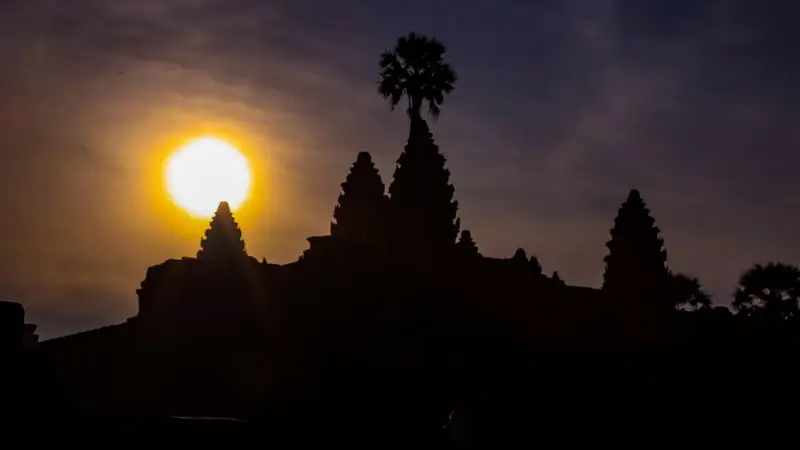
You cannot talk about Siem Reap without Angkor. But the archaeological site is so large (400 km², or 155 sq mi) and so rich (about 200 listed temples) that half a day is not enough. Here are the essentials for planning.
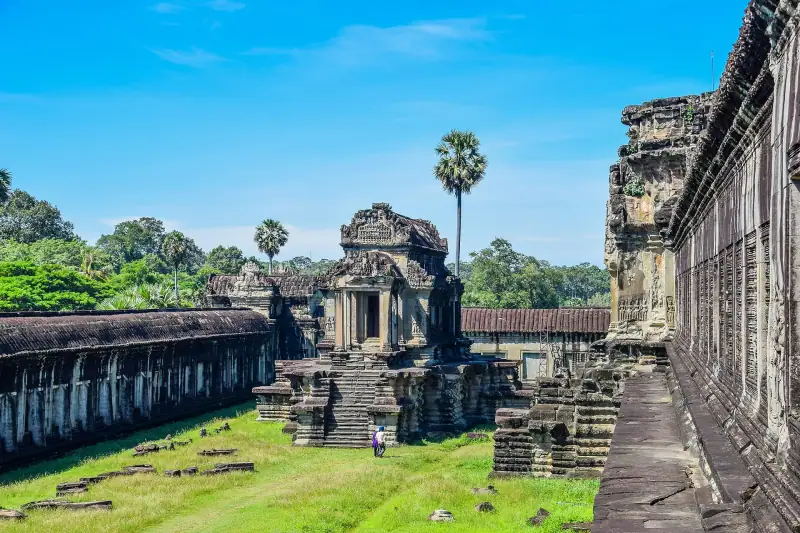
Angkor Wat: The temple-mountain par excellence and the largest religious monument in the world. Built in the 12th century under Suryavarman II, it represents Mount Meru, the cosmic mountain of Hindu mythology, surrounded by a vast mirror-like moat. The bas-relief gallery, 800 m (2,620 ft) long, is a masterpiece of Khmer art in itself. Arrive before dawn (4:30-5 am) for sunrise and to avoid the groups.
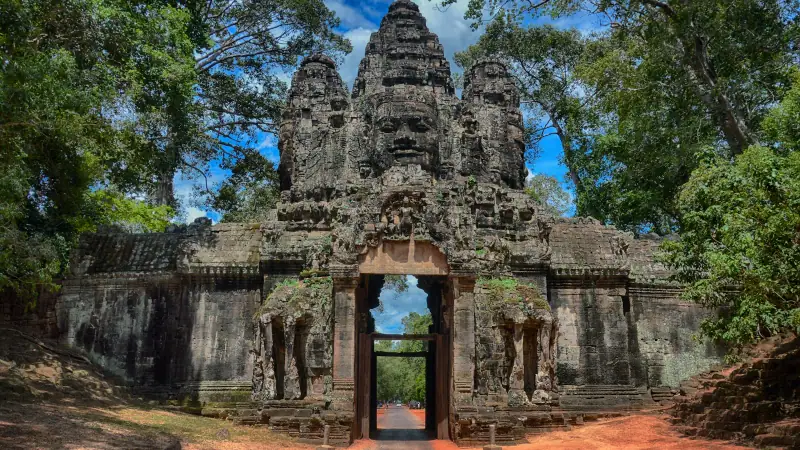
The Bayon: In the heart of Angkor Thom, the fortified royal capital built in the late 12th and early 13th centuries, the Bayon amazes with the 216 faces carved on what were originally 54 towers. These smiling faces, probably the deified king Jayavarman VII, look in the four cardinal directions. Mysterious and photogenic, the Bayon is often named as visitors’ favorite temple at Angkor.
Ta Prohm: Made famous by the Lara Croft film, this 12th-century temple was deliberately left partly overrun by the jungle. The sprawling roots of giant silk-cotton trees wrap around the stones. The contrast between carved stone and exuberant vegetation makes it one of the most photographed temples on the site.
Tips for Angkor:
- Buy your pass at the main ticket office of the site ($37 for 1 day, $62 for 3 days, $72 for 7 days), paid in cash or by bank card
- Leave before dawn for Angkor Wat and come back in the afternoon
- Drink water constantly: the heat at the temples can be intense (95-100 °F / 35-38 °C during the day)
- Avoid the hours of 10 am to 2 pm for the most exposed visits
For a detailed presentation of all the temples, see the complete guide to the Angkor temples.
Guided tours of Angkor from Siem Reap
Sunrise over Angkor Wat, private or group tours: book your experience in advance.
The old town and Psar Chas market
A few miles south of the temples, Siem Reap’s historic center is built around the Psar Chas (Old Market), an unmissable landmark. This covered market, built in the 1900s, is a maze of stalls selling spices, Khmer silks, silver jewelry, wood carvings and leather goods.
The local side: Market vendors sell everyday goods for residents: vegetables, fish from Tonle Sap, condiments, rice. In the evening part of the market turns into street food, with low tables and smoking skewers. This is where you will pay the least and eat the most authentic food.
The souvenir side: The outer aisles hold the craft shops. Krama (the traditional Cambodian scarf), stone Buddhist statues, silk paintings, spices and Kampot pepper (one of the best varieties in the world): the selection is wide and bargaining is expected.
The area around Psar Chas: The lanes radiating from the market form the pedestrian heart of Siem Reap. You will find contemporary art galleries, Khmer fashion boutiques, massage parlors and cafés in wooden houses on stilts. The walk is pleasant, especially in the evening when the shopfronts light up and the terraces fill.
Pub Street and nightlife
Pub Street, officially Street 8, is the backbone of Siem Reap’s nightlife. From dusk until the small hours, this pedestrian street and the lanes around it fill with travelers from all over the world.
The mood is eclectic: cocktail bars in colonial villas, restaurants serving Khmer food in inner gardens, street food stalls under fluorescent lights, street performers and local musicians. It is festive and good-natured, far from the pushy mass tourism found in some other Asian party capitals.
Night markets: Not far from Pub Street, the Angkor Night Market (open every evening) offers crafts, clothing and food under lanterns and candlelight. It is one of the best places to find authentic souvenirs at reasonable prices, in a more relaxed atmosphere than the day market.
Psar Leu night market: For a truly local experience, this market is popular with Cambodians from town and gives a look at everyday life away from the tourist routes.
Hotels in Siem Reap
From a $12 guesthouse to a luxury resort with a pool: compare and book with free cancellation.
Apsara dance shows
Classical Khmer dance is one of the most refined art forms in Southeast Asia. Listed as UNESCO intangible heritage, it portrays the apsara, the celestial nymphs carved by the thousands on the walls of the Angkor temples.
Siem Reap is the best city in Cambodia to see these performances. Several venues stage daily shows, often as a dinner-and-show package.
What an apsara show is: Dancers trained for years perform slow, precise movements of the hands, torso and eyes, in golden costumes and elaborate headdresses. The stories draw on the Ramayana (the Hindu epic) or Khmer mythology.
Tips for choosing one:
- Prefer shows at established cultural centers over those staged in tourist hotels
- A dinner-and-show package (around $20-35) is often the most practical and includes a traditional Khmer meal
- Book ahead in high season (December to January)
Artisans d’Angkor: the revival of Khmer crafts
Artisans d’Angkor is a social enterprise that trains young Cambodians from rural areas in traditional crafts: wood and stone carving, lacquer, gilding, silk weaving, embroidery and Khmer silverwork.
Its workshops in Siem Reap (in town and at the Chantiers-Écoles site at Angkor) are open to visitors. You can watch the artisans at work, with a patience and precision in front of a block of sandstone that is fascinating, and buy quality pieces, part of the proceeds of which fund the training of new artisans.
The main shop is in central Siem Reap, not far from the airport. Artisans d’Angkor silks are among the finest in Cambodia. Prices are higher than at the markets, but the quality and social impact justify the spend.
Tonle Sap: the floating villages
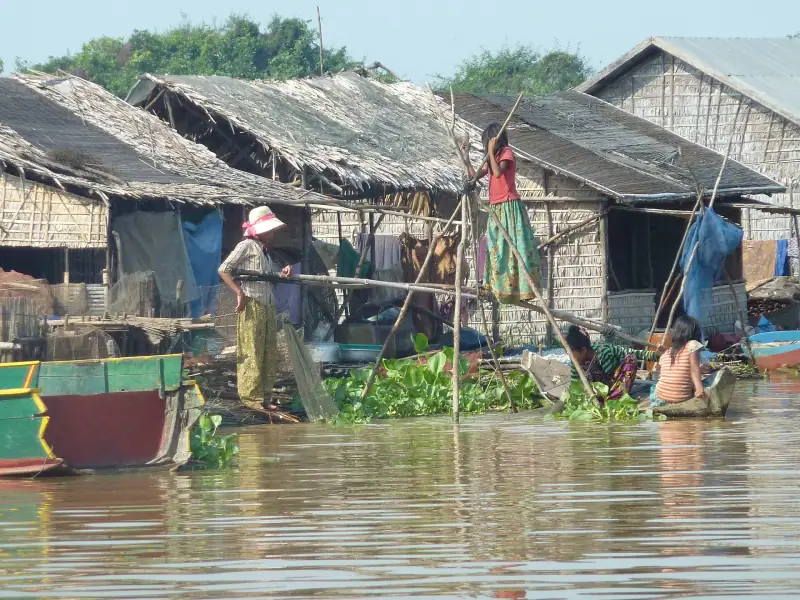
About 16 km (10 mi) south of central Siem Reap (to the Chong Kneas boat landing), Tonle Sap is the largest freshwater lake in Southeast Asia. In the rainy season (June to October) it swells to up to six times its size, covering as much as 16,000 km² (6,200 sq mi). This unique water cycle makes it one of the most productive lake ecosystems on the planet. For more, see the guide to Tonle Sap.
What strikes visitors most are the floating villages: whole communities (mainly Cham and Vietnamese fishing families) living on houses built on the water or on stilts. The villages move with the lake level through the seasons.
The boat trip: From the landings at Chong Kneas village (about 15 km / 9 mi from Siem Reap) or Kampong Khleang, local boats take visitors to these villages. The cruise usually lasts 1 h 30 to 2 h.
Tips:
- The end of the rainy season (October-November) is the best time: the lake is full and the villages are easiest to reach
- Avoid organized tours that inflate prices or force stops at tourist-trap shops. Negotiate directly with local boatmen or use a recommended local operator.
- Kampong Khleang village, less touristy than Chong Kneas, offers a more authentic experience
Tonle Sap and floating villages tour
See the stilt villages and Cambodia's legendary lake with a local guide.
Getting around Siem Reap
Siem Reap is an easy town to get around. The historic center, the markets and Pub Street sit in an area you can cover on foot. For the temples (6 km / 3.7 mi to the north) and excursions (Tonle Sap, surrounding villages), you have a few options.
Tuk-tuk: The classic way to explore Siem Reap. These motorbike-drawn carriages, negotiated per ride or per day, are everywhere. For a day at the Angkor temples, negotiate a day rate ($15-25 depending on the season and route). Many tuk-tuk drivers speak workable English and can act as informal guides.
Scooter: For those who like independence, scooters rent for $8-12 a day. Traffic in Siem Reap is moderate and the roads to Angkor are well maintained. Check that your travel insurance covers scooter accidents before renting.
For distant sites such as Koh Ker (about 120 km / 75 mi), you need a car with a driver: see the guide Koh Ker from Siem Reap.
By bicycle: The center of Siem Reap and the roads around the temples are well suited to cycling, especially early in the morning. Many guesthouses rent bicycles for $3-5 a day.
The PassApp app: In Siem Reap (as in Phnom Penh), the PassApp Taxis app lets you order tuk-tuks and cars at fixed prices, which avoids negotiating up front.
Food in Siem Reap
Siem Reap has become one of the food capitals of Southeast Asia, with a strong dining scene, from $1 street food to chef-led restaurants with international menus.
Classic Khmer cooking:
Amok is the national dish: fish or chicken steamed in coconut cream and curry paste, served in a banana-leaf bowl. It is mild, fragrant and slightly sweet, a perfect introduction to Khmer food.
Lok lak, stir-fried beef in Kampot pepper sauce, served with a fried egg over rice, is Cambodia’s bistro dish. Inexpensive and delicious.
Kuy teav, a rice noodle soup in pork or beef broth topped with bean sprouts and fresh herbs, is the everyday Cambodian breakfast.
Street food and markets: To eat like a local, head to Psar Leu market or the streets around Psar Chas as soon as they open (6-7 am). Caramelized pork skewers, fried banana fritters and bowls of soup at $1-2 are on offer.
For restaurant recommendations, see the guide to restaurants in Siem Reap.
Practical Siem Reap: the essentials before you go
Entry rules: Entry rules depend on your passport. Check the official travel advice of your government before you book: travel.state.gov (US), GOV.UK (UK), travel.gc.ca (Canada), Smartraveller (Australia) (checked November 2026).
Money: The Cambodian riel (KHR) is the official currency, but US dollars are accepted everywhere in Siem Reap. Bills of $1, $5, $10 and $20 are common. Small purchases under $1 are often given back in riels. Carry small bills for tips and street purchases.
Daily budget:
- Backpacker budget: $30-50 a day (basic guesthouse, street meals, shared tuk-tuk)
- Comfort budget: $60-100 a day (boutique hotel, mid-range restaurants, private tuk-tuk)
- Luxury budget: $150+ a day (5-star resort, spa, fine dining)
Health and safety:
- Drink only bottled or filtered water
- Use insect repellent (mosquitoes are active, especially in the rainy season)
- The heat can be intense: bring a hat, sunscreen and plenty of water for temple visits
- Siem Reap is generally safe for travelers, but stay alert in very touristy areas (pickpockets)
- For vaccines or other health questions, ask your doctor or a travel clinic, and see the official travel health pages (CDC in the US, TravelHealthPro in the UK)
Language: Khmer is the official language. English is widely spoken in the tourist sector. A few words of Khmer (thank you: orkun, hello: chum reap suor) are always appreciated.
Suggested 3-day itinerary in Siem Reap
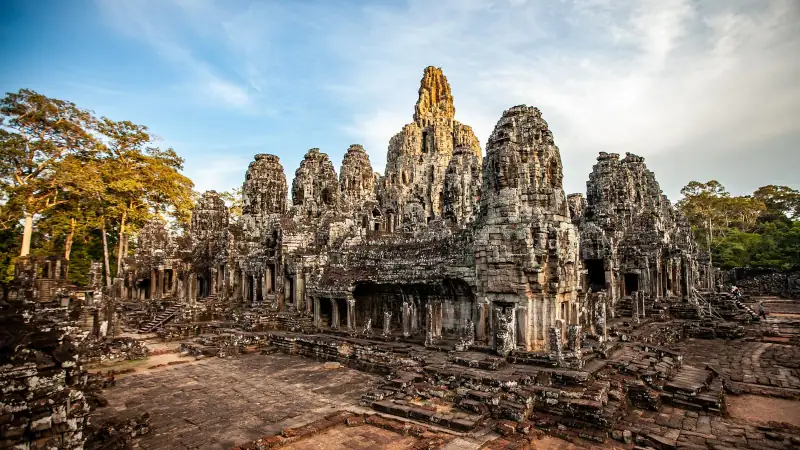
Day 1: Angkor Wat and Angkor Thom
Get up before dawn (leave the hotel at 4:30-5 am) to watch the sunrise over the towers of Angkor Wat. Spend the morning exploring the bas-relief gallery and inner courtyards. After a lunch break to avoid the heat (noon to 2 pm), continue to Angkor Thom: the south gate, the Bayon and the Baphuon. Dinner in the Psar Chas area.
Day 2: Ta Prohm, secondary temples and Pub Street
Leave early for Ta Prohm (open a map app and note the signs, as the site is a maze). In the afternoon, choose according to taste: Banteay Srei (about 30 km / 19 mi to the northeast, 35 km / 22 mi by road), an extraordinary pink sandstone temple with unmatched carving, or closer in, Preah Khan and Neak Pean. Evening at Pub Street and an apsara show.
Day 3: Town, crafts and Tonle Sap
Morning in town: visit the Artisans d’Angkor workshops, shop at Psar Chas, and spend time reading over coffee on a terrace in the old quarter’s lanes. Afternoon: a 2-hour boat trip on Tonle Sap from the Chong Kneas landing. Back at sunset for a farewell dinner. If you stay one more day, the waterfall and sacred mountain of Phnom Kulen make another nature excursion.
When to go to Siem Reap
November to February (high season): The ideal season. Temperatures are mild (77-90 °F / 25-32 °C), skies are blue and rain is rare. Temples and hotels are full, so book 2 to 3 months ahead for December-January.
March and April: Still dry but hot (95-100 °F / 35-38 °C in the middle of the day). The heat at the temples can be punishing at midday. On the other hand, this is the time of Khmer festivals (Khmer New Year in April), a good cultural immersion.
May to October (rainy season): Daily showers, often late in the afternoon but rarely all day. The intense green of the vegetation and temple moats turned into mirrors have a magic of their own. Prices drop by 20 to 40% and crowds thin out considerably. October is a good month to visit: the rains ease and Tonle Sap is at its peak.
For a complete guide to the seasons, see the article best time to visit Cambodia.
Siem Reap, much more than a stop for Angkor
Many travelers come to Siem Reap with the sole aim of ticking Angkor Wat off a list. They often leave surprised: the town itself is worth the trip. The mix of centuries-old Khmer history, contemporary urban energy and Cambodian hospitality gives Siem Reap a particular feel that is hard to explain and easy to sense once you are there.
Take the time to stroll, chat with your tuk-tuk driver, sit in a café by the canal and watch local life go by. Siem Reap rewards those who do not rush.
To plan the rest of your trip, see the Cambodia destination page and the trip planner, or pick a route: Cambodia in 7 days, Cambodia in 10 days from Siem Reap to Phnom Penh or the 4-day road trip around Battambang.
Frequently asked questions
How many days do you need in Siem Reap?
Three days is the minimum to see Angkor Wat, the Bayon and Ta Prohm and explore the town. Five days lets you cover the more distant temples, take a trip on Tonle Sap and enjoy the town's nightlife and cultural scene.
How do you get from Phnom Penh to Siem Reap?
By plane the flight takes about 45 minutes (2 to 3 flights a day). By express bus, allow 5 to 6 hours ($8-12); several companies run this route from the Phnom Penh bus station. By shared taxi the trip takes about 4 to 5 hours.
Do you need to rent a car or a tuk-tuk in Siem Reap?
A tuk-tuk is the ideal way to visit the temples and get around town. For a day of temple visits, expect to pay $15-25 for a tuk-tuk for the day. Scooters are also available for rent for those who prefer independence ($8-12 a day).
Where is Pub Street in Siem Reap?
Pub Street (officially Street 8) is in the heart of the old town, a few minutes on foot from the Psar Chas market. It is the main nightlife area, with restaurants, bars and street entertainment, lively from 6 pm every evening.
Can you visit Siem Reap on a small budget?
Yes. Comfortable guesthouses are available for $10-20 a night, and street food and local market meals cost $1-3. The one big expense is the Angkor pass ($37 for 1 day, $62 for 3 days, $72 for 7 days).
What is the best time to visit Siem Reap?
November to February, in the dry season: temperatures around 25-30 °C (77-86 °F), little rain and beautiful light on the temples. The rainy season (June to October) is quieter and turns the moats into green mirrors, but paths can be slippery.
More Cambodia guides
Keep reading
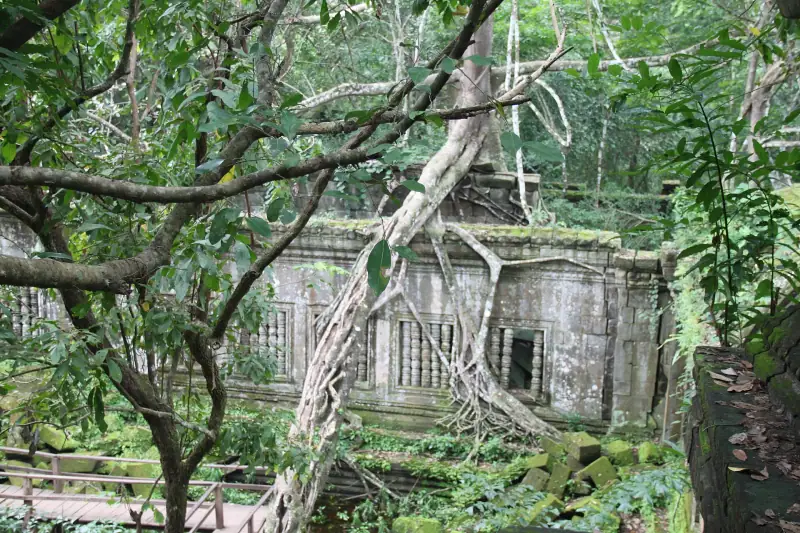
Banteay Srei or Beng Mealea: Which Should You Visit With a Half Day?
Banteay Srei or Beng Mealea near Angkor: distance, ticket, visit time and atmosphere. Which one to pick when you only have half a day.
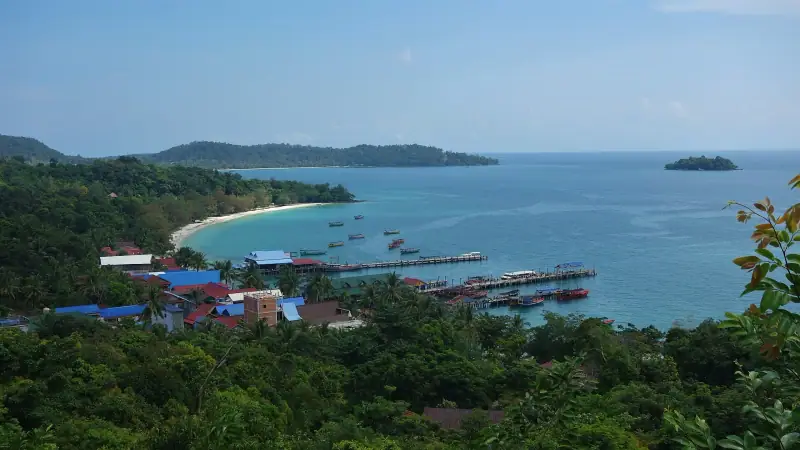
Visiting Koh Rong: Complete Guide to Cambodia's Island Getaway
Guide to visiting Koh Rong: white-sand beaches, bioluminescence, activities, where to sleep and how to get to the island from Sihanoukville.
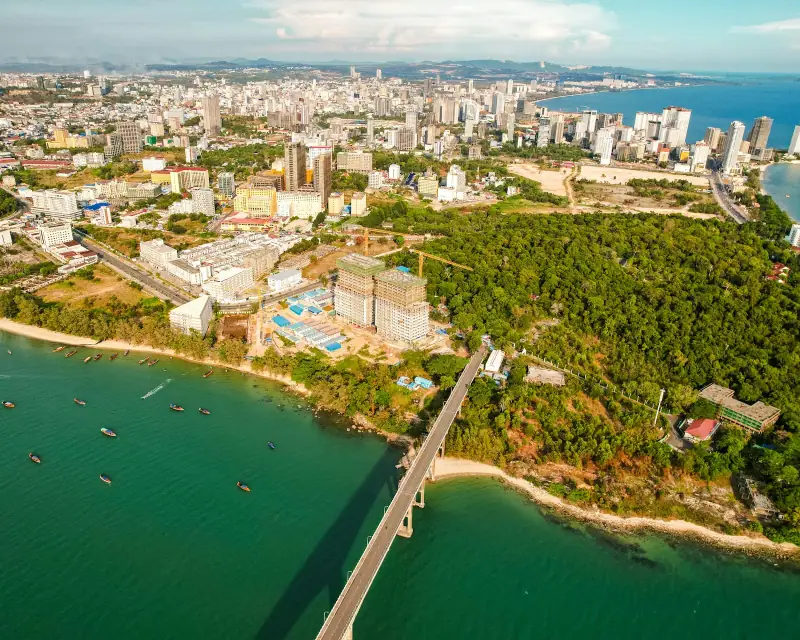
Visiting Sihanoukville: Complete Guide to Cambodia's Coast
Complete guide to Sihanoukville: Otres and Occheuteal beaches, diving, the ferry to Koh Rong, where to stay and practical tips.
Ready-made
Cambodia itineraries
12 days
Cambodia in 12 Days with Kids: Stops, Distances and a Realistic Pace
Siem ReapPhnom PenhKampotKoh Rong Samloem
7 days
Cambodia in 7 Days: The Perfect One-Week Itinerary
Phnom PenhSiem Reap
Can be adapted in the planner
4 days
Road Trip in Northwest Cambodia: Battambang and Around in 4 Days
4-day road trip itinerary in northwest Cambodia: bamboo train, rice paddies, Phnom Sampeau bats and Angkorian temples away from the crowds.
Can be adapted in the planner