Itineraries
Cambodia in 10 Days: The Ideal Itinerary From Siem Reap to Phnom Penh
We may earn a commission when you book through links on this page, at no extra cost to you. We don't visit or try the places we cover: we summarize published sources. How we work
Day by day
- Day 1Arrive in Siem Reap, Old Market, Pub Street
- Day 2Angkor Wat sunrise, Bayon, Ta Prohm, Banteay Srei
- Day 3Angkor Thom, Preah Khan, Neak Pean, Phnom Bakheng sunset
- Day 4Bus to Battambang, bamboo train, Sangkae riverside
- Day 5Phare Ponleu Selpak, Phnom Sampeau bat caves
- Day 6Travel to Kampot, bike around town, pepper farms
- Day 7Kep crab market, Bokor plateau, back to Kampot
- Day 8Phnom Penh: Royal Palace, National Museum, Tuol Sleng
- Day 9Central Market, Mekong riverfront, dinner in BKK1
- Day 10Departure from Phnom Penh, or extension to Koh Rong
Where to sleep
- Siem Reap3 nights
- Battambang2 nights
- Kampot2 nights
- Phnom Penh2 nights
In short
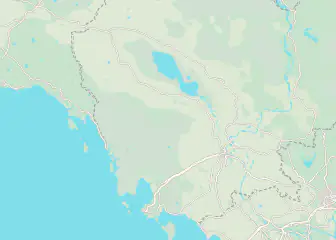
- Route runs north to south: Siem Reap (days 1-3), Battambang (4-5), Kampot and Kep (6-7), Phnom Penh (8-9), departure on day 10.
- Intercity buses are the main transport: Siem Reap to Battambang 3-4 h ($6-8 USD), Battambang to Phnom Penh 5-6 h ($6-10 USD), Phnom Penh to Kampot 2 h 30-3 h ($5-8 USD).
- Budget about $40-60 USD a day on a shoestring, $80-120 at comfort level; the 3-day Angkor pass is $62 USD, paid separately.
- Best season is November to February (25-30 °C / 77-86 °F); March-April reaches 35-40 °C (95-104 °F).
Ten days in Cambodia is the ideal format for a first trip: enough time to discover the essentials without rushing, and enough flexibility to improvise a few detours. From the thousand-year-old temples of Angkor to the colonial streets of Battambang, from Kampot’s bohemian atmosphere to Phnom Penh’s historic upheavals, this itinerary takes you through the whole Cambodian soul.
This day-by-day plan was designed to optimize travel, alternate the pace (intense days and more relaxed days), and let you have truly memorable experiences, not just tick off tourist boxes.
Itinerary overview
Here is the overall structure before getting into the details:
- Days 1-3: Siem Reap and the Angkor temples
- Days 4-5: Battambang, the bamboo train and Khmer arts
- Days 6-7: Kampot, Kep and the Cambodian coast
- Days 8-9: Phnom Penh, the capital
- Day 10: Departure or extension to Koh Rong
The direction of travel (north to south) matches the most practical bus connections and lets you finish in Phnom Penh, which handles most international flights.
Days 1-3: Siem Reap and the Angkor temples
Day 1: Arrive in Siem Reap, first steps
You land at Siem Reap-Angkor International Airport (SAI), opened in October 2023, about 45-50 km (28-31 mi) from town (allow about 1 hour for the transfer). Depending on your arrival time, spend the afternoon exploring the town center on foot: the Old Market (Phsar Chas), the lanes of the colonial old town, and of course Pub Street, which comes alive in the evening.
In the evening, have dinner at a Siem Reap restaurant to get used to Cambodian flavors. Khmer Kitchen or Abacus are excellent options to start. Take the opportunity to book your tuk-tuk driver for the next two days directly through your hotel or from a local on the street. Expect $15-25 for a full day at Angkor.
Don’t miss tonight: If an apsara dance show is scheduled at one of the big hotels, it is a lovely introduction to Khmer culture.
Hotels in Siem Reap
From guesthouses to boutique hotels, Siem Reap has every range at competitive prices. Book ahead in high season.
Day 2: Angkor, the grand temple circuit
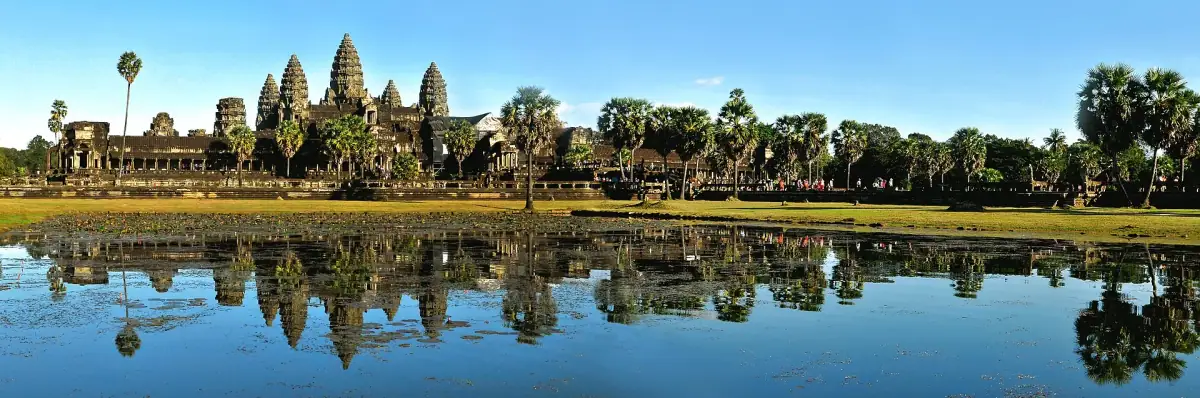
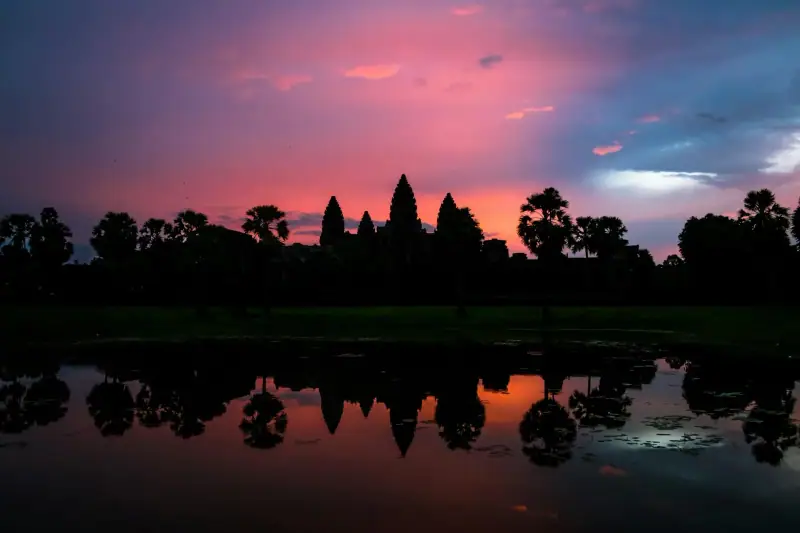
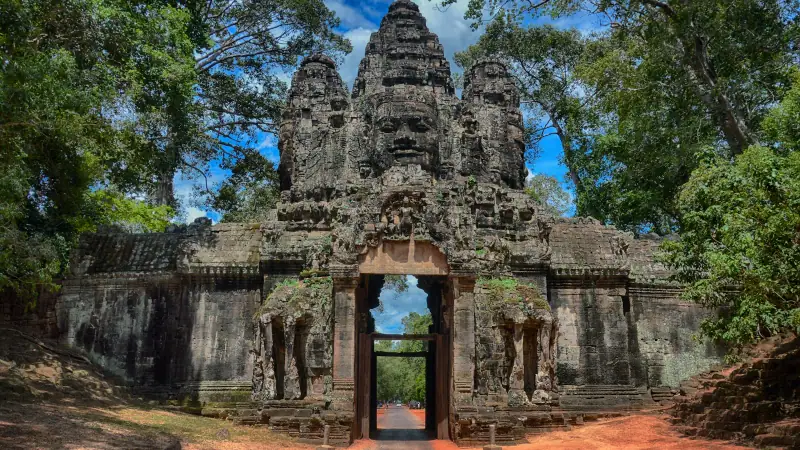
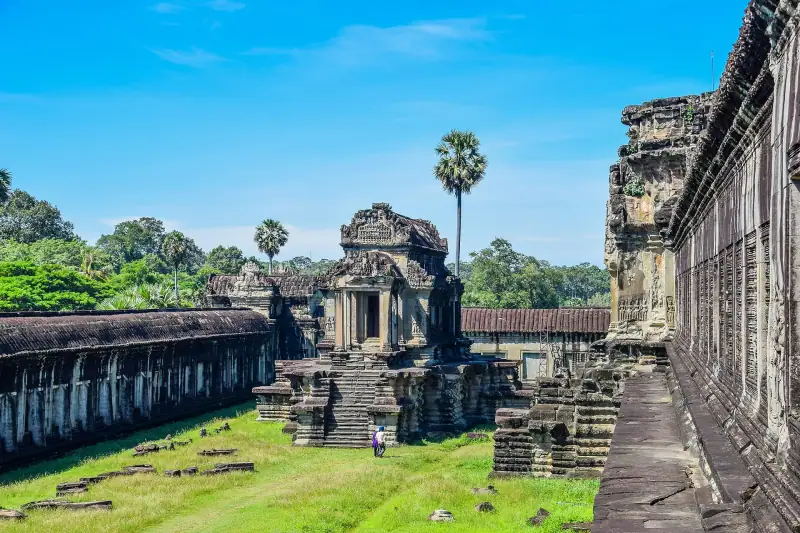
Get up before dawn to reach Angkor Wat at 5:30 am and watch the sunrise over the lotus towers. It is one of the most spellbinding sights in Asia, especially beautiful between December and March. Then visit the inside of the temple in the morning, before the tourist rush.
In the afternoon, head to the Bayon, the temple with 200 smiling faces, then Ta Prohm, overrun by the roots of giant fig trees, the most “jungle” and most photographed temple in the whole Angkor area. Finish the day with Banteay Srei if your energy allows, the “temple of the women” with exceptionally fine pink sandstone carvings (about 32 km / 20 mi from Siem Reap, worth the detour).
Practical tip: Buy the 3-day Angkor pass ($62) as soon as you arrive (online at angkorenterprise.gov.kh or at the official ticket office). It gives access to all the temples in the area for a limited period: check the validity period when you buy.
Day 3: Angkor Thom and the forgotten temples
Spend this morning at Angkor Thom, the “Great City”: enter through the south gate flanked by 54 deities holding a naga serpent, and explore the Baphuon and the Terrace of the Elephants. In the afternoon, venture to less-visited temples: Preah Khan (a forest of corridors overgrown with vines), Neak Pean (an island temple in the middle of a basin) or Banteay Kdei for its serenity.
Toward the end of the day, climb Phnom Bakheng for a panoramic sunset over the Khmer forest. Arrive 1 hour early because access is limited.
Days 4-5: Battambang, the little-known pearl
Day 4: On to Battambang, the bamboo train
Leave by bus for Battambang (3-4 h, about $6-8). Battambang is Cambodia’s second city and arguably its most authentic: less touristy than Siem Reap, with fine French colonial architecture and a vibrant arts scene.
The must-do experience of the afternoon: the bamboo train (norry). These bamboo carriages set on a single pair of rails, powered by a lawnmower engine at 40 km/h (25 mph), cross the rice paddies in an unforgettable metallic racket. The current line is near Banan, 20-30 minutes from town, and crosses typical rural landscapes. An experience like no other: about $5 (check the price there).
In the evening, stroll along the Sangkae River and explore the night market. Battambang street food is delicious: try lok lak (stir-fried beef), num banh chok (rice noodles with fish) and grilled skewers.
Battambang excursions
Bamboo train, bat cave, craft villages: see Battambang on an organized excursion so you miss nothing.
Day 5: Phare Ponleu Selpak, the bat cave and temples
The morning ideally starts with a visit to the Phare Ponleu Selpak circus arts school. This extraordinary NGO has turned children traumatized by war into internationally skilled circus artists. Shows take place in the evening (7 pm, booking essential), but you can visit the school during the day to watch rehearsals, a moving experience.
In the afternoon, head to Phnom Sampeau, the bat mountain, 12 km (7 mi) from Battambang. Around 5:30-6 pm, roughly 1 to 1.8 million bats rise in long spiraling columns from the caves into the glowing sky to go hunt insects. The show lasts 20 minutes and leaves you speechless. The site also holds a memorial to the Khmer Rouge’s victims (the caves were used as an execution site) and several temples.
Option: The pottery villages of Kampong Leaeng and the longan orchards around Battambang are worth an extra half day for fans of local life.
Days 6-7: Kampot and the Cambodian coast
Day 6: Battambang → Kampot, arriving in the bohemian town
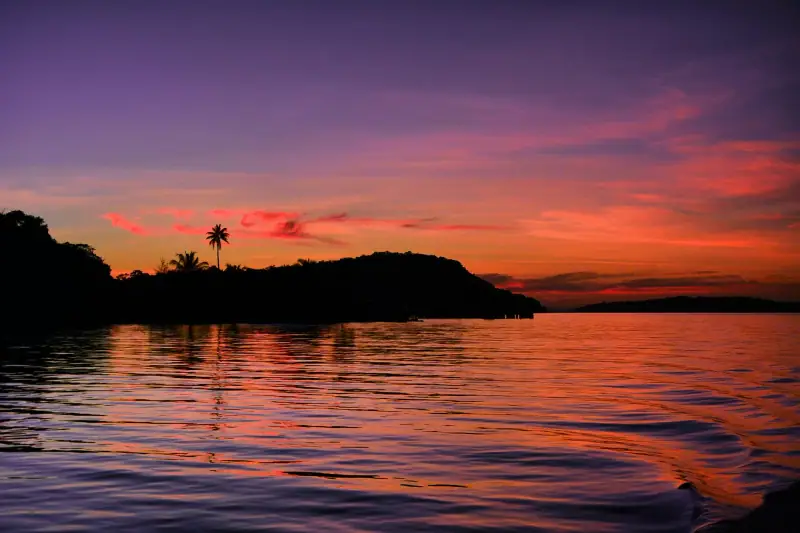
The Battambang → Kampot trip takes about 6 hours by private car (the most direct route) or 9 hours by bus with a change in Phnom Penh, depending on the company. Kampot is a colonial town on the Kampot River, surrounded by rice paddies, caves and the Elephant Mountain, Bokor.
Arrive in the afternoon. Kampot is made for slowing down. Settle into a guesthouse on the river, rent a bike or a motorbike ($5-10 a day) and explore the lanes at your own pace. The French colonial architecture is well preserved, and the town has many expats who have opened excellent restaurants and bars.
Kampot pepper, one of the best in the world, with a protected geographical indication, is worth a plantation visit. Electric bike or motorbike tours to the farms are easy to arrange from your hotel.
Car rental in Cambodia
To explore Kampot, Kep and the surrounding area at your own pace, a rental car or scooter offers total freedom.
Day 7: Kep and the crabs, Bokor late in the day
Twenty-five km (16 mi) from Kampot, Kep is a tiny seaside town known for its crabs. “Kampot pepper crab” is a national specialty. The Kep crab market is an institution: crab grilled, steamed or stir-fried with fresh green pepper, to nibble with your feet in the water while watching the fishing boats. Expect $4-6 for a feast.
In the afternoon, climb the Bokor plateau (1,079 m / 3,540 ft) by motorbike or tuk-tuk. This misty plateau holds a former 1920s Art Deco hotel-casino, the Bokor Palace, now renovated and run as a hotel by the Sokha group, which has served as a filming location in several movies. The view over the Gulf of Thailand is spectacular. The access road passes through primary forest.
In the evening, return to Kampot for dinner at one of its many restaurants (the international food is surprisingly good here) before taking the night bus or the next morning’s bus to Phnom Penh.
Days 8-9: Phnom Penh, the contrasting capital
Day 8: Royal Palace, National Museum and Khmer Rouge memory
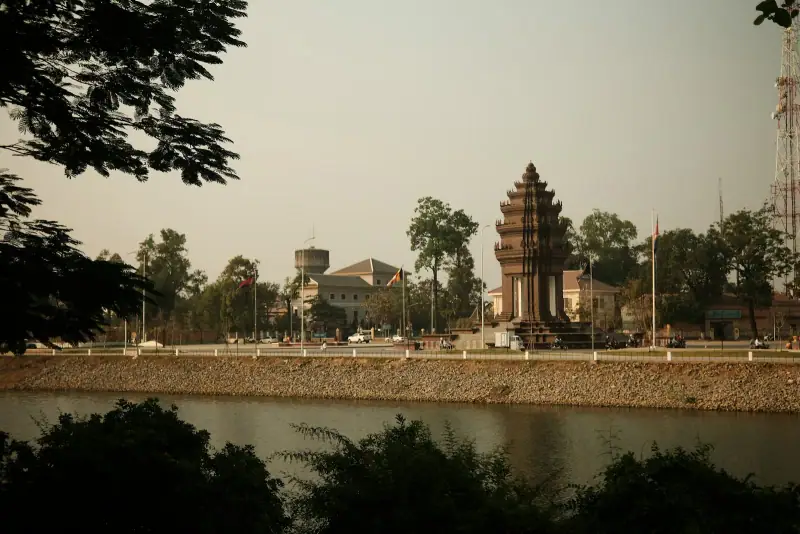
Arrive in Phnom Penh, a capital of 2 million people that concentrates Cambodia’s political, economic and cultural power. The city is less “pretty” than Siem Reap or Kampot, but its historical and human depth is incomparable.
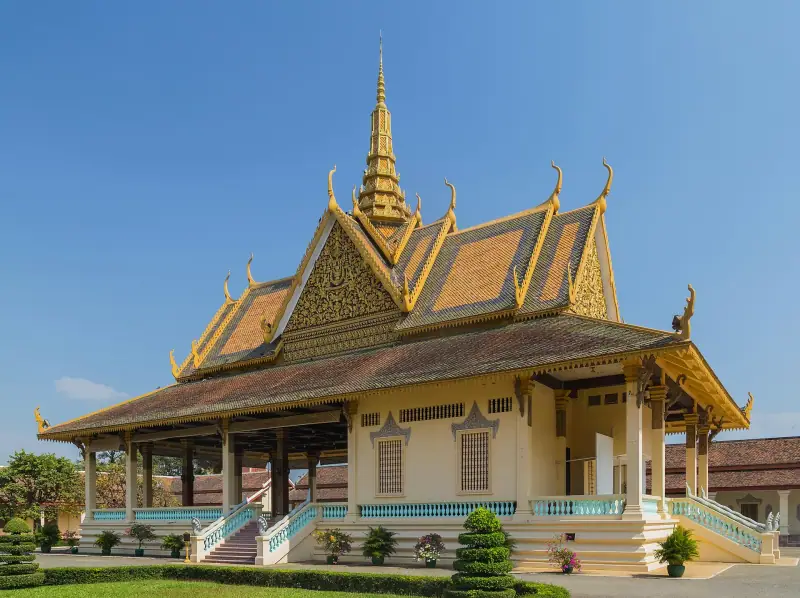
The morning starts with the Royal Palace and Wat Phnom (a hill stupa, the city’s legendary founding site). Then the National Museum and its extraordinary collections of Khmer sculpture from the Angkorian era.
The afternoon is set aside for a visit you will not forget: Tuol Sleng (S-21), the former Khmer Rouge prison, a school turned into a torture center where 17,000 people died between 1975 and 1979. The visit is emotionally hard but essential for understanding contemporary Cambodia. It can be followed by a visit to the Choeung Ek Killing Fields (15 km / 9 mi, an execution site and exceptional memorial).
Tip: Taking a guide for the S-21 visit greatly adds to your understanding.
Day 9: Central Market, Wat Phnom and the Mekong riverfront
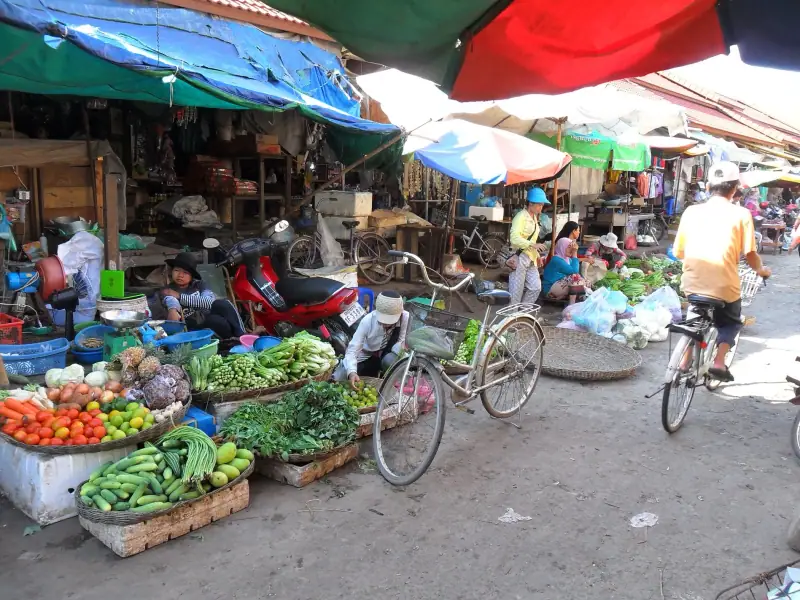
Last full day in Cambodia. Start with the Central Market (Phsar Thmei) and its yellow Art Deco dome, one of the most beautiful markets in Southeast Asia. Buy your last souvenirs: Khmer silk, sculptures, spices, Cambodian coffee.
In the afternoon, stroll the Phnom Penh Riverside, along Sisowath Boulevard, which runs by the confluence of the Mekong and the Tonle Sap. Sunsets from the riverbanks are magnificent. In the evening, dine at one of the restaurants in the BKK1 district, the trendiest and most cosmopolitan in the city.
Flights to Cambodia
Compare the best flight deals to Phnom Penh or Siem Reap to plan your trip.
Day 10: Departure or extension
Depending on your flight times, you can leave from the new Techo International Airport (KTI, opened in September 2025 about 28 km / 17 mi south of the city; allow more than an hour for the trip) in late morning, or enjoy an extra half day to visit the Museum of Decorative Arts or take a boat outing on the Mekong.
Possible extension: If you have 12-14 days, add 2-3 nights on the islands of Koh Rong or Koh Rong Samloem from Sihanoukville (4 hours by bus from Phnom Penh). These island paradises, with turquoise water, bioluminescence at night and empty beaches, are well worth the detour.
Practical information
Intercity transport
| Route | Duration | Approximate price |
|---|---|---|
| Siem Reap → Battambang | 3-4 h | $6-8 |
| Battambang → Phnom Penh | 5-6 h | $6-10 |
| Phnom Penh → Kampot | 2 h 30-3 h | $5-8 |
| Kampot → Phnom Penh | 2 h 30-3 h | $5-8 |
Recommended companies: Mekong Express, Giant Ibis (premium), Virak Buntham (budget). Book online 1-2 days ahead in high season.
Estimated daily budget
- Shoestring: $40-60 a day (dorm bed or simple room, street food, local buses, shared tuk-tuk)
- Comfort: $80-120 a day (3-star hotel, mid-range restaurants, private tuk-tuk, a few excursions)
- Premium: $150 a day and up (boutique hotel, fine dining, private driver, guided tours)
Costs to budget separately:
- 3-day Angkor pass: $62
- e-Visa fee, if you need one: $30 (order before you leave at evisa.gov.kh)
- Tuol Sleng admission: $5
- Killing Fields: $6
When to go
Ideally between November and February for dry weather and the mildest temperatures (25-30 °C / 77-86 °F). March-April is hot and dry (up to 40 °C / 104 °F in the shade). The rainy season (May to October) brings green landscapes and lower prices, but roads to some temples can be difficult.
Health and safety
- Recommended vaccines: hepatitis A and B, typhoid, tetanus (see your doctor 6-8 weeks before departure)
- Antimalarials: not essential for classic tourist routes, but worth considering in forested areas (medical advice)
- Water: never drink tap water; bottled or filtered water only
- Dental and medical care: Phnom Penh and Siem Reap have clinics for English-speaking expats
Tips for optimizing your itinerary
Book Angkor ahead: The Angkor pass is only sold by the official operator (online or at the ticket office), but a trusted tuk-tuk for 2-3 days is worth arranging through your Siem Reap hotel as soon as you arrive.
Getting around Battambang: The town is small but the attractions are spread out. A tuk-tuk or moto-dop (motorbike taxi) by the day ($8-12) is the most efficient solution.
Kampot by bike: The town and its immediate surroundings are easy by electric bike. For Kep and Bokor, choose a motorbike or join an organized excursion.
Phnom Penh by app: The Grab app works well in Phnom Penh for tuk-tuks and cars, with prices shown in advance and no haggling.
Currency: The US dollar is accepted everywhere in Cambodia. ATMs dispense dollars. Keep small bills ($1, $5) for street food and tips. The Cambodian riel is used for small change (4,000 riel = $1).
This 10-day trip to Cambodia will leave you with images and encounters that will stay with you: the smiles of children in Battambang, the silent majesty of Angkor at dawn, the taste of green pepper crab in Kep, and the quiet strength of a people who rebuilt everything after the genocide. Cambodia is one of the most endearing countries in Asia, and this first trip will rarely be the last.
To prepare your visa, see our guide to Cambodia entry formalities, and to refine your budget, our article how much a trip to Cambodia costs gives you all the up-to-date figures.
Sources
- Tuol Sleng Genocide Museum: prices checked November 2026
Frequently asked questions
Is 10 days in Cambodia enough to see the essentials?
Yes, 10 days lets you see the highlights: Angkor Wat and the Siem Reap temples (2-3 days), Battambang and the bamboo train (1-2 days), Kampot and the coast (2 days), and Phnom Penh with the Royal Palace and museums (2 days). The pace is brisk but very doable. For travelers who want to add the beaches of Koh Rong, 14 days are recommended.
Which direction is recommended for this itinerary?
Siem Reap → Battambang → Phnom Penh (→ Kampot optional) is the most logical because it follows the available public transport (direct buses). The reverse is possible but less convenient for bus connections. If you arrive or depart through Bangkok, starting in Siem Reap and finishing in Phnom Penh or Sihanoukville is ideal.
What budget should I plan for 10 days in Cambodia?
Expect between €600 and €1,200 (about $695-1,390) for 10 days depending on your travel style. Shoestring backpacker: $50-60 a day (hostels, street food, local buses). Comfort: $80-120 a day (3-star hotels, mid-range restaurants, tuk-tuks). Premium: $150 a day and up (4-5 star hotels, private excursions). The Angkor pass (3 days) is $62 and is budgeted separately.
Do I need a visa to enter Cambodia?
Entry rules depend on your passport: check the official government site before you book. Visitors who need a visa can generally choose between the online e-Visa (evisa.gov.kh) or a visa on arrival at international airports; rules and fees vary at land borders. For arrivals by air, also fill in the free e-Arrival Card on arrival.gov.kh within 7 days before arrival. For more details, see our full guide to entry formalities.
What is the best time of year for this itinerary?
The dry season (November to April) is ideal, with November to February the most pleasant (temperatures of 25-30 °C / 77-86 °F, clear skies). March-April gets very hot (35-40 °C / 95-104 °F). The rainy season (May to October) is less crowded, with lower prices and lush landscapes, but some roads can be difficult. For Angkor, a lightly cloudy sky gives beautiful light for photos.
How do I get between cities on this itinerary?
Buses are the main means of transport: Siem Reap → Battambang (3-4 h, $5-8), Battambang → Phnom Penh (5-6 h, $6-10), Phnom Penh → Kampot (2 h 30, $5-8). Mekong Express, Giant Ibis and Virak Buntham are reliable companies. For Angkor and Battambang, a tuk-tuk is essential (rent by the half day or full day). Bike rental is ideal in Kampot and Kep.
More Cambodia guides
Keep reading
Cambodia Travel Budget: How Much Does a Trip Cost in 2026?
How much does a trip to Cambodia cost? Daily budgets, hotel prices, transport, meals and activities so you can plan your stay without surprises.
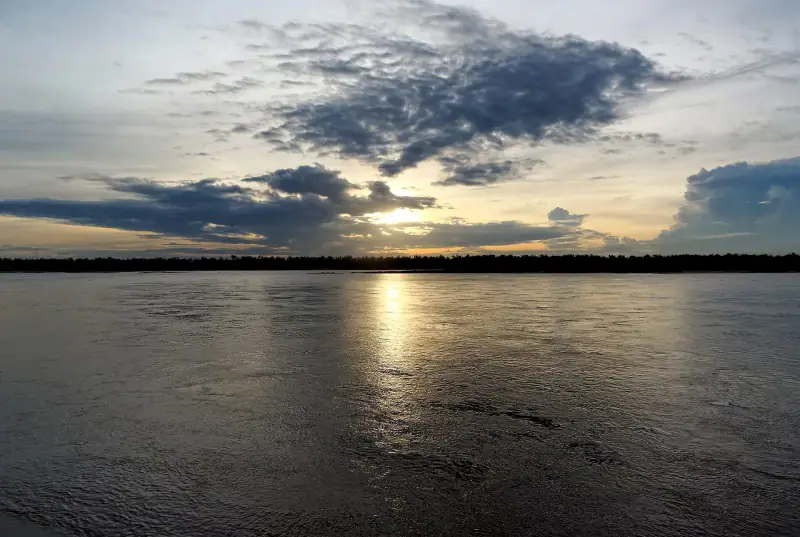
Eastern Cambodia: Kratie, Ratanakiri and Mondulkiri, the wild east
Exploring eastern Cambodia: Mekong dolphins at Kratie, Yeak Loam lake in Ratanakiri, ethical elephant experiences in Mondulkiri. A practical guide.
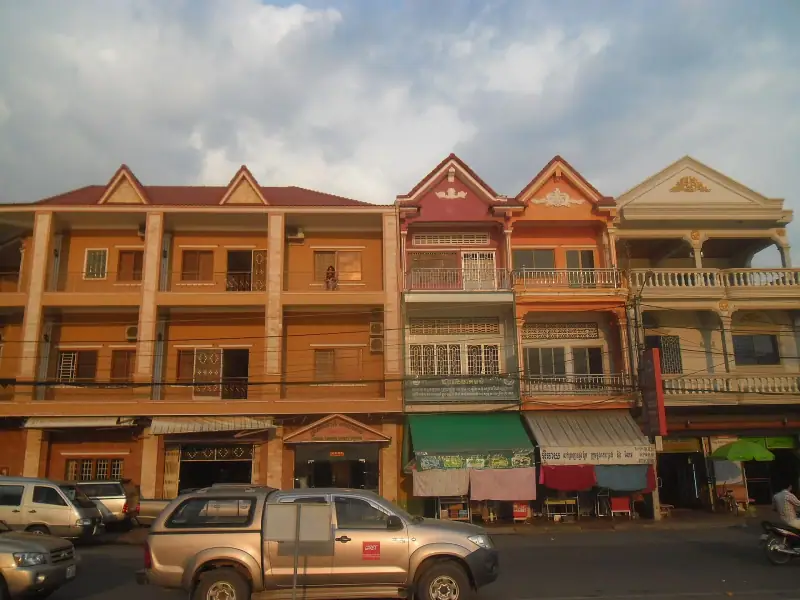
Where to Stay in Kratie: In Town or on Koh Trong Island?
Stay in Kratie or on Koh Trong island? Areas, lodging types, getting to the Mekong dolphins and tips for choosing based on your trip.
Ready-made
Cambodia itineraries
12 days
Cambodia in 12 Days with Kids: Stops, Distances and a Realistic Pace
Siem ReapPhnom PenhKampotKoh Rong Samloem
7 days
Cambodia in 7 Days: The Perfect One-Week Itinerary
Phnom PenhSiem Reap
Can be adapted in the planner
4 days
Road Trip in Northwest Cambodia: Battambang and Around in 4 Days
4-day road trip itinerary in northwest Cambodia: bamboo train, rice paddies, Phnom Sampeau bats and Angkorian temples away from the crowds.
Can be adapted in the planner