Plan your trip
Getting around the Amalfi Coast: bus, ferry, car or scooter?
We may earn a commission when you book through links on this page, at no extra cost to you. We don't visit or try the places we cover: we summarize published sources. How we work
In short
- The coast is about 40 km (25 mi) long, but a few kilometers can take an hour because everything runs along a single cliff road, the SS163.
- Two gateways from Naples: Sorrento by Circumvesuviana train (a little over an hour) or Salerno by train (about an hour or less), then bus or ferry.
- Ferries mostly run from spring to early fall and can be canceled in rough seas, so keep the bus as a fallback.
- A car makes most sense off-season. Parking is scarce and paid, and ZTL fines arrive months later.
On paper, the Amalfi Coast is tiny: about 40 km (25 mi) of shoreline between Sorrento and Salerno. In practice, a trip of a few kilometers can take an hour, because everything goes through a single corniche road clinging to the cliff. Choosing the right means of transport, and above all the right time to use it, radically changes the travel experience. Here is how to arrive, get around and avoid the classic pitfalls.
Arriving from Naples: the gateways to the coast
There is no airport or train station on the coast itself. Most travelers land in Naples, then reach the coast by one of two main accesses: the Sorrento side to the west, or the Salerno side to the east. Naples is only a waypoint here, and this guide focuses on what comes after.
The main lines:
- To Sorrento: the Circumvesuviana regional train links Naples to Sorrento in a little over an hour. It is the simplest access for Positano, Capri or the Sorrento peninsula.
- To Salerno: high-speed and regional trains link Naples to Salerno in about an hour or less depending on the service. Salerno is the best starting point for Amalfi, Ravello and Minori, notably thanks to the ferry.
- Private transfers: a driver avoids connections with luggage, useful if you arrive late or travel with family.
One tip: choose your gateway according to where you sleep, not out of habit. Lodging in Positano is easier to reach via Sorrento, lodging in Amalfi or Ravello via Salerno. To compare possible bases, see our guide to where to stay on the Amalfi Coast, or our analysis on sleeping in Sorrento and visiting the coast.
Flights to Naples
Compare flights to Naples, the main airport for reaching the Amalfi Coast.
The bus along the SS163
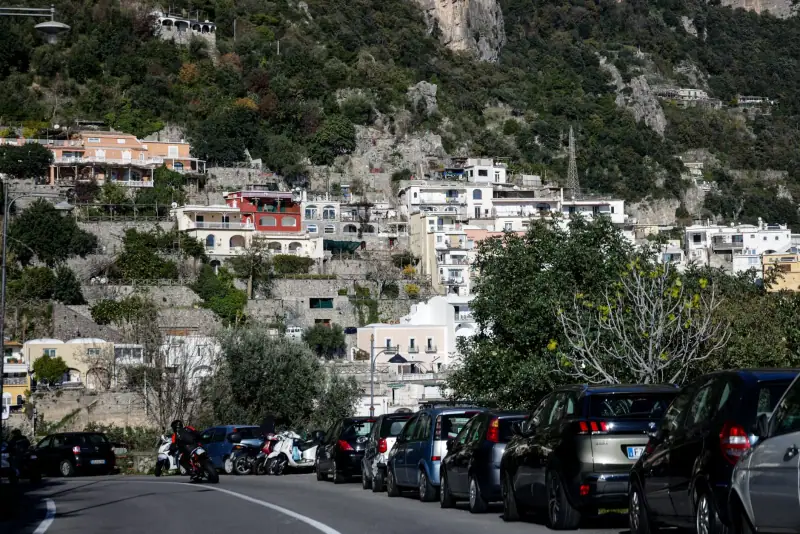
The bus is the backbone of local travel. It takes the national road SS163, known as the “Amalfitana”, which links Sorrento to Amalfi via Positano and Praiano, then continues toward Salerno. Fares are modest and tickets are generally bought at tobacco shops (tabaccherie) or on board, sometimes at a slightly higher price.
What to know before boarding:
- Crowds: in summer, buses can be full at the main stops and drive past without stopping. Getting to the terminus early gives you a better chance of a seat.
- Side of the road: the best views are usually on the sea side, whether you sit on the right or left depending on the direction.
- Delays: heavy traffic can shift schedules significantly. Do not plan a tight connection, particularly before a train or a return ferry.
- Last bus: check the time of the last evening departure before dining in another village.
The bus is also the way to reach villages up high, such as Ravello, above Amalfi, or Bomerano, the starting point of the hike described in our guide to the Path of the Gods.
Ferries: Salerno, Amalfi, Positano and Sorrento
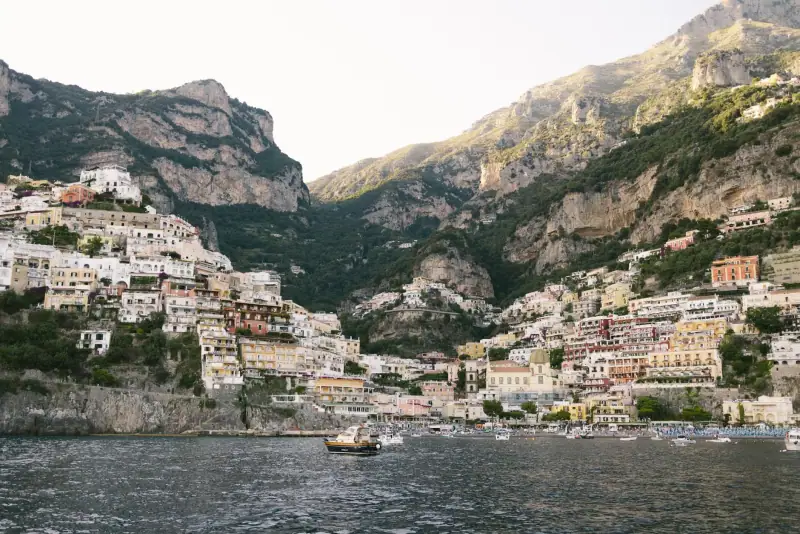
Traveling by sea is often the best choice in season. The boat avoids the congested road, offers a stunning view of the terraced villages and drops you right at the port. Several companies run connections between Salerno, Amalfi, Positano and Sorrento, as well as to Capri.
A few practical guidelines:
- Salerno to Amalfi: one of the most practical connections for those arriving by train, with a trip of about half an hour to forty minutes depending on the boat.
- Amalfi to Positano: a pleasant trip, faster than the road at peak hours.
- Positano to Sorrento: a seasonal connection useful for completing a round trip without a car.
- Capri: fast boats reach the island from Sorrento, Positano and Amalfi in season.
Two important caveats. First, service mostly runs from spring to early fall, with a very reduced offer in winter. Second, rough seas can cause crossings to be canceled: always keep a fallback by road. Timetables change every year, so check them locally or with the companies.
Boat excursions
Discover cruises and excursions at sea along the Amalfi Coast and to Capri.
Driving on the Amalfi Coast: car and scooter

Driving is the most flexible mode of transport in theory, and the most stressful in practice. The road is narrow, winding, lined with low walls, and shared with large buses that regularly force drivers to back up. Local drivers go fast and honk to signal their approach in bends.
Points of caution:
- Parking: scarce and paid in the villages, often in a private lot at a high rate. If your lodging has a space, it is a major plus.
- Traffic restrictions: in high season, access limits on the SS163 may be put in place depending on the day or license plate. Ask your lodging before leaving.
- Limited traffic zones (ZTL): several historic centers are regulated. An infraction can mean a fine sent months later.
- Scooter: handy for slipping through traffic, but reserved for experienced riders, because roads are slippery and bends are tight.
A car makes the most sense off-season, or if you want to explore the inland hamlets at your own pace. In that case, choose a small vehicle, far easier to park and to pass others.
Lodging with parking
Filter Amalfi Coast hotels by your dates and needs, including parking.
Taxis, private transfers and drivers
Taxis and private drivers are a comfortable but expensive option, especially for long trips. It is wise to agree on the fare before leaving rather than relying on a meter. For a group of several people with luggage, sharing the cost makes the formula more reasonable, particularly for the trip from Naples airport or Salerno station to your lodging.
Another frequent use: the transfer to Ravello. Perched on the heights, the town is reached by a mountain road from Amalfi, and a taxi can simplify the climb with suitcases. To prepare the visit, see our article on the villas and gardens of Ravello.
Tips for organizing your trips well
A few simple rules avoid most bad surprises:
- Travel light: village lanes and stairs are impractical with a big suitcase. Positano in particular has many steps.
- Leave early: the road is much clearer in the morning, and sites are less crowded.
- Combine modes: bus out, boat back is often the most pleasant formula for enjoying the landscape without tiring yourself.
- Allow a margin: do not book a train or flight on the same day without several hours of safety.
- Choose the best-placed base: sleeping in Amalfi, a central point served by bus and boat, simplifies most itineraries.
- Think about the season: off-season, the lack of ferries and the reduced frequency of buses require more advance planning, but the roads are far more pleasant.
In short: the boat for pleasure and speed, the bus for flexibility and budget, the car only if you have a real need. Once the logistics are settled, all that remains is to enjoy the coast.
Frequently asked questions
How do you get from Naples to the Amalfi Coast?
Two common options: the train to Salerno then the ferry or bus to Amalfi, or the Circumvesuviana train to Sorrento then the bus or boat to Positano. Naples is the gateway (airport, station), but the coast is best reached from Salerno or Sorrento.
Do you need to rent a car on the Amalfi Coast?
It is not essential, and often discouraged in high season: the road is narrow, very busy and parking is scarce and expensive. Buses and ferries are enough to link the main villages. A car is mostly useful off-season or for hamlets at altitude.
Do the ferries run all year?
Sea connections between the villages mostly run from spring to early fall. In winter, service is very reduced and depends on the weather. Always check that day's timetables with the operators or the port ticket offices.
What is the best way to get from Amalfi to Positano?
The ferry is generally the most pleasant and avoids the coast road's traffic jams, but it only runs in season. Otherwise, the bus follows the SS163: expect a trip much longer than the distance (about 16 km / 10 mi) suggests.
Is motion sickness a problem?
The coast road is a chain of bends. If you are prone to motion sickness, the boat may suit you better. Ask your doctor or a travel clinic for advice.
More Amalfi Coast guides
Keep reading
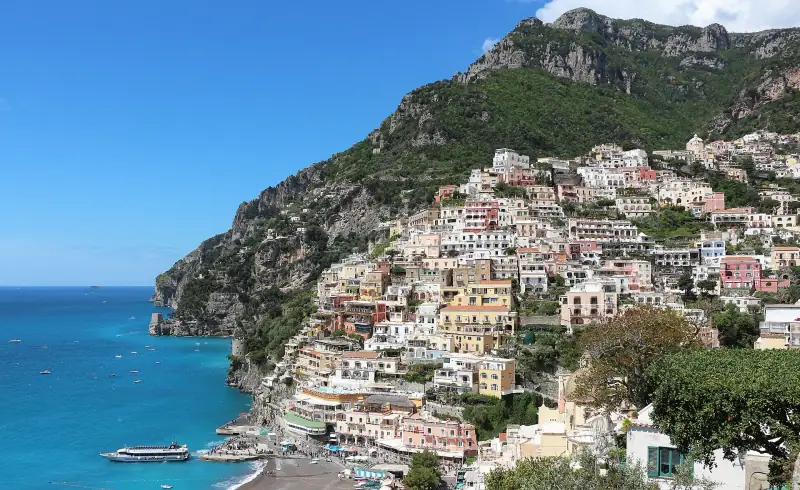
When to visit the Amalfi Coast: weather, seasons and crowds month by month
When to visit the Amalfi Coast? Weather, crowds, sea, ferries and hiking: a month-by-month guide to choose the best time for your trip.
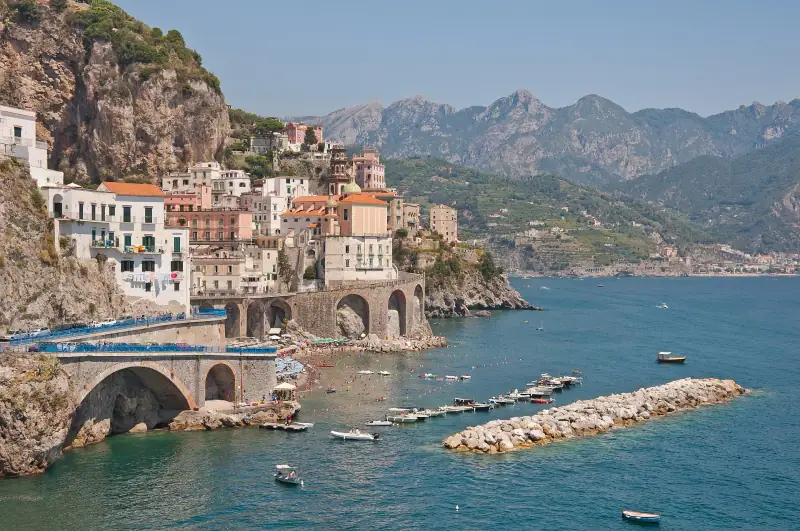
Is Atrani worth the detour from Amalfi? A half-day walking visit
Is Atrani worth the detour from Amalfi? Walking access, churches, beach, stairs to the Santuario del Bando, where to eat and visit length for half a day.

Valley of the Mills and Valle delle Ferriere in Amalfi: hiking without a guide, time, access and difficulty
Valley of the Mills and Valle delle Ferriere above Amalfi: hiking without an agency, duration, access to Pontone, difficulty, Paper Museum and FAQ.
Ready-made
Amalfi Coast itineraries
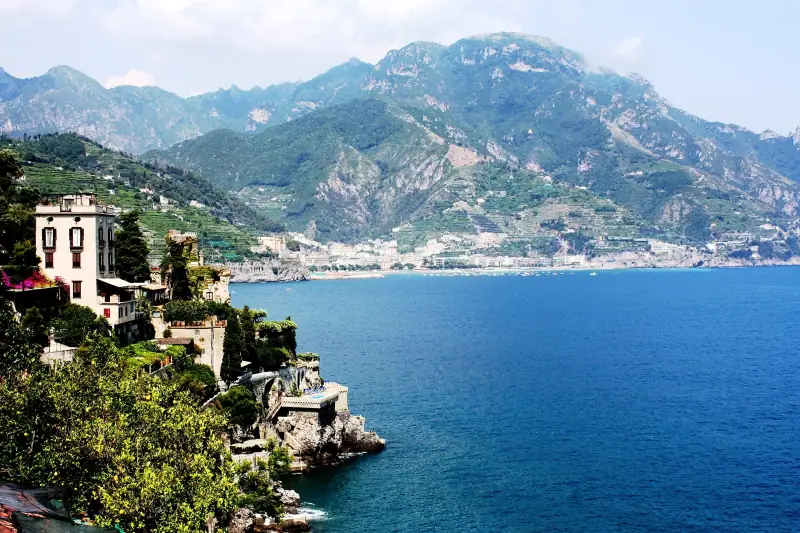
3 days
Amalfi Coast in 3 days: a day-by-day itinerary without a car
Plan 3 days on the Amalfi Coast without a car: Amalfi, Ravello, the Path of the Gods and Positano, with bus, ferry and practical tips for each day.
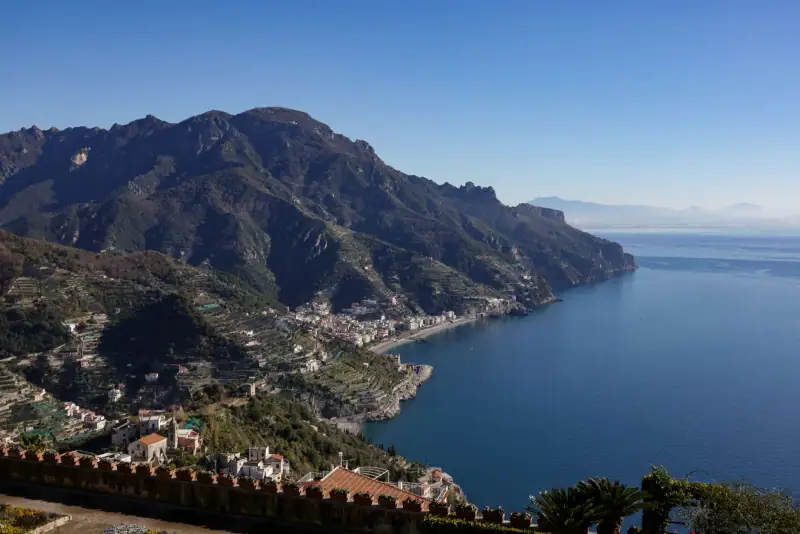
5 days
Amalfi Coast road trip by car: a Sorrento to Salerno itinerary
Drive the Amalfi Coast from Sorrento to Salerno on the SS163: stops in Positano, Amalfi and Ravello, parking, and tips for narrow roads.
5 days
Amalfi Coast without a car: a 5-day itinerary by bus, ferry and train
Visit the Amalfi Coast without a car in 5 days: day-by-day itinerary by bus, ferry and train, with Amalfi, Ravello, Positano, Capri, Pompeii and tips.