Things to do
Things to do in Bukhara: the best activities and must-see visits
We may earn a commission when you book through links on this page, at no extra cost to you. We don't visit or try the places we cover: we summarize published sources. How we work
In short
- Two full days cover the major sites: the Ark citadel, the Poi Kalon complex, the Lyabi-Hauz square and the covered bazaars; a third day adds the residential districts and an excursion.
- Free activities include Lyabi-Hauz, the lanes and covered bazaars (you only pay if you buy), and evening strolls in the old town.
- The Bahauddin Naqshband complex is about 10 km (6 mi) northeast of Bukhara, 30 minutes by taxi, a major pilgrimage site open to non-Muslim visitors.
- Craft experiences include suzani embroidery, silk miniatures (about €15-80 / $17-93) and ikat silk.
Bukhara is not just an open-air museum: it is a living city where crafts continue in the same bazaars as under Tamerlane, where Sufis gather in thousand-year-old mosques, and where Lyabi-Hauz square comes alive every evening as it has for centuries. Behind the famous minarets and turquoise domes hides a Bukhara to be experienced: on foot, at the end of the day, in master craftsmen’s workshops and in lanes far from the marked tourist trails.
This guide lists the best things to do in Bukhara, from the great historic sites to the authentic experiences most travelers miss, to build a memorable stay in the holy city of the Silk Road.
Visit the Ark citadel: Bukhara’s historic heart
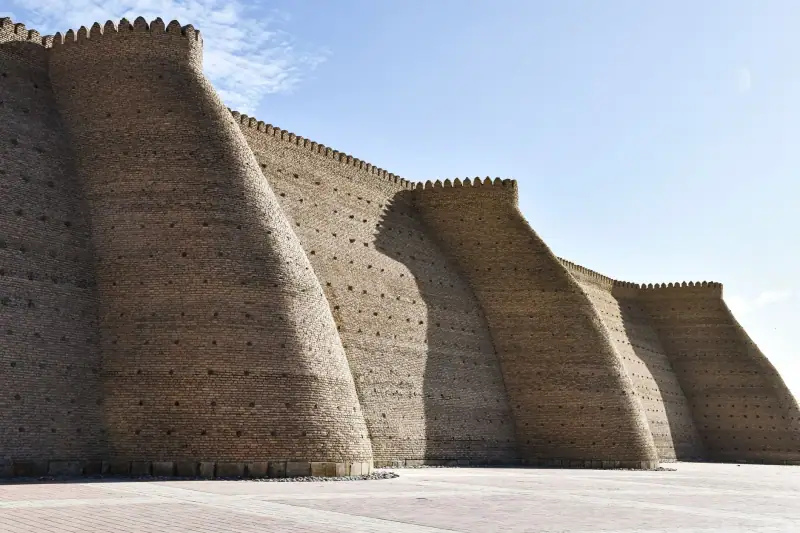
The Bukhara Ark is the palace fortress that has dominated the old town since at least the 5th century. Continuously occupied by the emirs of Bukhara until 1920 (when Soviet forces under Frunze bombarded it with artillery and aircraft, a fire then destroying about 80% of the fortress), it is now partly restored and open to visitors. It is one of the most important monuments in Central Asia, and often underestimated by hurried travelers who only see it from the outside.
What you will see inside
The inner citadel includes the Reception Court, where the emir received ambassadors and dignitaries, an imposing space with a large platform on which the throne was set during official ceremonies. The Ark museum presents archaeological collections (coins, ceramics, everyday objects) and regional history covering more than two millennia of Bukharan history. The Jangi Mosque (17th century), still in use, is the oldest mosque in the citadel.
Practical tips
Entry is paid (fare in force at the time of your visit). The climb to the main gate, a sloping corridor between two massive towers, is already spectacular. Once at the top, the view over the city and the Kalon minaret is excellent.
Come early in the morning (at opening, around 9 am; hours vary by season, so check there) to avoid the crowd and enjoy a low light that brings out the adobe walls. A local guide can enrich the visit considerably: the history of the Ark is complex and explanatory signs are rare.
Explore the Poi Kalon complex
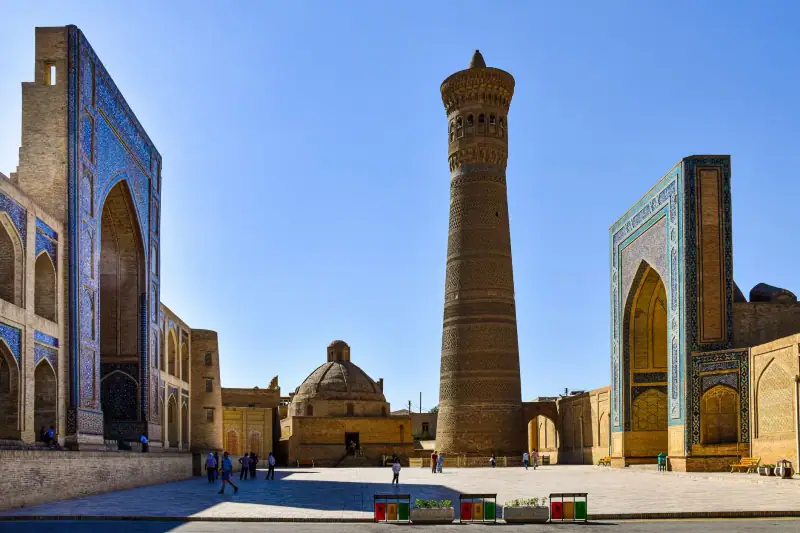
The Poi Kalon complex is the religious and architectural heart of Bukhara, a set of three major monuments organized around the Kalon minaret, one of the most recognizable symbols of Central Asia.
The Kalon Minaret (12th century)
Built in 1127 under the Karakhanids, the Kalon Minaret (“Great Minaret”) rises to about 46 meters (150 ft). It is one of the best-preserved medieval monuments of the old Silk Road, and one of the few structures Genghis Khan spared during the sack of Bukhara in 1220, said to have been impressed by its beauty. Its terracotta brick decoration forms different geometric patterns that vary from band to band, from the base to the top.
The minaret is visible from afar and serves as a landmark in the city. It is not open for climbing by visitors.
The Kalon Mosque (16th century)
Facing the minaret is the Kalon Mosque, built (or rebuilt) in the early 16th century. It can hold about 12,000 worshippers and remains active as a place of worship. Non-Muslims can visit outside prayer times; entry to the courtyard is generally free, but access to the main prayer hall may be restricted. Modest dress is required (shoulders and knees covered, shoes removed).
The Mir-i-Arab Madrasa (16th century)
Opposite the Kalon Mosque, the Mir-i-Arab Madrasa is one of the only madrasas to have kept operating as a religious school through the Soviet era; it still trains students in Islamic studies. It is generally not open to the public inside, but its facade of blue and white tiles is absolutely remarkable. Admire it in the late afternoon when the light strikes the mosaics directly.
Hotels in Bukhara's old town
Sleep a few minutes' walk from the Kalon minaret to experience Bukhara at dawn and in the evening without crowds.
Settle in at Lyabi-Hauz square
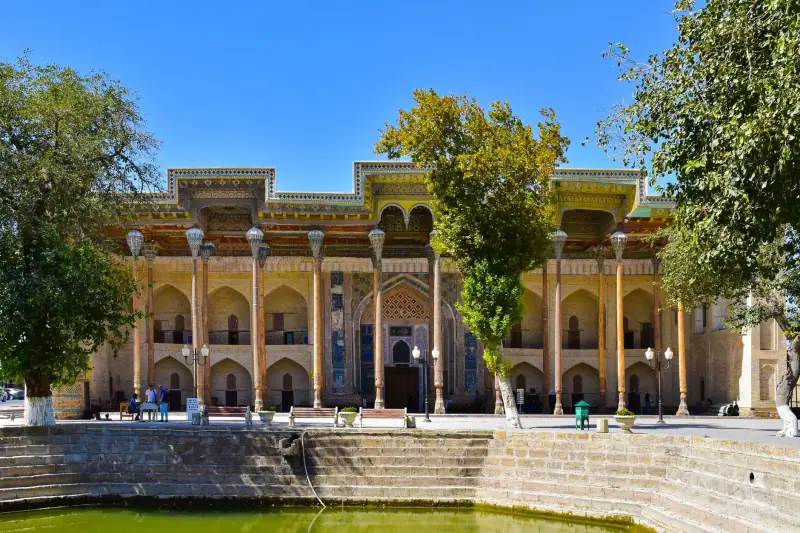
Lyabi-Hauz square (“edge of the pool” in Persian-Tajik) has been the heart of social life in Bukhara since its large pool was built in 1620. This is where residents converge in the evening, from old chess players under the centuries-old mulberry trees to families out for a stroll, along with travelers enjoying the restaurant terraces by the water.
What surrounds the square
Three first-rate monuments surround Lyabi-Hauz:
- The Nadir Divan-Begi Madrasa (1622), east of the pool, whose portal is decorated with a mural showing two simurghs carrying white deer and a solar face, an unusual iconography for Islamic architecture, said to have surprised the emir himself at the inauguration.
- The Nadir Divan-Begi Khanqah, a Sufi retreat center built in 1620, facing the madrasa on the other side of the pool to the west.
- The Kukeldash Madrasa (16th century), just to the north, is the largest madrasa in Bukhara.
Daily life around the pool
Lyabi-Hauz is the ideal place to observe local life without trying to capture a postcard image. Elderly men gather on the benches and wooden tables under the old mulberry trees to play dominoes or chess, a scene unchanged for decades. Families arrive at the end of the day to stroll and settle into the terrace restaurants. Children play at the edge of the pool.
It is also one of the best places to have tea in the early evening, on the terraces of the traditional teahouses (chaikhanas) lining the square.
Explore the historic covered bazaars
Bukhara’s covered bazaars (“taki” in Uzbek) are among the oldest in Central Asia still in operation. Built in the 16th century under the Shaybanids, these brick domes each housed a different trade, and continue to do so today.
The three main bazaars
Taki-Zargaron (jewelers’ bazaar) is the largest and best preserved of the three. Located at the crossing of the major pedestrian streets, it now houses shops of jewelry, silks and souvenirs. The central dome, pierced with oculi that let in natural light, is a marvel of medieval engineering.
Taki-Sarrafon (money changers’ bazaar) is the smallest of the three covered bazaars. It lies on the road between Lyabi-Hauz and the Kalon complex. It mainly offers ceramics, embroideries and lacquer objects.
Taki-Tilpak-Furushon (headwear sellers’ bazaar) is famous for traditional caps and headgear, notably the karakul, the astrakhan cap characteristic of Central Asia.
How to visit the bazaars
Visiting the bazaars is free. You can enter, observe and move around freely. The unwritten rule is not to haggle aggressively: prices are often posted or clearly stated, and a small negotiation (5-10%) is acceptable for major pieces but not systematic. Do not hesitate to look and compare before buying, as quality and prices vary a lot from shop to shop.
Discover Bukhara’s living crafts
Bukhara is not only a city of monuments: it is also a craft capital where dozens of masters carry on techniques centuries old. The difference from Samarkand or Tashkent is noticeable: Bukharan workshops are often more accessible to visitors and the craftspeople more willing to explain their work.
Suzani embroidery
Suzani is Central Asia’s great ceremonial embroidery. Historically, brides-to-be embroidered their suzani for years before their wedding; a large piece could take 2 to 5 years of collective work (the women of the family worked together on the same piece). Bukhara is one of the great centers of this tradition.
In several workshops in the old town, you can watch embroiderers at work and buy pieces directly from the source. Some workshops also offer short introductions (1-2 hours) where you can learn the basic stitches under the guidance of a craftswoman.
Miniatures painted on silk
Miniature painting, a tradition inherited from Persian and Timurid courts, is alive in Bukhara. Artists reproduce in fine ink scenes of the Silk Road, medieval daily life or portraits of historical figures. The supports used are silk, handmade paper or vegetable ivory.
A small miniature (10 x 15 cm / 4 x 6 in) represents several hours to several days of work depending on the level of detail. Prices range from €15 to 80 (~$17-93) depending on size and finesse of execution.
Ikat silk fabrics
Bukhara is the great production center of ikat (“atlas” in Uzbek), resist-dyed silk whose patterns with slightly blurred outlines are characteristic. The warm colors (saffron, burgundy, emerald green) and the geometric or floral motifs come directly from the Timurid tradition. Ikat is found as lengths of fabric, made-up dresses, scarves and stoles.
Flights to Bukhara
Compare flights to Bukhara (BHK airport) or to Tashkent with a connection.
Visit the lesser-known mosques and mausoleums
Beyond the headline monuments, Bukhara holds an extraordinary collection of Islamic monuments often ignored by standard tourist circuits, yet just as impressive as the famous sites.
The Samanid Mausoleum (9th-10th century)
The Samanid Mausoleum is one of the jewels of medieval Islamic architecture, and one of the oldest fired-brick monuments in the world still standing. Built between 892 and 943 for the Samanid royal family, it stands out for its brick decoration laid in geometric patterns that vary with orientation and light.
The mausoleum is in a small park northwest of the old town, often less visited than the Kalon complex. Come in the late afternoon: the low light brings out the relief of the bricks like nowhere else.
The Chor Minor complex (19th century)
Chor Minor (“four minarets” in Persian) is one of Bukhara’s most photographed monuments, and one of the most atypical. This entrance gate of a former madrasa is crowned with four small blue-tiled towers, each slightly different from the others. The monument is compact but extremely photogenic.
It lies in a quiet residential district, about a fifteen-minute walk from the Kalon complex. The way there crosses real Bukhara streets: children play, women chat on doorsteps, neighborhood shops line up. It is a pleasant and instructive walk.
The Lyabi-Hauz complex and its surroundings
Around Lyabi-Hauz, several monuments deserve attention beyond the three main ones already mentioned. The small Magoki-Attari mosque (12th century, rebuilt in the 16th century), buried one meter (3 ft) below the present street level, a consequence of centuries of accumulated archaeological layers, is one of the oldest mosques in Bukhara. It sometimes houses a small exhibition on local carpets.
Excursion to the Bahauddin Naqshband mausoleum
About 10 km (6 mi) northeast of Bukhara (30 minutes by taxi), the Bahauddin Naqshband complex is a major pilgrimage site for Sufi Muslims worldwide, and a fascinating destination for travelers who are not believers but are interested in spirituality and architecture.
Bahauddin Naqshband (1318-1389 or 1391 depending on sources) is the founder of the Naqshbandiyya Sufi brotherhood, one of the most influential in the Islamic world (from the Maghreb to Southeast Asia). His mausoleum is surrounded by a complex of mosques, shaded courtyards and pools in a quiet green setting.
The atmosphere there is deeply different from the tourist sites of the old town: pilgrims come to pray and meditate, groups of women recite prayers while circling the tomb. Non-Muslim visitors are welcome but must respect the dress code (cover shoulders, arms and knees) and be discreet. The visit takes 1 to 2 hours.
The mausoleum is easily accessible by taxi from the old town; negotiate the ride (round trip with waiting) directly with the driver.
Car rental in Bukhara
Explore the Naqshband mausoleum and Bukhara's surroundings at your own pace.
Bukhara in the evening: the most beautiful free activity
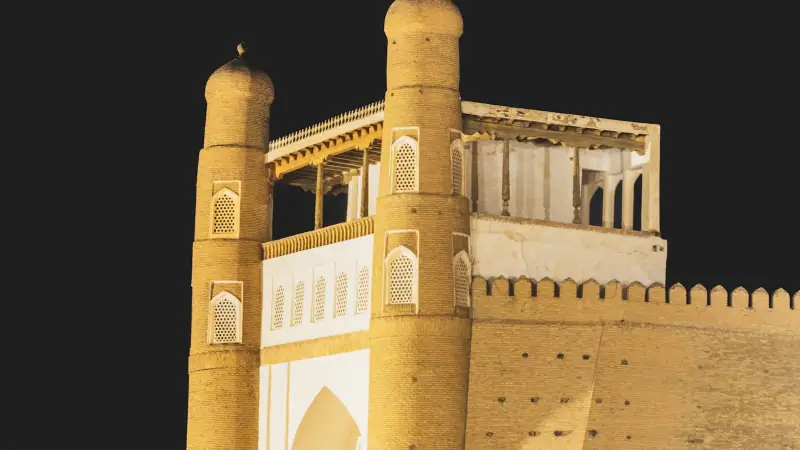
Bukhara changes radically after 6 pm. When the day-trip tour groups leave the old town to return to their modern hotels on the outskirts, residents take back their spaces, and Bukhara regains an authentic local life and an almost medieval atmosphere under the soft glow of the streetlamps.
What you can do in the evening in Bukhara
Stroll through Lyabi-Hauz square: Terrace restaurants come alive, the centuries-old mulberry trees bathe in amber light, the pool reflects the silhouettes of the minarets. It is one of the loveliest travel scenes in Central Asia.
The lit Kalon Minaret: After sunset, the Kalon minaret and surrounding monuments are lit. The square in front of the Poi Kalon complex, nearly deserted, lends itself to high-quality night photos (tripod recommended).
Residential lanes: Moving slightly away from the tourist center, you will pass lanes where families sit in front of their doors to enjoy the cool. These non-touristy, authentic neighborhoods give an idea of what life in Bukhara was like for ordinary residents.
Concerts and cultural evenings: Several charming guesthouses organize private concerts or evenings of traditional music in their courtyards. Ask your accommodation in advance; these events are not always announced long ahead.
Evening is also the best time to have dinner on a terrace by the pool and watch neighborhood life. Bukhara has a more modest food scene than Tashkent or Samarkand, but the old town’s restaurants serve excellent Uzbek dishes in charming settings.
A typical 2-day activity program in Bukhara
Day 1: Monuments and crafts
Morning (8 am-12:30 pm)
- 8 am: Ark citadel at opening (morning light on the adobe walls)
- 9:30 am: Samanid Mausoleum in its shaded park
- 11 am: Poi Kalon complex: Kalon Mosque, Mir-i-Arab Madrasa facade, viewing the minaret
Afternoon (2 pm-7 pm)
- 2 pm: Covered bazaars Taki-Zargaron, Taki-Sarrafon and Taki-Tilpak-Furushon (craft shopping)
- 4 pm: Suzani embroidery or miniature workshop (observation and possibly an introduction)
- 5:30 pm: Chor Minor complex (on foot from the old town)
- 7 pm: Dinner on a terrace on Lyabi-Hauz square
Day 2: Excursion and nighttime atmosphere
Morning (9 am-1 pm)
- 9 am: Taxi excursion to the Bahauddin Naqshband mausoleum (30 minutes by road)
- 11 am: Return to Bukhara, visit the Magoki-Attari mosque
Afternoon (2 pm-8 pm)
- 2 pm: Residential districts off the tourist circuits (free stroll)
- 3:30 pm: Nadir Divan-Begi Madrasa (facade with simurghs, inner courtyard)
- 5 pm: Tea in a traditional chaikhana on Lyabi-Hauz
- 6:30 pm: Drinks and sunset over the rooftops from an old-town terrace
- 8 pm: Lit Kalon Minaret, night photos
Bukhara reveals itself fully to those who take the time to read it at several speeds: the great monuments in the morning, craftsmen’s workshops in early afternoon, the covered bazaars at a stroller’s pace, and the lit old town in the evening when the crowd has dispersed. To prepare your visit, see our complete guide to Bukhara and our article on where to stay in Bukhara. If you are building a wider circuit, our guide to the Silk Road in Uzbekistan will help you link Bukhara, Samarkand and Khiva into a coherent itinerary.
Frequently asked questions
How long does it take to visit Bukhara?
Two full days cover the major sites: the Ark citadel, the Poi Kalon complex, the Taki-Zargaron bazaar and the covered bazaars. A third day lets you explore the residential districts, neighborhood mosques, and make an excursion nearby (Bahauddin Naqshband khanqah or the Shahrisabz area). If you have only one day, concentrate on Lyabi-Hauz square and the Kalon complex.
What are the free activities in Bukhara?
Lyabi-Hauz square is free to enter, as are the lanes and covered bazaars (you only pay if you buy). The Kalon Mosque can be seen from the outside for free. Bukhara's traditional bazaars (Taki-Zargaron, Taki-Sarrafon, Taki-Tilpak-Furushon) are open and free. Walking through the residential districts outside the tourist center is also entirely free and often very pleasant.
Can you see traditional music performances in Bukhara?
Yes. Performances of classical Uzbek music (Bukhara Shashmaqam) and dance are organized in some hotels and cultural centers, especially in high season (April-June, September-October). Ask your accommodation. Bukhara's cultural center also sometimes offers performances. These shows combine singing, traditional instruments (dutar, tanbur, sato) and dance and generally last 1 hour.
What is there to do in Bukhara in the evening?
In the evening Lyabi-Hauz square comes alive with local families and travelers. The terrace restaurants around the pool are pleasant for dinner. The lanes around the Kalon are discreetly lit. Walk through the old town once the groups have gone; the atmosphere is calmer and more authentic. Some accommodations offer private evening concerts in their courtyards. The lit Kalon minaret is especially beautiful at night.
Are there interesting excursions from Bukhara?
Yes. The Bahauddin Naqshband mausoleum (founder of the Naqshbandiyya Sufi order) is about 10 km (6 mi) northeast of Bukhara, a major pilgrimage site open to non-Muslim visitors, impressive for its calm and architecture. The town of Gijduvan, about 45 km (28 mi) away, is known for traditional pottery and sometimes hosts workshops open to the public. Shahrisabz (Tamerlane's birthplace) is about 270 km (168 mi) by road (via Karshi), a 4 to 5-hour trip, so plan a long day excursion.
What souvenirs should you buy in Bukhara?
Bukhara is especially known for its embroideries (suzani), miniatures painted on silk, ikat silk fabrics (atlas), karakul fur (caps and hats), blue and white ceramics and carpets. The historic covered bazaars (Taki-Zargaron, Taki-Sarrafon, Taki-Tilpak-Furushon) are the best places to shop. Negotiating is possible but prices generally stay reasonable for the craftsmanship.
More Uzbekistan guides
Keep reading
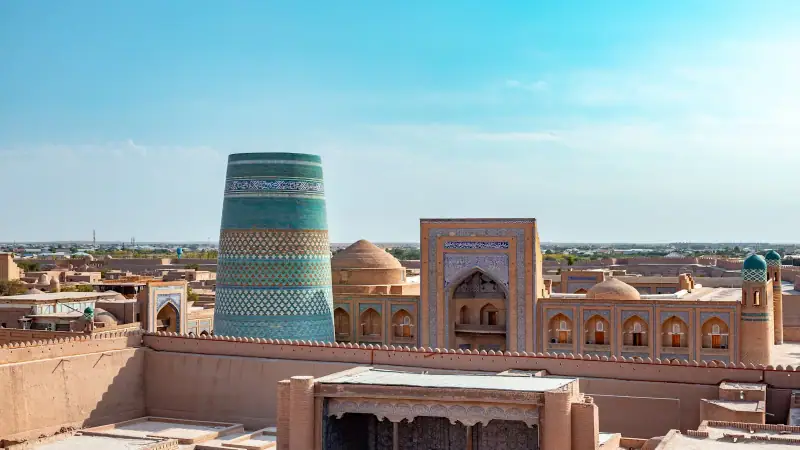
Things to do in Khiva: the best activities and must-see visits
What to do in Khiva? Minaret climb, craft workshops, desert fortresses, night walks... A complete guide to the activities not to miss in Khiva.
Chimgan and Beldersay from Tashkent without a tour: transport, cable car and a day's budget
Getting to Chimgan and Beldersay from Tashkent without a tour: taxi, minibus, cable car, trails, season and budget for a day in the mountains.

Arriving in Tashkent in the middle of the night: where to sleep, near the airport or downtown?
Flight landing at 2 am or 4 am in Tashkent? Hotel near the airport or in town, early check-in, night taxi and prices: a guide to choosing well.
Ready-made
Uzbekistan itineraries
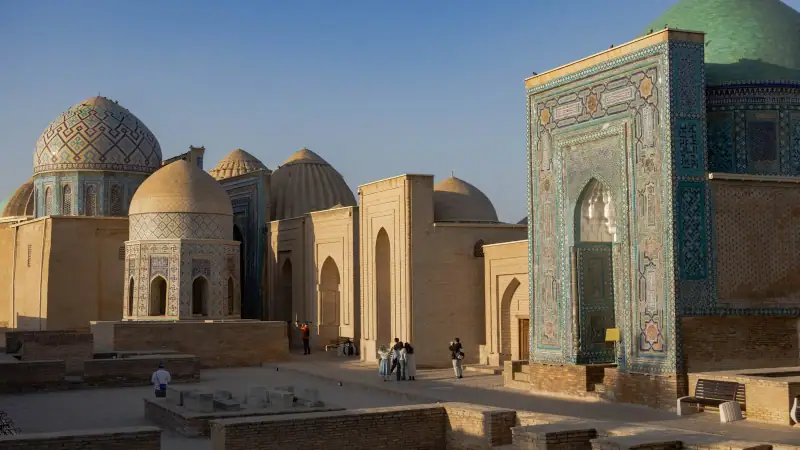
10 days
Uzbekistan in 10 days: a complete itinerary with the Ferghana Valley
TashkentFerghanaSamarkandBukharaKhiva
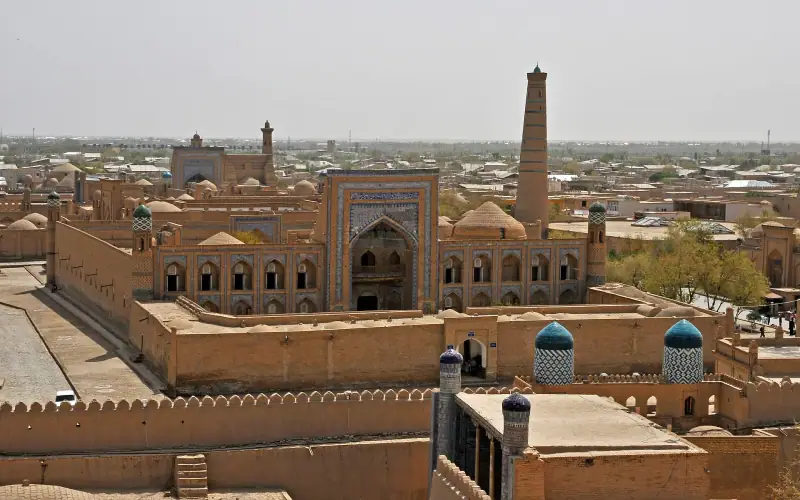
7 days
Uzbekistan in 7 days: the ideal Silk Road itinerary
TashkentSamarkandBukharaKhiva
9 days
Uzbekistan in 9 days with kids: stops and a family-friendly pace
TashkentSamarkandBukhara