Itineraries
Western Sicily in 5 Days: Trapani, Marsala and the Aegadian Islands
We may earn a commission when you book through links on this page, at no extra cost to you. We don't visit or try the places we cover: we summarize published sources. How we work
Day by day
- Day 1Trapani historic center: Purgatorio church, Via Garibaldi, fish market
- Day 2Trapani salt pans in the morning, Erice in the afternoon
- Day 3Marsala Baroque center and wine, boat to Mozia island
- Day 4Segesta temple and theater, San Vito Lo Capo beach
- Day 5Aegadian Islands from Trapani: Favignana, Levanzo or Marettimo
Weather through the year on this route
| Jan | Feb | Mar | Apr | May | Jun | Jul | Aug | Sep | Oct | Nov | Dec | |
|---|---|---|---|---|---|---|---|---|---|---|---|---|
| High °F (°C) | 5714 | 5714 | 6116 | 6519 | 7323 | 8228 | 8831 | 8932 | 8228 | 7424 | 6619 | 5915 |
| Low °F (°C) | 479 | 479 | 4910 | 5312 | 5815 | 6619 | 7222 | 7323 | 6921 | 6317 | 5614 | 5111 |
| Rain in (mm) | 2.770 | 2.255 | 1.845 | 1.540 | 0.820 | 0.515 | 0.25 | 0.515 | 2.255 | 3.075 | 3.180 | 3.180 |
Normals 1991–2020 at Trapani and Noto: averages over 30 years, not a forecast. Source: NASA POWER (MERRA-2), grid of about 50 km. Figures computed by us in November 2026.
In short
- Five days: Trapani, the salt pans and Erice, Marsala and Mozia, Segesta and San Vito Lo Capo, then the Aegadian Islands.
- A car is essential; the A29 links Palermo to Trapani (about 100 km / 62 mi, 1 h to 1 h 15).
- Best months are May, June and September (25-30 °C / 77-86 °F); July-August is busiest, especially at San Vito Lo Capo and Favignana.
- Hydrofoils from Trapani take about 25 minutes to Favignana, 30 to Levanzo and 1 h 15 to 1 h 30 to Marettimo.
Western Sicily is perhaps the least known part of the island, and the one that feels most unfamiliar. Here there is no marked-out tourist circuit: only windmills beside salt pans, Greek temples rising from the scrub, white towns set on promontories, and islands whose water comes close to the blue of the Maldives. Trapani, Marsala, Segesta, the Aegadian Islands: the west makes a coherent 5-day itinerary, ideally done by rental car from Trapani or Palermo.
This itinerary is designed to combine culture, beach and food at a pleasant pace, without overloading the days.
Day 1: arrival in Trapani and the historic center
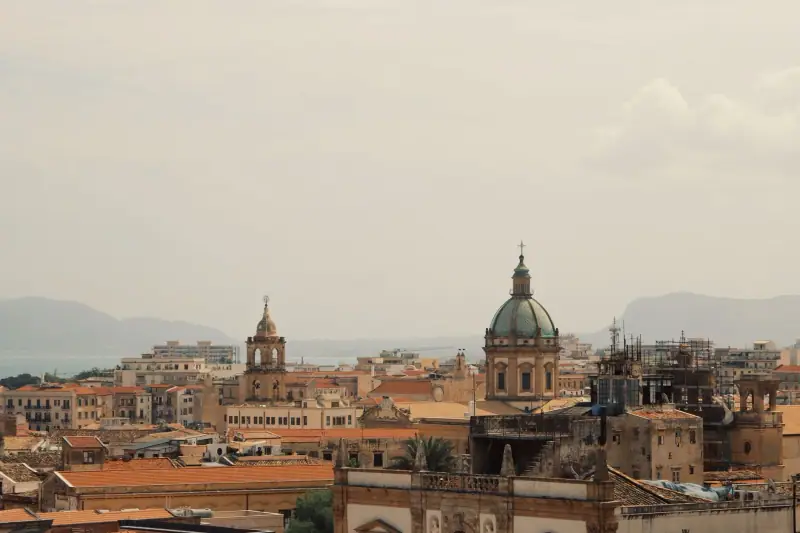
Trapani occupies a narrow cape that juts into the Mediterranean like the tip of a sickle; in Sicilian dialect, drepanon means exactly “sickle”. It is a city of sailors, salt and tuna, whose Baroque historic center can be covered entirely on foot.
Trapani’s historic center
The heart of the city is concentrated on Corso Vittorio Emanuele and the adjacent lanes. The church of the Purgatorio (17th century) houses the famous Misteri, a set of twenty sculptural groups in wood and fabric depicting the Passion of Christ, carried in procession every Good Friday in one of Sicily’s most impressive religious events.
Via Garibaldi, farther east, brings together several 18th-century Baroque palaces with their golden limestone facades. The fish market (mercato del pesce), near the port, comes alive early in the morning with arrivals of bluefin tuna, swordfish and oily fish caught in the surrounding waters.
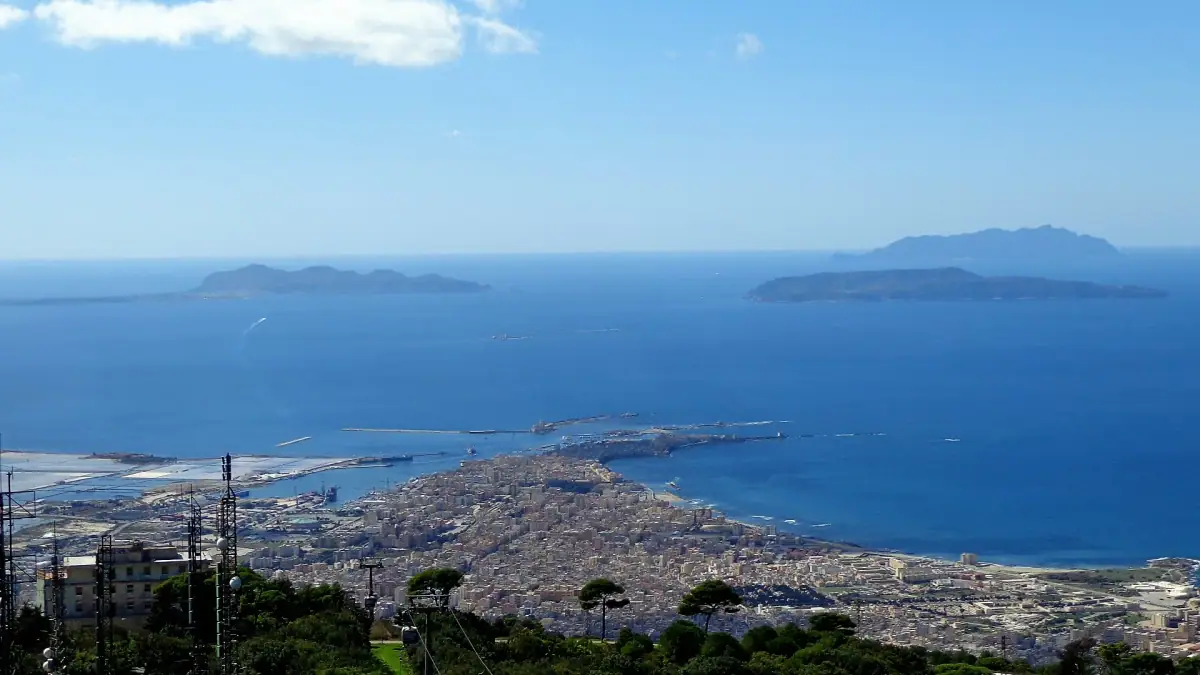
Tip: The western part of the promontory, around the Torre di Ligny (a 17th-century watchtower), offers a fine panorama over the salt pans and the Aegadian Islands in the late afternoon.
Where to stay in Trapani
Hotels in Trapani's historic center to explore the Baroque lanes, the port and the fish market on foot.
Trapani food
Trapani has its own version of Sicilian cooking, shaped by centuries of trade with the Maghreb and the Middle East. The emblematic dish is pasta al pesto trapanese, a pesto of raw tomato, almond, garlic and basil, served with busiate (hand-twisted pasta). The cous-cous al pesce, a fish couscous, reflects the North African influence: Trapani is one of the few Italian cities where this dish is considered a local dish in its own right.
For sweets, do not miss the granita di mandorla (almond granita) and the cassatelle (small fried turnovers filled with ricotta). The cafés on the main street serve these specialties from dawn.
Day 2: the Trapani salt pans and Erice
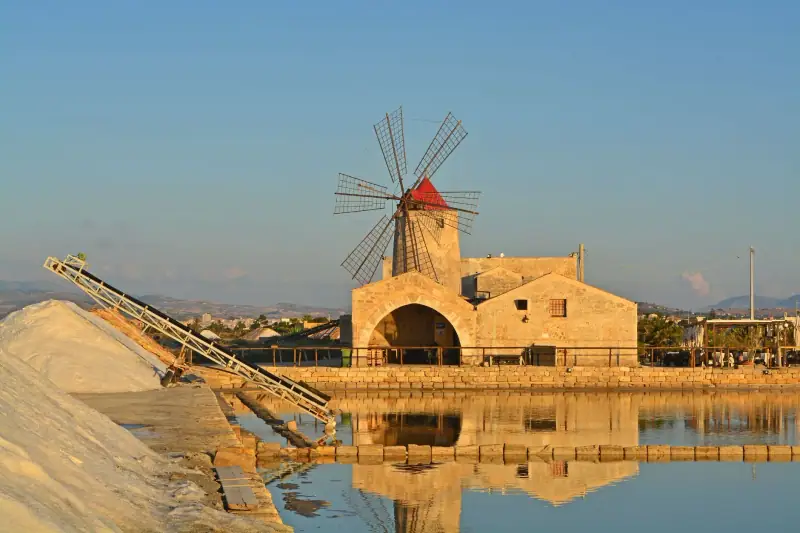
This day combines two very different but equally unforgettable visits: the salt pans in the morning, the mountain village of Erice in the afternoon.
The Saline di Trapani e Paceco Nature Reserve
Between Trapani and Marsala stretches one of the best-preserved coastal wetlands in the Mediterranean: the Trapani salt pans. The old windmills that pumped water between the basins have been restored and stand out on the horizon in recognizable silhouettes. In the late afternoon, when the sun grazes the salt crystals and tints the basins pink and orange, the landscape is of truly unreal beauty.
From May to September, flamingos (several hundred individuals depending on the year) stop over in the shallow basins, adding a touch of pink to the scene. The Salt Museum (Museo del Sale), set in a restored mill at Nubia, a few kilometers from Trapani, presents the history of salt harvesting since Antiquity.
Practical information: The coastal road (SP21) runs alongside the salt pans for about 10 km (6 mi). You can stop freely to watch the windmills and basins from the road. Entry to the museum and the reserve is modest.
Rental car in Trapani
Essential for exploring the salt pans, Erice, Segesta and San Vito Lo Capo at your own pace from Trapani.
Erice, the village in the clouds
Perched at about 750 meters (2,460 ft) on Mount Erice, the medieval village of Erice overlooks Trapani and the salt pans from a rocky promontory. It takes about 40 minutes by road from Trapani to go up (a cable car, the Funivia di Erice, links Trapani to the village in a few minutes when it is running, but its maintenance schedule is unpredictable, so check before you go).
The village itself is a marvel of cobbled lanes, hanging gardens and medieval churches. The Castle of Venus (12th-century Norman), built on the ruins of a temple dedicated to Venus/Astarte whose oracle was known across the ancient Mediterranean, offers a 360° view over the Sicilian cape, the coast as far as the Aegadian Islands on a clear day, and sometimes even the Tunisian coast.
Erice is renowned for its genovesi, small puff-pastry cakes filled with lemon cream, a must-try local specialty.
Day 3: Marsala and the island of Mozia
About 30 km (19 mi) south of Trapani (30-35 minutes by the A29 motorway), Marsala is a city of great Baroque elegance. Its name comes from the Arabic Marsa Ali (“Ali’s port”), and its history is closely tied to the wine that bears its name and to the Phoenician civilization that founded one of its most important colonies here.
Baroque Marsala and its wine
Marsala’s historic center is a quadrilateral of right-angled streets inherited from the Phoenician plan, later reshaped by the Romans and the Arabs. Piazza della Repubblica, with its Baroque cathedral and 18th-century loggia, forms the heart of a city that knows how to take its time.
Marsala wine (DOC) has been produced in the region since the late 18th century, when the English merchant John Woodhouse discovered how to fortify it with wine spirit so it could cross the Mediterranean without spoiling. The historic cantine in the area offer tastings: Marsala comes dry, semi-dry and sweet, and in versions aged for several years.
The island of Mozia: the Phoenicians in the Mediterranean
A few hundred meters off the Marsala coast, the island of San Pantaleo holds the ruins of Mozia (Motya in Phoenician), one of the best-preserved Phoenician colonies in the Mediterranean basin. Founded around the 8th century BC, the city was destroyed in 397 BC by Dionysius I of Syracuse after a memorable siege.
You reach the island by a short boat ride from the Marsala salt pans road. The archaeological site includes sections of rampart, a sacred basin (kothon, long interpreted as an artificial harbor but identified by recent archaeology as a freshwater basin for ritual use), houses and workshops, and above all the Whitaker Museum (Joseph Whitaker, a British ornithologist and archaeologist, acquired the island in the early 20th century, around 1902, and excavated it from 1905), which holds the Giovinetto di Mozia, an extraordinary 5th-century Greek marble statue found on the island.
Practical information: Boats leave regularly from the Stagnone Lagoon. The island visit takes about 2 to 3 hours.
Marsala and Mozia excursion
Discover Marsala's cantine, the salt pans and the Phoenician site of Mozia guided by a local guide with a background in ancient history.
Day 4: the Temple of Segesta and San Vito Lo Capo
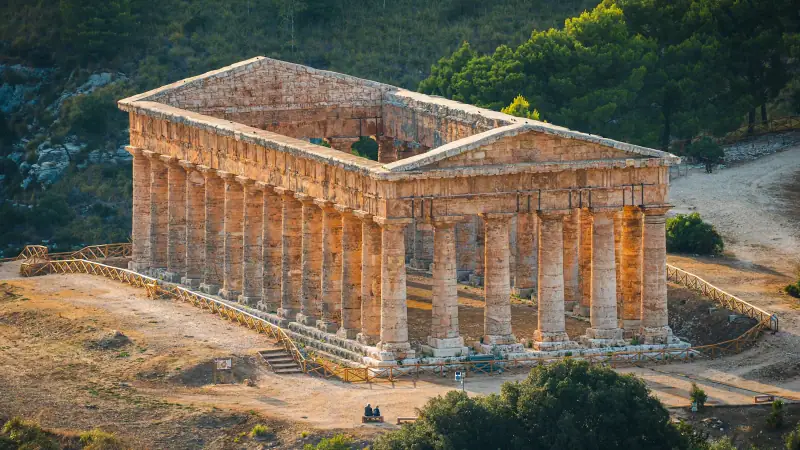
Segesta: the temple rising from the scrub
About 33 km (21 mi) southeast of Trapani (25-30 minutes by car), the archaeological site of Segesta is one of the most striking in Sicily, perhaps in the whole Mediterranean. The Doric temple, built around 420 BC by the Elymian city of Segesta, stands alone on a hill in the middle of a valley of scrub and fields. It was never finished (the columns are not fluted, the roof was never laid), but its silhouette is absolutely perfect.
A few hundred meters from the temple, a winding path climbs to the Greek theater (3rd century BC) at the top of the hill, with a panoramic view over the valley and the sea. In summer, performances are sometimes given in this theater (check the program on the official website of the Parco Archeologico di Segesta).
Practical information: From the parking lot, a shuttle (bus) goes up to the theater (a few euros extra). The full temple + theater visit takes about 2 to 3 hours. Go in the morning to avoid the heat.
San Vito Lo Capo: the beach of the west
About 38 km (24 mi) north of Trapani (50 minutes by road along the coast), San Vito Lo Capo is the best-known seaside town in western Sicily. Its white-sand beach of several kilometers, bordered by limpid water that shifts from emerald green to deep blue, is regularly ranked among the most beautiful in Italy. The village itself is charming, with low white houses and fish restaurants with terraces.
At the western end, the Zingaro nature reserve stretches over 7 km (4 mi) of wild, roadless coast, reachable only on foot from San Vito Lo Capo or from Scopello. The trails run along deserted coves of rare beauty. To choose the entrance and the trail, see our guide to the Zingaro reserve.
Day 5: the Aegadian Islands
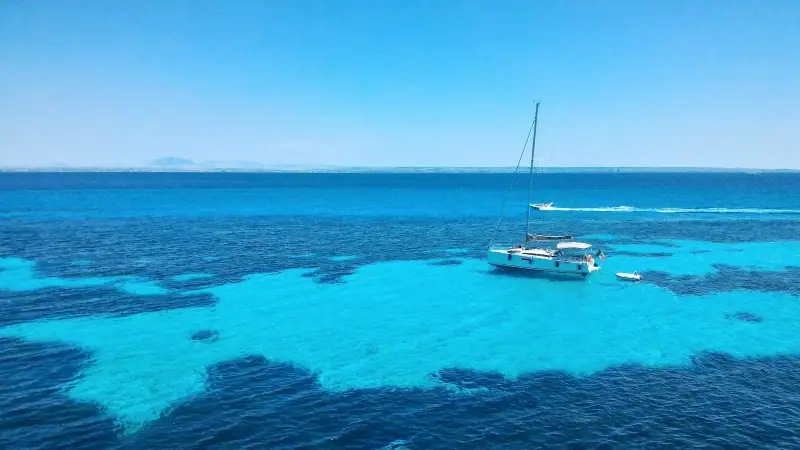
The Aegadian Islands (Isole Egadi) form an archipelago of three main islands west of Trapani, in a deep blue sea. These are the waters where the Battle of the Aegadian Islands took place in 241 BC, which saw Rome crush the Carthaginian fleet and mark the end of the First Punic War. Wrecks and bronze rams are still regularly found by underwater archaeologists.
Ferries and hydrofoils leave from Trapani port. Schedules vary by season; in July-August, frequency is at its maximum.
Favignana: the island of coves
Favignana is the largest and busiest of the Aegadian Islands. Biking is the ideal way to go around it (about 20 km² / 8 sq mi in area, flat roads). The coves of Cala Azzurra, Cala Rossa and Bue Marino are among the most beautiful in Sicily, with a spectacular rocky bottom of yellow tuff, the local stone with which much of western Sicily was built.
The Ex-Stabilimento Florio, a former bluefin tuna canning factory turned tuna museum, tells the story of the mattanza, the ritual bluefin tuna fishing that marked the economy and culture of the islands for centuries. The mattanza is no longer practiced on an industrial scale, but remains a central element of the island’s identity.
Levanzo: the prehistoric caves
Levanzo is the smallest of the three main islands (about 6 km² / 2.3 sq mi) and the quietest out of season. Its main curiosity is the Grotta del Genovese, a cave reachable only by boat or by a path (about 1 h on foot from the port), whose walls are decorated with cave paintings and prehistoric engravings dating from roughly 10,000 to 6,000 BC. The depictions of deer, horses, oxen and human figures are exceptionally well preserved. A guided visit is required to enter (ask at the Levanzo tourist office or book ahead in high season).
Marettimo: the wildest
Marettimo, the farthest, about 1 h 15 to 1 h 30 from Trapani by hydrofoil, is the pearl of the archipelago for hikers and diving enthusiasts. No road goes around the island (only a few kilometers of paved roads around the village), but a network of trails crosses the scrub-covered hills to the ruins of an old Roman castrum and several deserted coves. The water is especially limpid, with renowned dive sites.
Tip: With a single day, choose Favignana + Levanzo (two close islands) rather than Marettimo, which deserves at least one night on the island to be appreciated.
Flights to Trapani or Palermo
Trapani-Birgi airport (TPS) has seasonal flights. Palermo (PMO) is an alternative with more flights all year.
Practical information
How to get to western Sicily
Trapani-Birgi Airport (IATA code: TPS) is the most practical entry point for the west. Off season, flight options shrink considerably; in that case, Palermo Falcone-Borsellino Airport (PMO, about 100 km / 62 mi to the east) has year-round connections.
From Trapani airport, the town center is about 15 km (9 mi) away (15-20 minutes by car). Pick up your rental car directly at the airport.
Getting around
A car is essential to cover the west in 5 days. Roads are generally good; the A29 motorway links Palermo to Trapani (about 100 km / 62 mi, 1 h to 1 h 15). Plan for fuel in rural areas.
Buses link Trapani to Marsala (about 45-50 min), Palermo and a few coastal towns, but frequencies are limited and unsuited to visiting Segesta or the salt pans.
Budget
Itemized costs:
- Accommodation in Trapani: €60-130 (~$70-150) per night
- Meals (restaurants, trattorie): €15-25 (~$17-29) per person
- Entry fees (Segesta, Mozia, museums): €10-17 (~$12-20) each depending on the site (check current rates)
- Ferries Trapani → Aegadian Islands (round trip): about €25 (~$29) per person
- Rental car: €30-60 (~$35-70) per day depending on season
When to go
May, June and September are the ideal months for western Sicily: pleasant warmth (25-30 °C / 77-86 °F), swimmable sea, flamingos in the salt pans, and spectacular sunsets over the windmills. July-August are perfect for the beach and the islands, but visitor numbers are at their maximum, especially at San Vito Lo Capo and Favignana. April and October suit archaeological sites and hikes well, with cool evening temperatures.
Western Sicily is explored slowly. It is not a region of great monuments piled on top of one another, but a territory of landscapes, flavors and silences: windmills above the salt pans, Greek columns in the scrub, turquoise water between two tuff rocks. Five days are enough to touch the essentials; a week would let you find your own rhythm.
To extend your stay in Sicily, see our Sicily road trip guide or our article on the Aeolian Islands.
Sources
- Parco Archeologico di Segesta (Regione Siciliana): prices checked November 2026
- Fondazione Whitaker: prices checked November 2026
Frequently asked questions
How many days do you need to visit western Sicily?
Allow 5 to 7 days to explore western Sicily comfortably: 2 days in Trapani and around (salt pans, Erice), 1 day in Marsala and Mozia, 1 day at Segesta, and 1 to 2 days on the Aegadian Islands. A 5-day stay at a brisk pace covers all the highlights.
Do you need a car in western Sicily?
Yes, a car is essential to explore western Sicily. Public transport links Trapani to Marsala and Palermo, but to reach the salt pans, Segesta, San Vito Lo Capo and Erice, a car is almost mandatory. Plan for it from your arrival at Trapani-Birgi (TPS) or Palermo (PMO) airport.
When should you go to western Sicily?
May, June and September are ideal: pleasant warmth (25-30 °C / 77-86 °F), swimmable sea at San Vito Lo Capo and the Aegadian Islands, few crowds compared to summer. July-August are splendid for the beach and the islands, but Trapani and Erice get crowded. For the salt pans, the sunset is especially spectacular from May to October.
How do you get to the Aegadian Islands from Trapani?
Ferries and hydrofoils (aliscafi) leave from Trapani port. By hydrofoil, allow about 25 minutes to Favignana, 30 minutes to Levanzo and 1 h 15 to 1 h 30 to Marettimo. Regular ferries are slower but cheaper. Several companies operate the route; book ahead in July-August. Schedules vary by season.
Which Aegadian island should you choose?
Favignana is the most accessible and the most touristy, with its coves, rental bikes and its former tuna factory turned museum. Levanzo is quieter, with major prehistoric caves decorated with paintings and engravings. Marettimo is the wildest and best preserved, with hiking and crystal-clear water. With 2 days in the Aegadian Islands, combine Favignana + Levanzo or Favignana + Marettimo.
Can you visit Segesta and Marsala on the same day?
Yes, it is doable but busy. Segesta takes 2 to 3 hours (Doric temple + theater on the hill). Leaving early in the morning for Segesta (about 35 km / 22 mi from Trapani, 35-40 min), you can reach Marsala in early afternoon for the tasting and Mozia. The alternative is to devote a whole day to Segesta + San Vito Lo Capo and another to Marsala + Mozia.
What budget should you plan for 5 days in western Sicily?
Accommodation in Trapani costs €60 to 130 (~$70-150) per night depending on category. Meals come to €15-25 (~$17-29) per person (focacce, fresh fish, granite). Ferries to the Aegadian Islands cost about €25 (~$29) round trip per person. Entry to Segesta is around €14 (~$16; check the rate on the park's website).
More Sicily guides
Keep reading
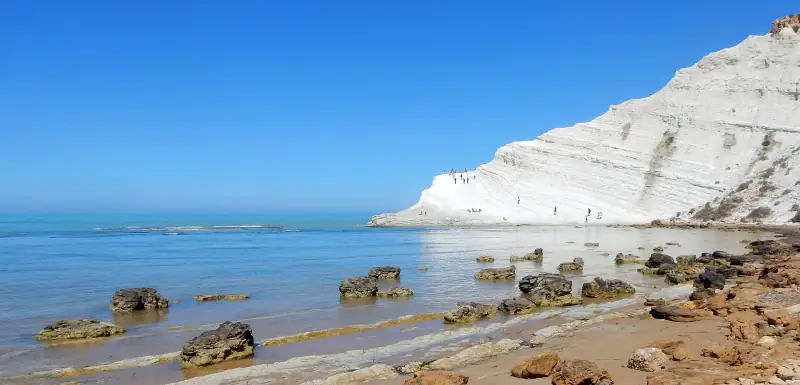
The Best Beaches in Sicily: A Selection by Region
Discover Sicily's best beaches: Cefalù, Taormina, Scopello, Agrigento, the Aegadian Islands. White sand, turquoise water, hidden beaches: our selection.
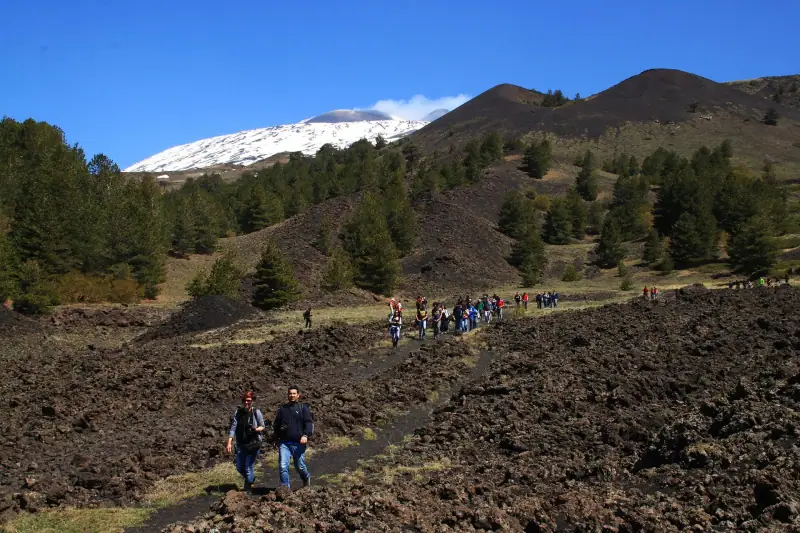
Hiking Mount Etna: A Complete Guide to Climbing the Volcano
Mount Etna hiking guide: cable car, trails, access, altitude, prices, season, gear. Everything to visit Europe's largest volcano safely.
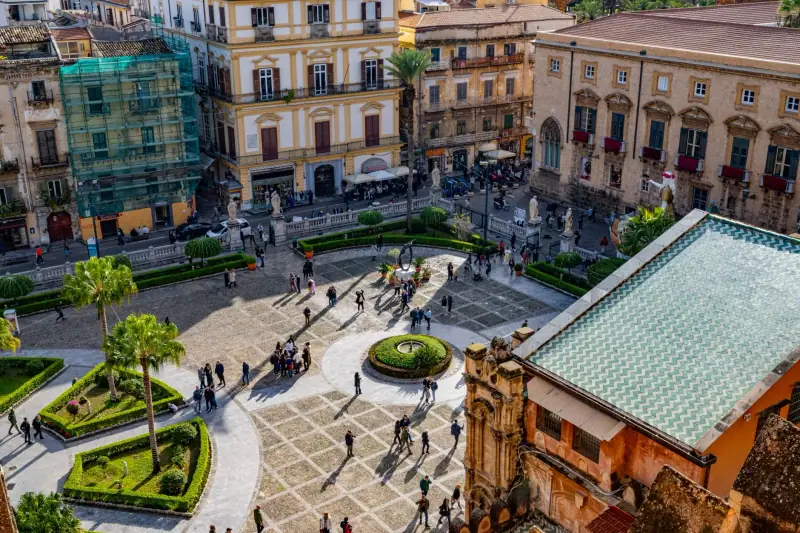
Palermo Highlights: The 12 Sights Not to Miss
What to see in Palermo? Our selection of 12 highlights: Cappella Palatina, markets, cathedral, Kalsa, Monreale. Practical guide with hours and tips.
Ready-made
Sicily itineraries
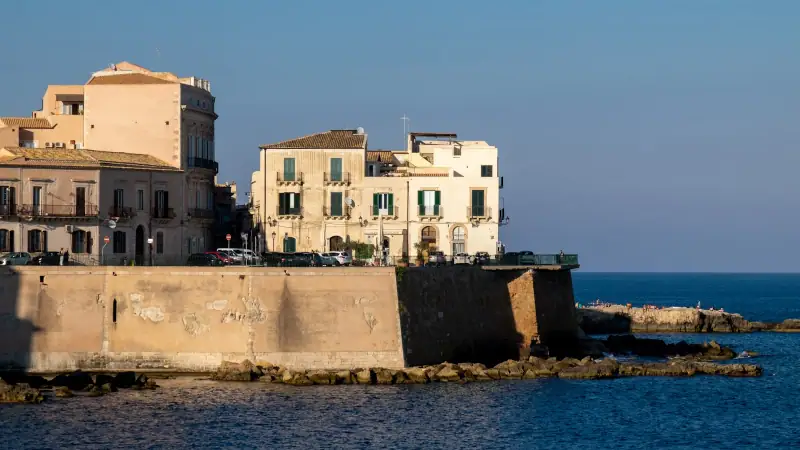
6 days
Southeast Sicily Itinerary: Syracuse, Noto, Ragusa and Agrigento in 6 Days
SyracuseRagusa or NotoAgrigento
14 days
Sicily Road Trip: The Full Island Loop in 14 Days
A 2-week Sicily road trip itinerary: full loop of Palermo, Mount Etna, Syracuse, Agrigento and Trapani, with practical tips for driving the island.