Things to do
Wildlife in Scotland: Where to See Eagles, Dolphins and Red Deer
We may earn a commission when you book through links on this page, at no extra cost to you. We don't visit or try the places we cover: we summarize published sources. How we work
In short
- Chanonry Point on the Black Isle is the best shore spot for Moray Firth dolphins: arrive 2 hours before high tide.
- Mull is the top island for sea eagles, and Glencoe, the Cairngorms and Ardnamurchan are good for golden eagles.
- The red deer rut runs from September to October; puffins can be seen from May to July, mainly on the Isle of May, Handa and Staffa.
- Keep your distance from nests and resting seals, keep dogs on a lead, and choose operators approved by NatureScot.
Scotland is one of the best countries in Europe for wildlife watching. From the dolphins of the Moray Firth to the white-tailed sea eagles of the Hebrides, and the deer rut in the Highlands, every season offers unforgettable natural spectacles. And unlike Africa or the Amazon, the animals are often visible from the roadside or on foot, with no costly safari.
This guide presents the best species to watch, the essential spots, the best seasons, and practical advice for an experience that respects Scottish nature.
Birds of prey: eagles and sea eagles
Scotland is one of the few countries in western Europe where you can see two species of eagle in their natural habitat: the golden eagle (Aquila chrysaetos) and the white-tailed sea eagle (Haliaeetus albicilla).
The golden eagle: lord of the Highlands
With a wingspan that can exceed 2 meters (6.6 ft), the golden eagle is one of the largest birds of prey in Europe. Scotland is home to about 500 breeding pairs, nearly the entire British population.
Where to see them: The Highlands are their favored territory. The most promising areas are the valleys of Glencoe, the hills around Fort William, the Cairngorms, and the Ardnamurchan peninsula. The Isle of Mull is a well-known spot where local guides take you to nesting sites.
How to recognize them: Entirely dark brown body, golden feathers on the nape, long rounded tail. In flight, they soar very steadily, wings slightly raised in a shallow V. Do not confuse them with the common buzzard (much smaller) or the sea eagle (distinctive white tail).
Best season: All year, but golden eagles are more active and more visible outside the nesting period (February to July), especially in fall and winter when the vegetation is less dense.
Car rental to explore the Highlands
Essential for reaching the best wildlife spots in remote areas.
The white-tailed sea eagle: a great comeback
The white-tailed sea eagle was wiped out in Great Britain in the early 20th century. Its reintroduction in Scotland starting in 1975 on the Isle of Rum (Hebrides) is one of the great success stories of European conservation. About 200 pairs now breed in Scotland (2025 data).
With a wingspan that can reach 2.5 meters (8.2 ft), the largest bird of prey in the British Isles, the sea eagle is a breathtaking sight. Its name comes from its short white tail, very visible in flight.
The best spots:
- Isle of Mull: the top destination. Local operators such as Mull Eagle Watch run guided outings with high chances of sightings from hides.
- Isle of Skye: especially around Loch na Dal and Loch Slapin. See our guide to the Isle of Skye for the best areas.
- Loch Lomond: pairs have settled in the National Park, which is more accessible from Glasgow.
- Tay Forest (Perthshire): a growing population in this central part of Scotland.
Dolphins and cetaceans of the Moray Firth
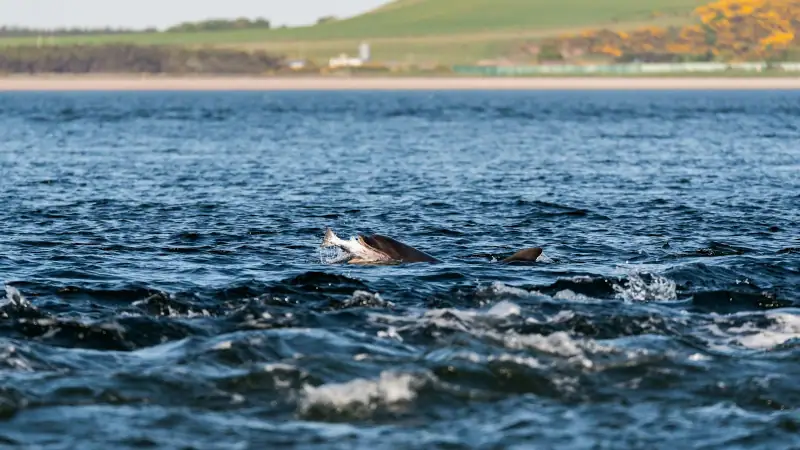
The Moray Firth, a narrow estuary in northeast Scotland, is home to the northernmost population of bottlenose dolphins (Tursiops truncatus) in the world, with about 200 resident individuals.
Chanonry Point: the best accessible spot
Chanonry Point (Black Isle, Ross-shire) is without question the best place in Europe to watch dolphins from the shore. This sandy promontory juts into the narrows of the Moray Firth, where the current creates eddies that are good for hunting.
How to get there: From Inverness, head toward Fortrose on the Black Isle (about 23 km / 14 mi, 25 minutes by car). Parking is free at the end of the road.
Strategy: Arrive 2 hours before high tide. The dolphins swim up the current to hunt salmon. In fine summer weather, expect dozens of spectators, and often as many dolphins, sometimes only a few meters from the shore.
Other Moray Firth spots: Cromarty (a picturesque village with boat trips), Spey Bay (the mouth of the Spey, also known for otters), and cruises from Inverness or Cromarty.
Places to stay in Inverness
An ideal base for the Moray Firth, Loch Ness and the northern Highlands.
Whales and large cetaceans
The north and northwest coasts of Scotland are visited by humpback whales, fin whales and sometimes orcas. The best departure points for whale-watching cruises are:
- John o’ Groats and Thurso (far north)
- Ullapool (west coast)
- Orkney and Shetland: top destinations for orcas, especially from November to January
Red deer and the Highland rut
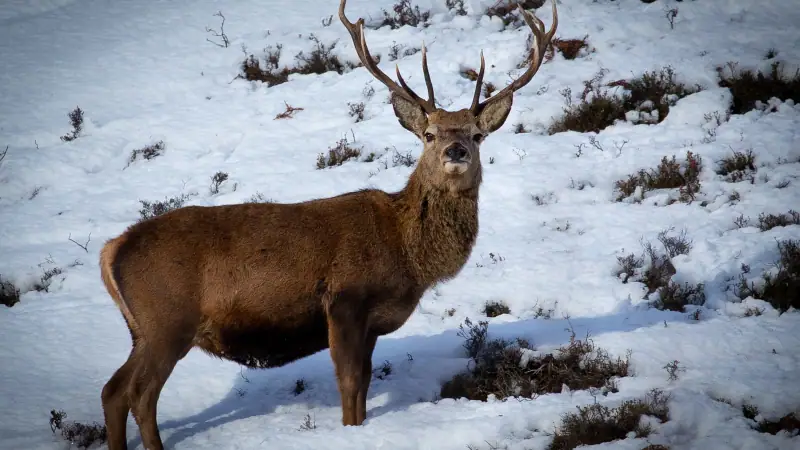
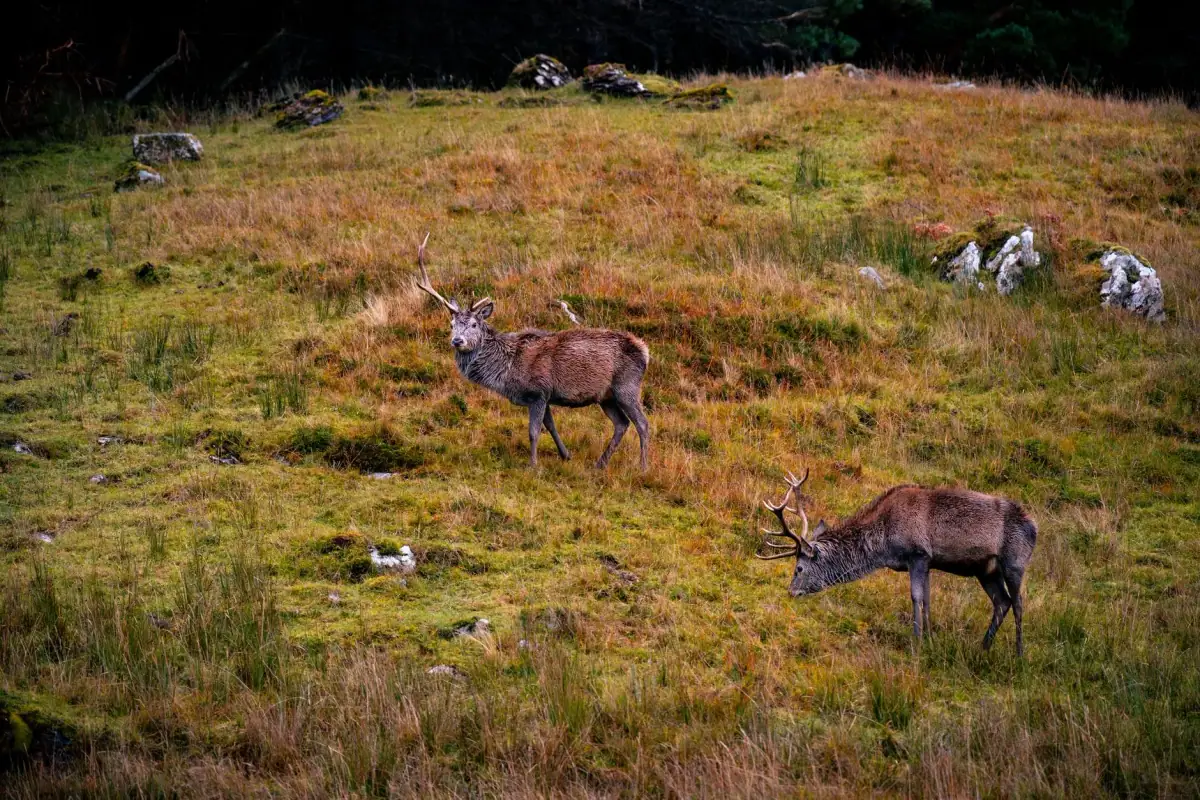
With about 360,000 to 400,000 red deer according to current government data, Scotland has the largest red deer population in Europe (excluding Scandinavia). These large deer are visible almost everywhere in the Highlands, often from the roads.
The rut: a unique show of sound and sight
In September and October, the stags compete for dominance and mating in noisy, spectacular rituals. The dominant stag roars, a deep, hoarse bellow that echoes through the valleys, and locks antlers with his rivals.
Where to experience it:
- Glen Etive (western Highlands, reachable from Glencoe): a wild valley where deer are often visible at the roadside.
- Cairngorms National Park: one of the best places to watch deer roaming free in a vast open space.
- Glen Torridon (Wester Ross): a spectacular setting with the ancient red sandstone mountains as a backdrop.
- Isle of Rum (Hebrides): a national nature reserve with a red deer population studied scientifically for more than 50 years.
Practical tips: Bring binoculars. Stay at a good distance, as stags can be aggressive during the rut. Dawn and dusk are the best times. Dress in green or dark brown.
To plan your route through the best spots, see our guide to a Scotland road trip.
Otters of the rivers and coasts
Scotland is home to one of the largest otter populations in Europe, estimated at more than 8,000 animals. Unlike other countries where the otter is mostly a nocturnal river animal, in Scotland it has adapted to coastal environments and is active during the day.
The best otter spots
Isle of Skye: The Sleat peninsula (south Skye) and Loch na Dal are known for their coastal otter populations. Local guides offer walking outings on the shoreline.
Loch Sunart (Ardnamurchan): Considered by many naturalists one of the very best otter-watching sites in Europe. The road along the loch (A861) has many scenic stops.
Spey Bay (Moray): The mouth of the Spey, known for both dolphins and otters. The Scottish Dolphin Centre (run by WDC, Whale and Dolphin Conservation) is a good starting point.
Kintyre and Knapdale: The Kintyre peninsula and Knapdale forest (where beavers have been reintroduced) have a well-established otter population.
How to spot them: Look for their tracks on the shore (characteristic droppings made of fish bones, called “spraints”). Watch the water surface early in the morning or late in the afternoon. Their swimming at the surface creates a V-shaped wake.
Guided wildlife tours in Scotland
An outing with a naturalist guide to maximize your chances of sightings.
Notable birds: ospreys, puffins and more
Scotland is a top birdwatching destination, with species that are hard to see elsewhere in Europe.
The osprey
The osprey had disappeared from Scotland in the early 20th century. Since its natural return in the 1950s, its population has grown to about 250 to 300 breeding pairs, and is still rising. RSPB Loch Garten in the Cairngorms is the historic nesting site. An observation center with webcams and RSPB staff is open from April to the end of summer (check the dates on the RSPB website).
Puffins
Atlantic puffins (Fratercula arctica) are among the most charismatic birds in Scotland. With their colorful red and yellow bills and their waddling walk, everyone loves them.
Main colonies:
- Isle of May (Firth of Forth): boats from Anstruther (East Neuk of Fife). The colony has about 52,000 breeding pairs (about 100,000 individuals). Accessible from May to July.
- Handa Island (Sutherland, northwest): boats from Tarbet. Also known for its cliffs of guillemots and razorbills.
- Isle of Staffa (Inner Hebrides): known for Fingal’s Cave. Boats from Fionnphort (Mull, direct departure) or via a day-trip package from Oban (ferry + transfer). A superb pairing with the geological site. Our guide covers the Staffa excursion: season, prices and booking.
Barnacle geese and Arctic wildfowl
In winter, tens of thousands of geese and ducks overwinter in Scotland, coming from Iceland, Greenland and northern Russia. The lochs of Galloway (southwest) and Loch Leven (Kinross) are particularly remarkable. The WWT Caerlaverock reserve (Dumfries) hosts nearly the entire world population of Svalbard barnacle geese each winter.
Seals on the Scottish coasts
Two species of seal are common on the Scottish coasts: the gray seal (Halichoerus grypus) and the harbor seal (Phoca vitulina).
Easy spots: Some sites offer practically guaranteed seal sightings:
- Donna Nook is in England, but on the Scottish side, the Ythan Estuary (Aberdeenshire) is remarkable for harbor seals.
- St Andrews: seals are regularly seen in the bay, sometimes on the beach itself.
- Isle of Staffa and the Treshnish Isles (Hebrides, boats from Mull): gray seal colonies, visible from the boat.
- Chanonry Point (already mentioned for dolphins): harbor seals are often present on the sandbanks.
Less conspicuous species: red squirrels and beavers
The red squirrel
The red squirrel is in sharp decline across Great Britain following the introduction of the American gray squirrel. Scotland is its last major British refuge. You can see it in Scots pine forests, notably:
- Galloway Forest (Dumfries and Galloway): Red Squirrel reserve
- Abernethy Forest (Cairngorms): ancient Caledonian forest
- Speyside pine forests (Badenoch and Strathspey): one of the best areas in Scotland
The return of the beaver
The Eurasian beaver (Castor fiber) was officially reintroduced in Scotland starting in 2009. It is now protected. The Tay basin (Perthshire) has several hundred animals. Local guides offer twilight canoe outings on the Tay to watch them.
Calendar of the best sightings
| Season | Star species |
|---|---|
| January-March | Deer herds near the roads, Arctic geese, orcas (Orkney/Shetland) |
| April-May | Return of the ospreys, seal births, ospreys in flight |
| May-July | Puffins (colony in full swing), active dolphins, sea eagles feeding their young |
| August-September | Salmon running up the rivers, golden eagles, start of the rut |
| October-November | Deer rut (Sept-Oct), red deer at their peak antler size, Arctic ducks |
| December | Barnacle geese at Caerlaverock, gray seals (pupping season) |
Recommended gear
To make the most of Scottish wildlife:
- Binoculars: the essential accessory. 8x42 minimum for birds, ideally 10x50 for cetaceans.
- Waterproof jacket: even in summer, showers are sudden in the Highlands.
- Rubber boots or waterproof shoes: for the shoreline and the moors.
- Tripods or monopods: for long-lens wildlife photography.
- iRecord or eBird app: to report your sightings and see those of others.
- Field guides: Collins Bird Guide (Europe), Wild Guide Scotland for wildlife spots.
To fit your nature outings into a complete itinerary, see our guide to hiking in the Highlands. Many trails cross areas of high wildlife value.
Watching wildlife responsibly
Scotland has a solid legal framework (Land Reform Act 2003, Scottish Outdoor Access Code, Wildlife and Countryside Act 1981). A few basic rules:
- Never approach the nests of eagles, ospreys or sea eagles. They are legally protected areas during the nesting season.
- Stay away from resting seals, especially during pupping season (November to January for grays).
- Do not feed wildlife, as it disturbs natural behavior.
- Keep dogs on a lead in areas with nesting birds (March to July) and around deer.
- Use your car as a hide: animals are often less frightened by vehicles than by people on foot.
Scotland is an exceptional nature destination that stays with you: watching a sea eagle plunge onto a loch, hearing the deer rut in a fine rain, or meeting an otter’s gaze from the shore are experiences that leave a lasting mark. The key is patience, discretion and good information, and this guide gives you the basics.
Frequently asked questions
Where can you see dolphins in Scotland?
The Moray Firth, near Inverness, is home to the northernmost population of bottlenose dolphins in the world. The best spot is Chanonry Point, on the Black Isle, which is reachable by road. The dolphins often hunt close to shore on the rising tide, especially in the morning.
What is the best time of year to see wildlife in Scotland?
Each season has its strengths. Spring (April-May): births, migratory birds, whales. Summer (June-August): puffins, dolphins, active sea eagles. Fall (September-November): the red deer rut (September-October), colors, few tourists. Winter (December-March): deer herds near the roads, Arctic ducks and geese. The most magical season remains fall, for the deer rut.
Can you see orcas in Scotland?
Yes, although rarely and with increasing difficulty. The West Coast Community, Scotland's only resident pod, unfortunately has only 2 surviving individuals (two males) and is considered functionally extinct. Passing orcas sometimes visit Orkney and Shetland. Boat trips from Lerwick or Stromness remain the best option, with no guarantee of a sighting.
Are wildlife tours regulated in Scotland?
Scotland has strict rules for wildlife-watching activities. The Scottish Outdoor Access Code applies: do not disturb wild animals, keep a respectful distance, and do not feed animals. Official exclusion zones exist for eagles and ospreys during nesting season. Choose operators approved by NatureScot.
What is a Highland cow?
The Highland cow (Highland cattle) is a Scottish breed with a long reddish-brown coat and long horns. Perfectly suited to the harsh Highland climate, it is one of the most photographed symbols of Scotland. You see them all over the Highlands, often near the roads. They are docile, but you should keep a respectful distance.
Where can you see puffins in Scotland?
The best puffin colonies are on the Isle of May (Firth of Forth, boats from Anstruther), Handa Island (Sutherland, boats from Tarbet), the Isle of Staffa (Hebrides, reachable from Oban or Mull), and Shetland. The season runs from May to July. Puffins leave their burrows in late July.
More Scotland guides
Keep reading

Golf in Scotland: Playing St Andrews and the Best Courses
Guide to playing golf in Scotland: St Andrews, Royal Troon, Carnoustie, Muirfield. Booking, green fees, tips and golf itineraries.
Hiking in the Highlands: The Best Trails in Scotland
The best hikes in the Scottish Highlands: Ben Nevis, Quiraing, Glencoe, Torridon. Levels, times, safety advice and gear.
Scotland travel budget: how much to plan for your trip
Estimate your Scotland travel budget: accommodation, transport, meals, activities. Tips to travel for less without sacrificing the experience.
Ready-made
Scotland itineraries
7 days
Scotland in 7 days: the perfect one-week itinerary
EdinburghFort WilliamInvernessPortree
14 days
Scotland road trip: the complete 2-week guide
Plan a 14-day Scotland road trip: full itinerary from the Lowlands to the far north, with logistics, places to stay and sights.
6 days
Scotland road trip in October: 6-day itinerary, roads and daylight hours
PitlochryInvernessPortreeFort William