What to see
Visiting Cagliari: A Complete Guide to Sardinia's Capital
We may earn a commission when you book through links on this page, at no extra cost to you. We don't visit or try the places we cover: we summarize published sources. How we work
In short
- Two days cover the essentials: the Castello quarter, the archaeological museum, San Benedetto market and Poetto beach. Three days add Nora and the Molentargius lagoon.
- From Cagliari-Elmas Airport (CAG), the regional train takes 6 to 10 minutes for €1.30 (about $1.50); a taxi costs about €15 to 20 (about $17 to 23).
- The National Archaeological Museum costs about €10 (about $12), or €5 (about $6) reduced, and is free on the first Sunday of the month.
- You can visit Cagliari without a car, but Nora, the southern beaches and the Sulcis need a rental car.
Cagliari is the surprise Sardinia holds for those who take the time to really look at it. Long overshadowed by the fame of the Costa Smeralda beaches or the wild gorges of the Ogliastra, the island’s capital deserves special attention. An authentic Mediterranean city of 150,000 inhabitants (more than 400,000 in the metropolitan area), it charms with its medieval quarter perched on a rocky spur, its exceptional museums, its busy markets and its 8 km (5 mi) beach right in the city. If you only see Cagliari from the taxi window between the airport and your resort, you miss one of the most fascinating cities in southern Italy.
Cagliari’s neighborhoods: a city with many faces
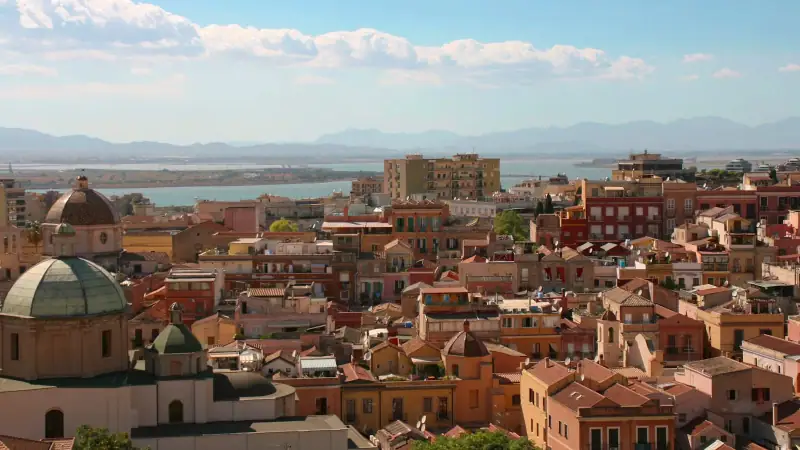
Cagliari was built on several hills that plunge toward the port and the gulf. Each neighborhood has a distinct personality, and exploring them on foot is the best way to understand the city.
Castello: the perched medieval city
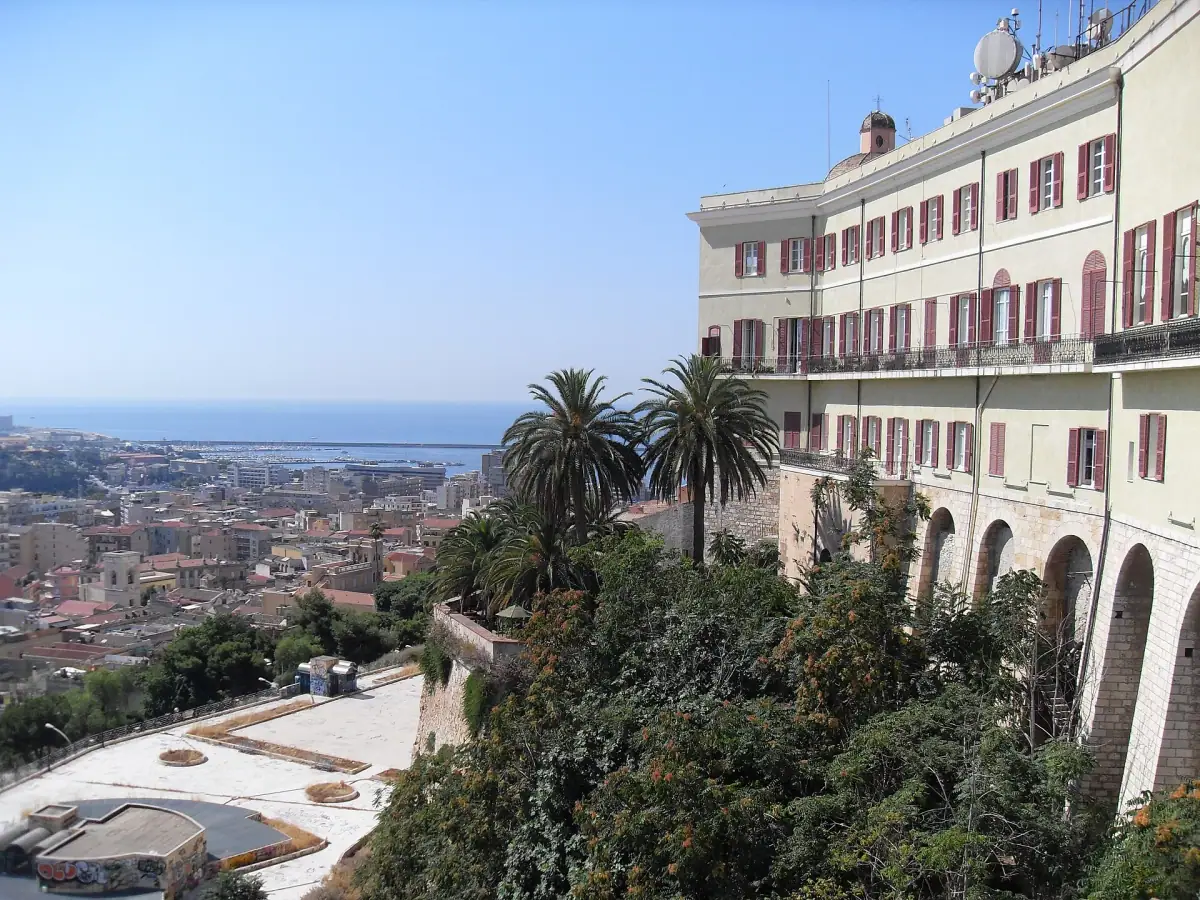
The Castello is the historic heart of Cagliari, set 80 m (260 ft) above sea level on a rocky spur and surrounded by imposing Pisan ramparts of the 12th to 14th centuries. This is where the city first existed, a fortress founded by Pisan merchants in the 12th century, later disputed by the Genoese, the Aragonese and finally the House of Savoy.
Its narrow streets and noble palaces now house the National Archaeological Museum of Cagliari (the most important in Sardinia), Santa Maria Cathedral and two emblematic medieval towers: the Torre di San Pancrazio and the Torre dell’Elefante, both built by the Pisans in the 14th century.
The Bastione di Saint-Remy, built between 1899 and 1903 by the municipality of Cagliari (architect Giuseppe Costa) on former 16th-century Spanish bastions, offers from its terrace a 360° view over the Castello rooftops, the Gulf of Cagliari, the Molentargius lagoon and the Sette Fratelli massif to the east. It is one of the most impressive panoramas in all of Sardinia, and access to the terrace is entirely free.
Marina: the lively port quarter
Below the Castello, the Marina quarter is the liveliest in Cagliari. Its grid of streets (a Genoese legacy) concentrates trattorias, enoteche, craft shops and aperitif bars. Via Roma, a long arcaded avenue running along the port, is the main artery of the modern city, ideal for a sunset passeggiata facing the gulf.
The Marina is where Cagliari’s nightlife beats, notably around Via Baylle and Via Sardegna, dotted with cocktail bars and restaurants open late. The Palazzo Civico (city hall, neo-Gothic and Art Deco style) and the Teatro Civico adorn Via Roma.
Stampace: the authentic working-class quarter
West of the Castello, Stampace is the most working-class and authentic quarter of Cagliari. Its streets climb gently toward the hills, lined with houses with colorful facades, small Sardinian grocers and Baroque oratories. The church of Sant’Efisio (17th century), the starting point each May 1 of the great procession in traditional costume, is the spiritual center of the quarter.
The Mercato Civico di San Benedetto, the largest covered market in Italy, stands on the edge of Stampace and the Pirri district. Two levels, hundreds of stalls of Sardinian fish, vegetables, cheeses and cured meats: an essential sensory experience.
Villanova: student and bohemian atmosphere
East of the Castello, Villanova is the quarter of students, literary cafés and vintage shops. Piazza San Domenico and the adjacent lanes hold the trendiest addresses. The Roman Amphitheater (2nd century AD), carved into the limestone rock at the intersection of Stampace and Villanova, hosts summer concerts.
Hotels in Cagliari
From boutique hotels in the Castello to seafront hotels at Poetto, find your accommodation.
The must-see sights
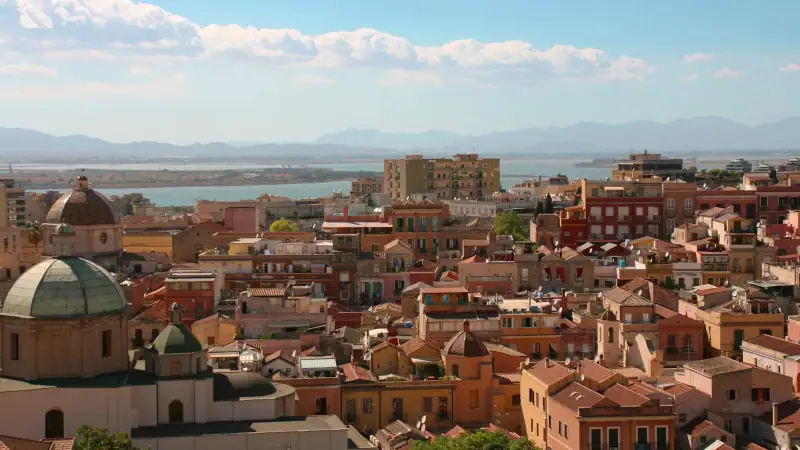
The National Archaeological Museum of Cagliari
The Museo Nazionale Archeologico di Cagliari, housed in the Aragonese palace in the heart of the Castello, is the most important in Sardinia and one of the richest in southern Italy. Its collection covers 4,000 years of the island’s history, from prehistoric remains to Phoenician, Punic, Roman and Byzantine treasures.
The centerpiece is undoubtedly the collection of Nuragic bronzetti: several hundred bronze statuettes of warriors, archers, veiled women, boats and animals, produced between the 9th and 7th centuries BC. These small masterpieces of precision reveal the sophistication of the Nuragic civilization, often underestimated in the tourist imagination.
Practical information: Open Tuesday to Sunday, about €10 (about $12) full price and €5 (about $6) reduced (single ticket with the Pinacoteca Nazionale; check rates on the Cagliari national museums site). Admission is free on the first Sunday of the month.
The Roman Amphitheater
The Anfiteatro Romano di Cagliari, dated to the 2nd century AD, is the best-preserved ancient monument in Sardinia. Carved directly into the limestone of the hill, it could hold about 8,000 spectators. Today partly restored, it serves as a setting for open-air concerts and shows during the summer (check the program with the tourist office).
The medieval towers of the Castello
The Torre di San Pancrazio (1305, about 36 m / 118 ft) and the Torre dell’Elefante (1307, about 31 m / 102 ft) are the two stone sentinels that guarded the north and east entrances of the Castello. Both were built by the Pisans with an open back (the inner side not walled, so archers could fire inward if the tower was captured), which makes them unique in Italy. Climbing the Torre di San Pancrazio offers a remarkable view over the Castello and the gulf.
Santa Maria Cathedral
The Cattedrale di Santa Maria has occupied the center of the Castello since the 13th century. Its Romanesque-Pisan facade (rebuilt in Romanesque style in the 20th century) houses two pulpits carved by Master Guglielmo for Pisa cathedral around 1159-1162, transferred to Cagliari in 1312 and then split into two pulpits in 1669, along with Guglielmo’s reliefs (12th century), among the finest examples of Romanesque sculpture in Sardinia.
The underground chapel (Santuario dei Martiri) holds the remains of several thousand Christian martyrs of the Roman persecutions, in a strikingly rich 17th-century Baroque setting.
Guided tours of Cagliari
Walking tours of the Castello, museum visits, excursions to Nora and the Molentargius flamingos.
Poetto beach: the jewel of the city
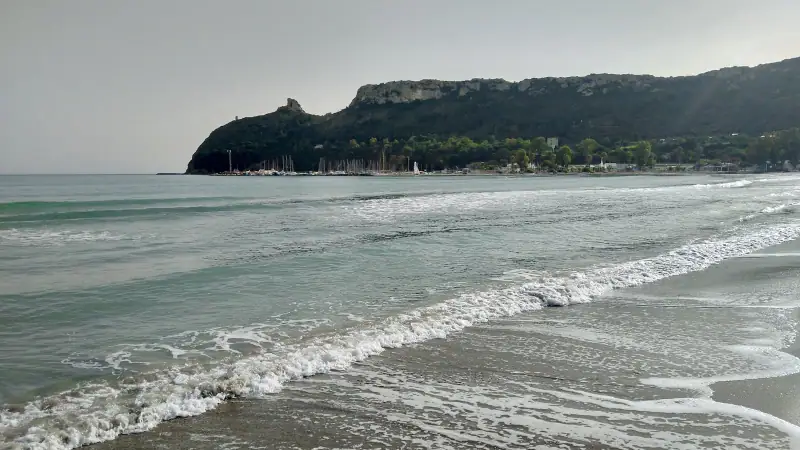
Spiaggia del Poetto is one of the great surprises of Cagliari. Only 5 to 6 km (3 to 4 mi) from the center, this fine-sand beach stretches about 8 km (5 mi), from the point of the Sella del Diavolo (the “Devil’s Saddle”, a limestone promontory at the western end of the beach, whose name recalls a Sardinian legend) to the district of Quartu Sant’Elena.
The sand at Poetto is remarkably fine, white and powdery, and the shallow turquoise water makes it an ideal beach for families. In the background, the Castello rooftops and the cathedral bell tower create a unique postcard setting.
Public beach or beach clubs?
Poetto is divided into two zones: the western end (near the Sella del Diavolo) is entirely free to access, with a few showers and public toilets. Most of it is occupied by stabilimenti balneari (lidi) that offer loungers and umbrellas (around €12 to 18 a day, about $14 to 21, for a double lounger) and bar and food services.
How to get there
CTM bus: From central Cagliari (Via Roma or Piazza Matteotti stop), CTM bus lines PQ and PF serve Poetto every 15 to 20 minutes in season. Ticket €1.50 (about $1.75), journey of about 15 to 20 minutes.
Summer shuttle: In July-August, extra shuttles run from the city center.
Car: Car parks (free or paid depending on the zone) line the coastal road parallel to the beach.
The Sella del Diavolo
At the western end of Poetto, the Sella del Diavolo promontory is a 135 m (443 ft) limestone spur marking the western end of Poetto beach. Marked trails let you walk around it in about 2 hours, with panoramic views over Cagliari, the gulf and the lagoons. It is one of the most pleasant urban hikes in all of Sardinia. At the tip of the promontory, small, little-visited coves offer crystal-clear water away from the Poetto crowds.
The Molentargius lagoon and the flamingos
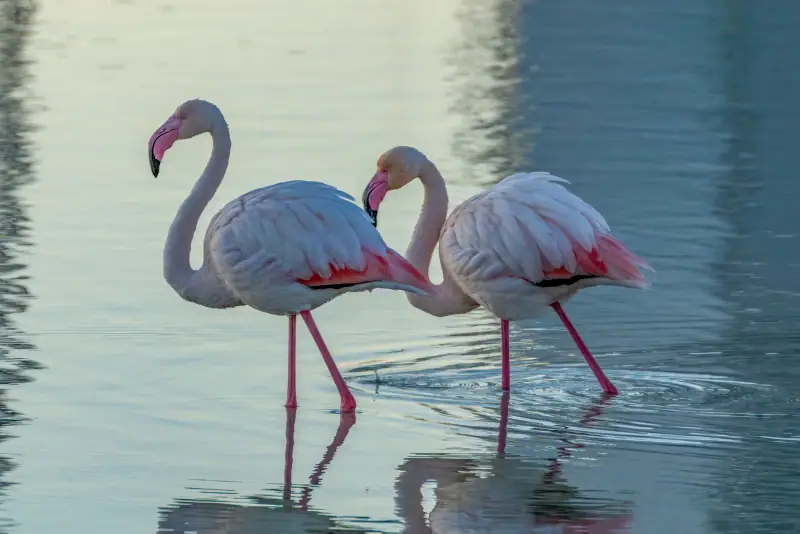
Just behind Poetto beach, separated by a simple road, the Molentargius lagoon is one of the most astonishing natural sites in Sardinia, and one of the few in the world where you can watch flamingos a few kilometers from a large city.
The lagoon (about 1,600 hectares / 3,950 acres, classified as a regional nature park) hosts a permanent colony of greater flamingos (Phoenicopterus roseus), which nest and feed there all year in the shallow ponds rich in micro-organisms. Generally between 1,000 and 3,000 are counted, sometimes more in winter. Access to the park is free. Several walking and cycling paths run along the ponds, with observation towers for watching from a respectful distance.
Around Cagliari: day trips
The ruins of Nora (35 km / 22 mi)
About 35 km (22 mi) southwest of Cagliari, the ancient city of Nora is one of the finest Phoenician-Punic and Roman ruins in the Mediterranean. Founded by the Phoenicians in the 8th century BC, the city was later Punic, then Roman and Byzantine before being abandoned in the Middle Ages. Today, a large part of the ruins is still under the sea (the peninsula on which the city is built has partly sunk), which makes it possible, in good weather, to glimpse columns and paving stones from the shore.
On the emerged site you can clearly make out Roman houses with mosaics, a 2nd-century theater, baths, a temple and Punic remains. The visit takes about 2 hours. Nearby, the fishing village of Pula and Santa Margherita di Pula beach deserve a lunch stop.
The southern lagoons and beaches (20 to 40 km / 12 to 25 mi)
The coastline south of Cagliari holds some of the most beautiful beaches in southern Sardinia. The Stagno di Cagliari (Cagliari lagoon) also shelters flamingos and is visible from the coastal road. Farther toward the Sulcis, the beaches of Chia (about 50 km / 31 mi from Cagliari), with white sand dunes, turquoise water and a Spanish tower, are among the most spectacular on the island.
For these excursions, a rental car is essential. See our guide to the Sulcis-Iglesiente to discover these wild landscapes.
Car rental in Cagliari
Compare rental company prices at Cagliari-Elmas Airport to explore all of southern Sardinia.
Food in Cagliari: the flavors of southern Sardinia
Cagliari’s cooking reflects the diversity of influences that shaped Sardinia: Pisan, Aragonese, Savoyard, and above all the pastoral and maritime traditions of the island. The flavors are intense, the local products of exceptional quality.
Specialties not to miss
Malloreddus alla campidanese: Malloreddus (small shell-shaped pasta ridged and made from durum wheat semolina, also called “gnocchetti sardi”) served alla campidanese is the emblematic dish of the Campidano, the fertile plain around Cagliari. The sauce combines tomatoes, spiced Sardinian sausage and saffron, with grated pecorino cheese. Simple, hearty and delicious.
Culurgiones: These Sardinian ravioli with a characteristic shape (edges braided like an ear of wheat) are filled with potato purée, pecorino and mint. Served with a simple tomato sauce, they are one of the most delicate preparations in Sardinian cooking.
Bottarga di muggine: Cagliari’s bottarga (cured, pressed mullet roe) is a local specialty with a worldwide reputation. Grated over spaghetti with olive oil and parsley, or simply sliced and served with bread as an antipasto, it is an iodine-rich, intense and memorable product. The Molentargius lagoon and the Campidano ponds are traditional mullet fishing areas.
Porcetto allo spiedo: Spit-roasted suckling pig (porcetto or porceddu), fed on milk and wild herbs, is the festive dish of all Sardinia. Around Cagliari, trattorias inland (toward the Barbagia, or toward Villasimius) often offer this specialty on weekends.
Seadas: Sardinia’s essential dessert: large fritters filled with pecorino cheese and lemon zest, fried and drizzled with chestnut or strawberry-tree (corbezzolo) honey. The sweet-salty, slightly tart mix is a revelation.
Vernaccia di Oristano: This amber white wine, produced in the Oristano region (about 100 km / 62 mi from Cagliari), is the Sardinian aperitif par excellence, close to a fino sherry, with a note of almond and iodine. The enoteche of the Marina quarter serve it by the glass.
Where to eat in Cagliari
For an authentic meal, head to the trattorias of the Marina quarter (around Via Simon, Via Baylle and Via Sardegna) and the small streets of Stampace (toward Sant’Efisio and Piazza Yenne). The covered San Benedetto market (Via Cocco Ortu) has extraordinary fresh fish stalls on the ground floor and, upstairs, sellers of Sardinian fruit, cheeses and cured meats, ideal for putting together a picnic.
For bottarga, the delicatessens of Via Manno (in the Castello) and San Benedetto market offer the best selections.
Where to stay in Cagliari
In the Castello
Sleeping in the medieval Castello quarter is an experience apart: B&Bs and small hotels in the cobbled lanes let you enjoy the unique atmosphere of old Cagliari in the evening, after the day visitors have left. Places here are rare and often in high demand. Expect to pay €80 to 150 a night (about $93 to 175) for a double room in high season.
In the Marina quarter
The Marina is the most practical quarter for visitors: restaurants, bars, museums and transport on foot. Several mid-range hotels (€60 to 120 a night, about $70 to 140) are found there within walking distance of the port and the station. It is the ideal quarter for those arriving by ferry.
Near Poetto
Residences and hotels along Poetto beach are perfect for families or travelers who want the beach at their door. It is 15 minutes by bus from the historic center. Rates are often slightly lower than in the city center (€60 to 110 a night, about $70 to 130).
For a detailed look at lodging options, see our complete guide “Where to stay in Cagliari”.
How to get to Cagliari
By plane
Cagliari-Elmas Airport (CAG) receives direct flights from all the major Italian cities and many European destinations. Check current direct connections with the airlines.
From the airport to the city center:
- Regional train (Trenitalia): The airport railway station is linked directly to Cagliari central station (Piazza Matteotti) in about 6 to 10 minutes for €1.30 (about $1.50). Trains about every 20 minutes during the day.
- Taxi: Expect to pay €15 to 20 (about $17 to 23) for the trip to the city center (about 8 km / 5 mi). Official taxis are available at the arrivals exit.
- Bus: Bus shuttles also link the airport to the city center.
By ferry
Cagliari is an important ferry destination from mainland Italy. Mostly overnight crossings link Cagliari to Civitavecchia (Rome, about 13 to 15 hours), Palermo (about 11 to 12 hours) and Naples (about 14 to 15 hours), mainly with Grimaldi Lines. Frequencies are limited (some routes one to three times a week) and the concessions for these lines are being renewed in 2026: check the operator and timetables before booking. The port is right in the city center, a few hundred meters from the station and the Marina quarter.
See the possible itineraries from Cagliari to plan your stay.
Getting around Cagliari and the surroundings
Urban transport (CTM)
The CTM city bus network covers Cagliari and its nearby surroundings well, including Poetto beach. Single tickets are sold at tobacco shops (about €1.50 / $1.75). Day ticket booklets let you travel without keeping count. The CTM app lets you follow timetables in real time.
On foot
Cagliari is a pleasant city to walk. From the Marina quarter to the top of the Castello, allow about 20 to 25 minutes on foot (the climb is steep by the historic stairs, but many lanes let you go up gradually). The historic center (Marina, Castello, Stampace, Villanova) can be explored entirely on foot in a day.
Rental car
For excursions in the area (Nora, Villasimius, the southern beaches, the Sulcis), a rental car is essential. Several agencies are at the airport. Avoid driving into the historic city center (ZTL zones, difficult parking); prefer the car parks at the gates of the Castello or around the Marina.
Cagliari in practice: essential information
When to go
| Period | Temperatures | Sea | Crowds | Best for |
|---|---|---|---|---|
| April-May | 18-24 °C (64-75 °F) | 16-19 °C (61-66 °F) | Low | Sightseeing, hiking, discovery |
| June | 25-29 °C (77-84 °F) | 21-23 °C (70-73 °F) | Moderate | Everything |
| July-August | 30-36 °C (86-97 °F) | 25-27 °C (77-81 °F) | High | Beach, evenings |
| September-October | 22-27 °C (72-81 °F) | 22-24 °C (72-75 °F) | Low | Ideal for all activities |
| November-March | 12-16 °C (54-61 °F) | 13-16 °C (55-61 °F) | Very low | City break, budget |
Indicative budget
| Expense | Indicative price |
|---|---|
| Double room (center) | €70-150/night (~$81-175) |
| Restaurant meal | €20-40/person (~$23-46) |
| National Archaeological Museum | about €10 (~$12) in 2026 |
| San Pancrazio Tower | €3 (~$3.50) |
| CTM bus (ticket) | €1.50 (~$1.75) |
| Taxi airport to center | €15-20 (~$17-23) |
| Poetto loungers | €12-18/day (~$14-21) |
| Car rental | €35-70/day (~$41-81) |
Language and communication
In Cagliari, people speak Italian and sometimes still Sardinian (the local dialect), especially among older people. English is understood in hotels, tourist restaurants and museums. A few words of Italian (buongiorno, grazie, per favore) are always well received.
Tourist office
Cagliari’s tourist office is on Piazza Matteotti, near the station and the port. City maps are available there.
Events and festivals
Processione di Sant’Efisio (May 1-4): This is the largest procession in Sardinia and one of the most important in Italy, with more than 300 years of unbroken tradition. Each May 1, a statue of Sant’Efisio (patron saint of Sardinia) is carried in procession from the church of the same name in Cagliari to the village of Pula (35 km / 22 mi), then brought back on May 4. Thousands of people in traditional costumes from all over Sardinia accompany the procession. An extraordinary spectacle.
Sant’Efisio Festival (summer): Concerts and cultural events animate the city in July-August, notably at the Roman amphitheater.
Sa Sartiglia (Oristano, 100 km / 62 mi, around Carnival): The Sartiglia of Oristano is one of the most impressive medieval equestrian tournaments in Europe. If you visit Sardinia in February, it is a unique opportunity, an hour’s drive from Cagliari.
Cagliari in 2 days: a suggested plan
Day 1:
- Morning: Castello quarter: National Archaeological Museum, Torre di San Pancrazio, cathedral
- Midday: Lunch in the Marina quarter (trattorias on Via Baylle)
- Afternoon: San Benedetto market, walk along Via Roma and the port, climb to the Bastione di Saint-Remy for sunset
- Evening: Aperitif in a Marina enoteca, dinner of fresh fish or malloreddus
Day 2:
- Morning: Poetto beach and Sella del Diavolo (walk on the promontory)
- Lunch: Sandwich at a Poetto bar or back to town
- Afternoon: Molentargius lagoon (flamingos), Villanova quarter and the Roman Amphitheater
- Evening: Departure toward other Sardinian destinations, or an extra night for an excursion to Nora the next day
For a full week-long itinerary, see our guide to Sardinia in 7 days.
Cagliari is not a city you fly over. It is savored slowly, on foot in its medieval lanes, seated before a plate of bottarga or with your feet in the sand at Poetto with the Castello in the background. It is a city that makes you want to come back.
Frequently asked questions
How many days do you need to visit Cagliari?
Two days are enough for the essentials: the Castello quarter, the archaeological museum, San Benedetto market and Poetto beach. With three days, you can explore the surroundings (the Molentargius lagoon, the ruins of Nora 35 km / 22 mi away, the beaches of the Sulcis). A week lets you use Cagliari as a base for all of southern Sardinia.
How do I get to Cagliari?
Cagliari-Elmas Airport (CAG) is the island's southern airport. From the airport to the city center it takes about 15 minutes by taxi (on the meter, from about €17 / $20 and often €20 to 25 / $23 to 29) or about 6 to 10 minutes by Trenitalia regional train (€1.30 / $1.50, central station a few hundred meters from the port). Check current flight connections with the airlines.
Is Cagliari a safe destination?
Yes, Cagliari is a safe and welcoming Italian city. As in any large Mediterranean city, keep an eye on your belongings in crowded tourist areas (market, port) and avoid isolated lanes at night. The Castello, Marina and Villanova quarters are lively and safe in the evening.
What is the best time to visit Cagliari?
April-May and September-October are ideal: pleasant temperatures (20 to 26 °C / 68 to 79 °F), sea still or already warm, moderate crowds and reasonable prices. July-August is hot (30 to 35 °C / 86 to 95 °F), lively but crowded and expensive. Winter (November-March) is mild (12 to 16 °C / 54 to 61 °F) and lets you enjoy the city without tourists and at low prices.
Can you do without a car in Cagliari?
To visit Cagliari itself, yes: the historic center is compact and pleasant on foot, and CTM buses cover the city well (including Poetto). To explore the surroundings (Nora, the southern beaches, the Sulcis-Iglesiente), however, a rental car is essential.
Is Poetto beach really worth the trip?
Absolutely. Poetto beach, 8 km (5 mi) long, is one of the most beautiful urban beaches in the whole Mediterranean. Its powdery fine sand, shallow turquoise water and the view of the Castello in the background make it a unique experience. CTM buses (lines PF and PQ) link it to the city center, with extra shuttles in July-August.
Are there free must-sees in Cagliari?
Yes, several: the ramparts and streets of Castello (free access), the terrace of the Bastione di Saint-Remy (free panoramic view), the harbor promenade and Via Roma, the Molentargius lagoon (flamingos, free entry) and Poetto beach (free access, only the loungers cost money).
More Sardinia guides
Keep reading
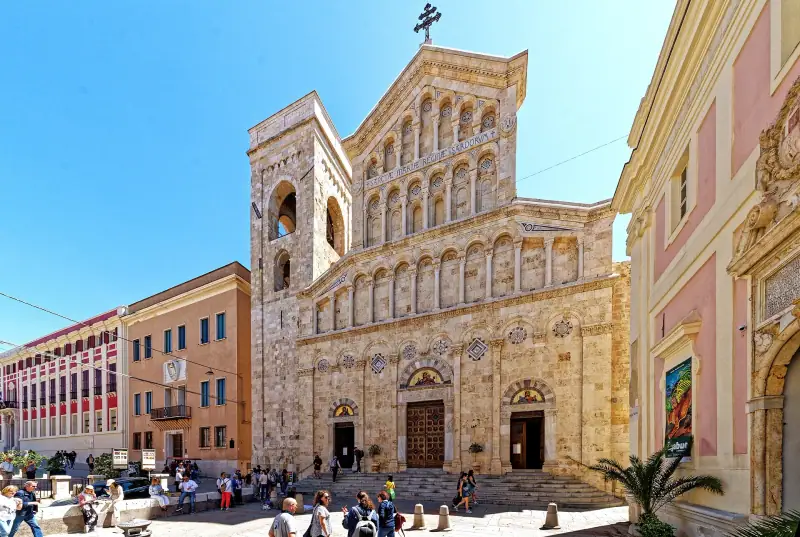
Cagliari Highlights: What to See and Do in Sardinia's Capital
The highlights of Cagliari: Castello, Poetto, museums, markets, food. A complete guide to visiting the capital of Sardinia in 2 days.
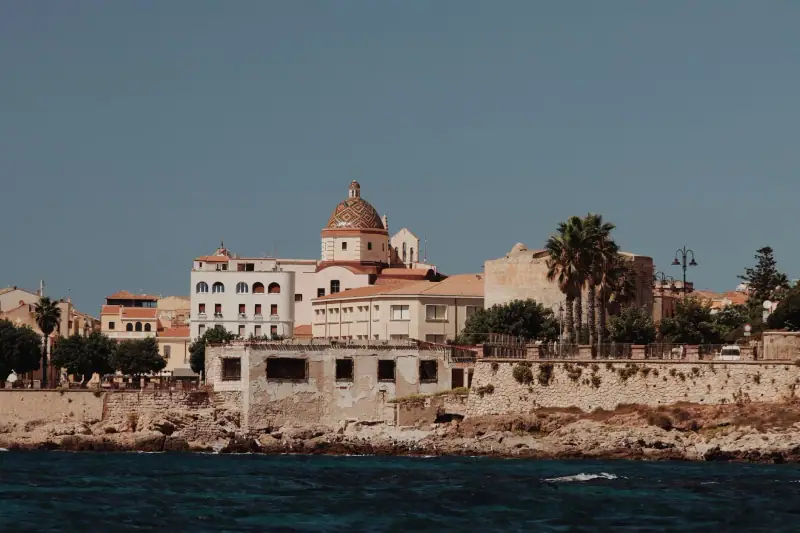
Visiting Alghero: A Complete Guide to Sardinia's Catalan Pearl
Visiting Alghero: Catalan old town, Neptune's Grotto, beaches. A 2026 practical guide to the pearl of northwest Sardinia.
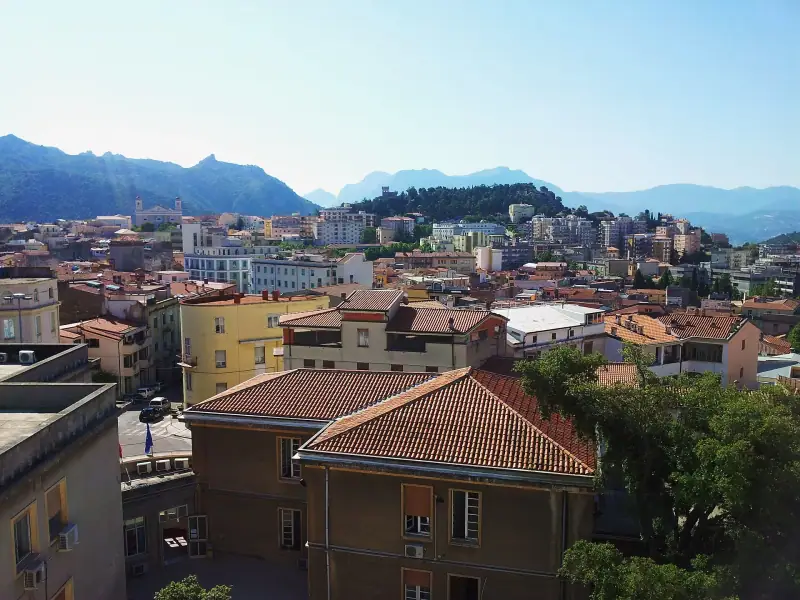
Visiting Nuoro: A Complete Guide to the Capital of the Barbagia
Visiting Nuoro: Sardinian museums, Monte Ortobene, Grazia Deledda, the Barbagia. A 2026 practical guide to inland Sardinia's most authentic town.
Ready-made
Sardinia itineraries
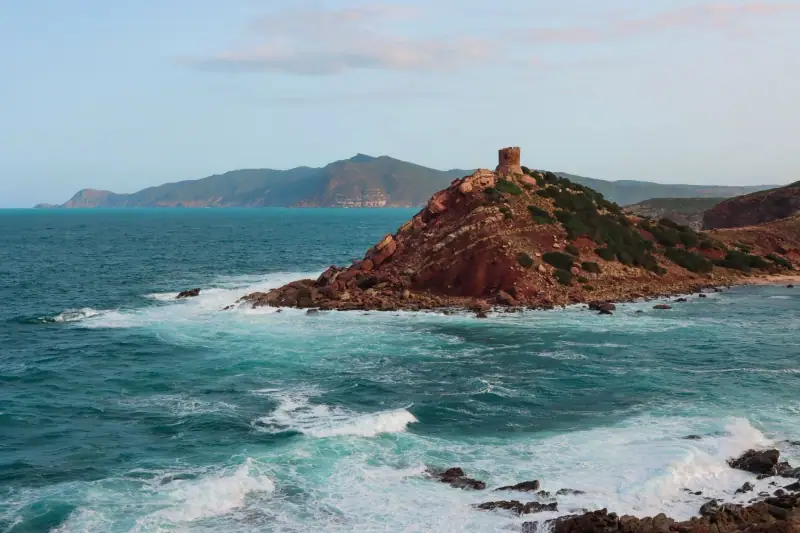
14 days
Sardinia Road Trip: The Complete Island Loop in 10-14 Days
Plan your Sardinia road trip: a complete 10 to 14 day itinerary, scenic roads, essential stops and driving tips.
7 days
Sardinia in 7 Days: A Complete Itinerary for an Unforgettable Week
7-day Sardinia itinerary: Cagliari, Chia, Ogliastra, nuraghi and Costa Smeralda. A day-by-day plan with practical tips.
5 days
Sardinia in 5 Days by Car: A Realistic Itinerary (Distances and Drive Times)
PalauCastelsardoAlghero