What to see
Bari and its surroundings: what to see and do in the area
We may earn a commission when you book through links on this page, at no extra cost to you. We don't visit or try the places we cover: we summarize published sources. How we work
In short
- Trains from Bari reach Polignano a Mare (~35-43 min), Monopoli and Trani (~40 min); Castel del Monte is only practical by car.
- Matera is about 65 km (40 mi) from Bari, under an hour by car via the SS96.
- Plan 5 to 6 days minimum for Bari, Polignano, Trani, Castel del Monte and Matera; a weekend covers Bari and Polignano.
- Spring and fall (20-26 °C / 68-79 °F) are the best seasons; arrive before 9 am in Polignano to beat the crowds.
Bari and its surroundings form one of the richest areas to discover in Puglia, a territory both urban and rural, coastal and inland. From the lively capital of the Mezzogiorno, you can easily reach gems such as Polignano a Mare and its spectacular cliffs, Castel del Monte built by Emperor Frederick II, Trani with its Romanesque cathedral by the sea, or Matera, the extraordinary cave city of Basilicata less than an hour away by road. Here is the complete guide to exploring the Bari area.
The Bari area: geography and orientation
The Bari area spreads around the capital of Puglia in several directions. To the north, the Adriatic coast leads to the port towns of Molfetta, Bisceglie, Trani and Barletta, dotted with Romanesque cathedrals and working fishing harbors. Inland, the Murgia plateau, a windswept high limestone plateau dotted with centuries-old olive groves, is home to Castel del Monte, Puglia’s most emblematic medieval fortress, and the deep gorge of Gravina in Puglia. To the south, the Adriatic coast offers the region’s most photographed landscapes: Polignano a Mare with its white limestone cliffs plunging into an intensely blue sea, and Monopoli with its Aragonese castle at the water’s edge.
This is the most densely populated part of Puglia. Bari itself has about 300,000 inhabitants and is the economic, university and rail hub of southern Italy. From Bari’s central station, Trenitalia and FSE (Ferrovie del Sud-Est) lines fan out to every point of the province and the region.
A rental car remains the best way to explore the area freely, but the train easily reaches Polignano, Monopoli, Trani and even Matera (via Altamura). For Castel del Monte, only a car is really practical.
Bari: the lively capital of Puglia
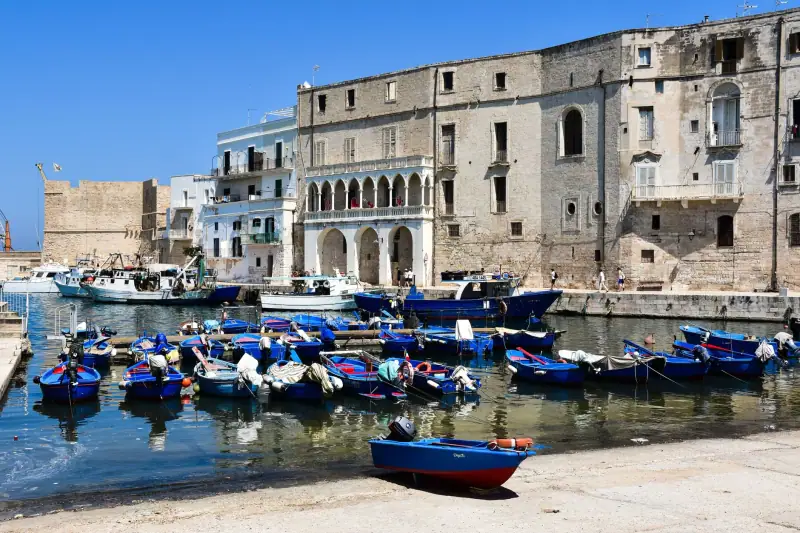
Lodging in Bari and the region
From a B&B in the old town to a boutique hotel on the waterfront, Bari has every category. Masserie and charming houses are available in the surrounding area.
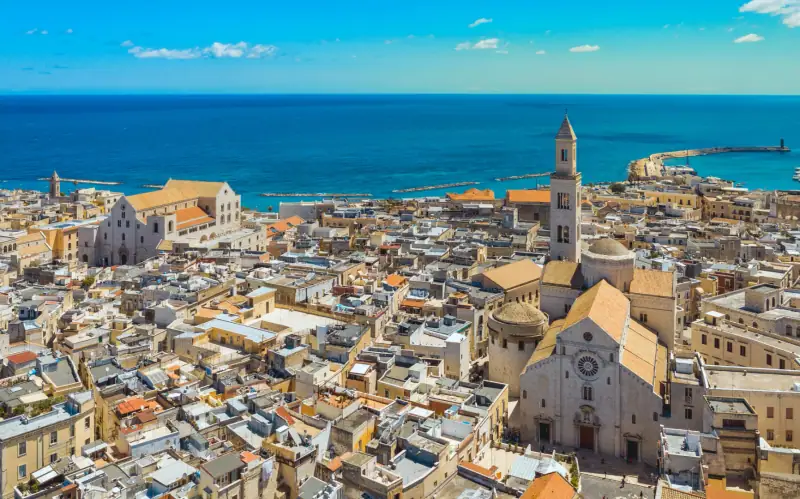
Bari is much more than a transit city. Its historic center, enclosed on a peninsula surrounded by water on three sides, is one of the most authentic in southern Italy: a maze of medieval limestone lanes where women still shape orecchiette by hand on their doorsteps, notably in the lanes near the Via Arco Basso, in the Bari Vecchia district.
The Basilica of San Nicola
Bari’s most important monument is without question the Basilica di San Nicola, built between 1087 and the end of the 12th century to house the relics of Saint Nicholas (the future Santa Claus), brought back from Myra (Lycia, present-day Turkey) by Bari sailors in 1087. It is one of the first and most important Romanesque basilicas in southern Italy, and served as a model for many other buildings across the region.
Its sober, moving crypt holds the saint’s tomb and is a pilgrimage site for Catholic and Orthodox Christians from around the world, a rare fact that reflects Bari’s ecumenical importance. The austere two-tower façade, the lion porch and the carved capitals of the nave form an ensemble of remarkable architectural power.
The Castello Svevo
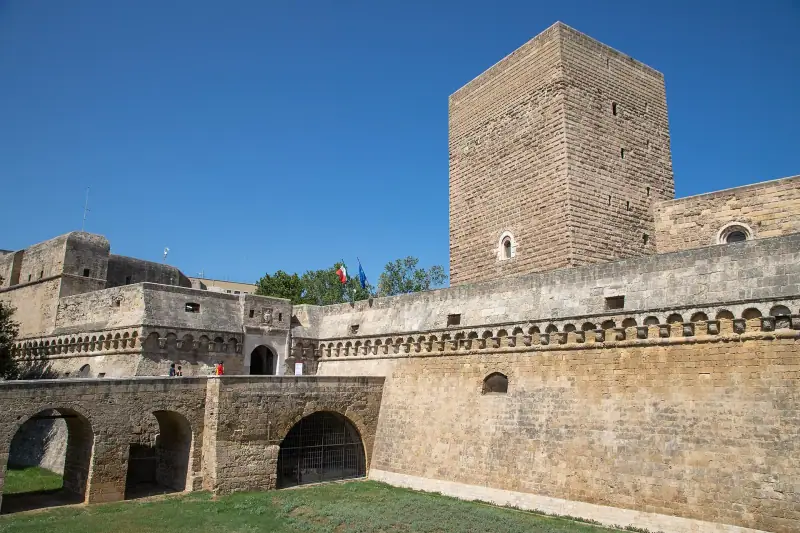
Right at the edge of the old town, the Castello Svevo (Norman-Swabian castle) has overlooked the waterfront since the 12th century. Initially built under Roger II of Sicily around 1132, destroyed by William I in 1156, then entirely rebuilt by Frederick II of Hohenstaufen in 1233, it houses permanent collections and temporary exhibitions. Visiting its rooms and terraces gives a fine view of the port and the silhouette of the old town.
Bari Vecchia: the old town
Bari Vecchia is a district to explore on foot, without a detailed map. The maze of lanes, some so narrow that two people can barely pass each other, opens onto lively squares, Baroque chapels and neighborhood shops. The smell of fresh focaccia coming out of the bakery ovens is everywhere.
The Lungomare Imperatore Augusto runs along the sea for several kilometers and is the Baresi’s evening promenade. On summer evenings it turns into a cheerful parade of families and young people: a show in itself.
The Teatro Petruzzelli
The Teatro Petruzzelli, opened in 1903 and completely rebuilt after a fire in 1991, is Italy’s fourth-largest opera house. Its belle-époque façade and its intact gilded interior are an emblem of the city. The opera and symphony season runs from October to May; tickets are sold on the theater’s official website.
Our guide to Bari’s highlights gives the details of all the sites to see in the city, with the neighborhoods to explore and practical tips for your stay.
Polignano a Mare: cliffs and turquoise sea
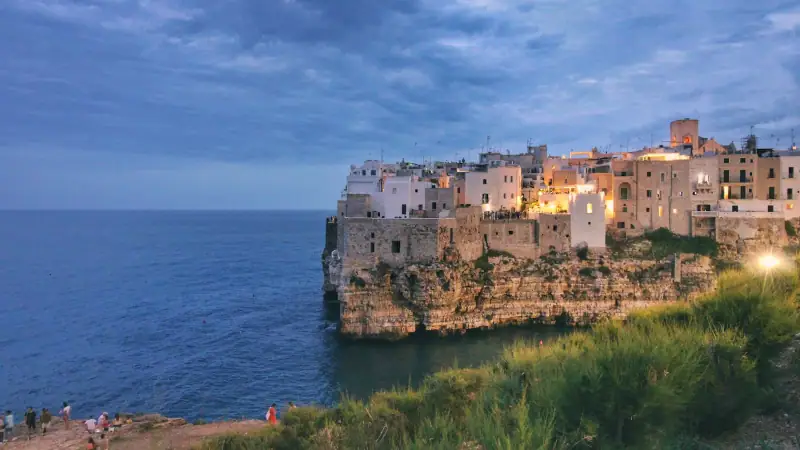
About 34 km (21 mi) south of Bari (30 minutes by car or 35 to 43 minutes by train), Polignano a Mare is perhaps the most photographed town in Puglia. Perched on the edge of limestone cliffs that plunge straight into a dazzling turquoise sea, it offers breathtaking views from its terraces and viewpoints.
The old town and viewpoints
Polignano’s centro storico sits on a rocky promontory ringed by cliffs. You walk its cobbled lanes to reach the natural viewpoints that overlook the sea from about 20 m (65 ft) up. The most famous is near Piazza Vittorio Emanuele II, where the statue of Domenico Modugno, a son of the town and the singer of “Volare” in 1958, greets visitors with open arms, his back to the sea.
The old town’s small size means that in high season (July-August), the lanes and viewpoints can be very crowded. Arrive before 9 am or late in the afternoon to enjoy the views in better conditions.
Lama Monachile beach
Polignano’s emblematic beach is Lama Monachile (also called Cala Porto), a cove tucked between two spectacular cliffs at the foot of the old town. Reached by a staircase from the centro storico, this small pebble beach offers swimming in remarkably clear water. In high season it is very busy; explore the small coves north and south of the town for more peace.
Polignano is also the setting for the famous Red Bull Cliff Diving, an international cliff-diving competition held every summer that draws spectators from around the world.
The Grotta Palazzese
The Grotta Palazzese is a sea cave, part of which holds a restaurant set inside the cavern itself, with a direct view of the sea from its candlelit tables. Cited among the world’s most unusual restaurant settings, it is booked up very far in advance in high season.
Our complete guide to Polignano a Mare details all the beaches, good spots and tips for avoiding the crowds.
Car rental at Bari airport
Bari airport is the gateway to the region. Compare offers to explore Polignano, Castel del Monte, Trani and Matera at your own pace.
Castel del Monte: Frederick II’s octagonal fortress
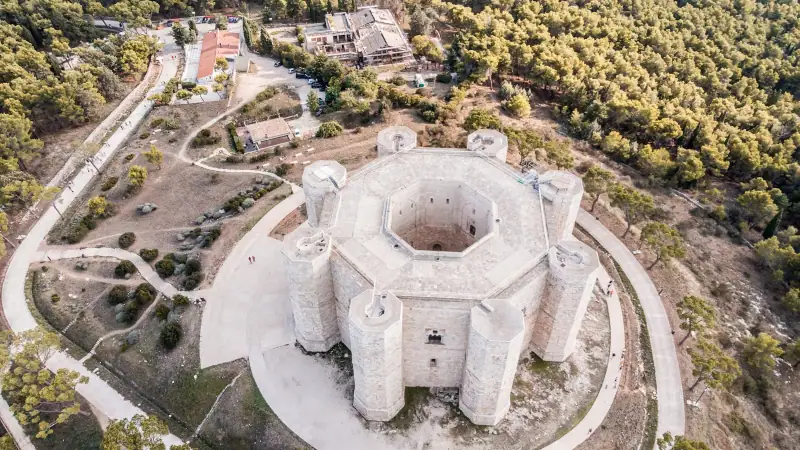
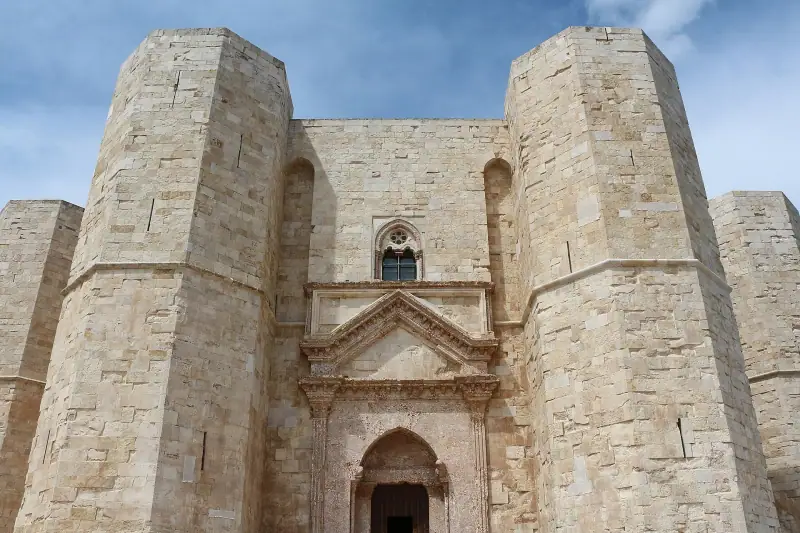
About 56 km (35 mi) west of Bari (about 57 minutes by car), on a spur of the Murgia at 540 m (1,770 ft), stands one of the most enigmatic medieval buildings in Europe: Castel del Monte. A UNESCO World Heritage site since 1996, this octagonal castle was built by Emperor Frederick II of Hohenstaufen in the 1240s.
Architecture without equivalent
The castle’s octagonal plan, a very rare form in medieval military architecture, repeats at every level: a central octagon, eight octagonal towers, eight rooms on each floor. Historians still debate the exact function of the building: neither a classic fortress (no interior water source, no standard defensive features) nor a simple hunting lodge, Castel del Monte may have been a place of display and reflection for the polyglot, visionary emperor who ruled from Palermo an empire stretching from southern Italy to Jerusalem.
The construction uses precious materials: portals of cipollino marble, columns of ancient breccia, capitals inspired by antique and Islamic models. The whole reflects the cosmopolitan culture and aesthetic ambition of Frederick II, the “stupor mundi” (wonder of the world).
Visiting Castel del Monte
Access is by shuttle from the parking lot at the bottom of the hill. The interior, sober and stripped of all furniture, impresses with its perfect geometric proportions and the oculi that flood certain rooms with light at particular hours. The visit is completed by a walk around the outside to appreciate the castle’s striking silhouette against the Murgia, open as far as the eye can see.
Nearby, the town of Andria (about 15 km / 9 mi) has a lively centro storico and is worth a stop for lunch.
Trani: the cathedral on the Adriatic
About 46 km (29 mi) north of Bari (37 to 39 minutes by car on the A14, or about 39 minutes by train), Trani is one of the most elegant towns on Puglia’s north coast. Its Cattedrale di San Nicola Pellegrino, a masterpiece of Apulian Romanesque built in the 11th and 12th centuries, stands directly on a rocky promontory by the Adriatic Sea.
Its golden limestone façade is reflected in the harbor waters at sunset, creating one of the most romantic images in all of southern Italy. The sober, bright three-nave interior preserves an 11th-century crypt and an even older hypogeum carved into the rock.
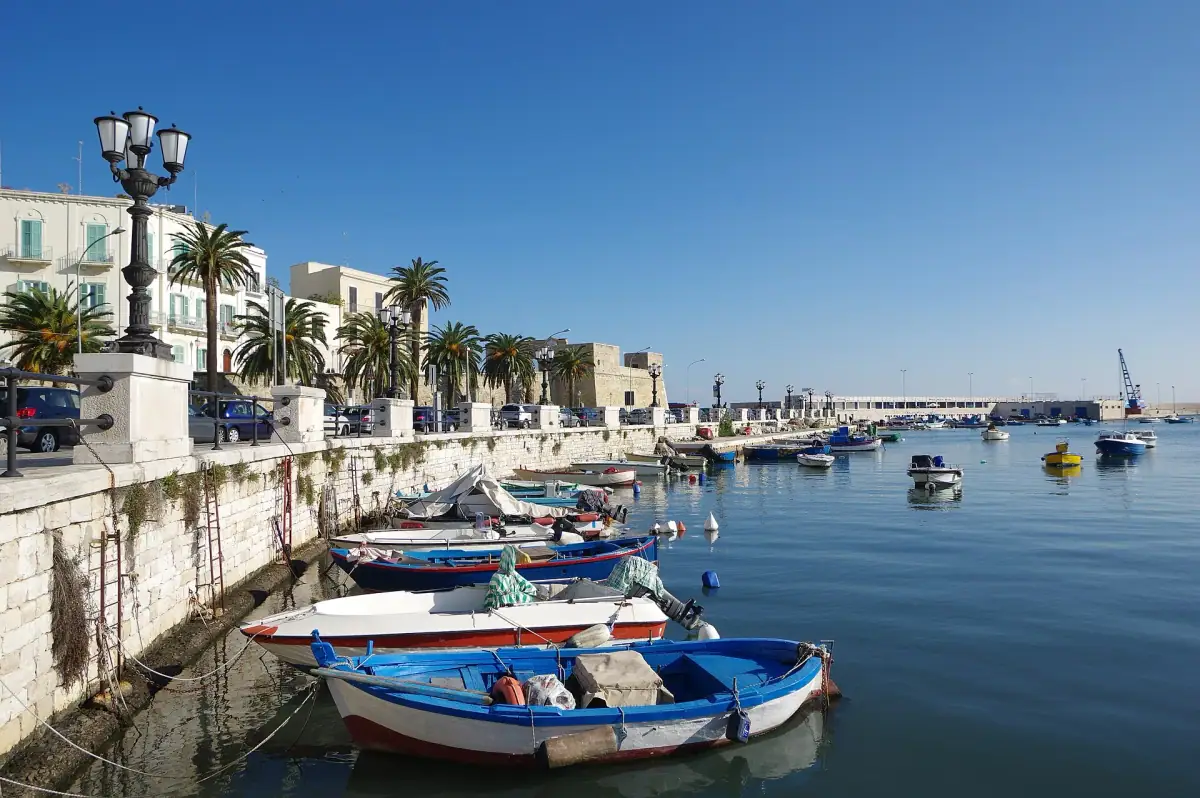
The porto vecchio of Trani is one of the busiest and most photogenic harbors on the coast, surrounded by 18th- and 19th-century noble palaces and converted old warehouses. The Sinagoga Scola Grande (13th century, today the Museo Sinagoga Sant’Anna, returned to the Jewish community in 2004 and back in use as a synagogue and museum since 2005) bears witness to the important Jewish presence that made Trani one of the most intellectually and commercially active towns of the Norman Kingdom of Sicily.
Excursions and guided tours from Bari
Castel del Monte, Matera, Alberobello, Trani... Discover the area around Bari with an expert guide.
Matera as a day trip from Bari
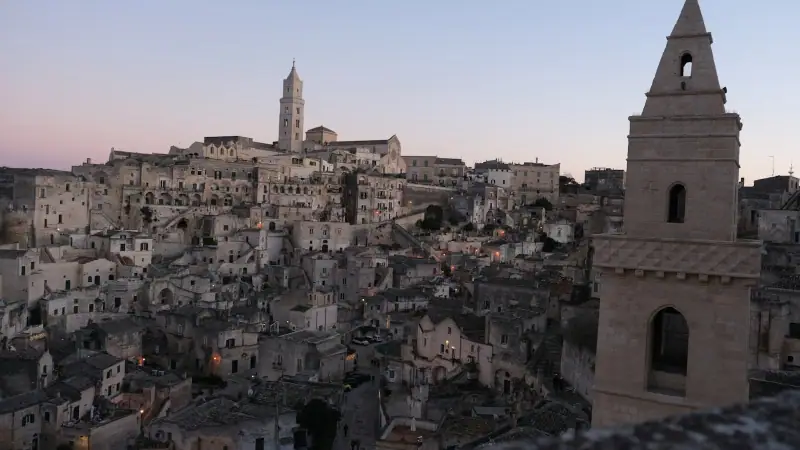
About 65 km (40 mi) from Bari (under an hour by car via the SS96, ~55 min), Matera is technically in Basilicata, the region next to Puglia, but it is the essential day trip from the Apulian capital. Travelers staying in Bari routinely include Matera in their plans.
The Sassi of Matera
The Sassi di Matera, the Sasso Barisano and the Sasso Caveoso, are two districts of cave dwellings carved into the sides of a canyon cut by the Gravina river. Continuously inhabited from the Paleolithic until the 1950s (when residents were forcibly rehoused by the Italian government, which judged the conditions unsanitary), the Sassi are among the oldest and most complex human habitats in the world.
A UNESCO World Heritage site since 1993 and European Capital of Culture in 2019, the Sassi have been gradually rehabilitated. The cave dwellings now house boutique hotels, restaurants, craft shops and museums, while keeping their extraordinary character as organic architecture cut into limestone.
What to see in Matera
The Casa Grotta di Vico Solitario, in the Sasso Caveoso, is an inhabited cave reconstructed as it was in the 1950s: it shows the living conditions of the families who lived there with their animals. The chiese rupestri (rock churches), carved into the stone and decorated with partly preserved medieval frescoes, are scattered across both districts and form a unique pictorial heritage.
The Cattedrale di Matera (13th century) crowns the Civita, the rocky spur separating the Sasso Barisano and the Sasso Caveoso, and offers a striking panoramic view over both districts. The Palombaro Lungo, an immense underground cistern 15 m (49 ft) deep beneath Piazza Vittorio Veneto, has been open to visitors since 2006.
Our complete guide to Matera gives you all the keys to visiting the cave city in depth, with the best viewpoints and recommended routes.
Food in the Bari area
The food of the Bari area is central to Apulian cooking. The city is the capital of orecchiette: these “little ears” of pasta made from durum wheat semolina are eaten all over Puglia, but it is in Bari, especially in the old town lanes where women shape them by hand, that they reach their most authentic form.
Specialties to try
Orecchiette alle cime di rapa: the Puglia classic, with turnip greens (broccoli rabe) sautéed with garlic and anchovies. A dish of deep, honest flavor.
Bari’s tiella: a sort of Mediterranean bake cooked in a large pan, made of layers of rice, fresh mussels and potatoes with tomatoes, onions, garlic and parsley, drenched in olive oil. An emblematic Bari dish, it is almost impossible to find outside the city and its immediate surroundings.
Focaccia barese: thick, soft, topped with cherry tomatoes, black olives and a generous amount of olive oil. Bari’s focaccia stands apart from others: its open crumb and crisp edges make it a class of its own among Mediterranean breads. You find it in every bakery in the old town from opening time.
Taralli pugliesi: small rings of firm dough flavored with fennel or chili, boiled first and then baked. Essential with an aperitif and sold everywhere in the markets.
Seafood: Bari’s port guarantees exemplary freshness. Ricci di mare (sea urchins) are traditionally eaten raw at the water’s edge, with a little bread and lemon. Polpi alla barese (octopus marinated in olive oil and lemon, cooked the local way) are on every table in the old town.
Primitivo: the most characteristic grape of southern Puglia produces powerful, generous, very aromatic red wines that pair ideally with local dishes.
Our guide to Puglia’s food presents all the regional specialties with the best places to eat.
The Bari area in practice
How to get there
By air: Bari Karol Wojtyła Airport (BRI) is served by several airlines throughout the year. It is about 8 km (5 mi) north of the city center, reachable by taxi (about 20-25 min) or by shuttle bus to the central station.
By train: Trenitalia connects Bari with the rest of Italy. From Rome, Intercity trains to Bari take about 4 h 30. From Naples, allow about 3 h 30.
Getting around the area
A rental car remains the most practical way to explore the area freely. Roads are generally in good condition, but the center of Bari and the old towns of the surrounding villages are explored on foot.
By train: the Trenitalia network links Bari to Polignano a Mare (~35-43 min), Monopoli (~45-49 min by regional train) and Trani (~40 min) at regular frequencies. FSE (Ferrovie del Sud-Est) lines reach Alberobello (~1 h 40) and the Itria Valley.
For Castel del Monte: there is no practical direct rail link. Take a train to Andria (~70-72 min from Bari, Ferrotramviaria FR2), then a seasonal tourist bus or a taxi.
For Matera: take the FAL train from Bari to Altamura (~60-75 min), then connect on the FAL to Matera, or drive directly (~65 km / 40 mi, ~55 min to 1 h depending on traffic).
Lodging
Bari offers every lodging category, from well-located hostels in the centro storico to four-star hotels on the waterfront. Our guide to lodging in Bari helps you choose the best neighborhood for your priorities.
Around Bari, Polignano a Mare has a good choice of B&Bs and small charming guesthouses with cliff views. Trani has several historic houses converted into charming places to stay. In the Murgia, masserie (farm-inns) offer an authentic stay in the countryside, often with a pool and restaurant.
Sample budget
| Item | Average budget |
|---|---|
| Car rental (7 days) | €180-350 (~$210-405) |
| B&B in Bari (double, per night) | €60-120 (~$70-140) |
| Masseria in the Murgia (double, per night) | €120-280 (~$140-325) |
| Restaurant (full meal) | €20-35 (~$23-41) per person |
| Street food (focaccia, taralli, seafood) | €4-10 (~$5-12) |
| Castel del Monte (admission) | ~€5 (~$6) per person |
For a full view of the budget for a trip to Puglia, see our Puglia budget guide.
Sample itinerary in the Bari area
Weekend (2-3 days)
Day 1, Bari: arrive at the airport, settle in the centro storico. Visit the Basilica di San Nicola, the Castello Svevo and the lanes of the old town. Focaccia and coffee at the market. Evening stroll on the Lungomare, dinner with tiella and orecchiette in the old town.
Day 2, Polignano a Mare: leave early in the morning by train (~35-43 min) or by car (~30 min). Visit the centro storico perched on the cliffs, the viewpoint and the Domenico Modugno statue, swim at Lama Monachile. Back to Bari in the late afternoon.
Day 3, Trani or Castel del Monte: depending on your preferences, head north (Trani, 40 minutes by train, for the cathedral and the port) or inland to the Murgia (Castel del Monte, 1 hour by car). Return to Bari airport in the evening.
One week (5-7 days)
See our 7-day Puglia itinerary, which fits the Bari area into a complete Puglia loop.
Bari-centered loop:
- Days 1-2: Bari (old town, San Nicola, Petruzzelli, food and market)
- Day 3: Polignano a Mare (cliffs, beach, old town)
- Day 4: Trani (cathedral, port) + Barletta (castle, north coast)
- Day 5: Castel del Monte + Gravina in Puglia (interior of the Murgia)
- Day 6: Matera (day trip to Basilicata, UNESCO Sassi)
- Day 7: Monopoli + Alberobello (south of Bari, trulli, Itria Valley)
The Bari area is one of the most versatile in southern Italy: the Adriatic Sea and its limestone cliffs on one side, the high Murgia plateau and its medieval fortresses on the other, a capital with intense neighborhood life, and within an hour’s drive two of the most extraordinary World Heritage sites (Castel del Monte and Matera). Whether you love history, beaches, food or are simply curious about southern dolce vita, the Bari area has enough to fill a whole week, and to make you want to come back.
Frequently asked questions
Can you visit Bari and its surroundings without a car?
Partly. The Trenitalia train links Bari efficiently to Polignano a Mare (~35-43 min), Monopoli (~30 min) and Trani (~40 min). Castel del Monte, however, is hard to reach without a car (you take a train to Andria, then a seasonal tourist bus). For Matera there is a train via Altamura (FAL), but a car is far more practical. Outside summer, renting a car is strongly recommended.
How long do you need to explore the Bari area?
To see Bari and the main surroundings (Polignano, Trani, Castel del Monte, Matera), allow at least 5 to 6 days. A weekend lets you discover Bari and Polignano a Mare. A full week gives time to explore the north coast (Trani, Barletta), the interior (Castel del Monte, Gravina) and make the trip to Matera.
What is the best season to visit Bari and its surroundings?
Spring (April-May) and fall (September-October) are the best periods: pleasant temperatures (20-26 °C / 68-79 °F), limited crowds and available lodging. Summer (June-August) is very lively, ideal for the beaches of Polignano a Mare, but hot and touristy. In winter, Bari stays lively and pleasant, and it is the ideal season for a cultural visit without lines.
Is Matera really in Puglia?
No, Matera is officially in Basilicata (Lucania), the region next to Puglia. But it is about 65 km (40 mi) from Bari, less than an hour by road, and is the essential day trip from the Apulian capital. It has been a UNESCO World Heritage site since 1993 and was European Capital of Culture in 2019.
Is Polignano a Mare worth the trip despite the summer crowds?
Absolutely. The limestone cliffs and the Lama Monachile cove are among the most spectacular views in southern Italy. To avoid the crowds, favor May, June or September, and arrive early in the morning (before 9 am) to enjoy the viewpoints without waiting. In high season, the secondary beaches north and south of the town are much less crowded than Lama Monachile.
What is Bari's tiella?
Bari's tiella (or teglia) is the city's emblematic dish, almost impossible to find outside the region. It is a layered bake cooked in a large pan: rice, fresh mussels, potatoes, tomatoes, onions, garlic, parsley and a generous amount of olive oil. Every family has its own recipe, handed down through generations. You can find it in the traditional trattorias of Bari Vecchia.
Can you do Castel del Monte as a half-day trip from Bari?
Yes, Castel del Monte is easy to visit in half a day. Allow about 1 hour of driving from Bari, 1 h 30 to 2 h to visit the castle and its grounds, then 1 hour back. You can combine the visit with a stop in Andria (15 km / 9 mi from the castle) or in Trani (on the way back to Bari). Morning is ideal for good light on the castle's façade.
More Puglia guides
Keep reading
Castel del Monte: hours, prices and how to get there from Bari without a car
Castel del Monte from Bari: hours, ticket price, train and bus or car, visit length and the best time to avoid crowds. A practical guide.
Bari Must-Sees: What to See and Do in the Capital of Puglia
What to see in Bari: the Basilica of San Nicola, Bari Vecchia, the lungomare and the best experiences in Puglia's capital.
Visiting Bari: a complete guide to the capital of Puglia
Complete guide to visiting Bari: old town, Basilica of San Nicola, neighborhoods, food, beaches and practical tips for a successful stay.
Ready-made
Puglia itineraries
4 days
Gargano in 4 Days: A Complete Itinerary for the Promontory
4-day Gargano itinerary: Vieste, Peschici, Foresta Umbra, Monte Sant'Angelo, sea caves and wild beaches. Day-by-day plan with practical tips.
Can be adapted in the planner
3 days
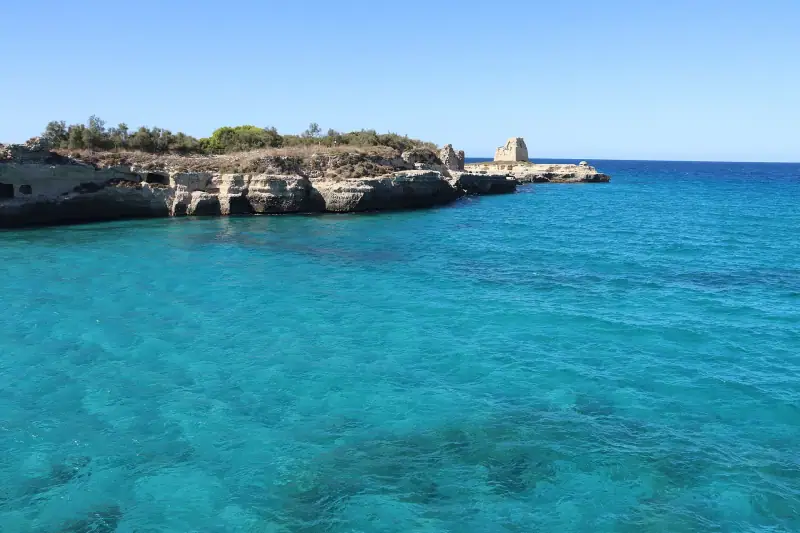
3 days in Salento: a complete itinerary through Lecce, Gallipoli and the secret coves
3 days in Salento: baroque Lecce, turquoise beaches, Gallipoli and Otranto. Detailed plan with transport and accommodation tips.
8 days
Puglia in 8 Days With Kids: Itinerary, Stops and a Relaxed Pace
Itria ValleyGallipoli