Itineraries
3 days in Salento: a complete itinerary through Lecce, Gallipoli and the secret coves
We may earn a commission when you book through links on this page, at no extra cost to you. We don't visit or try the places we cover: we summarize published sources. How we work
Day by day
- Day 1Lecce: Piazza del Duomo, Santa Croce, amphitheater, old lanes
- Day 2Otranto, Santa Cesarea Terme, Castro, east coast beaches
- Day 3Gallipoli old town and Ionian coast beaches
Weather through the year on this route
| Jan | Feb | Mar | Apr | May | Jun | Jul | Aug | Sep | Oct | Nov | Dec | |
|---|---|---|---|---|---|---|---|---|---|---|---|---|
| High °F (°C) | 5513 | 5513 | 5915 | 6418 | 7122 | 8027 | 8530 | 8630 | 7926 | 7222 | 6418 | 5714 |
| Low °F (°C) | 4910 | 4910 | 5111 | 5513 | 6217 | 7021 | 7524 | 7625 | 7122 | 6418 | 5714 | 5111 |
| Rain in (mm) | 2.665 | 2.360 | 2.460 | 2.050 | 1.435 | 0.925 | 0.720 | 0.925 | 2.360 | 3.180 | 3.795 | 3.180 |
Normals 1991–2020 at Santa Maria di Leuca and Brindisi: averages over 30 years, not a forecast. Source: NASA POWER (MERRA-2), grid of about 50 km. Figures computed by us in November 2026.
In short
- Day 1 Lecce, day 2 the east coast (Otranto, Castro, coves), day 3 Gallipoli and the Ionian beaches: about 250 km (155 mi) in total.
- A car is strongly recommended for at least one day; buses reach Gallipoli and Otranto, but the best isolated beaches are hard to reach without one.
- June and September are the best months; avoid Ferragosto, around August 15.
- Budget for 2 people for 3 days, excluding flights: about €300 (~$350) frugal, €500-700 (~$580-810) mid-range.
Salento is one of Italy’s most appealing destinations. This peninsula that forms the “heel of the boot” packs three treasures into a compact area: Lecce, nicknamed the Florence of the South for its extravagant baroque; beaches with turquoise water that could rival the Caribbean; and an authentic cuisine built on olive oil, fresh pasta and the dark Primitivo wines. In three days, you can take in the essentials.
This itinerary is designed for travelers who fly into Brindisi (the nearest airport) or Bari, and who have 72 well-filled hours. It mixes cultural sites, swims in unspoiled coves, and food stops.
Day 1: Lecce, the baroque capital of Salento
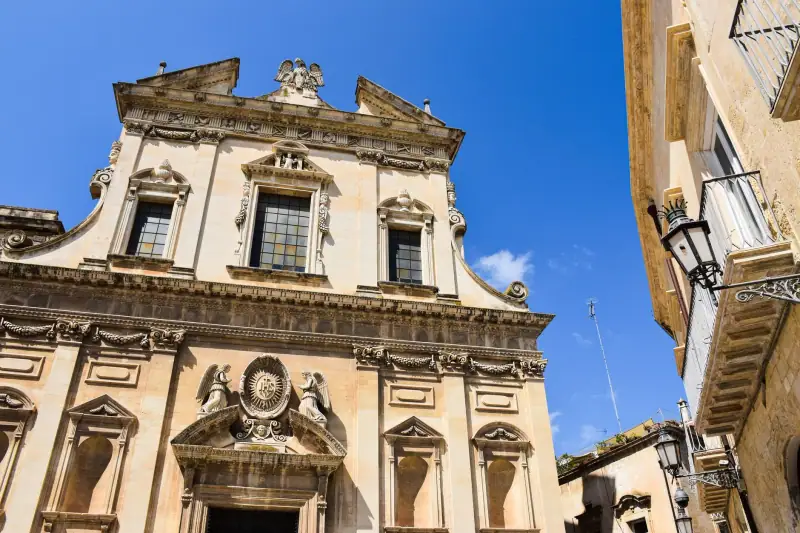
Lecce deserves a full day, even two. But even in a single day, you can soak up the unique atmosphere of this city built in pietra leccese, the golden limestone that carves like butter and gives facades warm glints at sunset.
Morning: the baroque monuments of the center
Start early, before the heat sets in (in summer, it easily reaches 35 °C / 95 °F in Lecce). Drop your bags at the hotel and set out on foot to explore the historic center. The main square, Piazza del Duomo, is one of the most beautiful in Italy: closed on three sides and surrounded by the Duomo, the bishop’s palace and the bell tower, it forms a natural baroque theater.
A short walk away, the Basilica di Santa Croce is the absolute masterpiece of Lecce-style architecture. Its facade, covered in scrolls, garlands and fantastic creatures, is the symbol of Lecce. The austere interior is a contrast that highlights the richness of the exterior. Entry is now with the combined ticket for Lecce’s churches (about €9 / ~$10; check when you get there).
Continue to the Roman Amphitheater (Anfiteatro Romano), partly excavated on Piazza Sant’Oronzo. Dating from the 2nd century, it could hold 25,000 spectators, a reminder that Lecce was already an important city in Roman times.
Stays in Lecce
Baroque palaces converted into B&Bs, boutique hotels in the centro storico.
Midday: Puglian street food lunch
Lecce is one of the street food capitals of Puglia. Don’t miss the rustico leccese: a kind of golden puff pastry pie filled with tomato, béchamel and mozzarella. You can find one for under €2 (about $2) in the bakeries of the center. Another highlight: the pasticciotto, a pastry made of shortcrust dough and custard, a Lecce specialty since 1745 according to local tradition.
For a sit-down meal, the traditional trattorias in the area around Via Paladini offer affordable lunch menus: fresh pasta with market vegetables, fava bean purée with chicory leaves (fave e cicoria), and local cheeses.
Afternoon: the lanes and the markets
In the afternoon, get lost in the maze of viuzze (lanes) of the centro storico. Lecce is a perfect city for strolling: cars are limited, the shade is deep, and craft shops selling papier mâché (a local specialty) brighten every corner.
Climb to the terraces of the church of Sant’Angelo if they are open in season, for a view over the Roman tile roofs and the sea in the distance. In the evening, head to Piazza Mazzini or Via Trinchese for an aperitivo with bruschette and small local snacks.
Day 2: The east coast, from Otranto to the sea caves
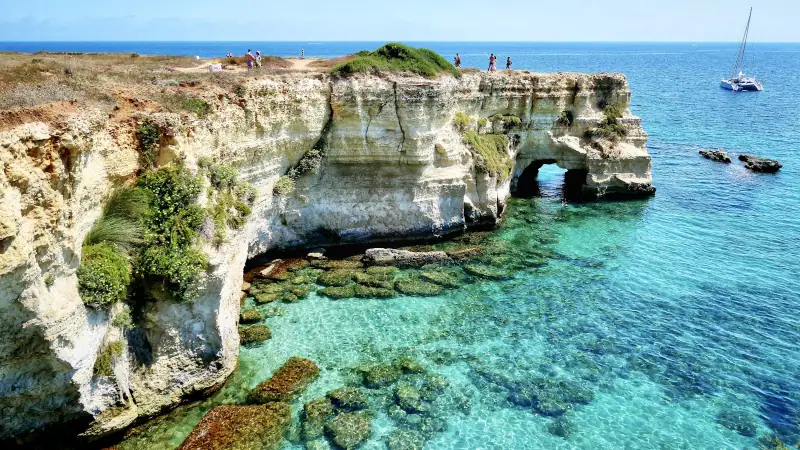
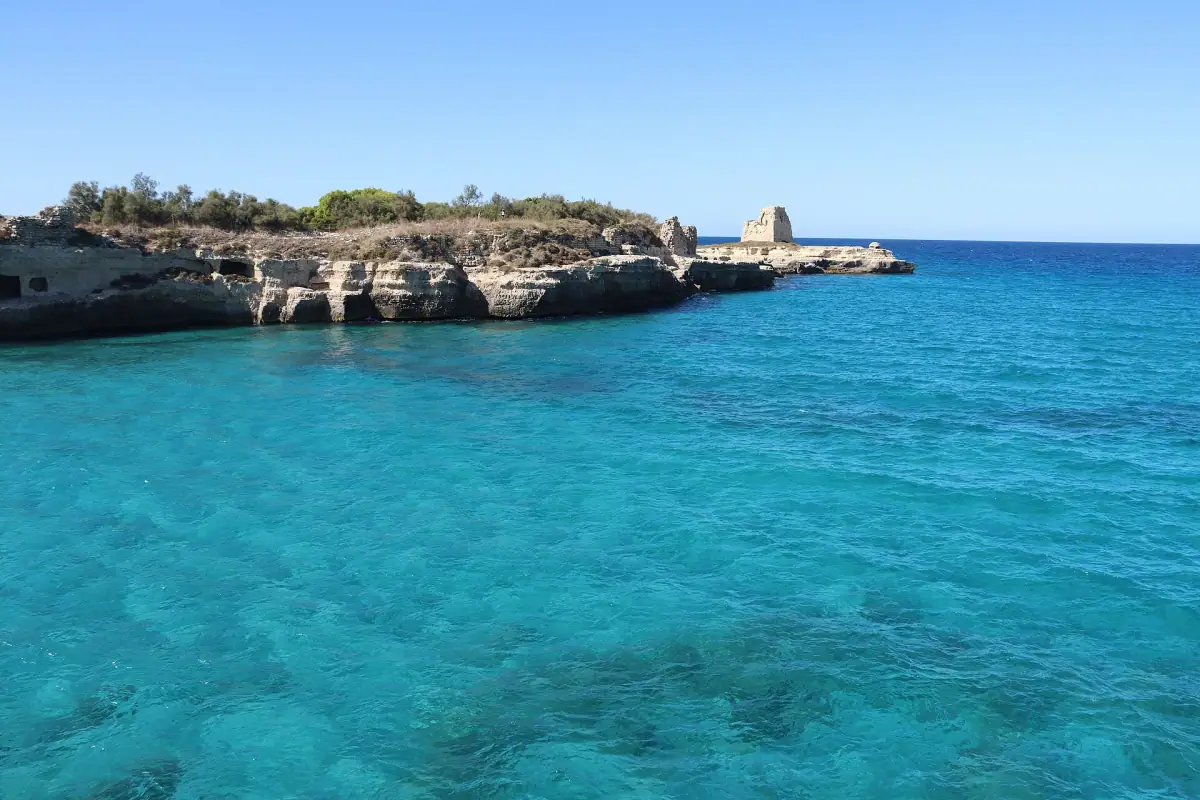
Salento’s east coast, between Otranto and Leuca, is a succession of limestone cliffs, secret coves and crystal-clear water. It is the wilder and more spectacular of the two coasts.
Morning: Otranto, the cathedral town
Otranto is about 45 km (28 mi) southeast of Lecce, 40 to 45 minutes by car. It is one of the most history-laden towns in Salento: inhabited in turn by the Greeks, Romans, Byzantines, Normans, Aragonese and Ottomans.
The main attraction is the Cattedrale di Santa Maria Annunziata, an underrated masterpiece. Its 12th-century floor mosaic depicts the Tree of Life: a tangle of biblical, mythological and symbolic scenes covering the whole nave. This mosaic is one of the largest preserved in Italy. The cathedral also houses the relics of the 800 Martyrs of Otranto, massacred by the Ottomans in 1480 and canonized in 2013.
After the cathedral, climb up to the well-preserved Castello Aragonese, which offers a view of the coast and of Albania on a clear day. The two countries are separated by only about 80 km (50 mi).
Midday: the coves between Castro and Santa Cesarea Terme
After Otranto, take the coastal road (SP358) south. This stretch is one of the most beautiful in Puglia: the road runs along the cliffs, with plunging views of a sea that changes color with depth.
Santa Cesarea Terme is a village perched above sulfur caves. Its Art Nouveau villas, built by wealthy Neapolitan families in the early 20th century, give it the look of a film set. The sea caves below can be reached from the harbor.
A bit farther south, Castro Marina is an authentic fishing village with a small sheltered beach and several waterfront fish restaurants. Across the way, the Grotta Zinzulusa is a partly submerged stalactite cave that you can visit by boat from the harbor (about €5-7 / ~$6-8 depending on the season).
Excursions in Salento
Boat tours of the caves, sea kayaking, guided visits of Otranto.
Afternoon: beach and swimming
On the way back north, or continuing depending on your route, several beaches on the east coast are worth the detour:
- Baia dei Turchi (north of Otranto): a wild cove lined with dunes and pines, reached on foot from a parking lot. One of the most beautiful in Salento.
- Acquaviva: a small pebble and sand beach, less well known, where the water is especially clear.
- Alimini: two natural lakes close to the sea, whose surroundings form a nature reserve with pines and cork oaks, an unusually green setting for this coast.
In the evening, return to Lecce for dinner, or continue to Otranto if you prefer to sleep on the coast.
Day 3: Gallipoli and the west coast
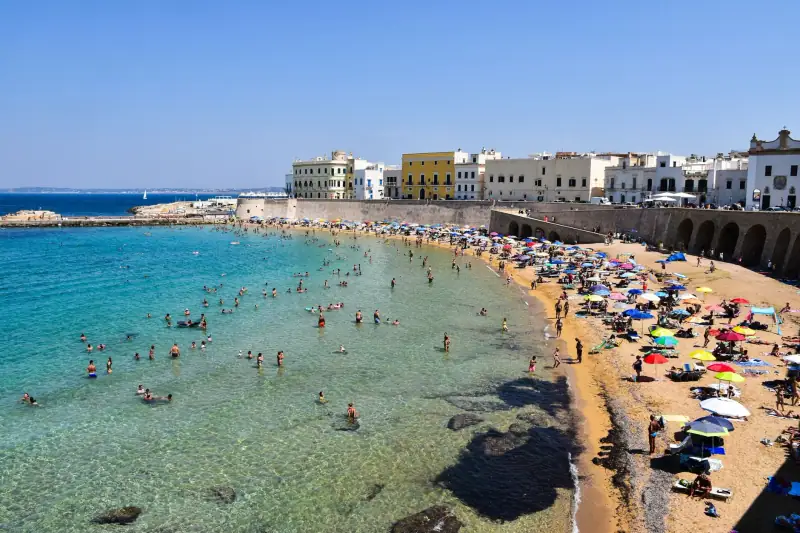
Salento’s west coast, bathed by the Ionian Sea, is different: the water is warmer, the sea calmer, the beaches wider and livelier. It is the coast of Italian vacationers, open-air clubs and blazing sunsets.
Morning: Gallipoli the beautiful
Gallipoli (“beautiful city” in Greek) is about 40 km (25 mi) southwest of Lecce (35 to 40 minutes). The old town is built on an islet linked to the mainland by a 17th-century baroque bridge. It is one of the most beautiful coastal towns in the region.
Cross the bridge and enter the città vecchia. The narrow lanes, whitewashed facades and flowered balconies evoke a Greek island. The Cattedrale di Sant’Agata (17th century) houses works by Giovanni Andrea Coppola and Nicolò Malinconico, baroque painters of southern Italy. The Castello Angioino (14th century, enlarged in the 16th) guards the entrance to the harbor. You can go inside to see the ramparts and the view over the old town from the towers.
Gallipoli’s harbor market is known for the freshness of its fish and the quality of its sea urchins (ricci di mare), a local specialty to eat on the spot with bread, only in season (generally November to April, check when you arrive).
Midday: seafood lunch
In Gallipoli, the harbor trattorias serve seafood platters, grilled octopus and linguine alle vongole (clams) at prices that are still reasonable compared to big cities. Choose restaurants set slightly back from the waterfront for better value.
Car rental in Salento
A car in Lecce or Brindisi to explore the coast at your own pace.
Afternoon: the wild beaches of the Ionian coast
After Gallipoli, the coast to the north offers some of the most beautiful fine-sand beaches in Italy. The main ones:
- Punta della Suina: a vast beach of sand and umbrella pines, 5 km (3 mi) north of Gallipoli, with a paid lido and a wild area.
- Baia Verde: a long urban beach just north of Gallipoli, easy to reach on foot or by bike from town.
- Porto Selvaggio (nature reserve): about 25 km (16 mi) north of Gallipoli, this wild inlet surrounded by Mediterranean scrub and pine forest is one of the best preserved in Salento. Reached only on foot from a parking lot (about a 15-minute walk). No lidos, no bars: just nature.
In the late afternoon, head back to Lecce or, if you leave the next day from Brindisi, stop in Brindisi for the night (60 km / 37 mi north of Lecce).
Practical information for your stay
How to get to Salento
By air: Brindisi airport (BDS) is the closest to Lecce (about 44 km / 27 mi by road). Bari airport (BRI) is larger and better served all year: allow 1 h 30 by road or train to Lecce. Check which airlines serve each airport for your dates.
By train: From Bari, direct Intercity trains reach Lecce in about 1 h 40 to 2 h. From Rome, allow 4 to 5 hours by Frecciarossa/Frecciargento, with a change in Naples or direct depending on the schedule.
From Brindisi: airport shuttle to the station, then a Trenitalia regional train to Lecce (about 30 min, a few euros), or a taxi.
Getting around Salento
Car: Essential to reach the wild beaches and villages off the main roads. Rentals are available at Brindisi airport, at Lecce station or in town. Beware of the ZTL (limited traffic zones) in the historic centers of Lecce, Gallipoli and Otranto: cameras issue fines automatically and the ticket is mailed to your home.
Scooter or e-bike: An excellent alternative for Lecce and its nearby surroundings. Rental agencies are located in central Lecce.
FSE bus: The Ferrovie del Sud Est bus network serves the main towns of Salento from Lecce. Handy for Gallipoli, Otranto and Maglie. Limited frequencies outside peak hours.
Budget for 3 days in Salento
| Item | Frugal budget | Mid-range budget | Comfort budget |
|---|---|---|---|
| Accommodation (per night) | €40-60 (~$45-70) (hostel, B&B) | €70-120 (~$80-140) (3-star hotel) | €150-300 (~$175-350) (boutique hotel) |
| Meals (per day) | €20-30 (~$23-35) | €35-55 (~$40-65) | €60-100 (~$70-115) |
| Transport (car, 3 days) | — | €90-150 (~$105-175) | €150-250 (~$175-290) |
| Admissions and activities | €0-15 (~$0-17) | €20-40 (~$23-46) | €40-80 (~$46-93) |
| Total 3 days (2 people) | ~€300 (~$350) | ~€500-700 (~$580-810) | ~€900-1,500 (~$1,045-1,740) |
Excluding flights.
Where to stay: options by type
In Lecce’s centro storico: Baroque palaces renovated as B&Bs or boutique hotels offer the most authentic experience. Only a few streets separate the room from the main monuments. Noisy on weekends in high season.
In Gallipoli: The città vecchia is ideal but accommodations there are scarce and often full in summer. The neighborhoods near the harbor on the mainland side offer more choice. Baia Verde (northern suburb) is full of vacation residences with pools.
In a masseria: These former fortified farms converted into lodgings are a Puglia specialty. The countryside around Lecce has several, with a pool, a garden and half board based on local products. A very different stay from standard hotels.
Food: Salento essentials
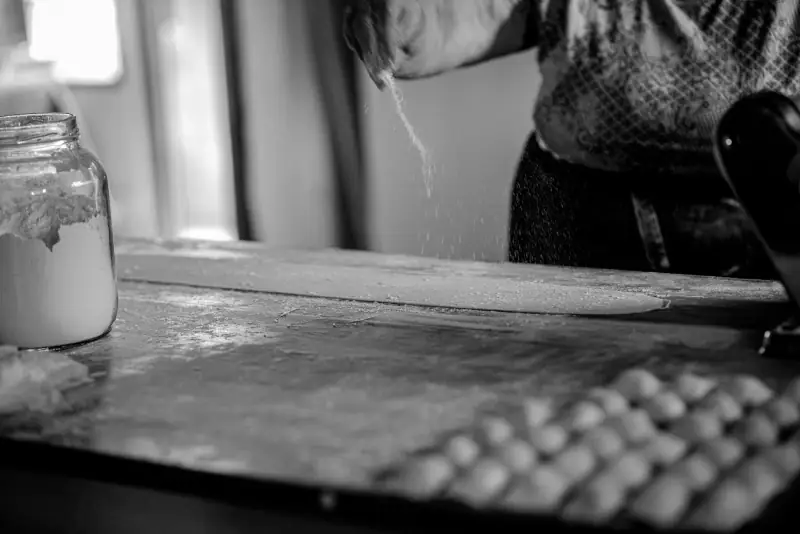
Specialties to try
Fave e cicoria: Fava bean purée served with wild chicory leaves is the emblematic dish of Salento. Simple, inexpensive and delicious.
Orecchiette alle cime di rapa: Ear-shaped pasta with broccoli rabe is the most famous regional dish of Puglia. In Salento, anchovies are often added.
Frisa: A kind of durum wheat bread rusk, dipped in water and topped with fresh tomatoes, olive oil and basil. The Puglian bruschetta.
Alici marinate: Anchovies marinated in olive oil, lemon and parsley. Served as an antipasto, their freshness is unmatched in harbor restaurants such as those in Gallipoli.
Pasticciotto leccese: The pastry symbol of Lecce, a sort of individual custard tart. The best ones are found in the historic cafés of the old town.
Wines: Primitivo di Manduria (DOP) is the most famous red of Puglia, powerful and fruity. For whites and rosés, Negroamaro and Salice Salentino deserve attention. Choose wines from a local cellar rather than the default house wine by the glass in tourist restaurants.
Practical tips
When to go: June (sunshine, sea still cool, few people) or September (warm water, perfect, far fewer tourists than in summer). July-August: magnificent but crowded and expensive. Ferragosto (the week of August 15) is best avoided.
Book ahead: In July-August, quality accommodations in Lecce are often full by March. Book as early as possible. Outside holidays, booking 2 to 3 weeks ahead is enough.
Sun protection: Salento’s beaches offer little natural shade. High-SPF sunscreen, a hat and avoiding the middle of the day (stay out of the sun from noon to 4 pm in midsummer) are essential.
Language: Knowing a few words of Italian is much appreciated in the villages. English is understood in hotels and tourist restaurants, much less in everyday shops.
ZTL and parking: In Lecce, Gallipoli and Otranto, the historic centers are ZTL (limited traffic zones). Park on the outskirts and explore on foot. Paid parking lots are available at the entrance of each old town (generally €1-2 / about $1-2 per hour).
FAQ: the 3-day Salento itinerary
Can you visit Salento in 3 days without a car? It is possible from Lecce thanks to FlixBus and FSE (Ferrovie del Sud Est) buses serving Gallipoli, Otranto and several coastal villages. However, the most beautiful isolated beaches, such as Porto Selvaggio or Baia dei Turchi, remain hard to reach without a vehicle. Renting a car or a scooter in Lecce for at least one day is strongly recommended.
What is the best time to visit Salento? June and September are the ideal months: good weather, warm sea, and far fewer people than in July and August. Avoid August 15 (Ferragosto), when the roads are jammed. In May, temperatures are pleasant for cultural visits but the water can still be cool.
Lecce or Gallipoli: where to stay to visit Salento? Lecce is the ideal base if you like architecture and culture: it is the liveliest city and is well connected by transport. Gallipoli is better if your priorities are the beach and nightlife. The best combination: two nights in Lecce and one night in Gallipoli.
How many kilometers is this itinerary? About 250 km (155 mi) in total for the route Lecce → Otranto → Santa Cesarea Terme → Castro → Porto Selvaggio → Gallipoli → Lecce. Distances are short and the roads are well maintained, ideal for relaxed driving.
Can you combine Salento with the rest of Puglia in 3 days? Not really: Salento alone justifies a stay of 3 to 4 days. To also explore the Itria Valley (Alberobello, Ostuni) and Bari, plan at least 7 days. Our 7-day Puglia itinerary covers the whole region.
How much does 3 days in Salento cost? Expect between €150 and €300 (~$175-350) per person depending on comfort level. Accommodation in Lecce: €60 to €120 (~$70-140) per night. Rental car: €30 to €60 (~$35-70) per day. Meals: €15 to €35 (~$17-41) per meal. Public beaches are free (only private lidos charge).
Frequently asked questions
Can you visit Salento in 3 days without a car?
It is possible from Lecce thanks to FlixBus and FSE (Ferrovie del Sud Est) buses serving Gallipoli, Otranto and several coastal villages. However, the most beautiful isolated beaches remain hard to reach without a vehicle. Renting a car or a scooter in Lecce for at least one day is strongly recommended.
What is the best time to visit Salento?
June and September are the ideal months: good weather, warm sea, and far fewer people than in July and August. Avoid August 15 (Ferragosto), when the roads are jammed. In May, temperatures are pleasant for cultural visits but the water is still cool.
Lecce or Gallipoli: where to stay to visit Salento?
Lecce is the ideal base if you like architecture and culture: it is the liveliest city and is well connected by transport. Gallipoli is better if your priorities are the beach and nightlife. Combining both, one night in Gallipoli and two in Lecce, gives you the best of both worlds.
How many kilometers is the 3-day Salento itinerary?
About 250 km (155 mi) in total for the route described here: Lecce → Otranto → Santa Cesarea Terme → Castro → Porto Selvaggio → Gallipoli → Lecce. Distances are short and the roads are well maintained, ideal for relaxed driving.
Can you combine Salento with the rest of Puglia in 3 days?
Not really: Salento alone justifies a stay of 3 to 4 days. To also explore the Itria Valley (Alberobello, Ostuni) and Bari, plan at least 7 days. Our 7-day Puglia itinerary covers the whole region.
How much does 3 days in Salento cost?
Expect between €150 and €300 (~$175-350) per person depending on comfort level. Hotel or B&B in Lecce: €60-120 (~$70-140) per night. Rental car: €30-60 (~$35-70) per day. Meals: €15-35 (~$17-41) per meal. Beaches are free (except private lidos).
More Puglia guides
Keep reading
Hiking in the Gargano: The Best Trails in Puglia
The best Gargano hikes: Foresta Umbra, Monte Sant'Angelo, the wild coast and trails between sea and forest in northern Puglia.
Bari or Brindisi airport: which one to choose for visiting Puglia?
Bari Karol Wojtyła or Brindisi-Salento? Full comparison (flights, distances, prices, shuttles) to pick the right airport for your Puglia itinerary.
Where to stay in Bari: the best neighborhoods and hotels
Where to stay in Bari? A guide to the best neighborhoods, hotels and B&Bs for every budget in the capital of Puglia.
Ready-made
Puglia itineraries
4 days
Gargano in 4 Days: A Complete Itinerary for the Promontory
4-day Gargano itinerary: Vieste, Peschici, Foresta Umbra, Monte Sant'Angelo, sea caves and wild beaches. Day-by-day plan with practical tips.
Can be adapted in the planner
8 days
Puglia in 8 Days With Kids: Itinerary, Stops and a Relaxed Pace
Itria ValleyGallipoli
5 days
Puglia and Matera in 5 Days by Car: A Realistic Itinerary With Distances and Drive Times
Polignano a Mare or MonopoliMateraOstuniLecce