Itineraries
Cebu, Bohol and Siargao: 10 Days in the Visayas
We may earn a commission when you book through links on this page, at no extra cost to you. We don't visit or try the places we cover: we summarize published sources. How we work
Day by day
- Days 1-3Cebu City, Kawasan Falls and Moalboal, Oslob or free day
- Day 4Ferry to Tagbilaran, tarsiers, Chocolate Hills, Panglao
- Day 5Diving and snorkeling at Balicasag Island, Virgin Island
- Day 6Loboc River, Panglao beaches, back to Tagbilaran
- Day 7Ferry to Cebu, flight to Siargao, Cloud 9
- Day 8Island hopping: Naked, Guyam and Daku islands
- Day 9Sugba Lagoon
- Day 10Free morning and flight home
Where to sleep
- Cebu City3 nights
- Panglao3 nights
- General Luna3 nights
In short
- 10 days is the comfortable minimum: 3 days in Cebu, 3 in Bohol and 4 in Siargao.
- Cebu to Bohol is a fast ferry of about 2 hours; Cebu to Siargao is a flight of about 55 minutes.
- The dry season, November to May, suits all three islands; July to October is typhoon season, especially in Siargao.
- Mid-range budget: €900-1,400 (about $1,045-1,625) on the ground for 10 days, excluding international flights.
The islands of the central Philippines hold the best of the archipelago: a lively city with wild beaches within reach by bus, an island of chocolate-colored hills with some of the finest underwater scenery in Southeast Asia, and a surfers’ island out in the Pacific. This 10-day itinerary between Cebu and Bohol (in the Visayas) and Siargao (in the Caraga region, north of Mindanao) is one of the most popular and best-trodden routes in the Philippines, and for good reason.
Overview of the itinerary
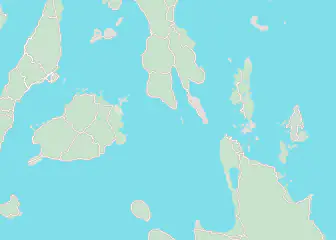
The route follows a simple geographic logic: Cebu City is the central hub, thanks to its well-served international airport. From there, a two-hour ferry reaches Bohol, and a one-hour domestic flight drops you in Siargao.
Itinerary summary:
- Days 1-3 → Cebu: colonial city, Kawasan Falls, southern beaches
- Days 4-6 → Bohol: Chocolate Hills, tarsiers, diving at Balicasag
- Days 7-10 → Siargao: surfing at Cloud 9, island hopping, Sugba Lagoon
This route avoids going back through Manila between islands, which saves valuable time and money.
How to join the itinerary
Entry point: Cebu (Mactan-Cebu International Airport, CEB)
Cebu is served by direct flights from several major Asian cities (Seoul, Tokyo, Hong Kong, Singapore, Kuala Lumpur). Most long-haul itineraries connect through one of these hub cities. Airlines with good routings include Qatar Airways, Malaysia Airlines, Korean Air and Cathay Pacific.
Alternative: enter through Manila (MNL) and take a domestic flight to Cebu (CEB) right away with Cebu Pacific or Philippine Airlines. The Manila–Cebu route is one of the most frequent in the Philippines (about every hour).
Days 1 to 3: Cebu, city, waterfalls and the west coast
Day 1: Cebu City
After landing at Mactan, take a taxi or a Grab to central Cebu City (about 30-45 minutes depending on traffic). Stay in the Lahug or IT Park area for modern lodging, or in the historic center to be close to the sights.
Start with Magellan’s Cross, the cross planted by Ferdinand Magellan (a navigator of Portuguese origin in the service of the Spanish Crown) in 1521 when Christianity arrived in the Philippines. Right across from it, the Basilica del Santo Niño (founded in 1565, current building from the 18th century) houses the oldest Catholic effigy in the country, an object of intense popular devotion.
A short walk away, Fort San Pedro (admission about 30 PHP) is the smallest Spanish colonial fort in the archipelago: its red coral walls offer a view over the harbor.
In the evening, Carbon Street and its surroundings make up one of the biggest street markets in the Philippines. Alternatively, the street food on Colon Street (the oldest street in the Philippines) is perfect for a first introduction to Filipino cuisine: lechon (roast suckling pig), puso (rice packed in a leaf pouch) and halo-halo for dessert.
Where to stay in Cebu City?
Compare Cebu City hotels by budget: historic center, IT Park or Mactan Beach.
Day 2: Kawasan Falls and the west coast
Get up early to catch a Ceres Liner bus from Cebu City’s south terminal toward Badian (~97 km / 60 mi, about 3 hours, ticket around 100-130 PHP). Kawasan Falls is a few kilometers from the town of Matutinao.
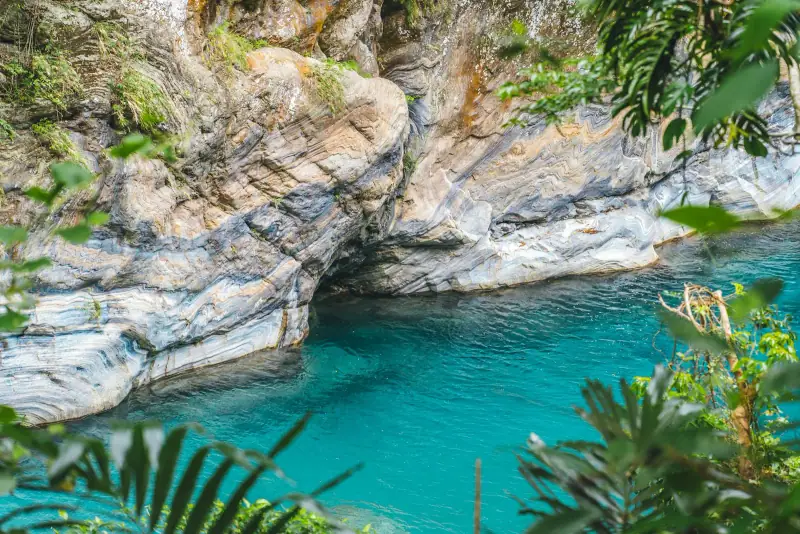
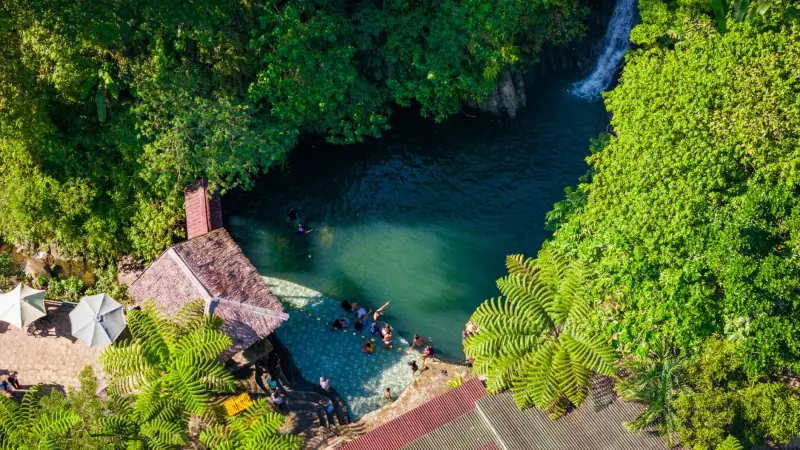
The Kawasan Falls are among the most spectacular in the Visayas: three tiers of milky blue-green waterfalls fed by underground limestone springs. The first fall (and the most accessible) is a 15-minute walk from the site entrance. The other two take more hiking but are much less crowded.
The signature activity here is canyoning: you follow the river through gorges, natural slides and pools. Local guides run this descent (2.5 to 3 hours) from the village of Matutinao. Bring a wetsuit or clothes that can get wet, and closed shoes. Canyoning has been suspended several times in recent years (latest known incident: a landslide in October 2025) and the site is undergoing rehabilitation work in 2026: check that it is open with the municipality of Badian or your operator before you go.
On the way back, a stop at Moalboal (about 90 km / 56 mi from Cebu City) lets you see the sardine run: a cloud of millions of sardines forming silvery swirls just below the surface, 50 m (165 ft) from shore, which you can reach by snorkeling or free diving. It is one of the most astonishing natural spectacles in the whole region.
Day 3: Oslob excursion or free day
If you have energy, leave early for Oslob (about 150 km / 93 mi south of Cebu City, ~3 hours 45 minutes to 4 hours by bus) to swim with whale sharks. The activity takes place very early in the morning (leaving at 5-6 am is advised): divers at the surface feed the animals to keep them near the boats during the viewing. Admission and the bangka tour cost about 500-700 PHP per person.
Ethical note: this practice is controversial because feeding conditions the whale sharks’ behavior and keeps them in an artificially coastal area. If you prefer a more natural encounter, whale shark diving exists elsewhere in the Philippines (Donsol) without feeding.
Another option for day 3: stay in Cebu City and visit the Taboan market (local food specialties to bring home) and relax before the crossing to Bohol the next day.
Days 4 to 6: Bohol, Chocolate Hills, tarsiers and Panglao
Day 4: Crossing and a grand tour of the island
Head to Pier 1 in Cebu City to take the fast ferry to Tagbilaran (Bohol). OceanJet and SuperCat run several departures a day, with a crossing of about 2 hours for 400 to 650 PHP (€7-11 / $8-13) depending on class. Book ahead in high season (December to March) to be sure of a seat.
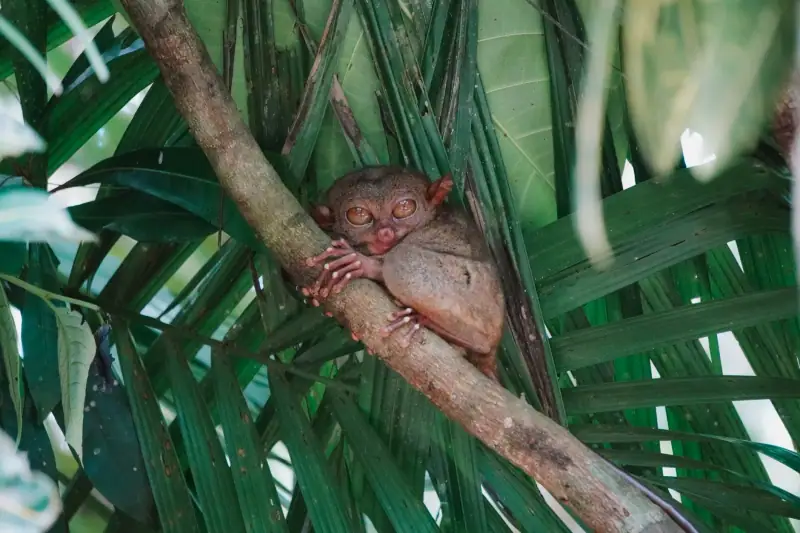
On arrival in Tagbilaran, take a tricycle or a habal-habal to the Corella Tarsier Sanctuary (about 16 km / 10 mi away). It is the best place to see the Philippine tarsier in an ethical setting: the animals live semi-free in the forest, guided by a ranger in small groups. No flash, no noise: these tiny primates with huge eyes are extremely easily stressed.
In the early afternoon, head for the Chocolate Hills in Carmen (55 km / 34 mi from Tagbilaran). The main viewpoint offers a panoramic view of more than 1,200 conical hills that turn brown in the dry season. Arrive before 4 pm to catch the late-afternoon light.
On the way back, drive through the Man-Made Forest: a 2 km (1.2 mi) avenue lined with giant mahogany trees planted in the 1960s and 1970s as part of the Bilar reforestation project, forming an impressive leafy canopy.
Settle in for the evening at Panglao (linked to Bohol by two bridges), ideally around Alona Beach to be in the middle of the action.
Guided Bohol day tour
Chocolate Hills, tarsiers, Loboc River and Panglao, all included with transport.
Day 5: Diving at Balicasag Island
The whole day is devoted to the sea. From the dive shops at Alona Beach, book a trip to Balicasag Island: this islet, protected by a marine reserve, is about 8 km (5 mi) southwest of Panglao.
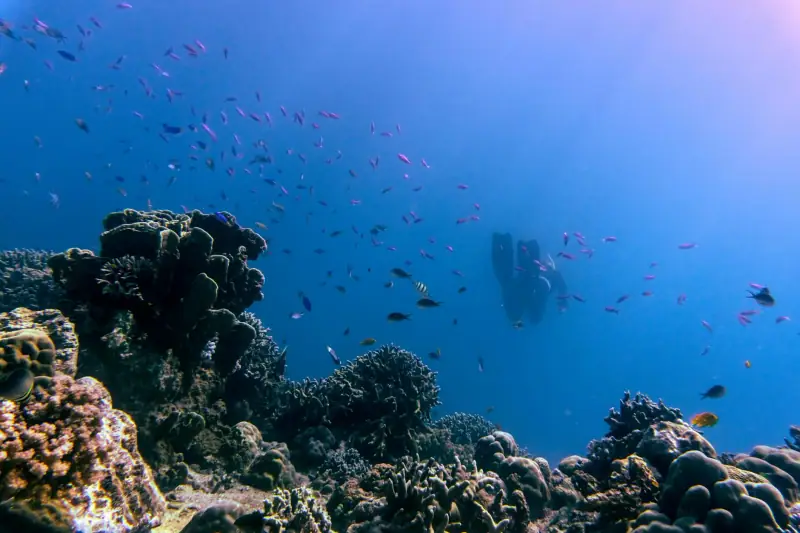
Its underwater drop-offs (from 5 m / 16 ft to more than 40 m / 131 ft) shelter giant moray eels, schools of barracuda, sea turtles that let you approach and jackfish in dense masses. The Black Forest (black coral, whitetip sharks) and Cathedral (light-filled caves) dive spots are among the best in the region.
If you don’t dive, snorkeling is still excellent in the shallow areas around the island: visibility of 20 to 30 m (65-100 ft) in good weather.
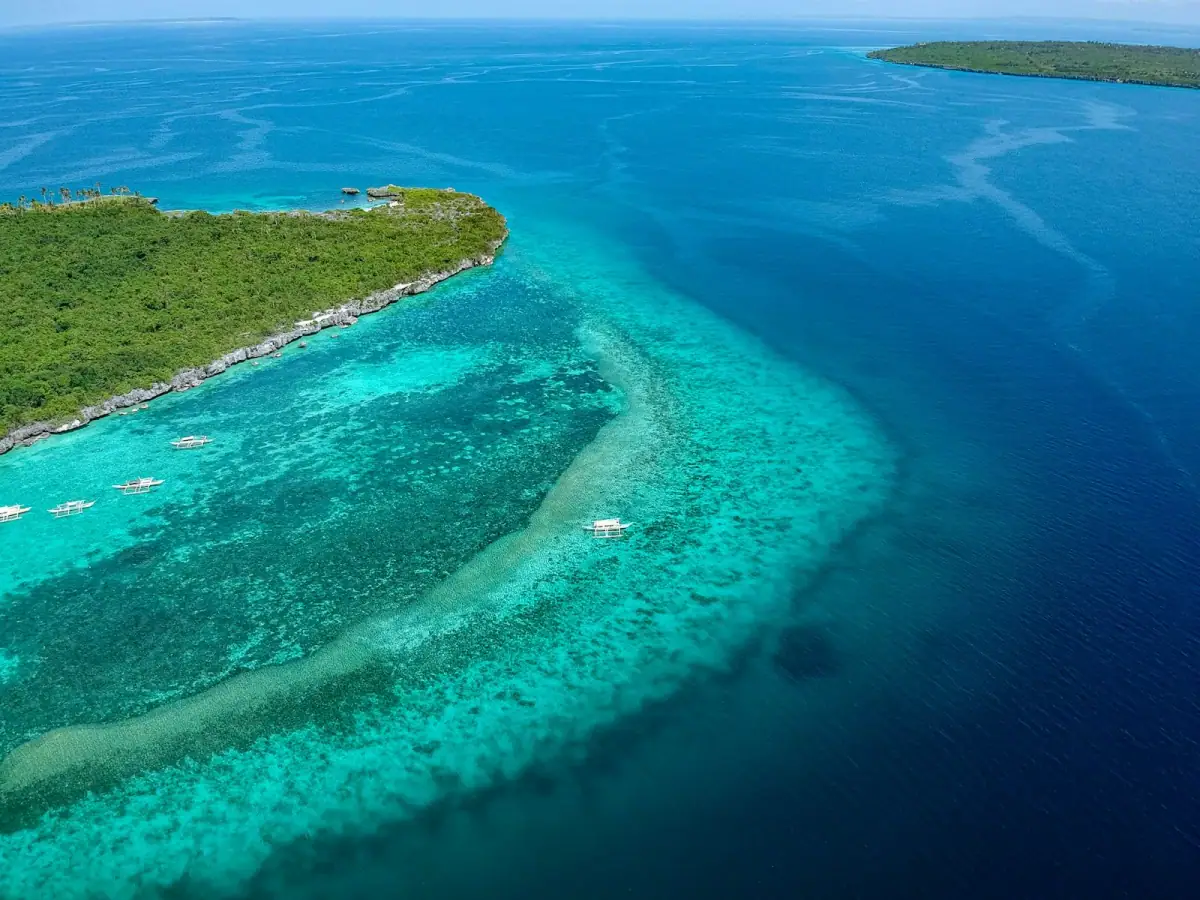
In the afternoon, stop at Virgin Island, a white sandbar that surfaces at low tide, perfect for a swim in flat, clear water.
For a full guide to the dive spots, see our article on diving in the Philippines.
Day 6: Loboc River and Panglao beaches
A quiet morning on the Loboc River: restaurant boats cruise up the river for 1 hour 30 minutes, framed by dense jungle, while you have lunch on board to the sound of local musicians. The boat turns around near Busay Falls. The atmosphere is kitschy but authentically Filipino.
In the afternoon, enjoy the beaches of Panglao. Dumaluan Beach is longer and quieter than Alona, with fewer people but equally beautiful water. Doljo Beach (north of the island) is almost untouched by mass tourism.
See our guide to where to stay in Bohol to choose your base according to your budget.
In the evening, head back to Tagbilaran to catch the next morning’s ferry to Cebu (or sleep in Tagbilaran directly).
Days 7 to 10: Siargao, surf, lagoons and a wild island
Day 7: Arriving in Siargao and Cloud 9
From Cebu, take a Cebu Pacific flight to Sayak Airport (IAO) in Siargao: the flight takes about 55 minutes and tickets generally run between 1,500 and 3,500 PHP (€25-60 / $29-70) depending on how far ahead you book.
On arrival, a habal-habal or a shared van takes you to General Luna (GL), the island’s main village and the base for all the adventures. The ride from the airport takes about 20-30 minutes.
Siargao is shaped like a teardrop spilled into the Pacific. The atmosphere is radically different from Cebu or Bohol: no grand colonial hotels or historic monuments here, but a bohemian surfers’ village, coconut palms as far as the eye can see, concrete roads lined with flowering hedges and the sea everywhere.
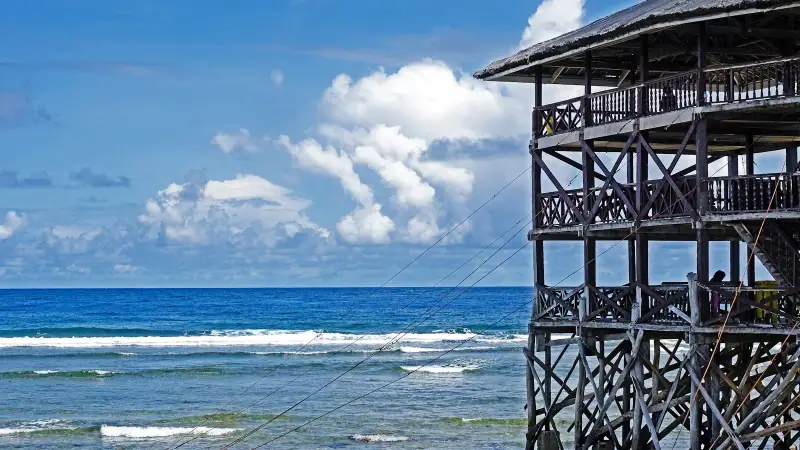
On the afternoon of day 7, go straight to Cloud 9 (about 3 km / 2 mi north of General Luna), even if you don’t surf. The wooden pier that juts out over the reef is one of the best viewpoints on the island: you watch surfers glide across one of the most perfect waves in Asia.
Cloud 9 is a reef break that breaks over a shallow reef and produces a short but powerful barrel, especially impressive during northeast swells (September to November). It is a spot for intermediate to advanced surfers. Beginners will find gentler waves at Jacking Horse, Cemetery or Stimpy’s on the island.
Flights Cebu → Siargao
Book your domestic flight in advance to avoid last-minute price increases.
Day 8: Island hopping, Naked Island, Guyam and Daku
The classic island hopping tour from General Luna combines three islands in one day by bangka:
Naked Island: a fine sandbar rising out of the blue water, without a single tree. The most shared image of Siargao. Ideal for swimming and photos.
Guyam Island: a tiny islet fringed with leaning palms. A few minutes of snorkeling to see the coral (quality varies by season), and lunch is often served here by the tour organizers.
Daku Island: the largest of the three, with real beaches and a small fishing community. This is the island where you start to feel that Siargao is not just tourism.
Island hopping tours usually leave General Luna at 8:30-9 am. Expect about 1,000-1,500 PHP (€17-25 / $20-29) per person in a group. Book the day before through your lodging or directly at the waterfront.
For more advice on island hopping in the Philippines, read our complete island hopping guide.
Day 9: Sugba Lagoon
Sugba Lagoon is the most spectacular natural jewel of Siargao, and the excursion takes more time and organization than standard island hopping.
Located in the municipality of Del Carmen, Sugba is an emerald lagoon ringed by mangroves and karst cliffs dropping into the water. Platforms and swing ropes have been set up by the local authorities for visitors. To reach it from General Luna, expect about 45 minutes by road to the port of Del Carmen, then 20 minutes by bangka to the lagoon, for a total of 1 hour to 1 hour 30 minutes from GL.
Logistics: many General Luna lodgings organize this tour (leaving 7-8 am, back around 3-4 pm). Otherwise, rent a scooter or take a habal-habal to Del Carmen and negotiate directly with local fishermen for the bangka ride (about 500-700 PHP per boat, shareable among 4-6 people).
Entrance fee: the lagoon is run by the local community; admission generally costs around 100 PHP (under €2 / about $2). Bring cash.
In the afternoon, if you are back early enough, enjoy the sunset from the coastal road along the north of the island, one of the best sights in Siargao.
Day 10: Free morning and flight home
Enjoy the last morning for a surf session (beginner lessons are available at several General Luna schools, about 600-800 PHP for a 1 hour 30 minute group lesson), a Thai massage at one of GL’s many spots, or simply a coconut coffee by the sea.
Depending on your domestic flight, plan to arrive at the airport 1 hour 30 minutes to 2 hours before takeoff. A tricycle or habal-habal from General Luna costs about 200-400 PHP.
Indicative budget for 10 days
| Item | Tight budget | Mid-range budget | Comfort budget |
|---|---|---|---|
| Lodging / night | €10-25 (~$12-29) | €30-60 (~$35-70) | €70-150 (~$81-175) |
| Meals / day | €8-12 (~$9-14) | €15-25 (~$17-29) | €30-60 (~$35-70) |
| Inter-island transport | €50-80 (~$58-93) | €100-150 (~$115-175) | €150-200 (~$175-230) |
| Activities / day | €15-25 (~$17-29) | €40-70 (~$46-81) | €80-150 (~$93-175) |
| Total 10 days | €500-700 (~$580-810) | €900-1,400 (~$1,045-1,625) | €1,800-3,000 (~$2,090-3,480) |
Excluding international flights.
Scooter rental in the Philippines
Essential in Siargao and Bohol to explore freely. Compare rental offers.
Lodging tips by island
Cebu City
Favor Lahug, IT Park or Mango Avenue for good access to restaurants and transport. Business hotels work very well for 1 to 2 nights: clean, with air conditioning and reliable wifi, at €25-60 (about $29-70) per night in the entry-level to mid-range bracket.
See our guide to where to stay in Cebu for the best addresses by neighborhood.
Bohol
Alona Beach (Panglao) is the ideal base for marine activities: dive shops within walking distance, beachfront restaurants, a lively atmosphere. Family guesthouses run around 800 to 1,500 PHP (€14-25 / $16-29) a night; resorts with a pool 2,000-4,000 PHP (€35-70 / $41-81).
Tagbilaran is less romantic but practical if you have an early-morning ferry.
For all the details, our article on where to stay in Bohol covers the options.
Siargao
General Luna (GL) is the epicenter of tourist life in Siargao. Every category of lodging is there, from surfer dorms to villas with private pools. The main street and the lanes behind the waterfront are full of guesthouses and small boutique hotels.
For those who want quiet, a few lodgings are outside GL, notably on the Pacifico side in the north (a more isolated surfer area) or around Dapa (the administrative capital).
Our complete guide to where to stay in Siargao will help you choose according to your travel style.
Best seasons for this itinerary
November to May: dry season, ideal for all three islands. December to March is the tourist peak (Filipino Christmas, long weekends).
September to November: best time for surfing in Siargao (the northeast swells arrive). But note that it is also typhoon season. Siargao is exposed to cyclones from October to November.
June to August: rainy season. Activities remain possible but the sea can be rough and domestic flights are sometimes canceled. The upside: lodging prices drop by 20 to 40%.
March and April are the sweet spot of the calendar: guaranteed sun, flat seas in Bohol for diving, good conditions in Siargao, and slightly lower crowds before the Filipino school holidays (April-May).
Practical tips before you go
Entry requirements: rules depend on your passport. Check the official Philippine government sources (immigration and eTravel registration) before you book. Read our guide to visas and formalities.
Money: the currency is the Philippine peso (PHP). ATMs are found in all cities but are often missing in small coastal villages. Always carry cash in Siargao: some lodgings and all market vendors do not take cards.
Connectivity: local SIMs (Globe or Smart) are available at Cebu airport on arrival, for 200-300 PHP with data. The network is excellent in Cebu and Bohol, good in General Luna and weak in remote areas of Siargao. Check your carrier’s international plan or consider a travel eSIM before you go.
Health: high-SPF sunscreen is a must (the Philippine sun is merciless on the water), and mosquito repellent for forested areas and the mangroves of Siargao. Don’t drink tap water. Travel insurance covering medical repatriation is strongly recommended.
Local transport: tricycles and habal-habal are everywhere. Negotiate the price before getting on. Scooter rental (200-500 PHP/day depending on the island) is the best way to explore Bohol and Siargao freely.
Going further in your preparation
Each island deserves a detailed read before you leave. See our complete guides:
- Visiting Cebu: complete guide
- Visiting Bohol: Chocolate Hills, tarsiers and diving
- Visiting Siargao: surf, island and lagoons
- Surfing in Siargao: Cloud 9 and the best spots
- The most beautiful beaches in the Philippines
Frequently asked questions
How many days do you need for the Cebu, Bohol and Siargao itinerary?
10 days is the comfortable minimum: 3 days in Cebu, 3 days in Bohol and 4 days in Siargao. With 12 to 14 days, you can slow down and add optional excursions such as Moalboal, Malapascua or the Siargao lagoons.
How do you travel between Cebu, Bohol and Siargao?
Cebu to Bohol: fast ferry from Pier 1 (OceanJet, SuperCat), about 2 hours for 400-650 PHP (€7-11 / $8-13), with several departures a day. Bohol to Siargao: go back to Cebu by ferry, then take a Cebu Pacific flight to Siargao (IAO), about 55 minutes. Or take a bus and ferry connection from Tagbilaran via Surigao (a long trip of 10-12 hours).
What budget should you plan for this 10-day itinerary?
On a mid-range budget, plan on €900 to 1,400 (about $1,045-1,625) on the ground for 10 days, excluding international flights. That covers lodging (€30-60 / $35-70 per night), meals (€15-25 / $17-29 per day), inter-island transport (about €100-150 / $115-175 in domestic flights) and activities (€50-80 / $58-93 per day on average). On a tight budget (guesthouses, market food), you can go down to €600-800 (about $695-930).
What is the best time of year for this itinerary?
The dry season from November to May is ideal for all three islands. December to March offers the best weather for diving in Bohol and surfing in Siargao. Avoid July to October: typhoon season hits Siargao and northern Cebu in particular. November and May are excellent compromises (fewer people, good weather).
Is this itinerary suitable for first-time visitors to the Philippines?
Yes, it is one of the best itineraries for a first trip to the Philippines. All three islands have solid tourism infrastructure and a good range of lodging, and inter-island transport is well established. English is spoken everywhere. Just leave a few spare days in case a flight is delayed.
Can you do this itinerary without a travel agency?
Absolutely. Ferries can be booked on site or online (12go.asia), and domestic flights on the Cebu Pacific website. Most activities can be booked directly at the destination (dive shops at Alona Beach, island hopping tours in General Luna). An agency can simplify logistics but is not necessary.
More Philippines guides
Keep reading
Diving in the Philippines: the best dive sites and wrecks
Guide to diving in the Philippines: best dive sites, wrecks, marine life, seasons and tips for divers of all levels.

Where to stay in Cebu: the best lodging by area
Where to stay in Cebu City and nearby? Hotels and resorts for every budget, from downtown to the beaches of the south coast.
Sagada without a car: how to get there from Manila, Baguio or Banaue
Reach Sagada by bus or jeepney from Manila, Baguio or Banaue, then see it all on foot: routes, travel times, registration, guides and pitfalls.
Ready-made
Philippines itineraries
10 days
The Philippines in 10 days with kids: stops, pace and travel times
Cebu (Mactan)Bohol (Panglao)Boracay
12 days
The Philippines in 12 days without a scooter or car: a realistic itinerary
ManilaEl NidoCoronManila
10 days
Palawan road trip: a 10-day itinerary from Puerto Princesa to El Nido
Puerto PrincesaPort BartonSan VicenteEl Nido