Where to stay
Where to Stay in Arequipa: Best Neighborhoods and Hotels
We may earn a commission when you book through links on this page, at no extra cost to you. We don't visit or try the places we cover: we summarize published sources. How we work
In short
- The Centro Histórico, around the Plaza de Armas, is the best base for walking to every sight; Yanahuara is quieter and more bohemian, about 2 km (1.2 mi) north.
- Boutique hotels in colonial houses cost about €60-150 a night (~$70-175), 3-4 star hotels €40-100 (~$46-116), dorms €8-15 (~$9-17).
- Book 4 to 6 weeks ahead in July-August and around the Santa Catalina festival in late July; a week is usually enough otherwise.
- Three nights is the ideal stay: one city day plus a 2-day / 1-night Colca Canyon trip.
Arequipa, the “Ciudad Blanca,” stands out as one of Peru’s must-see stops. The country’s second-largest city by population, it charms with its UNESCO World Heritage historic center, dominated by the white volcanic stone (sillar) that gives it its nickname. At 2,328 m (7,638 ft), far more accessible than Cusco, it is also an excellent base for discovering the Colca Canyon, one of the deepest in the world.
Choosing where to sleep in Arequipa strongly shapes your stay: neighborhoods vary enormously in atmosphere, proximity to the sights and noise level. This guide presents the best options for each budget.
The neighborhoods to stay in Arequipa
Arequipa is a human-scale city. Its main tourist neighborhoods are concentrated within a 3 km (1.9 mi) radius of the Plaza de Armas, which makes getting around much easier.
Centro Histórico: the heart of the White City
The Historic Center is by far the most popular option for visitors. Arequipa’s Plaza de Armas is reputed to be one of the most beautiful in Peru, framed by the 19th-century neo-Renaissance cathedral and white sillar arcades.
Sleeping in the Centro means being a few minutes’ walk from the Monasterio de Santa Catalina, the museums (Museo Santuarios Andinos, Museo de Arte Contemporáneo), the markets and the many restaurants lining Moral, San Francisco and Mercaderes streets.
Pros: Maximum centrality, everything on foot, wide variety of accommodation, lively neighborhood life in the evening. Cons: Can be noisy some evenings (music, local festivals), a few streets to avoid at night away from the tourist routes.
Yanahuara: the bohemian alternative with a view
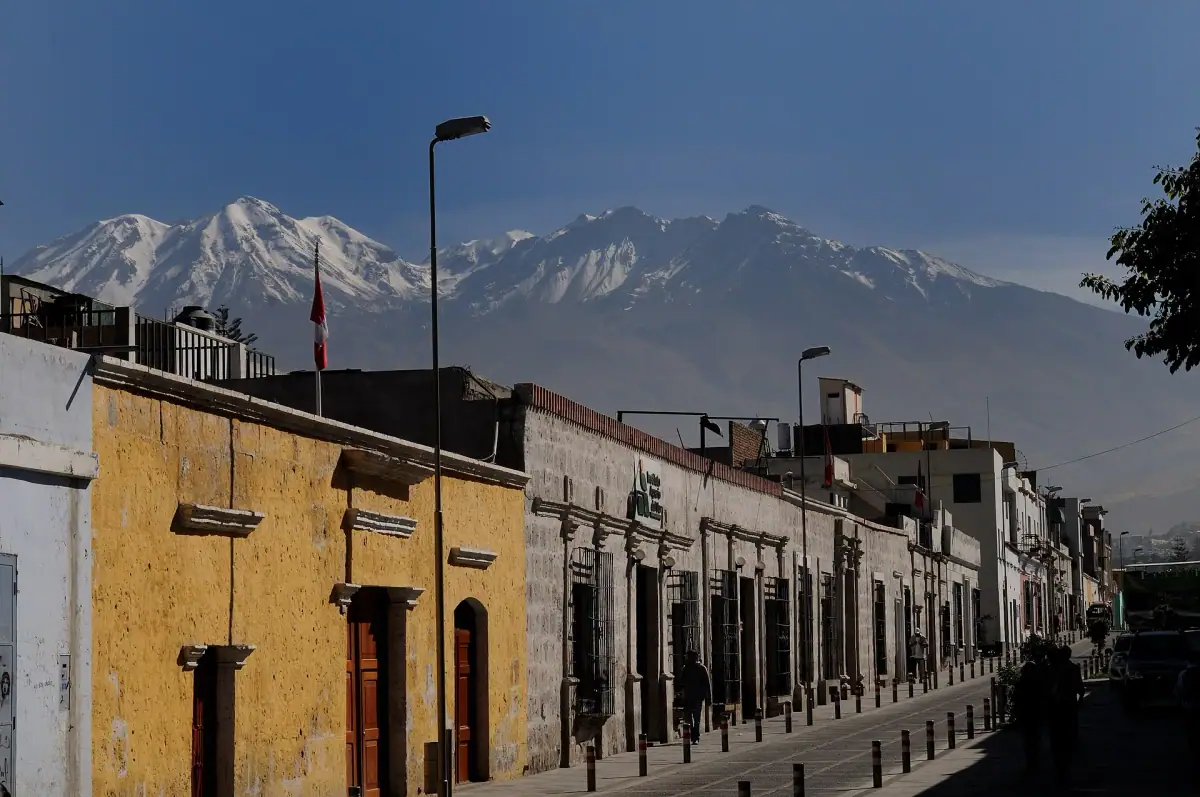
About 2 km (1.2 mi) northwest of the centro, Yanahuara is a residential neighborhood that has attracted design boutiques, specialty cafés and trendy restaurants without losing its authenticity. Its viewpoint offers a spectacular view of El Misti and Chachani, the two volcanoes that dominate the city.
Pros: Quiet, local atmosphere, quality restaurants, superb view, fewer street vendors. Cons: Requires a taxi or a 20-minute walk to reach the center and main sights, fewer hotels available.
Hotels in Arequipa
Compare and book the best hotels in the White City.
San Lázaro: the oldest neighborhood
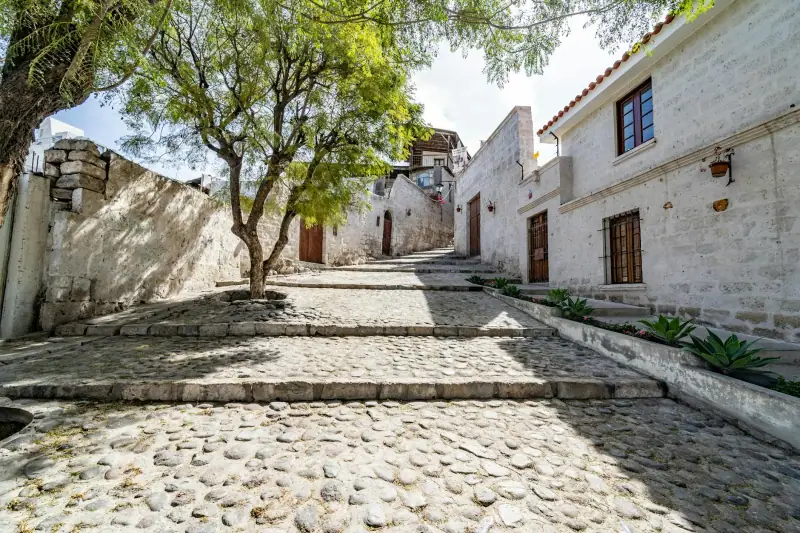
Nestled between the Centro and the Chili River, San Lázaro is Arequipa’s oldest lane. Its callejones (narrow lanes) in white sillar, its flowered colonial houses and its almost timeless atmosphere make it one of the most picturesque corners for lovers of authenticity. A few small guesthouses and bed-and-breakfasts have set up here, offering a rare immersion in colonial architecture.
Pros: Very authentic, quiet, unique architecture, a few charming places. Cons: Limited choice of places to stay, streets sometimes poorly lit at night, taxi access recommended in the evening.
Cayma and Miraflores: the modern neighborhoods
Further north, Cayma and Miraflores are residential neighborhoods popular with well-off Arequipeños. You find modern hotels, often more spacious, with parking and a pool, but the distance from the center always requires a taxi (about 15-20 min). These neighborhoods suit mainly travelers with a car or on business.
Types of accommodation in Arequipa
Boutique hotels and colonial houses
Arequipa excels in boutique hotels in historic buildings. The city’s architectural richness (patio houses, sillar galleries, interior chapels) has allowed many owners to convert colonial mansions into charming places to stay.
Prices remain very reasonable compared with Lima or Cusco: allow €60 to 150 a night (about $70 to 175) for a double room in a charming place in the Centro Histórico, often with a flowered patio, colonial furniture and a buffet breakfast included.
Note: Hotels listed as “heritage” are required to preserve the original architecture, which sometimes means low ceilings, steep stairs or imperfect soundproofing. Check recent reviews on these points.
3-4 star hotels (mid-range)
Most travelers choose 3-4 star hotels, which offer excellent value in Arequipa. Peruvian chains such as Casa Andina or Sonesta have locations in the centro.
Price range: €40 to 100 a night (about $46 to 116) for a double room, breakfast generally included.
Hostels and guesthouses (budget)
Arequipa has plenty of budget accommodation, particularly around Calle Jerusalén and Calle Santa Marta. Quality dorms run between €8 and 15 a night (about $9 to 17), private rooms between €20 and 40 (about $23 to 46). The backpacker atmosphere is stronger here than in Lima, because Arequipa is a popular stop on the Peru-Bolivia route.
Colca Canyon excursion
The top excursion from Arequipa: the deepest canyon in the world.
Tips for choosing your hotel in Arequipa
Altitude
At 2,328 m (7,638 ft), Arequipa is much lower than Cusco (3,400 m / 11,155 ft) or Puno (3,827 m / 12,556 ft). The Colca Canyon, which you may visit next, lies at 3,600 to 4,350 m (11,811 to 14,272 ft) depending on the viewpoint. For anything related to altitude, ask your doctor or a travel clinic, and see the official travel health pages (CDC in the US, TravelHealthPro in the UK).
The view of the volcanoes
El Misti (5,822 m / 19,101 ft) and Chachani (6,057 m / 19,872 ft) dominate the horizon from almost everywhere in Arequipa. Some hotels advertise a “volcano view” from their rooftop terrace or upper-floor rooms. This view is spectacular at sunrise in clear weather, but clouds can hide it for much of the year (notably in the rainy season, from December to March). Check reviews before paying extra for this view.
Noise and quiet
Arequipa’s Centro Histórico can be lively on weekend evenings, especially around the Plaza de Armas and Calle San Francisco. If quiet is a priority, opt for:
- A hotel with an interior patio (sillar is naturally insulating)
- The Yanahuara or San Lázaro neighborhood
- An upper floor in centro hotels
Breakfast
Most mid-range hotels and boutique hotels include breakfast. In Arequipa, it often takes the form of a buffet with fresh fruit juices (maracuyá, chirimoya), bread, local cheese, and sometimes regional specialties such as queso helado (a traditional frozen dessert). Check whether the buffet is really complete or only symbolic.
What to do from your accommodation in Arequipa
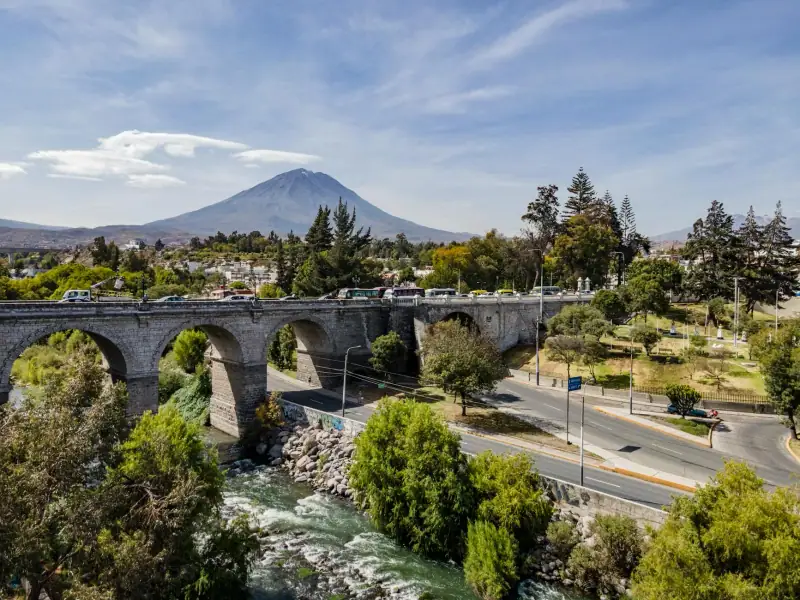
Arequipa’s central position in southern Peru makes it an ideal logistics base. From your hotel in the centro, you can reach a wide range of experiences on foot or with a short taxi ride.
Sights within walking distance of the centro:
- Monasterio de Santa Catalina (5 min walk): a city within a city, founded in 1579, one of the most beautiful monasteries in South America
- Plaza de Armas and cathedral: neo-Renaissance architecture in white sillar
- Museo Santuarios Andinos (5-10 min): the Juanita mummy, a sacrificed Inca teenager, one of the best preserved in the world
- San Camilo Market (10 min): a lively covered market, ideal for tasting Arequipa food
Excursions from Arequipa:
- Colca Canyon: leave at 3 am by bus or organized excursion (2 days / 1 night recommended), return the day after next
- El Misti volcano: 2-day climb (guide and equipment strongly recommended; check access conditions with the operator)
- Salinas y Aguada Blanca National Reserve: flamingos, vicuñas, lunar landscape (half day)
Flights to Arequipa
Arequipa has an international airport (AQP) with direct flights from Lima (about 1 h 30).
How many nights to spend in Arequipa
Arequipa deserves more than a quick pass. Here are our recommendations depending on your plans:
- 1-2 nights (quick stop): Enough for the Plaza de Armas, the Monasterio de Santa Catalina and a few typical restaurants. Ideal if you have not planned the Colca Canyon.
- 3 nights: The ideal formula: 1 city day + 2 days / 1 night at the Colca Canyon, with return on the third day.
- 4-5 nights: If you want to include the Salinas Reserve, a Peruvian cooking class, or simply let yourself go with the rhythm of the city.
Good to know: Arequipa has an international airport (AQP) with regular flights to Lima (about 1 h 30). You can arrive or leave by plane without going back through Lima if your circuit then takes you to Puno and Lake Titicaca (Arequipa-Puno bus: about 5 h 30 to 7 h depending on stops).
Car rental in Arequipa
Explore the region at your own pace: Colca Canyon, Salinas Reserve...
Arequipa often holds the best surprise of a Peruvian trip. Less famous than Cusco, less sprawling than Lima, the Ciudad Blanca combines striking colonial architecture, food recognized as among the best in Peru and a gentle way of life that invites you to linger. Whatever your budget, you will find accommodation to suit you in Arequipa, and probably one of your best Peruvian nights.
Frequently asked questions
What is the best neighborhood to stay in Arequipa?
The Centro Histórico (around the Plaza de Armas) is ideal for being within walking distance of all the attractions. Yanahuara offers a more residential and bohemian atmosphere with a view of El Misti. For small budgets, the center remains the best option with plenty of hostels.
Is altitude a problem in Arequipa?
Arequipa is at 2,328 m (7,638 ft), noticeably lower than Cusco (3,400 m / 11,155 ft) or Puno (3,827 m / 12,556 ft). For anything related to altitude, ask your doctor or a travel clinic, and see the official travel health pages (CDC in the US, TravelHealthPro in the UK).
Do you need to book a hotel in Arequipa far in advance?
In high season (July-August) and during the Santa Catalina Festival (late July), it is advisable to book 4 to 6 weeks ahead for the sought-after boutique hotels. Outside these periods, a week is generally enough.
Are there places to stay near the Santa Catalina Monastery?
Yes, several hotels and guesthouses are within a 5-minute walk of the monastery, in the Centro Histórico. It is one of the most in-demand areas because it lets you visit the monastery in the evening after the crowds have gone.
What is the difference between the Centro Histórico and Yanahuara for staying?
The Centro is lively and convenient, with all the attractions on foot. Yanahuara, about 2 km (1.2 mi) to the north, is quieter and residential, with excellent restaurants and cafés, and a magnificent view of El Misti from its viewpoint. Yanahuara requires a taxi or a 20-minute walk to reach the center.
Is Arequipa safe for tourists?
Arequipa is generally considered one of the safest Peruvian cities for travelers. The Centro Histórico and Yanahuara are the most secure areas. As everywhere, vigilance is needed at night on poorly lit streets.
More Peru guides
Keep reading
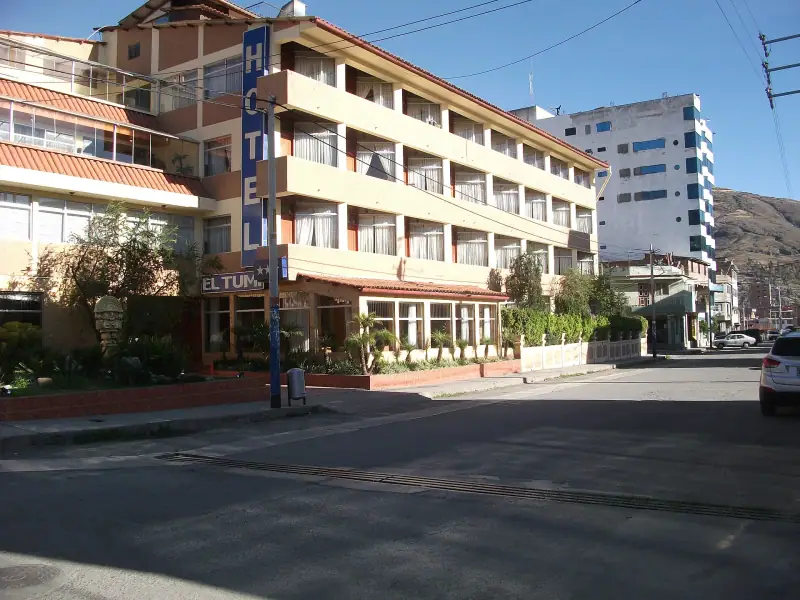
Where to Stay in Huaraz: Best Neighborhoods and Hotels for Trekkers
Where to stay in Huaraz? El Centro, Centenario, Soledad: the best neighborhoods and hotels for every budget at the gateway to the Cordillera Blanca.
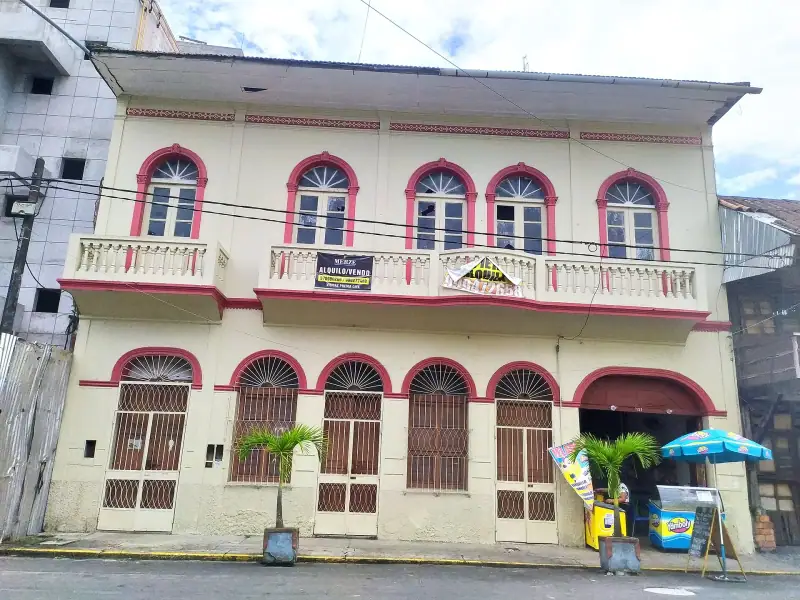
Where to Stay in Iquitos: Neighborhoods, Hotels and Amazon Eco-Lodges
Where to stay in Iquitos? Downtown, the riverfront or an eco-lodge deep in the Amazon: complete accommodation guide for the capital of the Peruvian jungle.
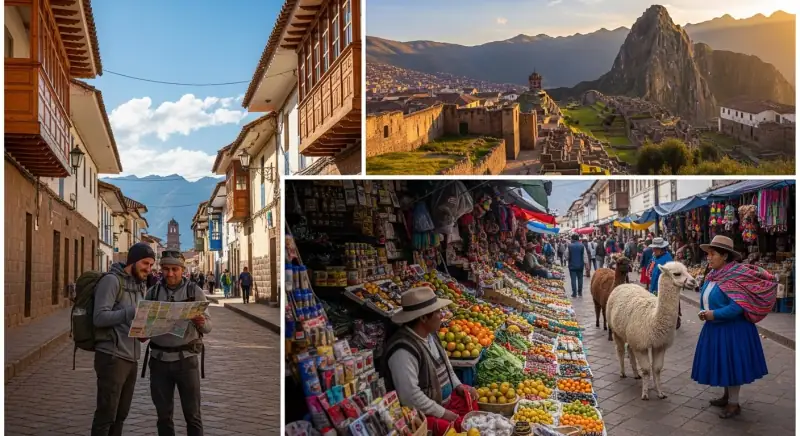
Peru Budget 2026: How Much Does a Trip to Peru Cost?
What budget for a trip to Peru? Accommodation, meals, transport, tourist sites: our complete guide with real 2026 figures.
Ready-made
Peru itineraries
7 days
Peru in 7 Days: The Ideal One-Week Itinerary
LimaCuscoAguas CalientesCusco
12 days
Peru Sierra Road Trip: 12 Days from Cusco to Huaraz
12-day Peruvian Sierra road trip: Cusco, Machu Picchu, Lake Titicaca, Arequipa, Colca, Huaraz. Complete itinerary with budget.
4 days
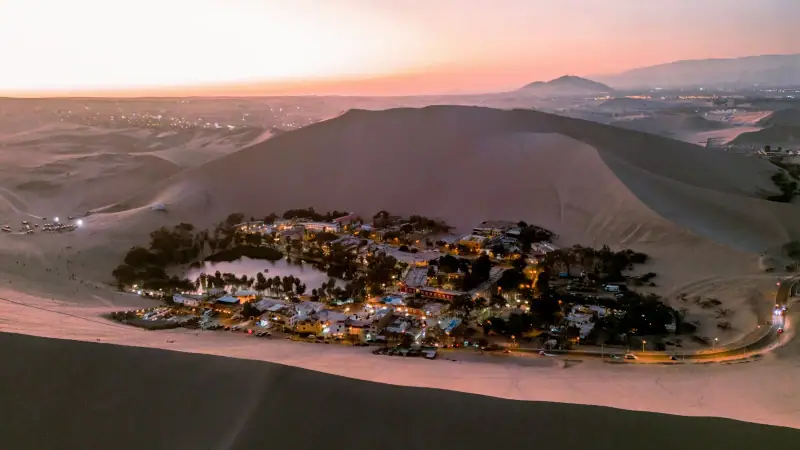
Lima, Paracas, Huacachina and Nazca in 4 Days by Bus: Doable Without a Car?
Lima, Paracas, Huacachina and Nazca in 4 days by bus: stages, km, real travel times, recommended departures and what to sacrifice to keep the pace.