What to see
Visiting Malacca: complete guide to the UNESCO city 2026
We may earn a commission when you book through links on this page, at no extra cost to you. We don't visit or try the places we cover: we summarize published sources. How we work
In short
- One to two days cover the essentials (Red Square, Jonker Street, Bukit China, museums); allow 3 days to go at your own pace and see the weekend night market.
- From Kuala Lumpur, buses from TBS take about 2 hours for 12-15 MYR; Malacca has no train station or commercial airport.
- The Jonker Walk Night Market runs Friday to Sunday evenings, from about 6 pm to midnight.
- The historic center is walkable: all major attractions are within about 2 km (1.2 mi). The dry season on the west coast runs May to September.
Malacca is one of Malaysia’s most fascinating destinations, and one that many travelers overlook. Listed as a UNESCO World Heritage site since 2008, this former sultanate city packs five centuries of colonial history into a few square kilometers: Portuguese forts, red-brick Dutch buildings, Chinese shophouses decorated with tiles and mosques of hybrid architecture. The capital of Peranakan (Baba-Nyonya) culture, a city whose flower-decked trishaws have become one of Malaysia’s most photographed symbols, Malacca fully deserves the two days that classic itineraries rarely give it. This complete guide covers everything you need to make the most of it.
The Red Square and the historic heart
The Stadthuys: the oldest Dutch building in Southeast Asia
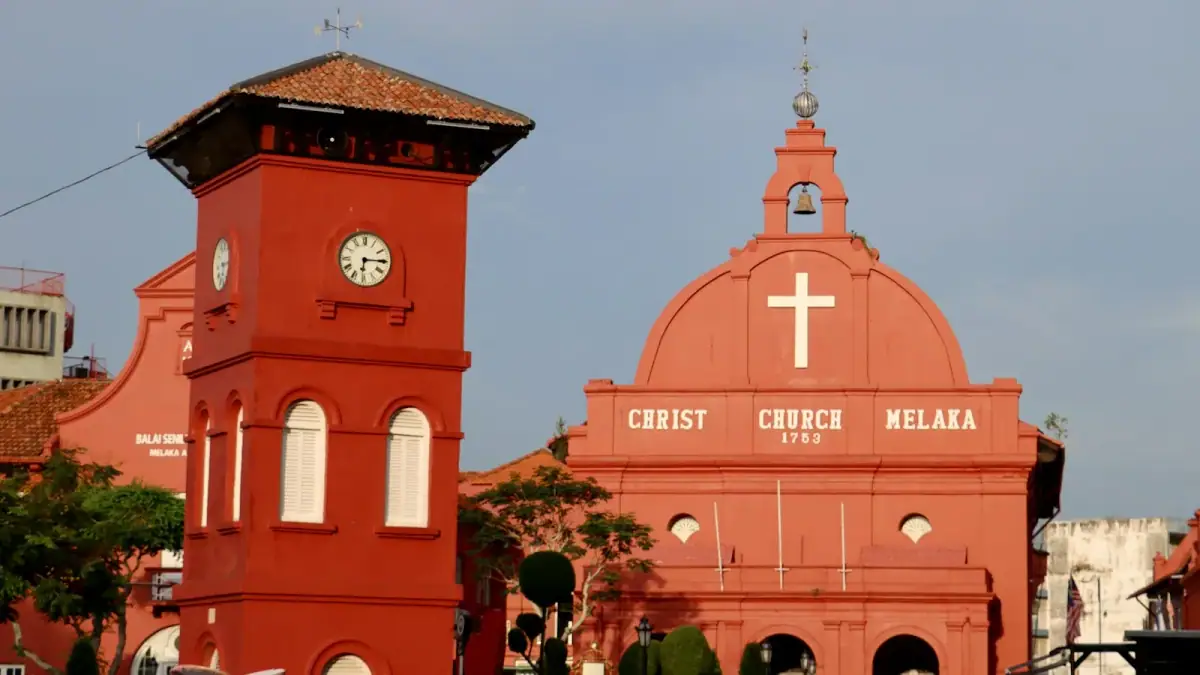
The Red Square (Dutch Square) is the essential starting point of any visit to Malacca. Its main building, the Stadthuys (1650), is an imposing red-brick structure that was for two centuries the seat of the Dutch administration. Today it is the Malacca History and Ethnography Museum, which traces the history of the Malacca sultanate and its various colonial occupations.
The square itself is dominated by the Queen Victoria Fountain (British era) and the ochre-yellow bell tower that frames it. This is where the trishaws, decorated with light garlands, plastic flowers and figurines, converge to take tourists around: a kitsch but irresistibly photogenic attraction.
What to see around the Red Square:
- Christ Church (1753): the Dutch Protestant church in red brick, adorned with century-old teak pews and Armenian gravestones
- Proclamation of Independence Memorial (the former Malacca Exclusive Club): a commemorative museum; official independence was proclaimed at Merdeka Stadium in Kuala Lumpur on August 31, 1957
- The former Dutch governor’s palace: today occupied by souvenir shops
A Famosa: the ruins of the Portuguese fort
A few hundred meters from the Red Square, on St Paul’s Hill (Bukit St Paul), you find the remains of A Famosa, the fort built by the Portuguese in 1511 after their conquest of Malacca. Only the Porta de Santiago remains today, a survivor of the demolition ordered by the British in 1807, thanks to the intervention of Stamford Raffles, founder of Singapore, who recognized its historic value.
At the top of the hill, the ruins of St Paul’s Church (1521) offer a panoramic view over the Strait of Malacca and the rooftops of the old town. The church was successively Portuguese, Dutch and British before being turned into a powder magazine; its roofless walls now serve as a setting for engraved Dutch gravestones.
Guided tours in Malacca
UNESCO heritage walking tours, Peranakan district visits and food tours with a local guide.
Jonker Street and the historic districts
Jonker Street (Jalan Hang Jebat)
Jonker Street is Malacca’s liveliest and most photographed artery. Lined with Sino-colonial shophouses with colorful facades (ochre, turquoise, pink), decorated with red lanterns and light garlands, the street concentrates antique dealers, galleries, batik shops, trendy cafés in restored spaces and, on weekends, the city’s best night market.
The Jonker Street night market (Friday-Sunday, 6 pm-midnight) is the highlight of the weekend. Hundreds of stalls set up over several hundred meters: Peranakan street food, grilled seafood, durian, sugarcane juice, local crafts. The atmosphere is electric and popular, with Malay families, Asian tourists and a few stray Western visitors mixing happily.
To explore in and around Jonker Street:
- Jalan Tokong (Harmony Street): the street of religious harmony, where the Kampung Kling Mosque (1748), the Cheng Hoon Teng Temple (1645) and the Hindu Sri Poyyatha Vinayagar Moorthi Temple (1781) coexist within a few meters of each other
- Jalan Hang Kasturi and its batik galleries
- Heeren Street (Jalan Tun Tan Cheng Lock): the street of Peranakan boutiques, with the city’s most beautiful shophouses
Cheng Hoon Teng Temple: the oldest in Malaysia
Cheng Hoon Teng (1645) is the oldest Chinese temple in Malaysia still in use. Dedicated to Kuan Yin, the goddess of mercy, it is a masterpiece of Sino-Malay architecture, built without plans, according to tradition, by master craftsmen from China. The roof tiles are adorned with Chinese opera scenes in polychrome porcelain, and the pillars carved with dragons and phoenixes. The atmosphere is particularly contemplative early in the morning, when the offerings of fruit and incense perfume the air.
Practical information:
- Hours: 7 am-7 pm every day
- Free entry
- Decent dress recommended (shoulders covered)
Kampung Kling Mosque
The Kampung Kling Mosque (1748) is a remarkable example of Peranakan Islamic architecture: its four-tier minaret looks like a Chinese pagoda, its pyramidal roof recalls Hindu-Javanese architecture and its tiles imported from England betray British influence. This syncretic mosque is the perfect reflection of Malacca’s unique cultural blending.
Hotels in Malacca
From Peranakan boutique hotels in historic shophouses to modern hotels with a pool. Book with free cancellation.
Peranakan (Baba-Nyonya) culture
Who are the Peranakan?
The Peranakan (literally “born here” in Malay) are descendants of Hokkien and Teochew Chinese merchants who settled in Malacca from the 15th century and formed unions with Malay women. This hybrid community, called Baba (men) and Nyonya (women), developed over the centuries a culture of extraordinary richness, halfway between Chinese and Malay traditions.
Peranakan culture is recognized by:
- Nyonya cuisine: a fusion of Chinese techniques and Malay spices, with sour, sweet and spicy flavors (assam pedas, ayam pongteh, laksa lemak)
- The kebaya: a lace-embroidered blouse worn with a batik sarong, the traditional dress of Nyonya women
- Nyonya ceramics: brightly colored porcelain tableware (pink, green, blue) imported from China, decorated with phoenixes and peonies
- Architecture: shophouses with facades decorated with ceramic tiles (Majolica tiles), colored stucco and finely carved woodwork
Baba & Nyonya Heritage Museum
The Baba & Nyonya Heritage Museum (48-50 Jalan Tun Tan Cheng Lock) is one of the most important visits in Malacca. Set in three restored Peranakan shophouses, this family museum presents a remarkable collection of carved teak Victorian furniture, Nyonya porcelain, gold jewelry and traditional wedding costumes.
The visit is guided (mandatory, in English or Malay) and lasts about 45 minutes. The guide explains the Peranakan wedding rituals that lasted twelve days, the dress codes set by social rank, and how the Baba-Nyonya managed to preserve their identity through five centuries of successive colonial rule.
Practical information:
- Hours: about 10 am-4:15 pm (last entry); the weekly closing day should be checked before you come (sources differ)
- Entry: about 16-18 MYR (foreigners), guided tour included
- Address: 48-50 Jalan Tun Tan Cheng Lock
Bukit China and natural sites
Bukit China: the Chinese hill
Bukit China (Chinese Hill) is one of the most moving places in Malacca. This vast 25-hectare (62-acre) cemetery, set on a green hill at the edge of the city center, is the largest Chinese cemetery outside China, with more than 12,500 graves dating from the 15th century. The oldest go back to the Malacca Sultanate; according to the Malay Annals, the legendary figure of Hang Li Po is said to have married Sultan Mansur Shah around 1459 and settled there with her retinue, although historians debate her historical existence.
Walking along the shaded paths between the horseshoe-shaped tombs, adorned with turtle heads and Chinese inscriptions, is a contemplative experience. The seven wells of Admiral Zheng He (Perigi Tujuh) at the foot of the hill, near the Poh San Teng Temple (Sam Po Kong), are said to have been dug during his 15th-century expeditions, a pilgrimage site for Malaysians of Chinese origin.
The Malacca River Walk
The Malacca River (Sungai Melaka) is the common thread of the city’s history: it was along its banks that the first Arab, Chinese and Indian merchants settled in the 15th century, making Malacca the busiest port in the Islamic world. Today the riverbanks have been redeveloped into a 2 km (1.2 mi) pedestrian promenade, lined with cafés with outdoor seating, mural art galleries and shops in restored colonial buildings.
The river boat cruise (45 min, departing from the Quayside Hotel dock, about 30 MYR for a foreign adult) is an original way to see both banks at sunset, when the colonial buildings light up and the herons leave their perches.
Flights to Malaysia
Compare the best flight prices to Kuala Lumpur (KUL), the ideal gateway to Malacca, 2 hours away by bus.
Food: Malacca’s unique flavors
Malacca has one of the most original cuisines in Malaysia, driven by Peranakan tradition and Portuguese influences. It is hard to leave without having tried something new at every meal.
Malacca’s essential dishes
Peranakan (Nyonya) cuisine:
- Assam pedas: a sour-spicy fish curry with tamarind, pineapple and ginger flower, Malacca’s signature dish
- Ayam pongteh: chicken simmered in a fermented soy sauce with mushrooms and potatoes, with mild, umami flavors
- Laksa lemak: a noodle soup with coconut milk, shrimp and tofu, milder and creamier than Penang’s assam laksa
- Kuih lapis: a steamed layered cake in colored layers, made from rice flour and coconut milk
Local specialties:
- Chicken rice balls: Malacca’s Hainanese chicken rice balls have become the emblematic dish of the city. The rice is shaped by hand into dense balls, served with poached chicken and a spicy sauce. The best-known address: Hoe Kee Chicken Rice (Jonker Street)
- Malacca cendol: the local version of the iced coconut dessert is known across the country, enriched with red beans, melted palm syrup and green pandan jelly
Where to eat in Malacca:
- Jonker Street (evening): the weekend night market is the ideal place to taste a bit of everything
- Nancy’s Kitchen (13, 13/1, 13-2 Jalan KL 3/8, Seksyen 3, Taman Kota Laksamana): the go-to address for authentic Nyonya cuisine, run by the same family for two generations
- Capitol Satay (41 Lorong Bukit Cina): specialist in satay celup, Malacca’s satay fondue where you dip skewered meats and vegetables in a boiling satay broth
- Sek Ya Cendol (Jonker Street): the best address for cendol, especially in the afternoon heat
A 2-day itinerary in Malacca
Day 1: the colonial and Peranakan heart
Morning: Start with St Paul’s Hill at opening time (before 10 am) to enjoy the view of the strait without crowds. Head down to the Porta de Santiago, then the Red Square (Stadthuys, Christ Church). Explore Harmony Street and the Cheng Hoon Teng temple, the Kampung Kling Mosque and the Hindu Sri Poyyatha Vinayagar Moorthi temple: three places of worship within 200 meters (656 ft).
Lunch: Chicken rice balls at Hoe Kee (Jonker Street), arriving before noon to avoid the queue.
Afternoon: Baba & Nyonya Heritage Museum (45-minute guided tour), then a free walk along Jalan Tun Tan Cheng Lock and its shophouses. Malacca river cruise at sunset (departure ~5:30 pm).
Evening (Friday-Sunday): Jonker Street night market until midnight. Sek Ya cendol for dessert.
Day 2: Bukit China and relaxation
Morning: Morning walk on Bukit China (arrive before 9 am, before the heat). Sam Po Kong wells on the way back.
Lunch: Satay celup at Capitol Satay, an experience in itself.
Afternoon: Malacca Sultanate Palace Museum (a replica of the 15th-century royal palace, interesting for history), then shopping on Jonker Street for Nyonya ceramics and batik.
Evening: Authentic Nyonya dinner at Nancy’s Kitchen.
Getting around Malacca
Malacca’s historic center is surprisingly compact: all the main attractions are within 1.5 km (0.9 mi) of the Red Square. Walking is the best way to get around the old quarter.
Transport options:
- Trishaw: the decorated trishaws (rickshaws with flowers and lights) are an attraction in themselves. Fare: 40-50 MYR for a 30-minute tour of the old quarter. Ideal in the evening for photos.
- Grab: essential to reach Bukit China, the shopping malls on the edge (Mahkota Parade, Dataran Pahlawan) or to park your car outside the center.
- Panorama Melaka bus: the local network (1-2 MYR per trip) serves the main attractions, but frequencies are irregular.
From Kuala Lumpur: The most practical option is the bus from Terminal Bersepadu Selatan (TBS): many companies (Transnasional, Starmart Express, KKKL), 2 hours, fare 12-15 MYR. By car, allow 1 h 45 via the A1 (E1/PLUS Highway) from central KL.
Car rental in Malaysia
Rent a car in Kuala Lumpur and reach Malacca with total independence. Compare the best rates.
Where to stay in Malacca
Malacca offers some of the most original accommodation in Malaysia. Staying in the old quarter, within walking distance of the main attractions, is strongly recommended.
In the old quarter (recommended)
The boutique hotels set in restored Peranakan shophouses are the Malacca experience par excellence. These multi-story houses, with their colored-tile facades and interiors furnished with carved teak and Nyonya ceramics, are sometimes more beautiful than the museums.
Options by budget:
- Budget (50-100 MYR / about $12-23): Hostels and guesthouses on Jalan Tun Tan Cheng Lock and Jonker Street (Baba House, Casa del Rio budget rooms)
- Mid-range (200-500 MYR / about $46-115): Boutique hotels in shophouses (The Baba House, Majestic Malacca, 1825 Gallery Hotel, Jalan Jalan Guesthouse)
- Luxury (600+ MYR / about $140+): Majestic Hotel Malacca (a former colonial villa), Casa del Rio (on the river), Hatten Hotel (view of the strait)
Good to know
Malacca is very popular on weekends with travelers from Kuala Lumpur and Singapore. Book at least 2-3 weeks ahead for a Friday-Sunday stay, and several months ahead for Chinese New Year or China’s Golden Week.
Practical information
Best time: The peninsula’s west coast is most pleasant from May to September (dry season). Malacca gets less rain than Kuala Lumpur thanks to its sheltered position. October and November can be wet. The heat is constant all year (28-34 °C / 82-93 °F).
Indicative daily budget:
- Small budget (dorm, street food): 80-120 MYR (about $17-29)
- Mid budget (double room, restaurants): 200-350 MYR (about $46-80)
- Comfort (boutique hotel, visits, restaurant dinner): 400-600 MYR (about $93-139)
Currency: Malaysian ringgit (MYR). Exchange rates vary, so check a current rate. ATMs are available around the Red Square and in the shopping malls.
Internet: A local SIM card is recommended (bought in KL at the airport or at any 7-Eleven); you can also check your carrier’s international plan or use a travel eSIM. Wi-Fi is available in all hotels and cafés.
Safety: Malacca is one of the safest cities in Malaysia. Usual vigilance in crowded markets (pickpockets). Women traveling alone can move around the old quarter without worry, day or night.
Malacca fits perfectly into a road trip on the Malay Peninsula or a 7-day itinerary in Malaysia. If you want to go deeper into temple and worship culture, our guide to Malaysia’s temples will help. And to prepare your budget as well as possible, see our complete guide to the budget in Malaysia.
Frequently asked questions
How many days should you plan to visit Malacca?
One to two days are enough for the essentials: Red Square, Jonker Street, Bukit China and the museums. Allow 3 days if you want to explore at your own pace, catch the weekend night market and make trips to the surroundings.
How do you get to Malacca from Kuala Lumpur?
By bus from Kuala Lumpur's Terminal Bersepadu Selatan (TBS): 2 hours, departures every 30 minutes with Transnasional or Starmart Express (12-15 MYR). By car: 150 km (93 mi) via the PLUS expressway (about 2 hours depending on traffic). Malacca has no railway station or commercial airport.
Is Malacca a UNESCO World Heritage site?
Yes! Malacca and George Town (Penang) were inscribed together as UNESCO World Heritage in 2008, under the name "Melaka and George Town, Historic Cities of the Straits of Malacca". The listing recognizes the unique colonial architecture and living culture that blend Portuguese, Dutch, British, Chinese and Malay influences.
What is Peranakan (Baba-Nyonya) culture?
The Peranakan (or Baba-Nyonya) are descendants of the Chinese merchants who settled in Malacca from the 15th century and married Malay women. This hybrid Sino-Malay culture stands out for its food (assam pedas, rendang), its dress (embroidered kebaya), its ceramics (brightly colored Nyonya porcelain) and its shophouse architecture decorated with tiles. Malacca is the cradle of this culture.
Is Jonker Street open every day?
Jonker Street (Jalan Hang Jebat) can be visited every day. The weekly night market (Jonker Walk Night Market) takes place on Friday, Saturday and Sunday evenings, from about 6 pm to midnight. It is by far the liveliest time to visit the street: street food stalls, crafts, antiques and a festive atmosphere guaranteed.
Do you need to rent a car to visit Malacca?
No, Malacca's historic center can be done entirely on foot or by trishaw (a decorated rickshaw). All major attractions are within a 2 km (1.2 mi) radius. A Grab is enough to reach farther sites such as Bukit China or the shopping malls.
When is the best time to visit Malacca?
The best time is May to September (dry season on the peninsula's west coast). Avoid October-November (northeast monsoon) and the weeks of Chinese New Year (heavy crowds). Malacca can still be visited all year thanks to its sheltered location.
More Malaysia guides
Keep reading
Visiting Kuala Lumpur: complete guide 2026
Complete guide to visiting Kuala Lumpur: Petronas Towers, Batu Caves, Chinatown, Bukit Bintang, street food and transport. All you need to know.
Penang Hill: funicular, hours, ticket prices and how to get up
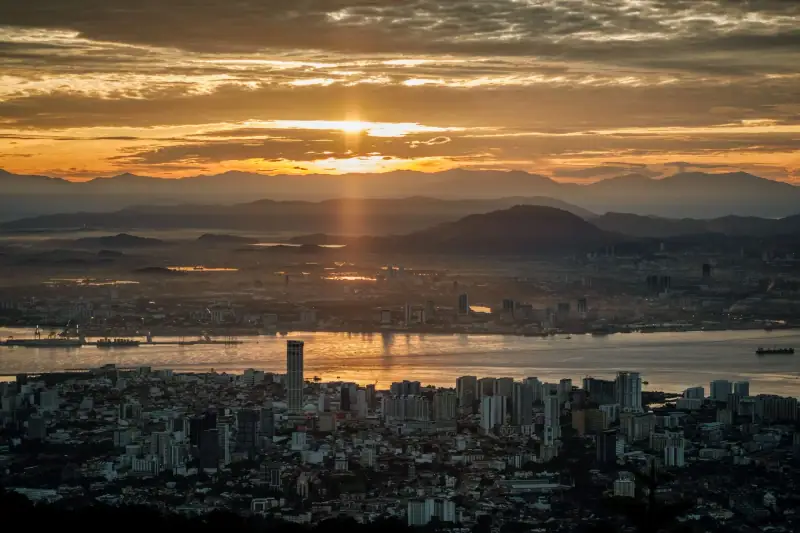
Penang Hill from George Town: funicular hours, regular and express fares, bus 204, getting up on foot or by jeep, and the best time to avoid the queue.
Kuala Lumpur top sights: 15 things to see and do
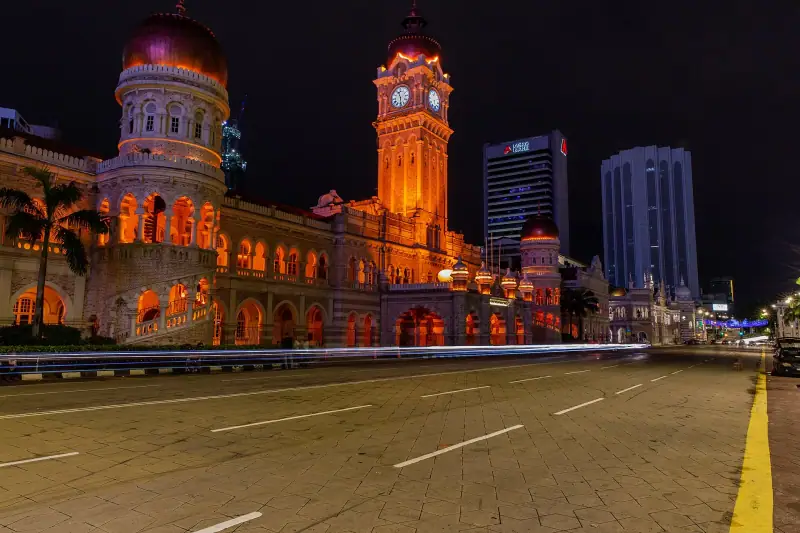
Kuala Lumpur's top sights: Petronas Towers, Batu Caves, Chinatown, street food and neighborhoods. Everything to see in KL in 2 to 4 days.
Ready-made
Malaysia itineraries
14 days
Malaysia's East Coast: Perhentian, Tioman, Redang and the eastern peninsula
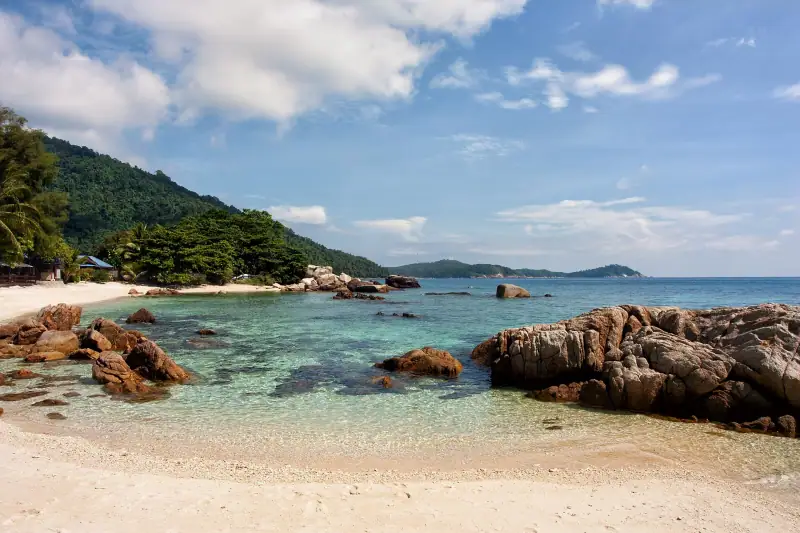
Complete guide to Peninsular Malaysia's east coast: Perhentian, Redang, Tioman, Kota Bharu and Taman Negara. Diving, beaches and jungle. 10 to 14 days.
10 days
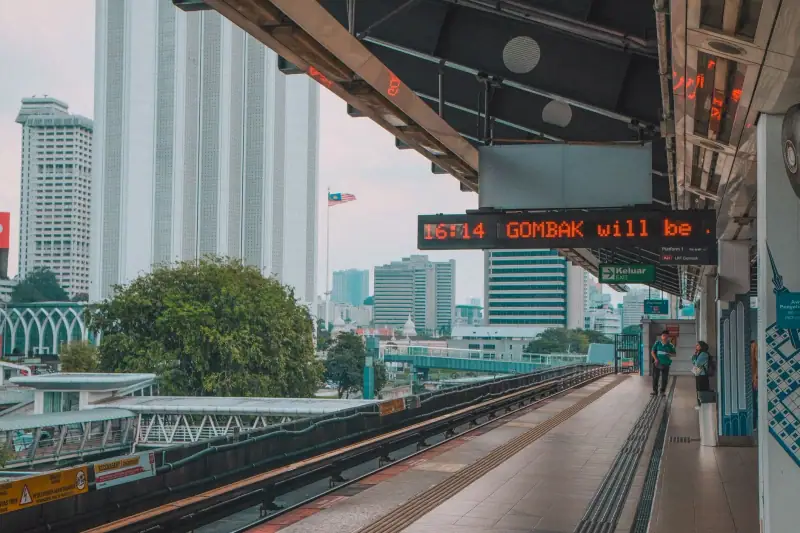
Malaysia in 10 days without a car: a train, bus and ferry itinerary
Kuala LumpurTanah Rata, Cameron HighlandsIpohGeorge Town, PenangLangkawi
14 days
Malaysia road trip: a complete 2 to 3 week itinerary
Malaysia road trip in 2 to 3 weeks: detailed route from KL to Penang, Langkawi, the Cameron Highlands, Malacca and Borneo, with transport and tips.