What to see
Visiting Kazbegi (Stepantsminda): a complete guide to the roof of the Caucasus
We may earn a commission when you book through links on this page, at no extra cost to you. We don't visit or try the places we cover: we summarize published sources. How we work
In short
- Kazbegi is about 150 km (93 mi) north of Tbilisi on the Georgian Military Road: about 3 hours by marshrutka from Didube (10-15 GEL) or by car.
- Gergeti church (2,170 m / 7,120 ft) is a 1 h 30 to 2 h walk up from Stepantsminda, about 600 m (1,970 ft) of climbing; local 4x4 drivers also go up.
- Plan two days at least; three or four add Gveleti waterfalls, Truso Valley and the Dariali Gorge. June to September is the ideal period.
- Climbing Mount Kazbek (5,054 m / 16,581 ft) requires serious high-mountain experience; the base camp is about 3,650 m (11,975 ft).
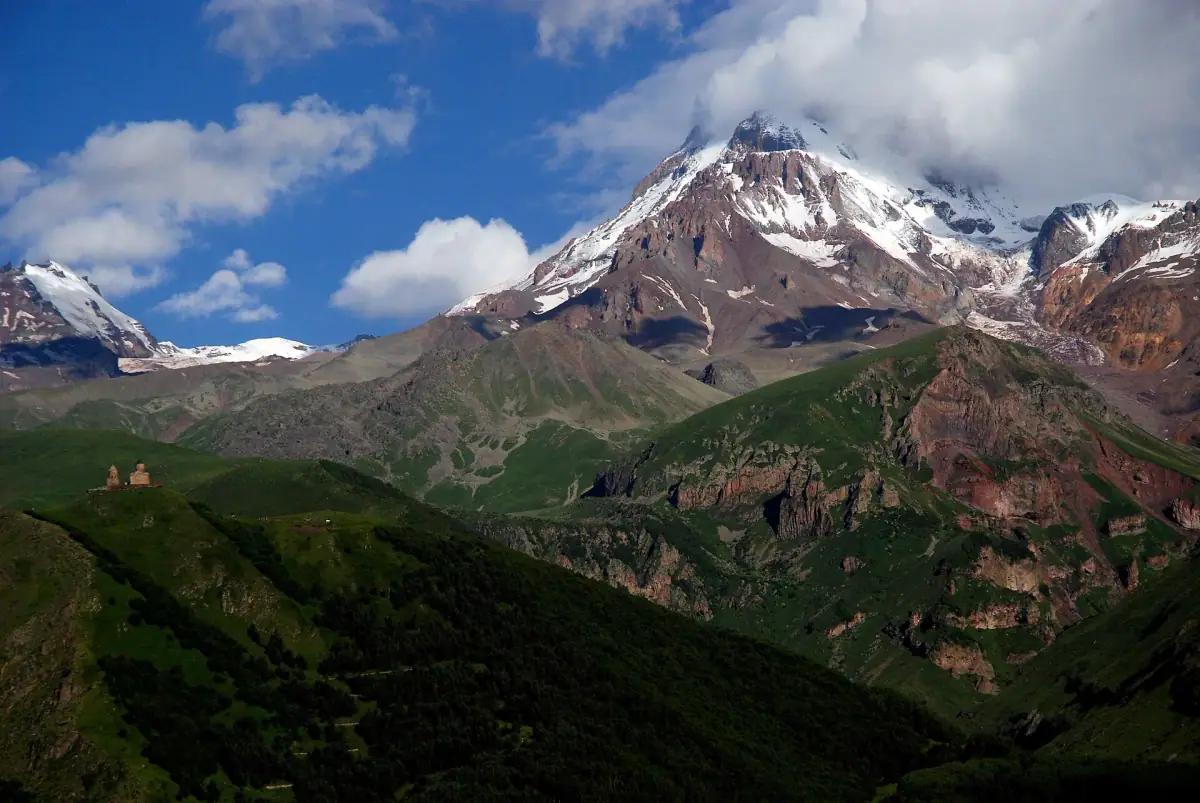
Kazbegi, or Stepantsminda, its official Georgian name since 2006, is one of the most spectacular mountain destinations in the Caucasus. About 150 kilometers (93 mi) north of Tbilisi, this high-altitude village is dominated by two silhouettes that stay in every traveler’s memory: the medieval Gergeti Trinity Church, perched on its rocky spur at 2,170 meters (7,120 ft), and behind it Mount Kazbek, a dormant volcano whose snowy cone peaks at 5,054 meters (16,581 ft). Together they form one of the most photographed views in Georgia, and arguably one of the most beautiful on the continent.
But Kazbegi is not just a postcard. It is also a starting point for demanding and accessible hikes, a stop on the legendary Georgian Military Road, and an outpost where Georgian mountain life, with its stone houses, its flocks of sheep and its inhabitants both hospitable and taciturn, can be seen with rare authenticity.
Kazbegi and the Georgian Military Road
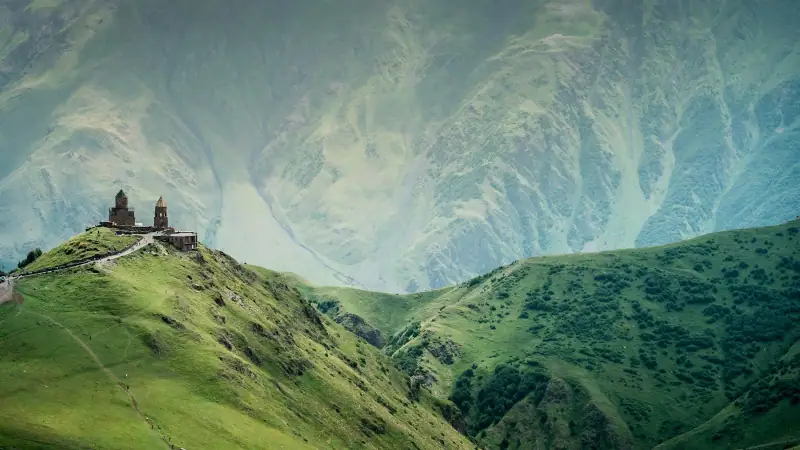
To reach Kazbegi, you will inevitably take the Georgian Military Road (E117), and this trip is an attraction in itself. Laid out along the Terek River and its tributaries, this mountain road crosses the Cross Pass (Jvari Pass, about 2,379 meters / 7,805 ft) and is the only drivable route linking Georgia to Russia across the Greater Caucasus.
The route from Tbilisi is a succession of panoramas that gradually widen. The first hour crosses the surroundings of the capital, relatively flat and agricultural. Then the road enters the Aragvi gorges and starts climbing seriously. Halfway, the Jinvali Reservoir and Ananuri Fortress (a medieval fortress founded in the 13th century, whose large church dates from 1689, overlooking the lake from a cliff) deserve a half-hour stop.
The road keeps rising through the Gudauri ski resort (2,100 m / 6,890 ft), then passes the Cross Pass where, in clear weather, the view of the Greater Caucasus ridges is dizzying. A Soviet-era Georgian-Russian friendship monument marks this pass and is a classic photo stop. The descent to Kazbegi then runs through a valley that gradually opens onto the village and the first views of Kazbek.
Allow about 3 hours of travel from Tbilisi (about 150 km / 93 mi, much of it in the mountains with many bends).
Car rental for the Military Road
A rental car gives you the freedom to stop at Ananuri, Gudauri and the passes on the way to Kazbegi. Ideal for a Caucasus road trip.
Gergeti Trinity Church (Tsminda Sameba)
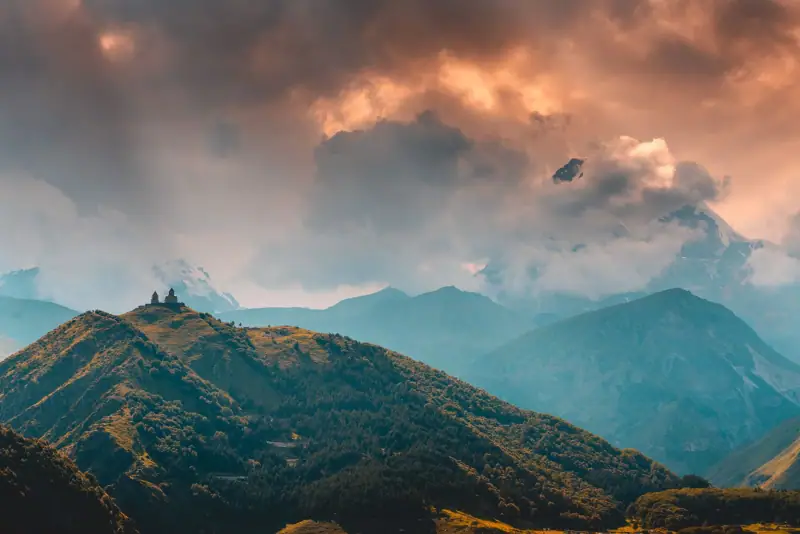
This is what everyone comes to see, and it never disappoints. Gergeti Trinity Church (Tsminda Sameba in Georgian, meaning “Holy Trinity”) is a medieval 14th-century cathedral-church built on an isolated rocky spur at about 2,170 meters (7,120 ft), facing Mount Kazbek. This position, at once defensive, symbolic and simply sublime, makes it one of the most impressive religious buildings in the Caucasus.
The church itself is a stocky building in medieval Georgian style, in gray stone, with a 16th-century bell tower slightly off-axis from the nave. The interior is modest but functional: partly preserved frescoes decorate the walls, and a community of monks maintains an active monastic presence. A dress code applies (shoulders and knees covered, headscarf for women).
What makes the place beautiful is above all the view from the plateau around the church. In fine weather, Mount Kazbek fills the whole northeast horizon, its ice cap shining in the sun, while to the south you see the Terek valley stretching to the mountains on the opposite side. Sunrise and late-afternoon light are the most photogenic moments.
How to walk up: the trail starts from the center of Stepantsminda (from the village’s main square or from the parking lot at the north entrance of the village). It climbs steadily through meadows and pastures, well marked. The slope is steady but never technical. Allow 1 h 30 to 2 h going up and 1 h to 1 h 15 coming down depending on your pace. Walking shoes with a good sole are strongly recommended: the trail can be muddy after rain and the stones are sometimes slippery.
4x4 alternative: local drivers offer the climb in an off-road vehicle from the village. This option is handy if you are in a hurry or if the weather is unfavorable for a long walk. Ask your accommodation for rates and to be put in touch.
Hikes around Kazbegi
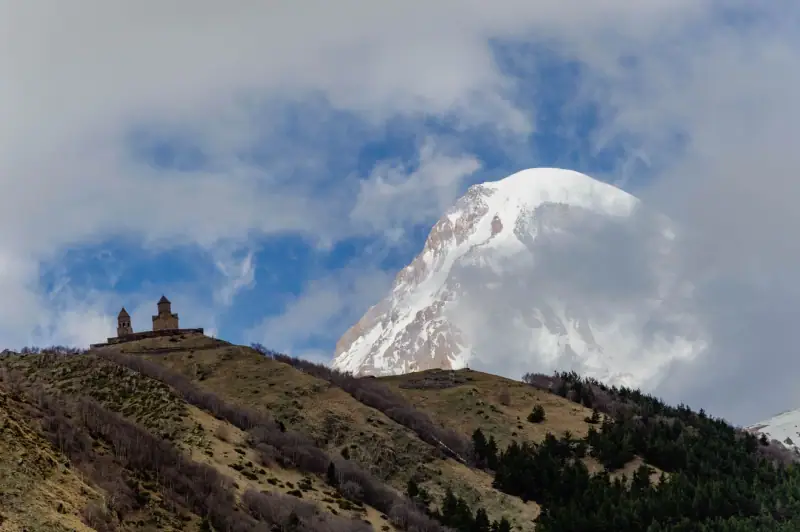
Beyond Gergeti church, Kazbegi is a natural base camp for half a dozen quality hikes in the surrounding alpine pastures and gorges.
Gveleti waterfalls
About 7-9 kilometers (4-6 mi) north of Stepantsminda, the Gveleti waterfalls are an accessible and very popular excursion. The path follows the gorge on fairly easy terrain and ends at a main waterfall about thirty meters (100 ft) high in a wild forest setting. Allow about 2 h 30 to 3 h round trip for a family walk. The trail starts from the main road, a few kilometers north of the village.
Truso Valley
The Truso gorge, west of Stepantsminda (reached by car or on foot along the Terek valley), is less visited and offers a particularly unusual landscape: reddish mineral springs color the stones and streams, ruined medieval towers punctuate the valley, and the old Zakagori fortresses overlook the heights. A full day is needed to explore the Truso Valley at your own pace. The abandoned Ossetian villages dotted around this area add a poignant historical dimension.
Kazbek base camp (experienced hikers)
For mountaineers and seasoned trekkers, the Kazbek base camp (called Betlemi or Metnari Ludi, at about 3,650 meters / 11,975 ft) is a reference stage. The climb from Stepantsminda takes a good day of sustained walking and requires good fitness as well as suitable gear (tent, sleeping equipment for night temperatures at altitude). Climbing the summit (5,054 m / 16,581 ft) is a mountaineering route that demands proven experience in high mountains with glaciers.
Guided excursions and hikes in Kazbegi
Go hiking with a local guide to discover the Truso gorge, the Gveleti waterfalls or the alpine trails around Stepantsminda safely.
The Dariali Gorge and the border
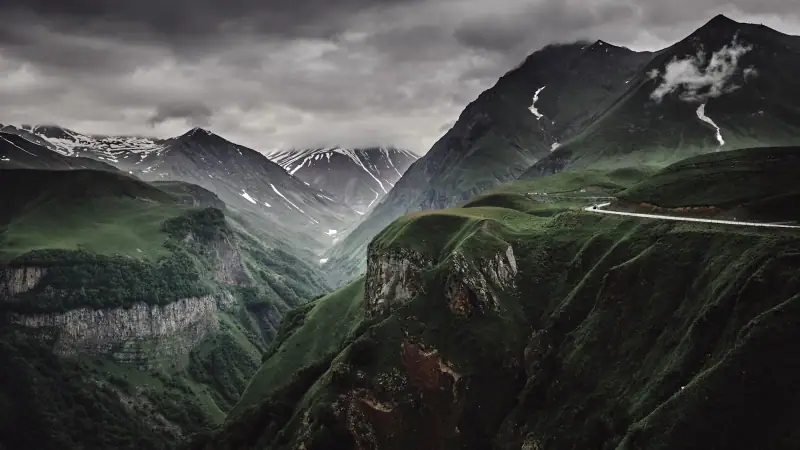
The Dariali Gorge, which opens a few kilometers north of Stepantsminda and extends to the Russian border, is one of the most impressive natural passages of the Greater Caucasus. Hemmed in by steep rock walls that the Terek hurtles down in a tumultuous torrent, this gorge was for centuries the only way across the Caucasus between the Russian and Georgian worlds. Dariali Fortress, built on a spur overlooking the river, controlled this strategic passage.
The area is reachable by car from Stepantsminda; Dariali Monastery, the main site to visit, is about 10-12 km (6-7 mi) north of the village. From the fortress ruins, the view over the gorge is dizzying. A contemporary monastery has been rebuilt near the ruins, creating a surprising mix of medieval history and recent religious architecture. Access to the site is free.
Stepantsminda: the village
The village of Stepantsminda itself is modest: a few hundred stone and wooden houses, narrow streets, a high-mountain atmosphere. But it is precisely this simplicity that adds to the destination’s charm. The people of this Greater Caucasus area, in the Mtskheta-Mtianeti region, maintain a mountain way of life that changes very little from one generation to the next.
The village’s central square holds the few shops, restaurants and guesthouses. This is where taxis, marshrutkas and hikers leaving or returning converge. There are grocery stores to stock up before a hike, a few restaurants serving Georgian classics (khinkali, khachapuri, skewers), and hiking gear rental shops.
The local Kazbegi museum (Aleksandre Kazbegi Museum), dedicated to the 19th-century Georgian writer Aleksandre Kazbegi, whose name the town formerly bore, offers an introduction to the region’s history and culture. It is a modest building but the collections are interesting for understanding the region’s identity.
How to fit Kazbegi into your itinerary
Kazbegi fits naturally into several trip configurations in Georgia.
Option 1: weekend from Tbilisi (2 days) Leave Saturday morning from Didube (marshrutka, 3 h). Settle in, have lunch, then walk up to Gergeti church in the late afternoon to enjoy the golden light. Sleep in the village. On Sunday morning, explore the surroundings (Gveleti waterfalls or Truso gorge) and take the marshrutka back in early afternoon to be in Tbilisi in the evening.
Option 2: stage of a Northern circuit (3-4 days) Combine Kazbegi with Gudauri for a night of skiing in winter or summer hiking, and with a stop at Ananuri Fortress on the Military Road. This “mountain North” circuit perfectly complements a trip starting with Tbilisi and Kakheti.
Option 3: trekking base (4-7 days) For serious hikers, Kazbegi is an ideal base for linking alpine routes over several days: Gergeti on the first day, Truso on the second, Gveleti on the third, and the following days for hikes to higher pastures or the Kazbek base camp.
In our 7-day itinerary in Georgia, Kazbegi is one of the two nature getaways of the circuit, alongside Svaneti. For a road trip in Georgia, the Georgian Military Road is one of the essential axes.
Where to stay in Kazbegi
For full details on the places to stay in Stepantsminda (family guesthouses, mountain hotels, options with a Kazbek view), see our complete guide to sleeping in Kazbegi.
In short, the choice is wide for a village this size. Family guesthouses are the most common option and often the most authentic: half board (breakfast + dinner) is common and lets you taste Georgian mountain cooking. Hotels and lodges with direct views of Gergeti church and Kazbek are the most sought-after places to stay: book ahead in high season (July-August) and on weekends in June and September.
Places to stay in Kazbegi with a Kazbek view
Family guesthouses, mountain lodges and hotels with a view of Gergeti church: book ahead for the summer high season.
Budget for visiting Kazbegi
| Item | Indicative budget |
|---|---|
| Tbilisi-Kazbegi marshrutka | 10-15 GEL (about €3-4 / $3.50-4.50) |
| Shared taxi Tbilisi-Kazbegi | 25-40 GEL per seat |
| Gergeti by 4x4 (round trip) | 30-60 GEL per vehicle |
| Kazbegi museum entrance | Low (check the rate locally) |
| Restaurant meal | 25-50 GEL per person |
| Guesthouse with half board | 80-150 GEL per person |
| Hotel/lodge with a view | 150-300 GEL per double room |
| Hiking guide | 80-150 GEL per group per half day |
Average daily budget (accommodation included): 130-200 GEL per person for a comfortable guesthouse stay. Kazbegi remains very affordable compared with European Alpine standards.
For an overview of the costs of a trip to Georgia, our Georgia travel budget guide gives you all the benchmarks.
Practical tips for visiting Kazbegi
Weather and preparation: the mountains are unpredictable. Even in summer, fog and rain can set in quickly. Always carry a waterproof layer and a fleece, whatever the season. Mornings are generally clearer than afternoons, so take advantage of that to climb to Gergeti early.
Hiking gear: mid-cut hiking boots with a good sole are essential for mountain trails. For hikes above 2,500 meters (8,200 ft), plan on trekking poles and full rain gear.
Transport from Tbilisi: marshrutkas leave from Didube bus station (reached by metro). Check the schedule the day before as it can change. Shared taxis from Tbilisi are more flexible on times but slightly more expensive. Always negotiate the price before getting in.
Altitude: Stepantsminda is at about 1,700 meters (5,580 ft). Ask your doctor or a travel clinic about altitude before you go, and see the official travel health pages (CDC in the US, TravelHealthPro in the UK).
Mobile network: coverage (Magti, Silknet, formerly Geocell) is present in the village and on the main trails, but can be patchy in gorges and enclosed valleys. Download offline maps (Maps.me or offline Google Maps) before heading out to hike. For your phone, check your carrier’s international plan or use a travel eSIM.
Language: English is spoken in most tourist accommodations. Outside the center, Russian remains more useful than English. A few words of Georgian (gamarjoba for hello, madloba for thank you) are very much appreciated.
Dress code: Gergeti church is an active place of worship: shoulders and knees covered, headscarf for women. These rules are enforced courteously but firmly by the monks.
Kazbegi is one of those places that match the image you have of them before seeing them, and go beyond it. Gergeti church facing Kazbek is such a reproduced image that you might fear disappointment; there is none. The Greater Caucasus has a physical presence, a mass and a light that cannot be reduced to a photograph. Two days in Stepantsminda are enough to understand why so many travelers, who came for one night, extend their stay by several days. The mountain holds you.
Frequently asked questions
How do you get from Tbilisi to Kazbegi?
From Didube bus station in Tbilisi, marshrutkas leave daily for Stepantsminda (Kazbegi). The trip takes about 3 hours for a fare of about 10-15 GEL per person. By shared or private taxi from Tbilisi, the duration is similar or a little shorter depending on traffic. The Georgian Military Road (E117) is the only drivable road and offers spectacular scenery all the way.
How long do you need to visit Kazbegi?
A minimum of two days is recommended to climb to Gergeti church (Tsminda Sameba) and enjoy the scenery without rushing. With three or four days, you can hike to the Gveleti waterfalls, explore the Dariali Gorge or take trips to the surrounding villages. Trekking and mountaineering fans can stay a week or more for routes toward the Kazbek base camp.
Can you walk to Gergeti church?
Yes, Gergeti Trinity Church can be reached on foot from the village of Stepantsminda by a well-marked trail. The climb takes between 1 h 30 and 2 h depending on your pace and fitness. The elevation gain is about 600 meters (1,970 ft). You can also reach the church by 4x4 (local drivers offer this service from the town center). The walk down is faster, about 1 h to 1 h 30.
What is the best time to visit Kazbegi?
June to September is the ideal period: mountain roads are clear, daytime temperatures are pleasant (15-25 °C / 59-77 °F) and hiking trails are passable. July and August are the busiest months. Spring (May) is beautiful but the peaks remain snowy and some trails can be muddy. Fall (October) offers magnificent light. Winter is possible for ski or snow-scenery fans, but it is very cold (−10 °C / 14 °F and below) and some roads can be closed.
Can you visit Kazbegi as a day trip from Tbilisi?
Technically yes, but it is a very full day: 3 hours of driving each way, the climb to Gergeti (1 h 30 to 2 h), a brief visit, the descent and 3 hours back. You will spend more time in transit than enjoying the site. Two days (one night there) is far more satisfying and lets you explore Kazbegi without rushing.
How high is Kazbegi?
The village of Stepantsminda is at about 1,700 meters (5,580 ft). Gergeti church is at about 2,170 meters (7,120 ft). Ask your doctor or a travel clinic about altitude before you go, and see the official travel health pages (CDC in the US, TravelHealthPro in the UK). Climbing toward the summit of Kazbek (5,054 m / 16,581 ft) requires proper preparation and high-mountain experience.
More Georgia guides
Keep reading
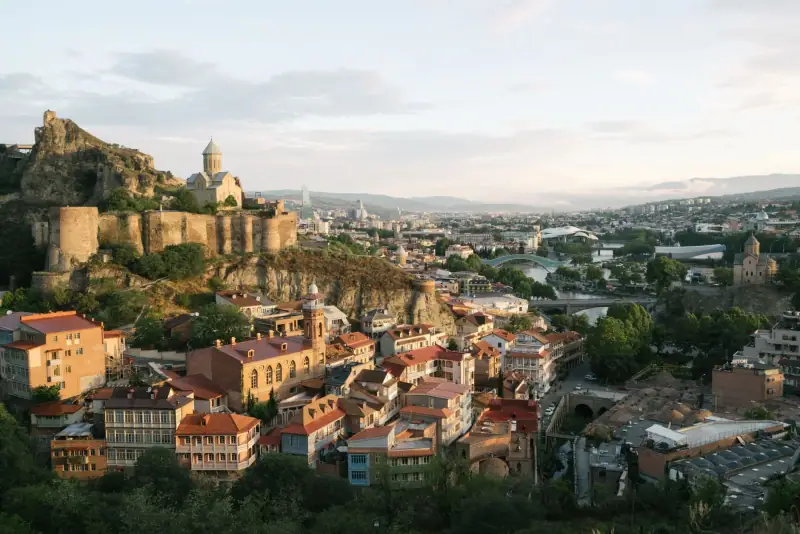
Tbilisi: the 15 must-see sights
Old town, Narikala Fortress, sulfur baths, Sameba Cathedral: the 15 must-see sights in Tbilisi.
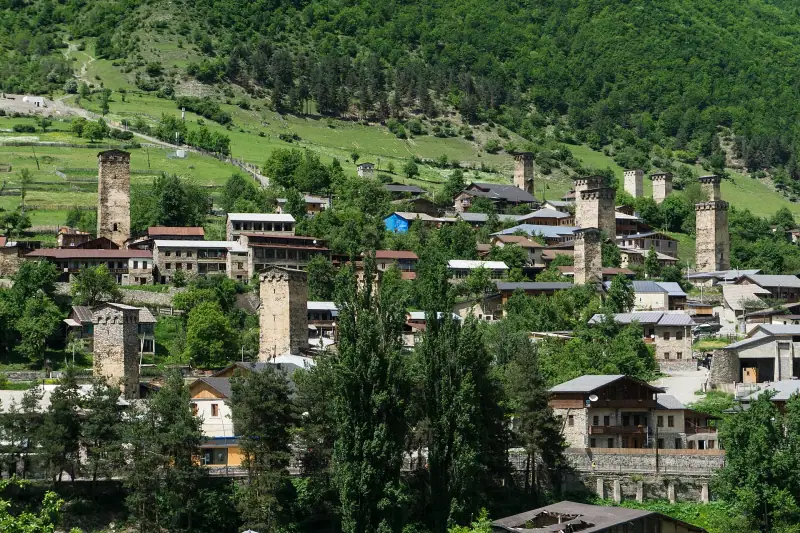
Visiting Mestia and Svaneti: a complete guide to the roof of the Caucasus
Mestia and Svaneti, Georgia: UNESCO Svan towers, the trek to Ushguli, glaciers and epic hikes. A complete guide to plan your stay.
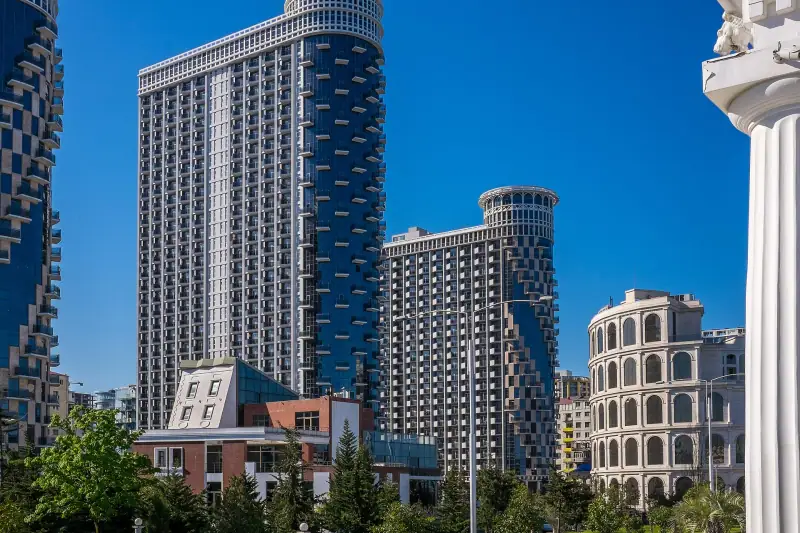
Visiting Batumi: a complete guide to the pearl of the Black Sea
Batumi, Georgia: seaside boulevard, botanical garden, old town and Adjarian food. A complete guide for your stay on the Black Sea coast.
Ready-made
Georgia itineraries
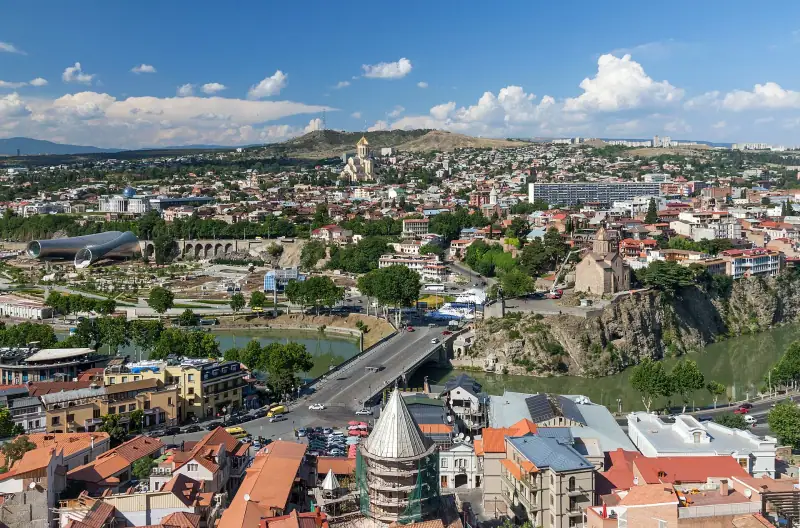
10 days
Georgia road trip: a 10-day route from Tbilisi to Svaneti
A 10-day Georgia road trip: Tbilisi, Kazbegi, Svaneti, Kutaisi and Kakheti. Detailed route, roads, places to stay and practical tips.
10 days
Georgia in 10 days without a car: a realistic itinerary by train and marshrutka
TbilisiKazbegiKutaisiMestiaBatumi
3 days
Batumi in 3 days: what to do on the Georgian Riviera
A practical guide to visiting Batumi in 3 days: beach, boulevard, old town, Botanical Garden, excursions in Adjara. Places to stay and tips.