What to see
Visiting Batumi: a complete guide to the pearl of the Black Sea
We may earn a commission when you book through links on this page, at no extra cost to you. We don't visit or try the places we cover: we summarize published sources. How we work
In short
- Two to three days cover Batumi's boulevard, botanical garden (about 20 GEL), old town and museums; a fourth day adds Gonio-Apsaros, the Acharistskali gorges or Borjomi.
- Beaches are black pebble; the water is warm in summer (22-26 °C / 72-79 °F in July-August). Quieter beaches are south, around Kvariati and Sarpi.
- From Tbilisi: train about 5 hours, marshrutka 5-6 hours (20-35 GEL), flight about 1 hour (BTM), or 370-390 km (230-242 mi) by car on the E60.
- Best months are June to September for the sea, May and October for fewer crowds; avoid November to March for beaches.
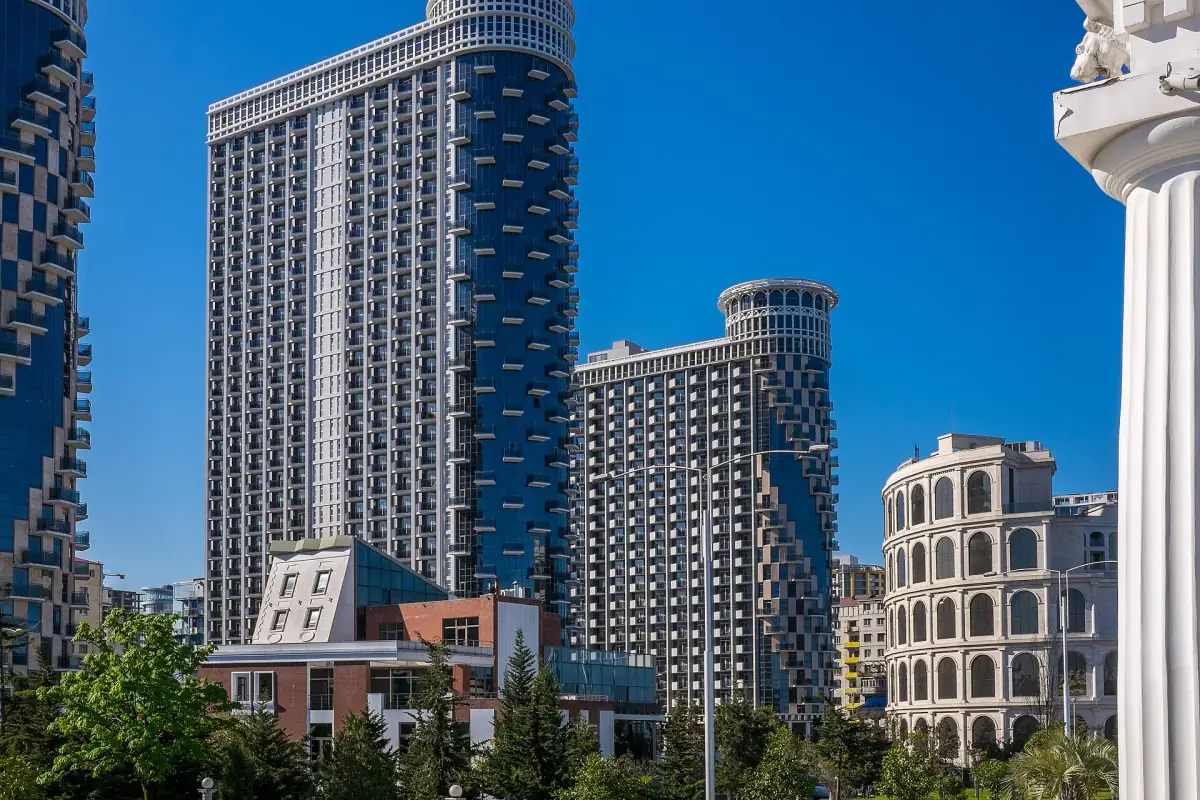
Between palm trees and the Black Sea, Batumi unrolls its boulevard over several kilometers in a surprising mix of architectural styles: 19th-century Art Nouveau buildings next to futuristic glass towers, old minarets beside ultramodern illuminated fountains. Capital of the autonomous region of Adjara, at the meeting point of East and West, Batumi is Georgia’s big beach city and one of the most surprising destinations in the Caucasus. Its subtropical easy living, generous Adjarian food, exceptional botanical garden and hybrid architecture make it a stop in its own right on any trip to Georgia, well beyond a simple beach detour.
Why visit Batumi?
Batumi both bewilders and charms. The city is neither historic Tbilisi nor wild Svaneti; it is something else: a cosmopolitan beach resort that boomed in the 2010s with a building spree of bold structures (the famous spiral Alphabet Tower, the moving Ali and Nino statue, the Radisson Blu with its minimalist blue glass facade) while keeping an old center with colorful houses and carved wooden balconies typical of Georgia.
The region of Adjara, to which Batumi belongs, has its own identity, shaped by centuries of Ottoman influence before being attached to Soviet Georgia in 1921. This particular history shows in the food (spicier, with Turkish influences), in the architecture of the old town, and in the general atmosphere of a city open to the sea and to the world.
In summer, Batumi attracts tourists from across the region (Armenia, Azerbaijan, Russia, Turkey, Europe), which gives it a festive, international energy quite unique in the Caucasus. Off season, the city regains real calm and is enjoyed differently, under the subtropical rain that feeds the lush vegetation of the surroundings.
The seaside boulevard: the heart of Batumi
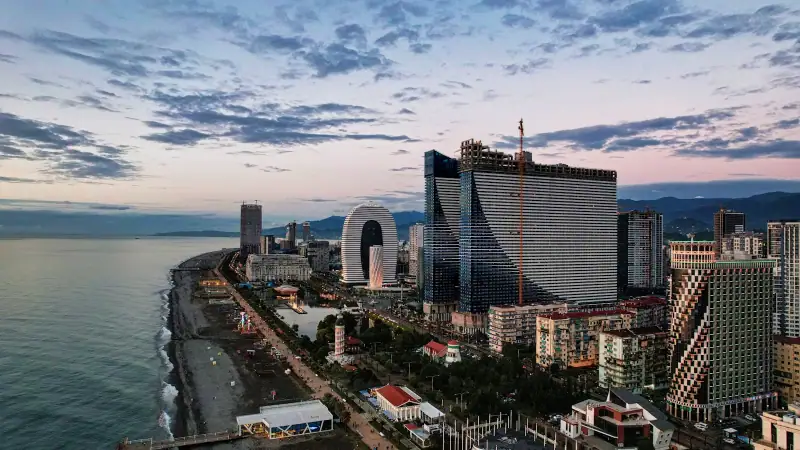
Batumi’s seaside boulevard, called Batumi Boulevard in Georgian, is the city’s showcase and its main gathering place. Several kilometers long, it runs along the Black Sea from the port to the northern beaches, lined with an avenue of palm trees, flower beds, fountains, sculptures and shaded benches that make it one of the most pleasant promenades in the Caucasus.
The promenade is divided into several distinct zones. The first boulevard (city-center side) holds the emblematic landmarks: the illuminated musical fountain that comes alive every evening, Miracle Park with its rides and attractions, the water park, cafe terraces and seaside restaurants. This is where the Ali and Nino statue, the Ferris wheel and the Alphabet Tower stand alongside century-old palm trees in a resolutely modern setting.
The second and third boulevards stretch farther north, offering a calmer atmosphere with gardens, contemporary sculptures and playgrounds. This part is popular with local families who come for an evening stroll in the sea breeze.
In the evening, the boulevard lights up and takes on another dimension: the musical fountains put on a show every hour, restaurants open their seaside terraces, and Batumi residents parade in a typically Georgian summer promenade. It is the best time to settle at a terrace, order an Adjarian khachapuri and watch the sun sink into the Black Sea.
Tip: the promenade is entirely flat and ideal by bike. Bike rental stations are available in season at several points on the boulevard (modest hourly rate). In the morning the boulevard is used by joggers and walkers; in the evening the whole city comes out for a stroll.
Batumi Botanical Garden
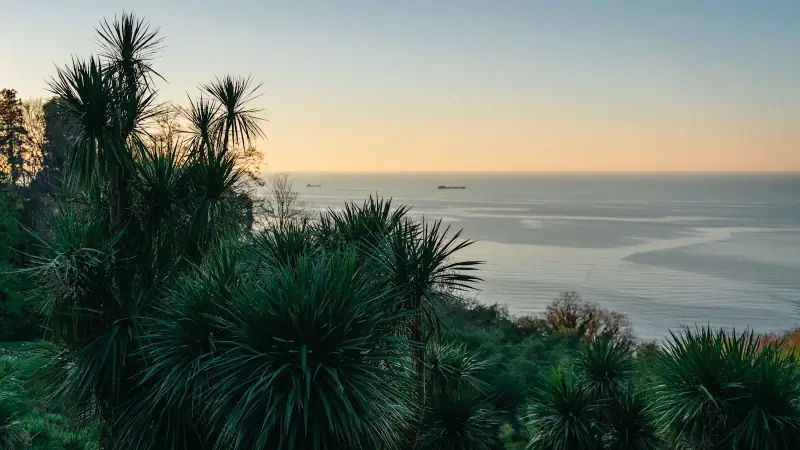
Batumi Botanical Garden is one of the largest and most beautiful in the Caucasus region. Founded in 1912 on the heights overlooking the Black Sea a few kilometers north of the city, it covers more than 100 hectares (250 acres) of subtropical and tropical vegetation arranged on terraces that descend toward the shore.
The plant collection is impressive: giant bamboo groves, century-old palms, camphor trees, magnolias, tree ferns, cacti, eucalyptus and climbing roses follow one another along well-marked paths. The Japanese section, the rose garden and the arboretum are among the most spectacular. At the end of the garden, a path descends to a small pebble beach reachable only by this trail, one of the most beautiful private beaches around Batumi.
The full visit takes 2 to 3 hours; bring good walking shoes because the terrain is hilly. Come preferably in the morning to avoid the heat and organized groups. The garden can be reached by marshrutka from the center of Batumi (line toward Makhinjauri), by taxi (about 10-15 GEL from the center) or by bike along the seafront.
Practical: open every day, roughly 9 am to 5:30 pm (indicative hours, check on visitajara.com). Admission: about 20 GEL per foreign adult.
Excursions from Batumi
Botanical garden, Acharistskali gorges, Gonio fortress: guided excursions from Batumi.
Batumi’s old town
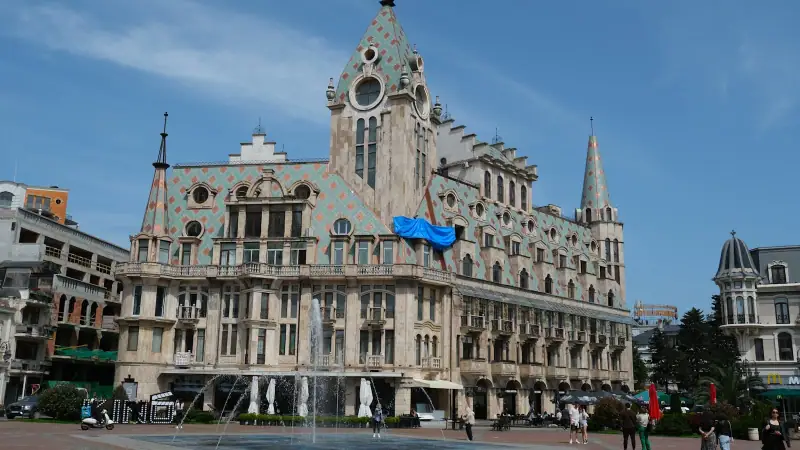
Batumi’s historic heart occupies a compact district inland, a few minutes’ walk from the seaside boulevard. This is where the city shows its most authentic face: houses with carved wooden balconies and colorful facades typical of Georgia, cobbled lanes shaded by vegetation, small inner courtyards recalling those of Tbilisi.
Europe Square (Evropis Moedani) is the lively center of the old town, with its cafe terraces, fountains and restaurants. Not far away, the Cathedral of the Mother of God, whose bell tower rises above the roofs, is Batumi’s main Orthodox religious monument. A few steps away, the Orta Mosque, built in the Ottoman period, recalls the centuries of Turkish influence on the region.
Batumi’s bazaar, set in a colorful market area, is a lively place to discover local products: Adjarian spices, western Georgian tea, homemade jams and pickles, textiles, souvenirs. A striking contrast with the hypermodern boulevard just steps away.
Tip: the old town can be explored on foot in two to three hours. In the evening, the lanes light up and the restaurants of Europe Square fill: the ideal time for a night stroll.
Places to stay in Batumi
Sea-view hotels, old town guesthouses, apartments with free cancellation: find where to sleep in Batumi.
The Ali and Nino statue and the Alphabet Tower
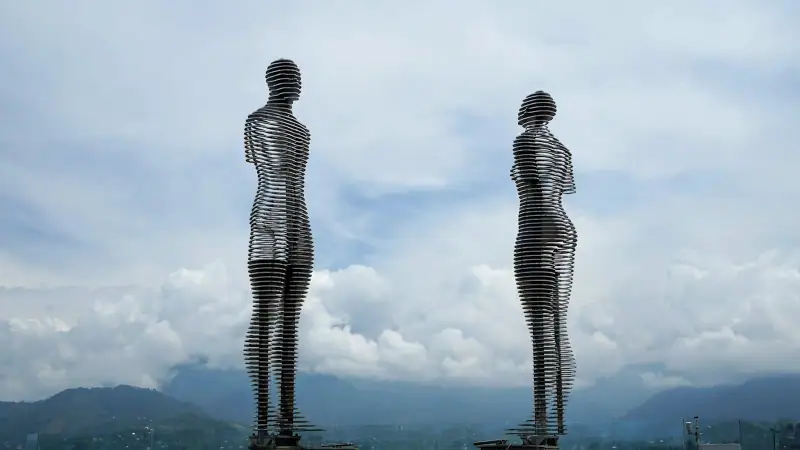
Two modern monuments have become the visual symbols of the new Batumi.
The Ali and Nino statue rises on the seaside promenade, at the entrance of Miracle Park. These two cut-steel sculptures, a man and a woman representing the characters of the famous Caucasian love novel of the same name, perform a poetic mechanical ballet of about ten minutes once each evening, during which they seem to move closer and merge into each other before separating again. The statue is about 8 meters (26 ft) tall and is one of the most remarkable kinetic art installations in the region. The view from this part of the boulevard, with the Black Sea as a backdrop, is especially beautiful at sunset.
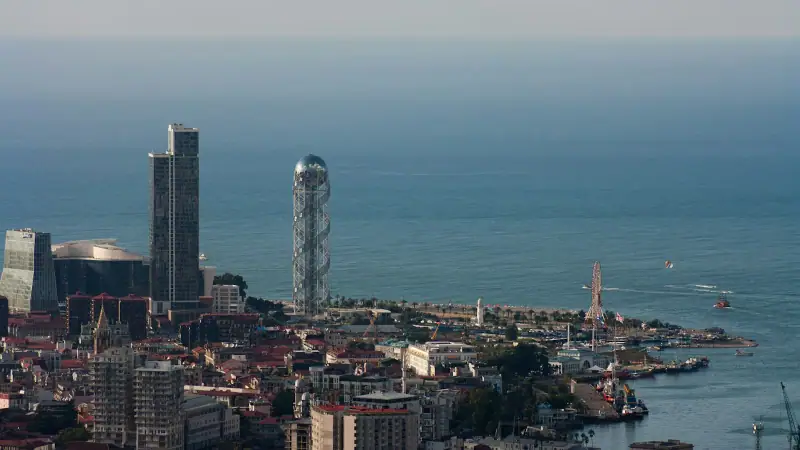
The Alphabet Tower (Batumi Alphabetic Tower) is the city’s other architectural curiosity: a spiral tower 130 meters (427 ft) tall whose facade is decorated with the 33 letters of the Georgian alphabet. At the top, a panoramic platform offers a 360° view of Batumi, the Black Sea and the green hills of Adjara. Elevators lead to the upper levels, where there are a cafe and a nightclub.
These two structures embody the policy of architectural modernization that transformed Batumi in the 2000s-2010s. They may divide aesthetic tastes, but they are part of the city’s urban landscape.
Batumi’s beaches
Batumi’s beaches are black volcanic pebble, typical of Georgia’s Black Sea coast. While they do not look like the fine-sand beaches of the Mediterranean, they have their own character: the water is clean, fairly warm in midsummer (22 to 26 °C / 72 to 79 °F from July to September), and the black pebbles absorb heat to offer a pleasant surface to lie on.
The city beach runs along the seaside boulevard for several kilometers, with many accesses from the promenade. Beach huts, sunbeds, umbrellas, showers and beach restaurants are available for a modest fee in season. Summer activity is at its peak: music, water activities, street vendors, sunbathing until nightfall.
For a calmer swim, it is better to move away from the center. To the south, the areas of Kvariati (about 15-17 km / 9-11 mi south of Batumi) and Sarpi (about 12-19 km / 7-12 mi, at the Turkish border) offer quieter beaches in a wild setting of green cliffs dropping into the sea. These beaches can be reached by marshrutka or taxi from Batumi.
Tip: pebbles can be hard to walk on barefoot for sensitive feet, so beach sandals are recommended. Sun-heated pebbles can also be hot underfoot.
Car rental in Batumi
Explore Adjara, the gorges and the mountain villages: rent a car at Batumi airport for more freedom.
Adjarian food: specialties to try
Adjarian cuisine is one of the most flavorful in Georgia, distinguished by Ottoman influences and Black Sea produce that give it its own identity. Here are the dishes to taste during your stay in Batumi.
Adjarian khachapuri is the pride of the region and one of the most emblematic dishes in Georgia. Unlike the classic closed khachapuri (a disc of bread stuffed with cheese), Adjarian khachapuri takes the shape of an open bread boat filled with melted cheese (sulguni), with an egg cracked on top and a knob of butter. You eat it by dipping the edges of the bread into the melting filling, a hearty, indulgent pleasure that illustrates Georgian cuisine wonderfully. Every restaurant serves it, and every family has a slightly different recipe.
Ajapsandali is a vegetable stew (peppers, tomatoes, eggplant, potatoes, onions) spiced with garlic and fresh cilantro. Served as a vegetarian main dish or a side, it is especially tasty in summer, when the vegetables are full of sun.
Mtsvadi and kupati (skewers of meat such as pork, beef or lamb, and grilled sausages) are enjoyed in the beach restaurants and summer gardens along the seafront. The atmosphere of these terrace restaurants, with the sea breeze and the sound of waves on the pebbles, is one of the most pleasant experiences in Batumi.
Georgian tea deserves a special mention: Batumi and the Adjara region are at the heart of the Georgian tea-growing zone, whose terraced plantations cover the green hillsides around the city. Local tea, often sold loose in markets, is an authentic souvenir to bring back.
Tropical fruits grown in the region (lemons, oranges, tangerines, kiwis, hazelnuts) are bought at the market at very affordable prices. Homemade preserves and jams (blackberry, plum, fig) also make excellent gifts.
Excursions from Batumi
Batumi’s geographic position, between sea and mountains, allows many half-day or full-day excursions in a region of great natural richness.
Gonio-Apsaros Fortress is about fifteen kilometers (9 mi) south of Batumi, reachable by marshrutka or taxi. It is one of the best-preserved Roman fortresses in the Caucasus, dating from the 1st-2nd century AD. Its rectangular walls enclose an archaeological complex that includes Roman baths and a necropolis. Local legend held that Jason and the Argonauts passed through here on their quest for the Golden Fleece: history meets myth in this ancient region at the eastern edge of the Greek world.
The Acharistskali gorges are reachable in about 45 minutes by road from Batumi. The Acharistskali River, which descends from the highlands of Adjara, has carved deep, green gorges whose beauty contrasts radically with Batumi’s urban seafront. The Adjara valley (inner Adjara) reveals superb mountain villages, temperate forests and viewpoints over the ranges that separate Georgia from neighboring Turkey.
Kobuleti, about twenty kilometers (12 mi) north of Batumi, is a more family-oriented beach resort with long beaches and a more relaxed atmosphere. A pleasant stop if you want to explore the coast beyond Batumi.
How to get to Batumi
By train (recommended for the experience): Georgian Railway links Tbilisi to Batumi with modern trains (Stadler). The trip takes about 5 hours. Schedules, classes and the existence of a night departure change with the season: check the Georgian Railway website (railway.ge), where tickets are also bought.
By marshrutka: from Didube bus station in Tbilisi, marshrutkas leave regularly for Batumi throughout the day (about 5 to 6 hours, 25-35 GEL). It is the cheapest and most frequent way. Marshrutkas also leave from Kutaisi (about 3 hours; 2 h 30 to 3 h 30 depending on traffic).
By air: Batumi International Airport (IATA: BTM) is served from Tbilisi by domestic flights (about 1 hour), as well as from several European cities in season. Direct links with Europe are limited and vary by season; most travelers go through Tbilisi or Kutaisi (low-cost flights). Check connections with the airlines for your starting point.
By car: from Tbilisi, the E60 highway links the two cities in about 5 to 6 hours (about 370-390 km / 230-242 mi). The road crosses varied landscapes, from the plains of Kartli to the gorges of western Georgia. With a rental car, Batumi is the logical end of a road trip in Georgia.
Where to stay in Batumi
Batumi offers a very wide range of accommodation, from budget guesthouses to luxury hotels with Black Sea views. See our complete guide on where to stay in Batumi for recommendations by neighborhood and budget.
Sea view and boulevard: the seaside boulevard area has the most modern and most expensive hotels, with Black Sea views. It is the liveliest location, ideal for partygoers and fans of summer atmosphere. Allow 100 to 300 GEL or more a night for a double room in season.
Old town: calmer and more authentic, the old town has lovely guesthouses in restored houses. The atmosphere is more Georgian, with often welcoming owners and good homemade breakfasts. Rates: 60 to 150 GEL a night.
Budget: hostels and apartments to rent (Airbnb) offer lower rates (25 to 50 GEL in a dorm).
Flights to Batumi
Compare flights to Batumi International Airport (BTM) from major European cities.
Budget for a stay in Batumi
| Item | Indicative budget |
|---|---|
| Guesthouse (night) | 60-150 GEL/person |
| 3-4 star hotel | 120-300 GEL/night |
| Restaurant meal | 20-45 GEL/person |
| Adjarian khachapuri | 10-18 GEL |
| Botanical garden entrance | about 20 GEL |
| Taxi in town | 5-10 GEL |
| Batumi-Tbilisi marshrutka | 25-35 GEL |
| Tbilisi-Batumi train | 30-80 GEL (depending on class) |
Average daily budget: 80 to 180 GEL per person depending on travel style. Batumi is slightly more expensive than the Georgian average in high season (July-August), especially for sea-view accommodation.
Batumi in a Georgia itinerary
Batumi is the natural end of a 7 to 10-day circuit in Georgia. The classic sequence goes from Tbilisi (starting base) to Kazbegi or Svaneti for the mountains, then down to Kutaisi and ends in Batumi for a few days of seaside relaxation.
Batumi can also be the start or end point of a trip if you have direct flights from your city. It combines perfectly with discovering Adjara, a region that deserves much more than a simple beach stop.
Practical tips for visiting Batumi
Getting around town: Batumi has local marshrutkas, buses and taxis. For taxis, use an app (Bolt or Yandex Go) to avoid the inflated prices charged to tourists. The seaside boulevard is entirely walkable and pleasant by bike (rental available on the seafront in season).
Money and ATMs: many ATMs (Bank of Georgia, TBC Bank) line the boulevard and the old town. Hotels and restaurants generally accept bank cards, but keep cash for markets and transport.
Best time: June to September for the sea and beach-resort atmosphere. May and October for lower prices and fewer people. Avoid November to March if you come for the beaches (frequent rain and cold sea).
Language: English is increasingly common in Batumi, especially in tourist hotels and restaurants. Russian remains useful with older generations. Georgian is appreciated, though a few basic words are enough.
Safety: Batumi is a very safe city. Stay alert at night on the boulevard in high season (dense crowds) and watch your belongings at cafe terraces. No particular areas to avoid for tourists.
Phone: Georgian operators (Magti, Silknet, Cellfie) offer tourist SIM cards with data at very competitive rates, available at the airport or in downtown shops. You can also check your carrier’s international plan or use a travel eSIM.
Batumi is the city of successful contrasts: between Ottoman heritage and unbridled futurism, between the Black Sea and subtropical forests, between summer activity and the tranquility of the Adjarian hinterland. It embodies something particular in the Georgian landscape: an opening to the sea and to the world that stands out from the mountain isolation of the rest of the country, and gives Georgia a seaside dimension often overlooked. A stop worth making on any complete tour of the Caucasus.
Frequently asked questions
How do you get to Batumi from Tbilisi?
Three main options: the train from Tbilisi station (about 5 hours; check schedules and whether a night departure exists on railway.ge), the marshrutka from Didube bus station (about 5 to 6 hours, 20-25 GEL), or a flight from Tbilisi airport to Batumi airport (IATA BTM, about 1 hour of flight). By car, allow about 370-390 km (230-242 mi) via the E60 highway, or 5 to 6 hours depending on traffic.
What is the best time to visit Batumi?
June to September to enjoy the beaches and the Black Sea: Batumi has a humid subtropical climate with hot summers (25-32 °C / 77-90 °F). July and August are the busiest months, with a lively beach-resort atmosphere but also more people and higher prices. May and June offer a good balance between pleasant temperatures and moderate crowds. In fall (October), the city is quieter and rain is frequent, but the region's landscapes remain magnificent.
Are there good beaches in Batumi?
Batumi's beaches are black pebble, typical of the Georgian Black Sea. They do not look like fine-sand Mediterranean beaches, but the water is clean and warm in summer (22-26 °C / 72-79 °F in July-August). The city beach runs along the boulevard for several kilometers. Quieter beaches lie a few kilometers south of town, especially toward Kvariati and Sarpi, preferred by families.
How many days do you need to visit Batumi?
Two to three days are enough to explore Batumi's main sights: seaside boulevard, botanical garden, old town, museums. With a fourth day, you can add an excursion in the region (Gonio-Apsaros, Acharistskali gorges, the Adjara valley). If you just want a beach stop at the end of a Georgia circuit, two days are sufficient.
Is Batumi safe for tourists?
Batumi is a very safe destination for tourists. Crime is low and the city is used to foreign visitors, especially in summer. As in any tourist destination, stay alert in very busy areas (boulevard, seafront) and watch your belongings on public transport. Public transport (marshrutkas, taxis) is reliable; use a taxi app (Bolt or Yandex Go) to avoid inflated prices.
Can you take excursions from Batumi?
Absolutely. The immediate surroundings of Batumi offer great possibilities: Gonio-Apsaros fortress (about 15-20 km / 9-12 mi south), the Acharistskali gorges and the Adjara canyon (less than an hour from Batumi), and the spa town of Borjomi (about 3 hours by road). The Turkish border at Sarpi is 30 km (19 mi) south, and some travelers even do a day trip to Trabzon. To the north, Kobuleti is a pleasant beach resort about twenty kilometers (12 mi) away.
More Georgia guides
Keep reading
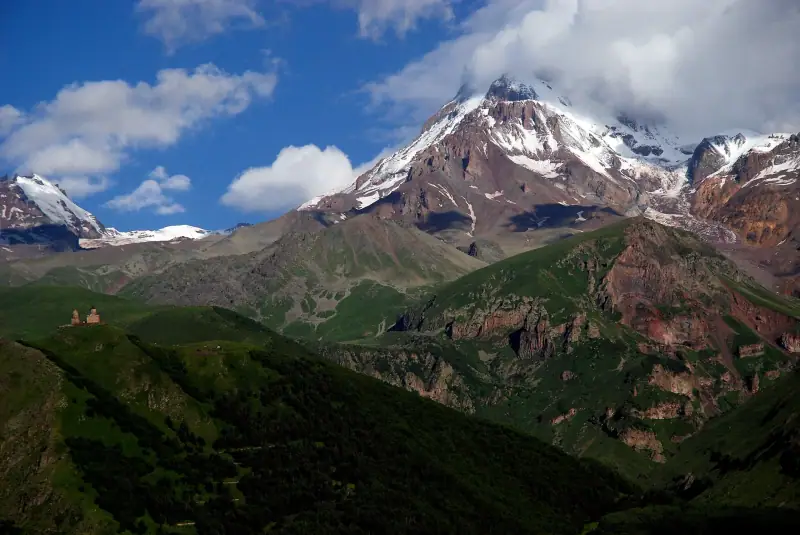
Visiting Kazbegi (Stepantsminda): a complete guide to the roof of the Caucasus
Kazbegi: Gergeti church at 2,170 m, Mount Kazbek at 5,054 m, hikes and the Georgian Military Road. A complete guide to plan your stay in Stepantsminda.
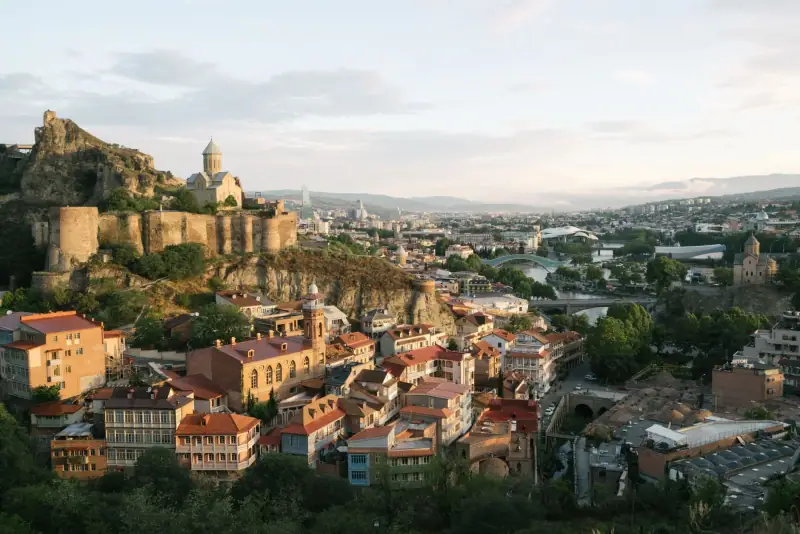
Tbilisi: the 15 must-see sights
Old town, Narikala Fortress, sulfur baths, Sameba Cathedral: the 15 must-see sights in Tbilisi.
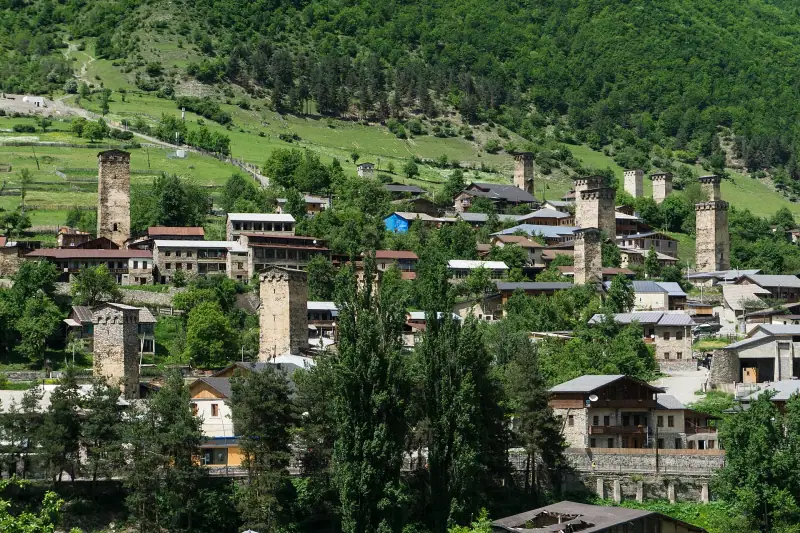
Visiting Mestia and Svaneti: a complete guide to the roof of the Caucasus
Mestia and Svaneti, Georgia: UNESCO Svan towers, the trek to Ushguli, glaciers and epic hikes. A complete guide to plan your stay.
Ready-made
Georgia itineraries
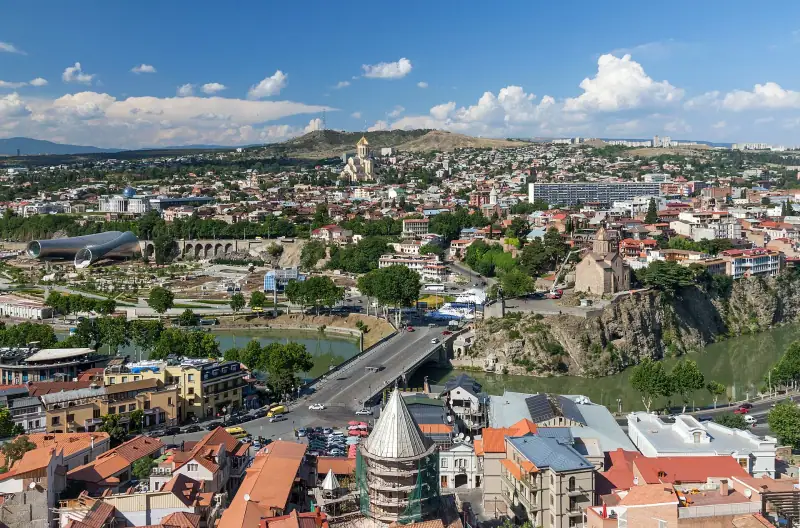
10 days
Georgia road trip: a 10-day route from Tbilisi to Svaneti
A 10-day Georgia road trip: Tbilisi, Kazbegi, Svaneti, Kutaisi and Kakheti. Detailed route, roads, places to stay and practical tips.
10 days
Georgia in 10 days without a car: a realistic itinerary by train and marshrutka
TbilisiKazbegiKutaisiMestiaBatumi
3 days
Batumi in 3 days: what to do on the Georgian Riviera
A practical guide to visiting Batumi in 3 days: beach, boulevard, old town, Botanical Garden, excursions in Adjara. Places to stay and tips.