Things to do
Canoeing the Dordogne: A Guide to Paddling the River
We may earn a commission when you book through links on this page, at no extra cost to you. We don't visit or try the places we cover: we summarize published sources. How we work
In short
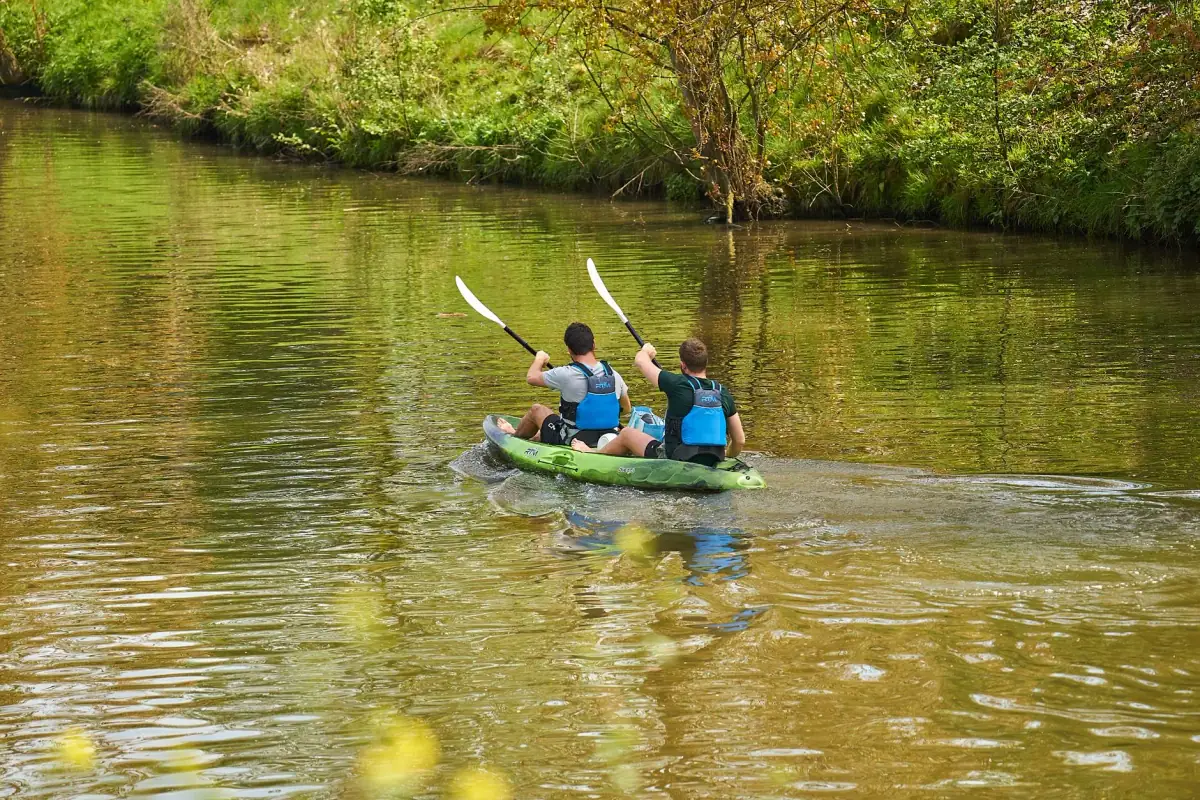
- Canoeing the Dordogne suits almost everyone: the current is moderate on the busiest stretches, and operators supply canoe, paddles, life jacket and a waterproof bag.
- The stretch between Domme, La Roque-Gageac, Castelnaud and Beynac is the most spectacular and the busiest; leave early in summer.
- The season runs from spring to late summer, with a peak in July and August; June and early September are good compromises. Most operators close from October.
- Book in July and August, ask what is included (shuttle back, gear) and allow a margin on the duration.
Canoeing down the Dordogne is one of the great classics of a stay in the Black Périgord. You glide along the water under limestone cliffs, pass the foot of stone villages clinging to the rock, glimpse châteaux perched on their promontory, and stop on a gravel bar for a picnic. It is an activity within reach of almost everyone: families, couples, groups of friends, beginners. This guide helps you choose your route, the right time, your gear and avoid common mistakes.
Why the Dordogne is ideal for canoeing
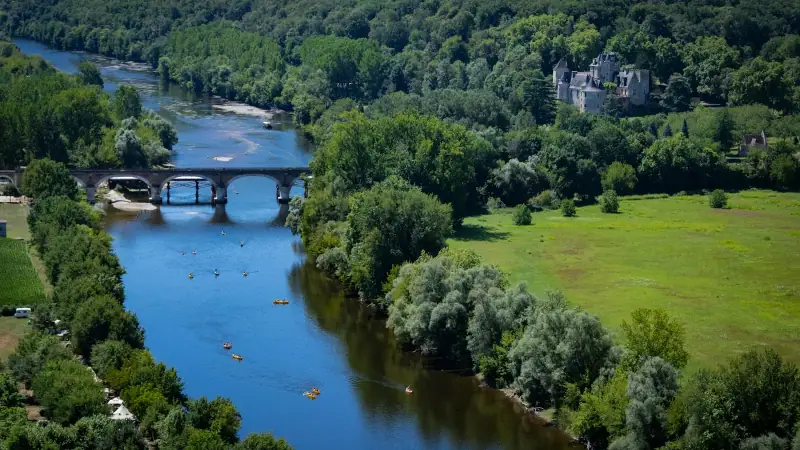
The Dordogne river crosses several regions before reaching the Gironde estuary. Through the Black Périgord, it unrolls wide, peaceful meanders lined with cliffs, meadows and forests. The current is most often moderate, with no major technical difficulties, which explains this stretch’s success with beginners.
Three assets make the area’s reputation:
- The landscapes: the river is the thread through a succession of listed sites, with villages and châteaux visible from the water, an angle you do not get from the road.
- Ease: no experience needed. Operators give you a canoe, paddles, a life jacket and a few basic instructions before departure.
- Logistics: many operators offer a return to the starting point by shuttle, which lets you descend in a straight line rather than make a round trip.
If you are discovering the region, fit the descent into your stay by combining it with valley visits. Our 3-day Dordogne itinerary offers a day devoted to the Dordogne valley, very easy to adapt to slip in a canoe descent.
Where to start: the most popular sectors
The river is long and several stretches suit canoeing. The busiest sectors are around Sarlat, between a few of the valley’s best-known villages. Here are the landmarks to know.
Between Domme, La Roque-Gageac and Beynac
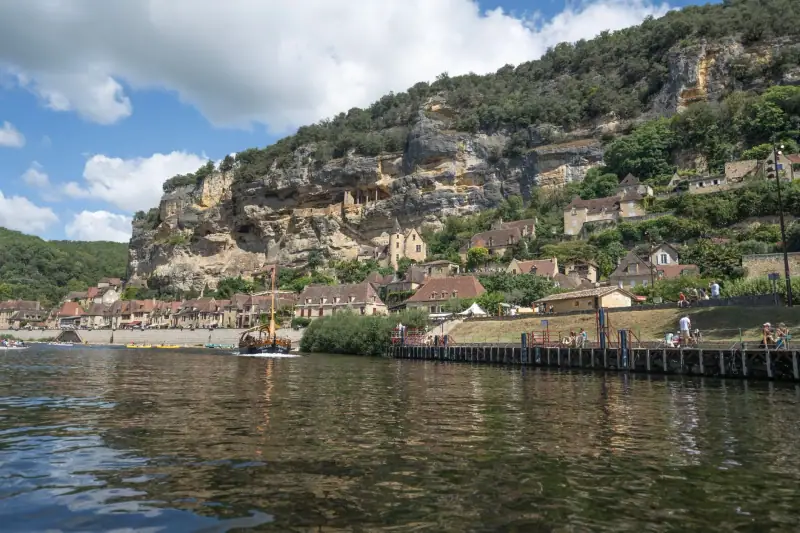
This is the historic heart of the descent. The river first passes the foot of Domme, a bastide perched on a cliff overlooking the valley. It then runs alongside La Roque-Gageac, ranked among the most beautiful villages of France, whose houses seem glued to the rock. Further on, you glimpse the châteaux of Castelnaud and Beynac, facing each other across the river.
This sector is the most spectacular: if you only do one descent, it is generally this one. It is also the busiest in summer, which is why an early start is worthwhile.
Around Vitrac and Castelnaud
Shorter routes, of a few kilometers, suit families with young children well. They let you get started without spending the whole day, and keep time to visit a château or garden in the afternoon. Operators generally offer several durations, from a short half day to a full day.
The Vézère, a wilder alternative
If you prefer a calmer setting, the Vézère, which crosses the prehistoric valley between Montignac and Les Eyzies, also offers canoe descents. The mood is more intimate, with wooded banks and rock shelters visible from the water. It is a good option if you want to combine nature and prehistory without joining the crowd at the most famous sites.
In any case, ask the operator to explain the start and end points, the estimated paddling time and any passages to watch. Information changes with the years and the water level, and the operator knows the state of the river best.
Water activities on the Dordogne
Canoe, traditional boat rides, family excursions: compare the activities offered in the Dordogne valley.
Choosing your duration and level
The choice of route depends on your fitness, the age of participants and the time you have. A few general pointers apply to all operators.
For a first experience with young children: choose a short route, about one to two hours of paddling. You avoid fatigue and end-of-route tantrums, and can stop on a gravel beach to play.
For a group of beginners or a family with teens: half a day is the right format. Allow for the paddling time and the breaks, since people gladly stop to swim or admire a château.
For the more athletic: the longest routes take a whole day. They require regular paddling and suit those used to effort. Bring a proper picnic and plenty of water.
In all cases, actual duration depends on current, wind and your pace. Operators give an estimate: take it as a range and allow a margin, especially if you must reach a booking afterward, for example a château or cave visit.
Canoe or kayak?
You will generally be offered two types of craft. The canoe seats two or three, stable and roomy: the choice of families and groups. The kayak, more individual and maneuverable, suits those who want to paddle at their own pace. For a first descent, the canoe is the most reassuring choice.
When to go: the best period
The canoe season in the valley runs roughly from spring to late summer. Each period has its advantages.
- April to June: nature is green, the river is often livelier from spring floods, and crowds remain moderate. Check water level and conditions with the operator, since high flow can change the activity.
- July and August: high season, with a warm river, pleasant gravel beaches and many people. Book, leave early in the morning and avoid mid-afternoon slots, often the most crowded.
- September: a popular period, with air temperatures still mild, fewer people and superb light on the cliffs. It is an excellent time if you can choose your dates.
- October to March: most operators are closed. If you come out of season, turn to other activities, such as hiking or visiting prehistoric sites.
A good habit: check the weather forecast the day before. A storm or strong wind can make the descent less pleasant, or even force a postponement. Operators are used to these adjustments and will give you honest advice.
What to bring
A canoe descent takes some preparation, but no sophisticated gear. Here are the essentials.
On you:
- a swimsuit, with spare clothes left in the car;
- shoes that stay on your feet and can get wet (closed sandals or water shoes), since banks are sometimes stony;
- a hat or cap, glasses with a strap and water-resistant sunscreen.
In the waterproof drum (generally provided by the operator):
- phone, car keys and papers;
- at least one bottle of water per person, and snacks;
- a small picnic if you go for the day.
To leave behind: valuables, non-waterproof cameras and anything you could not bear to lose. If you want to film, favor a camera or phone in a waterproof pouch attached to you.
For the picnic, turn to local products. Our guide to Périgord food specialties helps you put together a tasty basket: walnuts, cheeses, cured meats and seasonal fruit travel very well.
Safety: the rules to know
Descending the Dordogne is reputed to be calm, but a river is still a river. A few common-sense rules are enough to have an excellent time.
- Always wear the life jacket, even if you swim well. It is mandatory and provided by the operator.
- Listen to the briefing before departure. It tells you how to hold the paddle, how to behave if you fall in and which passages to watch.
- Stay together and do not stray from other craft, especially with children.
- Avoid stronger-current areas the operator points out, as well as the surroundings of obstacles (fallen trees, bridge piers, weirs).
- Do not stand up in the canoe and distribute the weight well.
- Drink regularly and protect yourself from the sun: on the water, heat and glare are more intense than you think.
- Watch the weather: in a storm, leave the river and take shelter.
Finally, respect the place. Leave no trash on the gravel beaches, do not disturb wildlife and respect riverside properties. The river is a space shared with anglers, swimmers and residents.
Stay near the river
Sarlat and the neighboring villages are the best bases for descending the Dordogne. Compare hotels, B&Bs and cottages in the Black Périgord.
Canoeing with the family
The Dordogne valley is one of France’s favorite family destinations, and canoeing is one of its high points. To make the day go well, a few tips.
- Choose a route suited to the youngest’s age. A route that is too long can quickly become a chore. Better to start short and enjoy the breaks.
- Check the minimum age the operator requires and the availability of life jackets in your children’s sizes. This varies from one provider to another.
- Distribute the crews: one adult and one child per craft, or one adult for two children in a three-seat canoe, according to the operator’s rules.
- Bring beach games: gravel bars are perfect for supervised swimming, a pebble hunt or a picnic.
- Leave early: children are fresher in the morning, and the river is calmer.
For families who want variety, a gabarre ride, the traditional flat-bottomed boat, offers a gentler way to see the river. It suits toddlers, grandparents and those who prefer not to paddle.
Organizing your day: transport, logistics, combinations
A canoe descent is organized like a full day. Here are the practical points to anticipate.
Getting to the start. Most operators are on the riverbank, in the valley’s villages. The simplest way to get there is by car, since public transport is limited outside the large towns. If you have no vehicle, compare rental offers or ask about organized excursions with transport.
The return. Many operators offer a shuttle return or a pickup at the finish, sometimes included in the price. Ask when you book: it is the key to a stress-free day.
Combining with a visit. Do not try to do everything on the same day. After a descent, fatigue sets in. Ideally, plan a light afternoon visit, such as a village to walk or a garden, rather than a cave with a fixed time.
Where to eat. Picnic on a gravel bar, or plan lunch at the finish, in a village of the valley. In season, terraces are often full: arriving before the rush avoids waiting.
If you rent a vehicle for your stay, compare offers ahead: the Dordogne valley is best visited with a car, which also gives you the freedom to reach the starting points at your own pace.
Budget: how much to plan
Prices vary with the operator, duration, season and type of craft. Rather than give figures that change every year, here is how to reason.
- The price is generally calculated per craft or per person, and depends on the route length. A short route costs less than a full-day descent.
- Families sometimes get child rates or group packages. Ask.
- The shuttle return is sometimes included, sometimes charged separately. Compare with this in mind.
- The waterproof drum and life jackets are generally included in the price.
- High season is the most expensive and in demand. Booking early lets you choose your slot.
To compare, ask each operator what is included (gear, shuttle, insurance) rather than relying on the base price alone. A seemingly more expensive offer with transport included can cost less in total.
Other ways to enjoy the river
If you do not want to paddle, or want to round out your stay, the valley offers other water-based activities.
- A gabarre ride, the traditional flat-bottomed boat, from La Roque-Gageac and Beynac. It is a calm way to see the cliffs and châteaux, with commentary on the river’s history.
- Swimming, on the river’s gravel beaches. Ask about supervised areas and local safety instructions.
- Hiking along the river and on the cliffs, with superb viewpoints over the valley.
- Cycling: some stretches of the valley suit bike rides, between villages and meadows.
Gabarre ride on the Dordogne
To see the valley from the water without paddling, compare the traditional boat rides offered in the valley.
The essentials
- Canoeing down the Dordogne is accessible to almost everyone, with a moderate current on the busiest routes.
- The sector between Domme, La Roque-Gageac, Castelnaud and Beynac is the most spectacular, but also the busiest.
- The season runs from spring to late summer: June and September are excellent compromises between weather and crowds.
- Always wear your life jacket, listen to the operator’s briefing and protect yourself from the sun.
- Book in July and August, ask what is included (shuttle, gear) and leave early in the morning.
- Do not overload the day: one descent, a picnic and a light visit are plenty.
With a little preparation, descending the Dordogne becomes one of the most memorable parts of a stay in the Périgord. To build the rest of your trip, see our 3-day Dordogne itinerary and our guide to Périgord specialties.
Frequently asked questions
Do you need to know how to swim to canoe in the Dordogne?
Wearing a life jacket is mandatory and operators provide it, but knowing how to swim is strongly recommended, especially for children. Operators generally ask for a certificate or a declaration on this point, notably for minors. Ask when you book.
What is the best time to canoe down the Dordogne?
The season runs roughly from April-May to September, with a peak in July-August. For a calmer river and fewer people, June and early September are often excellent compromises. In summer, leave early in the morning to avoid the crowd and the afternoon heat.
Is canoeing suitable for children?
Yes, it is one of the valley's flagship family activities, since the current is generally gentle on the busiest routes. Each operator sets a minimum age and a minimum weight for the life jacket: check before you come. Choose a short route for a first experience with young children.
Do you need to book in advance?
In July and August it is better to book, especially for weekends and morning slots. Out of season you can often walk up to an operator, but a phone call the day before avoids bad surprises, notably if the water level is unusual.
How do you get back to the starting point after the descent?
Most operators organize a minibus return or a shuttle to the starting point, sometimes included in the price. Check when you book: this is what makes a one-way descent so practical, without having to manage two cars.
What should you bring for a canoe descent?
A swimsuit, shoes that stay on your feet and can get wet, sunscreen, a hat, water and a snack. Operators generally provide a drum or waterproof bag to protect phone, keys and papers. Leave valuables behind.
Can you canoe on the Dordogne in fall or winter?
The activity is mostly seasonal: most operators close in fall, when the water cools and flows can vary. If you come out of season, favor a traditional boat ride or a hike along the river, and check openings with the tourist office.
More Dordogne guides
Keep reading
Rouffignac Cave: Train Visit, Prices, Booking and Opening Dates
Rouffignac Cave: prices, hours, booking (5 weeks ahead), length of the electric train ride and closure until March 28, 2027. Tips for families.
Châteaux of the Dordogne Valley: Beynac, Castelnaud, Marqueyssac and More
Beynac, Castelnaud, Les Milandes, Marqueyssac gardens: how to plan visits to the châteaux of the Dordogne valley, what to pick and in what order.

Proumeyssac Chasm: Prices, Hours, Booking and the Gondola Descent
Proumeyssac Chasm at Audrix: 2026 prices, hours by season, booking, gondola, strollers, dogs and tips for visiting without a wait.
Ready-made
Dordogne itineraries
7 days
One Week in the Dordogne: A Day-by-Day Itinerary
Sarlat-la-CanédaBrantômeBergerac
5 days
Dordogne in 5 Days with Kids: Stops, Kilometers and a Realistic Pace
Dordogne in 5 days with kids: an itinerary from Sarlat with distances, drive times, breaks and suitable activities, without overloaded days.
Can be adapted in the planner
3 days
3-Day Dordogne Itinerary: Sarlat, the Vézère and Châteaux
What to do in 3 days in the Dordogne? A day-by-day itinerary around Sarlat: Lascaux, the Vézère Valley, châteaux, villages and practical tips.
Can be adapted in the planner