Itineraries
3-Day Dordogne Itinerary: Sarlat, the Vézère and Châteaux
We may earn a commission when you book through links on this page, at no extra cost to you. We don't visit or try the places we cover: we summarize published sources. How we work
Day by day
- Day 1Sarlat-la-Canéda: medieval old town and market
- Day 2Lascaux IV in Montignac, then Les Eyzies
- Day 3Domme, La Roque-Gageac, Beynac or Castelnaud, Marqueyssac gardens
Where to sleep
- Sarlat-la-Canéda3 nights
Opens the trip planner with these stops and nights already filled in. Add a stop, drop one or change the nights.
Weather through the year on this route
| Jan | Feb | Mar | Apr | May | Jun | Jul | Aug | Sep | Oct | Nov | Dec | |
|---|---|---|---|---|---|---|---|---|---|---|---|---|
| High °F (°C) | 468 | 5010 | 5714 | 6116 | 6820 | 7524 | 8127 | 8228 | 7524 | 6619 | 5412 | 489 |
| Low °F (°C) | 341 | 341 | 373 | 436 | 489 | 5513 | 5915 | 5915 | 5412 | 489 | 394 | 362 |
| Rain in (mm) | 2.870 | 2.255 | 2.460 | 3.180 | 3.180 | 2.870 | 2.050 | 2.460 | 2.870 | 2.870 | 3.180 | 3.075 |
Normals 1991–2020 at Sarlat-la-Canéda: averages over 30 years, not a forecast. Source: NASA POWER (MERRA-2), grid of about 50 km. Figures computed by us in November 2026.
In short
- Three nights in Sarlat cover the Black Périgord: almost every stop is within 30 minutes of the town by road.
- Day 1 is the medieval town, day 2 Lascaux IV and the Vézère Valley (Les Eyzies), day 3 Domme, La Roque-Gageac, Beynac, Castelnaud and the Marqueyssac gardens.
- A car is strongly recommended; book Lascaux IV, the caves and the rental car ahead, especially from May to September.
- Spring and fall are the best seasons to avoid the crowds; July and August are very busy.
The Dordogne is a département that has to be earned: golden-stone villages, châteaux perched on cliffs, caves decorated by prehistoric peoples and a lazy river winding between walnut trees. The problem, when you prepare your trip, is choosing. This three-day itinerary is built around the Black Périgord, the tourist heart of the region, with Sarlat-la-Canéda as the home base. Each day has a theme (medieval town, prehistory, châteaux and river), short drives and a reasonable pace.
Before you go: the principle of the itinerary
The Black Périgord is compact. Sarlat sits at the center of a triangle whose three points are the Vézère Valley (to the northwest), the Dordogne valley (to the south) and perched villages like Domme. Almost every stop is less than 30 minutes by road from Sarlat, which lets you sleep in the same place for three nights and never unpack twice.
Here is the plan at a glance:
| Day | Theme | Main stops |
|---|---|---|
| Day 1 | The medieval town | Sarlat-la-Canéda, lanes, market, first local meal |
| Day 2 | Prehistory | Montignac and Lascaux, Les Eyzies, Vézère Valley |
| Day 3 | The river and châteaux | Domme, La Roque-Gageac, Beynac, Castelnaud, Marqueyssac gardens |
A simple rule: do not try to see everything. It is better to visit two or three sites in depth a day than to string together six at a run. If you are short on time, keep at least one “indoor” monument (cave, château) and one moment of strolling each day.
Day 1: Sarlat-la-Canéda, the medieval town
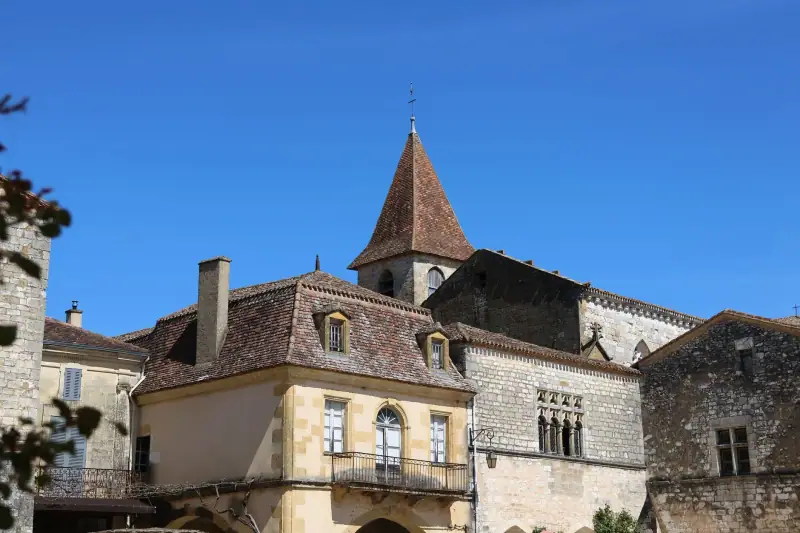
Sarlat is the great postcard of the département. Its historic center, with ochre stone mansions, narrow lanes and lauze roofs, is one of the best preserved in France. Start the day early: before 10 am the lanes are almost empty and the light on the stone is magnificent.
Morning: the old town on foot
Leave the car in one of the car parks on the edge of the pedestrian center, then enter by Rue de la République or follow the signs toward the historic heart. A few landmarks not to miss:
- The Place du Peyrou and Saint-Sacerdos Cathedral, in the heart of the town.
- The Place de la Liberté, surrounded by fine facades, which hosts the markets.
- The Lanterne des Morts, a curious medieval stone tower near the cathedral.
- The side lanes (around Rue des Consuls especially) where mansions and inner courtyards hide.
Allow about two to three hours for a relaxed walk with stops. If you are there on a Saturday morning, the big market is a highlight: local produce, stalls of fruit, cheese and duck. Check market days and hours with the tourist office before you come.
Lunch: taste without breaking the bank
Sarlat’s most touristy streets are not always the best for eating. Favor short menus listing seasonal products, and the midday set menu, often cheaper than dinner. To know what to order and how to recognize good products, see our guide to Périgord food specialties.
Stay in Sarlat for 3 nights
Sarlat is the ideal base for this itinerary. Compare hotels, B&Bs and cottages for three nights in the Black Périgord.
Afternoon: stroll and unwind
After lunch, slow down. Go back to the squares for a coffee, push open the door of a local-product shop, or climb to the heights of the town for an overview of the roofs. At the end of the day, golden light on the stone is one of the town’s finest moments. If you have energy, a themed guided tour (history, architecture) offered by the tourist office or local guides adds to your understanding.
Evening: dinner in a restaurant in the center or in a neighboring village. In summer, on certain evenings, night markets and events set up in the region. Ask locally.
Day 2: Lascaux and the Vézère Valley, cradle of prehistory
The Vézère Valley, a UNESCO World Heritage Site, concentrates an exceptional number of prehistoric sites. This is the day you go back some twenty thousand years. Plan to leave Sarlat fairly early, since visits run at set times.
Morning: Montignac and Lascaux IV
From Sarlat, Montignac-Lascaux is about 25 kilometers (16 mi) away, half an hour by road. The Lascaux cave, discovered in 1940, has been closed to the public since 1963 to protect its paintings. It is Lascaux IV, the International Center for Cave Art, that welcomes visitors: a complete replica of the cave, made with remarkable precision, with a museum route.
A few tips for this visit:
- Book ahead, particularly in high season. Slots fill quickly.
- Allow about two hours there, between the guided visit of the cave and the exhibition space.
- Dress warmly: the inside of the replica is kept at a low temperature to reproduce the cave’s conditions.
After the visit, go on to the center of Montignac, beside the Vézère, for a coffee break or a simple lunch.
Guided visits and activities in the Dordogne
Discover the guided visits, excursions and experiences offered in the Périgord: prehistoric sites, boat rides, tastings.
Afternoon: Les Eyzies, world capital of prehistory
From Montignac, the Vézère Valley runs down to Les Eyzies, a village nestled at the foot of a limestone cliff, which has given itself the title of “world capital of prehistory.” The road follows the river and crosses several stone villages: take the chance to stop for photos. The drive between Montignac and Les Eyzies is about half an hour.
At Les Eyzies, several possibilities depending on your interests:
- The National Museum of Prehistory, set in a building backed against the cliff, presents one of the most important prehistoric collections in the world.
- Decorated or developed caves of the region: some are in high demand and capacity is limited. You must book well ahead, sometimes several weeks in advance in summer.
- Rock shelters and open-air sites, which let you understand how prehistoric people lived in the shade of the cliffs.
Do not try to do everything: choose the museum or a cave, and keep time to walk along the cliff and have a drink on a terrace. At the end of the afternoon, return to Sarlat, about twenty to thirty minutes by road.
For children: many prehistoric sites offer workshops (flint knapping, ocher painting). Ask the sites in advance.
Day 3: the Dordogne valley, its villages and châteaux
This is the most visually spectacular day. The Dordogne river, its cliffs, its châteaux facing each other and its perched villages make a unique landscape. All stops are within about twenty kilometers (12 mi) of Sarlat, but summer traffic can slow valley roads: leave early.
Morning: Domme and La Roque-Gageac
Start with Domme, a bastide perched on a promontory about thirteen kilometers (8 mi) south of Sarlat. From the viewpoint, the view over the Dordogne valley is one of the finest in the region. Stroll the village streets, between stone houses and ramparts.
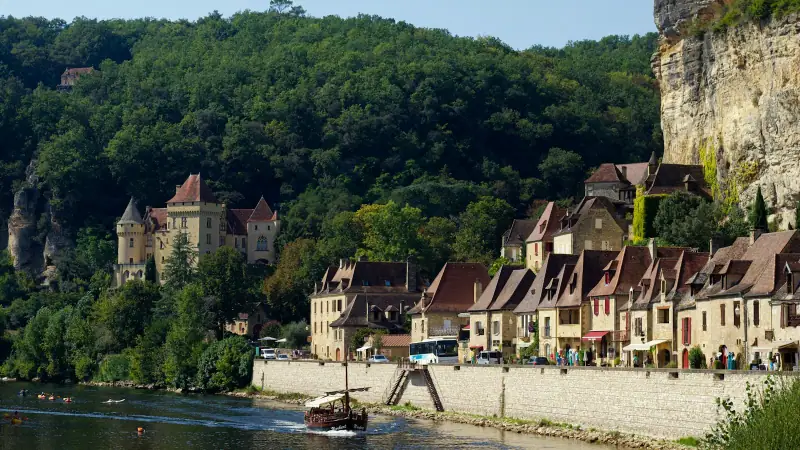
Then go down to La Roque-Gageac, a village clinging to a cliff beside the river. It is among the most beautiful villages of France and can be walked in a little under an hour. It is also the starting point for gabarre rides, the traditional flat-bottomed boats that let you see the cliffs and châteaux from the water.
Boat ride on the Dordogne
See the cliffs, villages and châteaux from the river: compare the rides and excursions available in the valley.
Lunch: choose a riverside restaurant or picnic with market produce, an excellent way to taste the region without spending much.
Afternoon: Beynac, Castelnaud and Marqueyssac
The valley has several fortified châteaux. Two of them face each other across the river, a legacy of the Hundred Years’ War:
- The Château de Beynac, perched on its cliff above the village of the same name, offers a panoramic view over the valley. The village of Beynac, below, deserves a stroll.
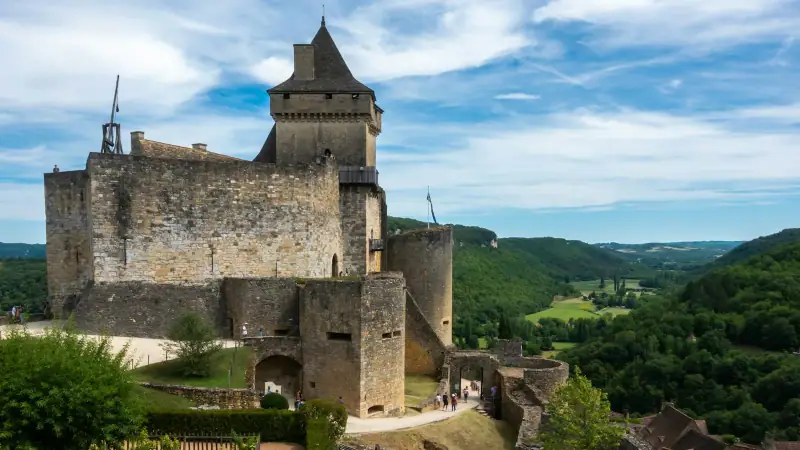
- The Château de Castelnaud, further southwest, houses a museum of medieval warfare, with weapons, siege engines and demonstrations in season.
- The Marqueyssac gardens, at Vézac, are known for their thousands of clipped boxwoods and their belvederes over the valley. It is a welcome green break at the end of the day.
Do not try to visit everything: choose just one château to visit in detail (Beynac for the view, Castelnaud for the content) and give the rest of the afternoon to the gardens or a river descent. For the road, allow barely ten to fifteen minutes between these stops.
Active option: if you travel in summer, a canoe-kayak descent of the Dordogne is a classic activity. Many operators offer routes of a few hours. Check swimming conditions and the water level before leaving, and do not forget a change of clothes.
Getting around the Dordogne
This itinerary relies on a car. Distances are short, but sites are scattered in the countryside, often on winding valley roads. A few tips:
- Book your car ahead in summer, when stocks run out fastest.
- Leave early, before 9 am, to avoid the crowd and full car parks near the châteaux.
- Avoid driving after a wine tasting: designate a driver.
- Allow time for valley roads, which are slower than you imagine, particularly behind motorhomes.
- Keep some change for the paid car parks in certain villages.
Arriving by train? The train stations at Périgueux, Bergerac or Brive-la-Gaillarde (in the Corrèze) are the most common entry points, and you pick up a rental vehicle there. Allow a good hour by road from Périgueux or Brive to reach Sarlat.
Coming to the Dordogne from abroad
Coming from far away? Compare flights to airports near the Dordogne, such as Bergerac or Brive, before booking your stay.
When to do this itinerary
Each season has its strengths:
- Spring (April to June): green countryside, mild temperatures, moderate crowds. An excellent period.
- Summer (July-August): everything is open, night markets and events abound, but the best-known sites are packed and lodging prices rise. Book very early.
- Fall (September to November): magnificent light, colorful forests, the season of porcini and walnuts. It is the favorite of many regulars.
- Winter (December to March): calm, but some sites are closed or open less often. In return, it is the season of truffles and markets for foie gras and other duck products.
Tips for a successful three days
- Book the flagship visits (Lascaux IV, caves, some châteaux) ahead, especially in high season.
- Check hours and opening days on the official sites: they vary by season and can change from year to year.
- Bring comfortable shoes: villages are cobbled and sloped, and many sites involve stairs.
- Take a small jacket even in summer, since caves are cool.
- Keep a buffer day if you have a fourth day: the Green Périgord with Brantôme, Périgueux or the Bergerac vineyards are good extensions.
- Stay a little flexible: a thunderstorm, a queue or a crush on a village can upend the plan, and that is a good thing.
Variants by profile
With the family: alternate a “serious” visit and a fun activity. For example, Lascaux IV in the morning and a swim break or boat ride in the afternoon. The Marqueyssac gardens and the châteaux are generally enjoyed by children.
As a couple: favor quiet moments. Dinner in a neighboring village rather than in the center of Sarlat, a walk on the belvederes at sunset, a night in a charming B&B.
Food lover: add a visit to a producer (walnuts, foie gras, wine) and a stop at a cellar in the Bergerac vineyard if you have an extra day. Our guide to Périgord specialties will help you build your program.
Small budget: rely on markets, picnics, outdoor visits of the villages (free) and choose only one paid site a day.
The essentials
- Settle in Sarlat for three nights: almost everything is within 30 minutes by road.
- Day 1: the medieval town; day 2: Lascaux IV and the Vézère Valley; day 3: Domme, La Roque-Gageac, Beynac, Castelnaud and Marqueyssac.
- Book Lascaux IV, the caves and your rental car ahead.
- Spring and fall are the best seasons to avoid the crowd.
- Do not try to see everything: two or three stops a day are enough to really enjoy it.
Sources
- Lascaux IV (Lascaux International Centre for Cave Art): figures checked November 2026
Frequently asked questions
Are three days enough to visit the Dordogne?
Three days let you see the essentials of the Black Périgord: Sarlat, the Vézère Valley and the Dordogne valley with its châteaux. They are not enough for the whole department: Périgueux, Brantôme and the Bergerac vineyards need extra time.
Where should you stay for a 3-day trip to the Dordogne?
Sarlat-la-Canéda is the most practical base: it is at the center of the Black Périgord, and most stops on this itinerary are within about 30 minutes by road. The surrounding villages (Domme, La Roque-Gageac) offer a quieter stay.
Do you need a car to follow this itinerary?
Yes, it is strongly recommended. Sites are scattered across the countryside and public transport is limited outside the main towns. A car gives you the freedom to vary stops and pause in villages.
Do you need to book Lascaux and the caves?
Yes, especially from May to September and during school-holiday periods. Lascaux IV, the faithful replica of the cave, and the authentic decorated caves have limited capacity. Book online ahead on the official sites, and check hours and prices before you come.
What is the best time for this itinerary?
Spring and early fall are ideal: pleasant temperatures, fewer people than in midsummer, and colorful landscapes. July and August are very busy. Winter offers a calm setting, but some sites reduce their opening days.
Can you do this itinerary with children?
Yes. The châteaux, the Lascaux replica, the prehistoric sites, the hanging gardens and the river descent by canoe or boat generally please children. Plan breaks and lighter days for the youngest.
Can you add Rocamadour to these three days?
Rocamadour is in the Lot, about an hour by road from Sarlat. With three days, it is better to stay in the Black Périgord; if you have a fourth day, it is a perfectly workable excursion.
More Dordogne guides
Keep reading
Rouffignac Cave: Train Visit, Prices, Booking and Opening Dates
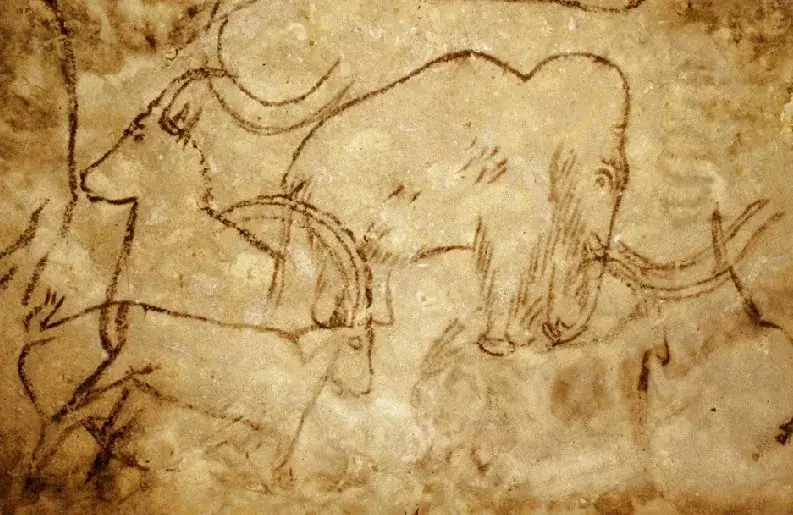
Rouffignac Cave: prices, hours, booking (5 weeks ahead), length of the electric train ride and closure until March 28, 2027. Tips for families.
Proumeyssac Chasm: Prices, Hours, Booking and the Gondola Descent
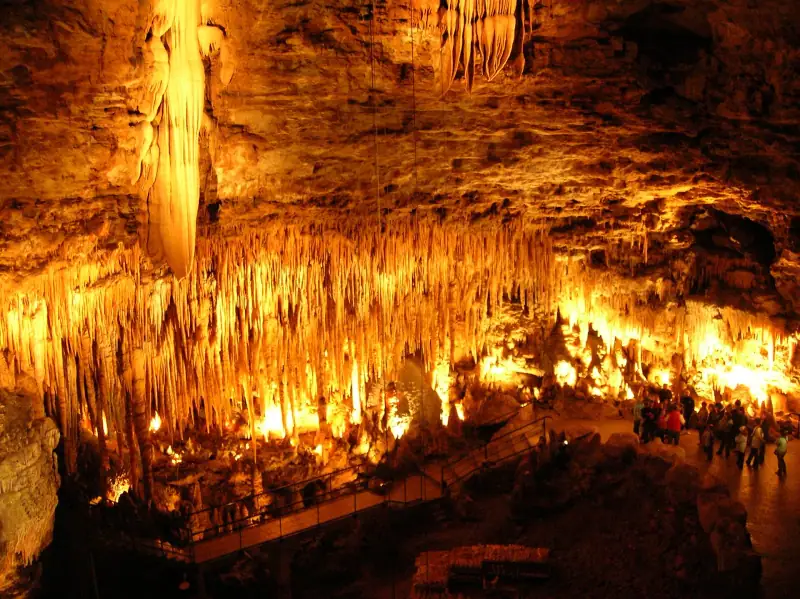
Proumeyssac Chasm at Audrix: 2026 prices, hours by season, booking, gondola, strollers, dogs and tips for visiting without a wait.
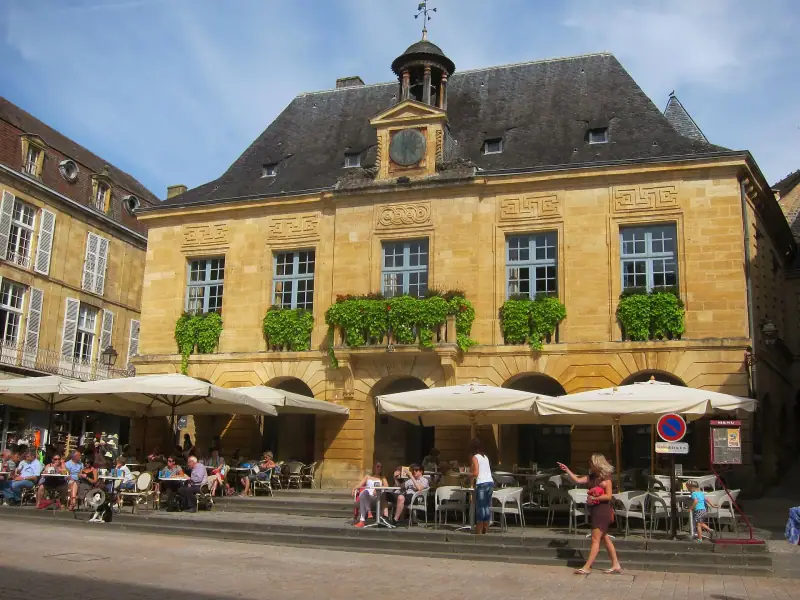
Visiting Sarlat-la-Canéda: What to See and Do in the Medieval Town
Visiting Sarlat-la-Canéda: cathedral, Place des Oies, medieval lanes, markets, Lanterne des Morts and day trips. A guide to plan your visit well.
Ready-made
Dordogne itineraries
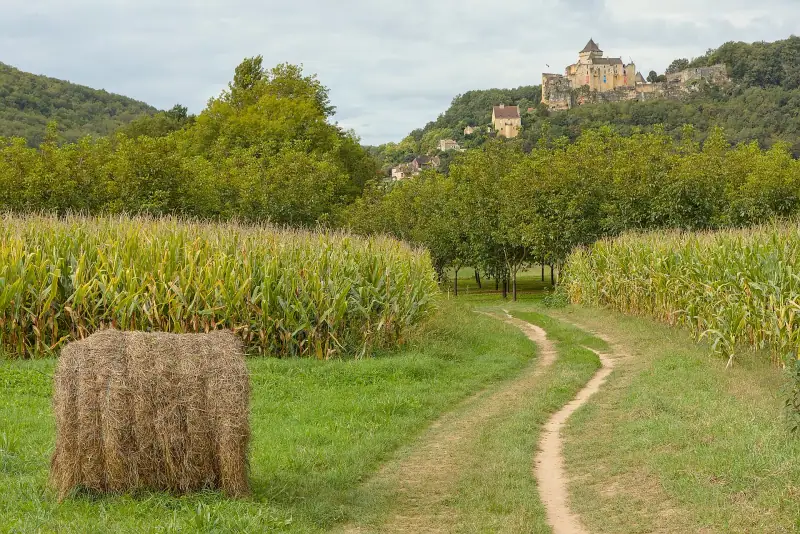
7 days
One Week in the Dordogne: A Day-by-Day Itinerary
Sarlat-la-CanédaBrantômeBergerac
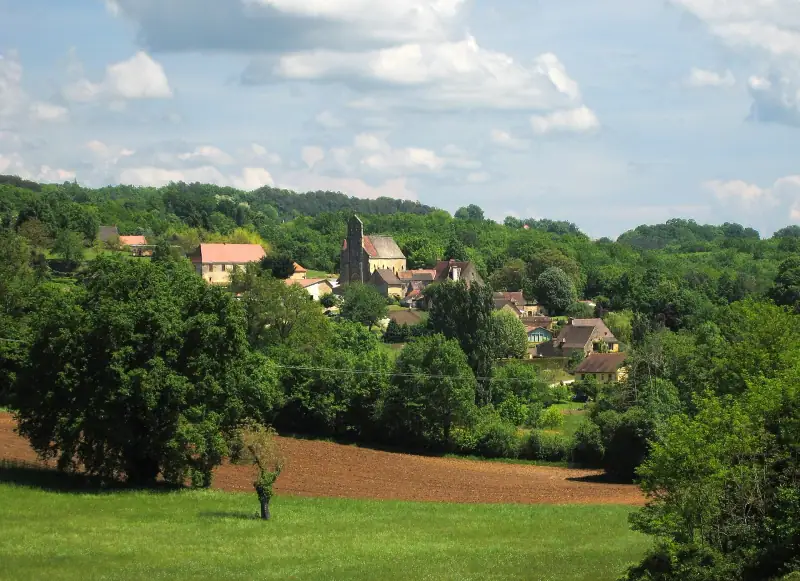
5 days
Dordogne in 5 Days with Kids: Stops, Kilometers and a Realistic Pace
Dordogne in 5 days with kids: an itinerary from Sarlat with distances, drive times, breaks and suitable activities, without overloaded days.
Can be adapted in the planner