What to see
Visiting Bolzano: A Complete Guide to the Capital of South Tyrol
We may earn a commission when you book through links on this page, at no extra cost to you. We don't visit or try the places we cover: we summarize published sources. How we work
In short
- One to two days are enough for the old town, the Ötzi museum and Runkelstein Castle; allow 3 to 4 days to add the Ritten plateau and the Dolomites.
- The South Tyrol Museum of Archaeology (adult ticket about €13, or $15) shows Ötzi, a 5,300-year-old mummy; allow 2 to 3 hours.
- Bolzano is a good Dolomites base: Val Gardena is 40 min away, Cortina d'Ampezzo 1 h 43 to 2 h 14, the Tre Cime about 2 h by car.
- Verona airport is 1 h by car, Innsbruck 1 h 40; by train, Milan is 2 h 30 away and Innsbruck 2 h.
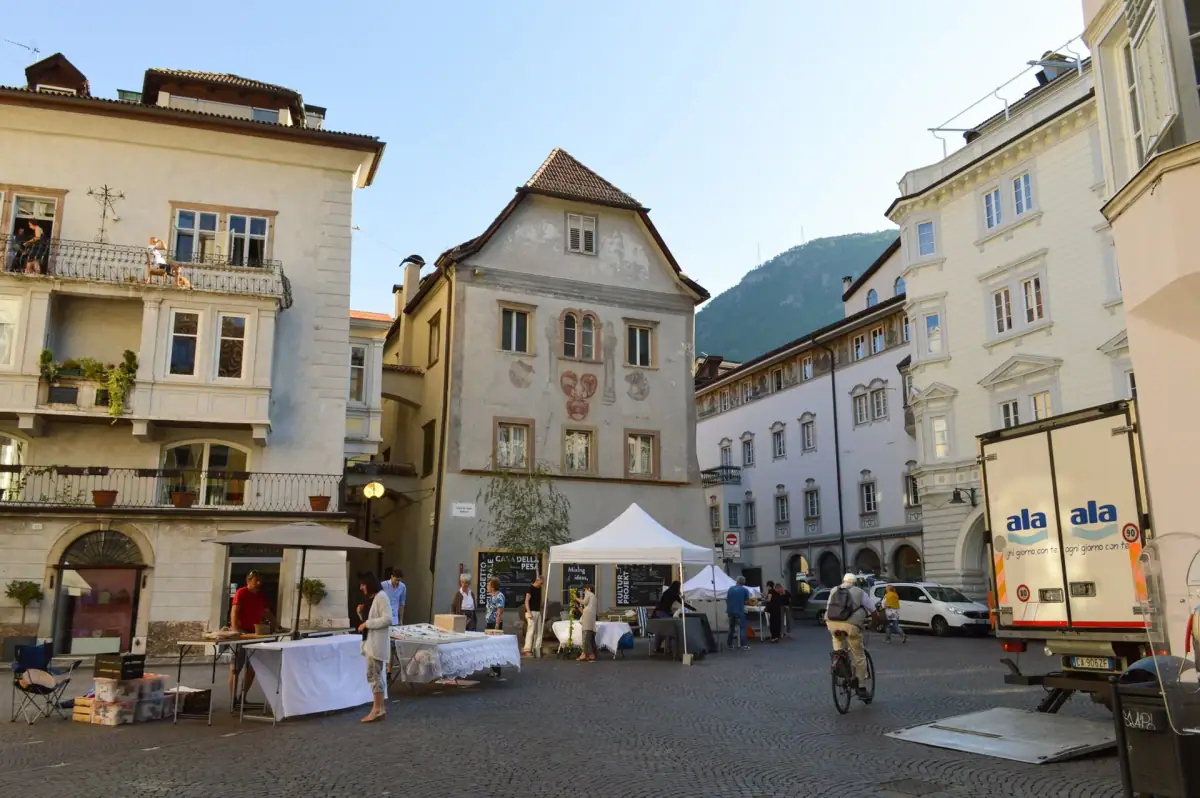
Bolzano is a city that throws you off balance, and that is exactly what makes it unforgettable. The capital of South Tyrol (Alto Adige for Italians), this city of 110,000 people sits at the crossroads of two cultures: Italian to the south, Austrian to the north. Its arcaded medieval lanes hold osterie serving polenta next to Gasthäuser serving sauerkraut, a Romanesque cathedral and a Gothic bell tower, a Provençal-style market and the Südtiroler Weinstrasse. Add a museum housing the best-preserved mummy in human history, Dolomites visible from the city, and a vineyard region that produces some of the best white wines in Italy, and Bolzano keeps surprising you.
Set at 262 meters (860 ft) above sea level where the Isarco and Talvera (Talfer) rivers meet, Bolzano enjoys a favorable microclimate: hot, sunny summers, winters that are mild for an Alpine city, and more than 300 days of sun a year. It is the ideal gateway to the Dolomites if you arrive from northern Italy or from Austria.
The old town: arcades, markets and cathedral
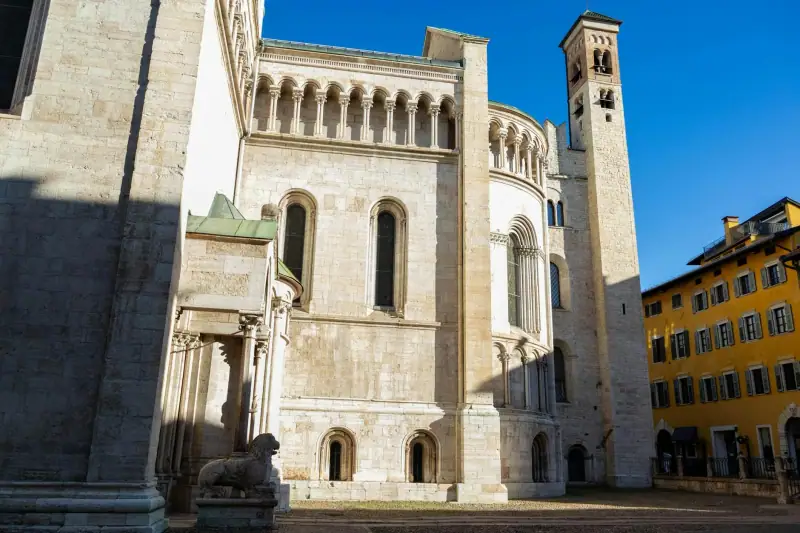
Bolzano’s historic center is organized around a few main axes that you can cover on foot in half a day. The Laubengasse (Via dei Portici in Italian) is the old town’s main artery: an arcaded street 300 meters (985 ft) long whose Gothic stone vaults have sheltered local trade since the Middle Ages. Even today, butchers, cheesemongers, herbalists, chocolate makers and fashion shops sit side by side under these arcades, which protect you from the summer sun and the autumn rain.
Piazza Walther
Piazza Walther (or Waltherplatz) is the living heart of Bolzano. Dominated by the statue of the medieval troubadour Walther von der Vogelweide, it is framed by the government palace, historic cafés with terraces and, above all, by Bolzano’s Gothic cathedral (Dom in German). This late Gothic masterpiece, built between the 14th and 15th centuries, stands out for its roof of colored glazed tiles, a diamond pattern in green, yellow and white that recalls Austrian cathedrals. The carved limestone spire reaches 65 meters (213 ft). Inside, the medieval frescoes, the red sandstone pulpit and the baptismal font are worth a look.
The square is also the site of the Bolzano Christmas Market, one of the most authentic in Europe, which takes over the square from late November to January 6 (Epiphany) every year. Handmade nativity scenes, Glühwein (spiced mulled wine), Lebkuchen (gingerbread) and local artisans turn the square into a winter postcard.
The covered market and the herb market
A short walk from the Laubengasse, the Merkantilgebäude covered market welcomes local producers every morning. Mountain cheeses (Graukäse, Bergkäse, Trentino pecorino), aged smoked speck (the raw ham typical of South Tyrol), Val Venosta apples, mountain honey and wild fruit schnapps make up a palette of flavors found nowhere else. Arrive between 8 am and 12 pm to find all the producers. To choose and bring home speck, see our guide on where to buy South Tyrol speck.
The fruit and herb market (Obstmarkt / Piazza delle Erbe) is livelier still: flowers, seasonal vegetables, fruit and local crafts are piled up in a picturesque, colorful jumble, framed by old buildings with Baroque facades.
Hotels in Bolzano
From charming boutique hotels to hotels with Dolomites views, for every budget.
The South Tyrol Museum of Archaeology: meeting Ötzi
This is probably reason number one to come to Bolzano: the South Tyrol Museum of Archaeology houses the best-preserved mummy in human history. In 1991, two hikers stumbled upon the body of a man who died about 5,300 years ago in the Ötztal Alps (on the Austro-Italian border). Nicknamed Ötzi the Iceman, this Neolithic hunter has been the subject of scientific studies that keep delivering astonishing discoveries.
What you will see at the museum
Over three floors, the museum carefully reconstructs Ötzi’s life:
- His full outfit: a hood of braided grass, a coat of goat and deer hide, shoes lined with brown bear fur and deerskin, goatskin leggings. This clothing sophistication reveals advanced Alpine survival technology.
- His tools: a copper axe with a yew handle (one of the oldest known copper axes), an unfinished yew bow, a quiver of 14 arrows, 2 of them with flint points, a flint knife, a medical kit.
- His health: Ötzi suffered from arthritis and atherosclerosis and had therapeutic tattoos (lines on painful joints). His last meal was a stew of ibex and deer meat with einkorn (an ancient grain).
- His death: Ötzi was killed by an arrow in the left shoulder. The arrowhead is still in his body. A violent death in the mountains, 5,300 years ago.
The mummy itself can be seen through a small refrigerated window (the chamber is kept at -6 °C / 21 °F and 98% humidity to preserve the body). Seeing that wrinkled face, those blackened hands, that astonishingly intact body is a dizzying experience.
Practical information:
- Address: Via Museo 43, Bolzano
- Hours: Tuesday to Sunday, 10 am to 6 pm (closed Monday except public holidays; open every day in summer, including Monday)
- Adult ticket: about €13 (~$15), child (6-14): about €4.50 (~$5) (check current prices on the museum website)
- Recommended time: 2 to 3 hours
Runkelstein Castle: medieval frescoes and panoramic views
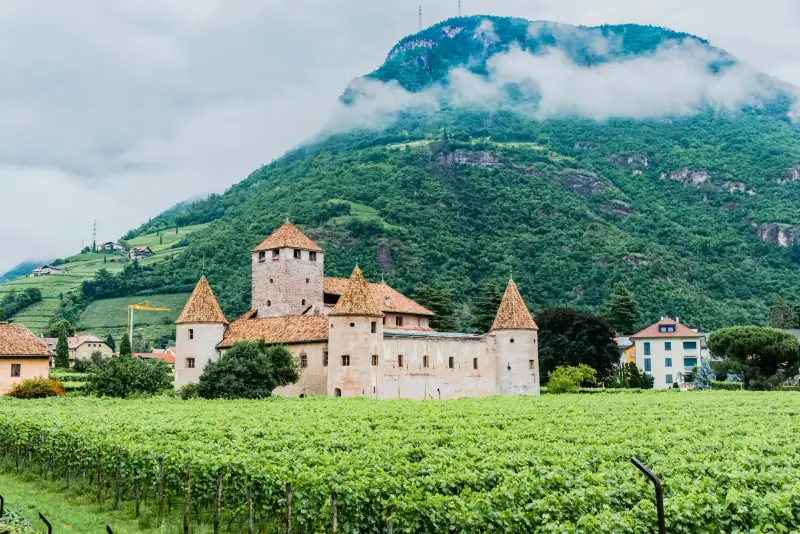
About 3 km (2 mi) north of the center, perched on a rocky spur above the Talvera gorge, Castel Roncolo (or Schloss Runkelstein in German) is one of the best-preserved medieval castles in the Alps. Its distinguishing feature is unique in Europe: its halls and corridors are entirely covered in 14th-century secular medieval frescoes, showing knights, tournaments, hunting scenes, dances and Arthurian legends in astonishingly fresh colors.
These frescoes do not show religious scenes but medieval aristocratic life in all its vividness: banquets, games, courtly love, period costumes. It is an exceptional historical and artistic record, included in UNESCO’s educational program.
The walk from the city center follows the Talvera stream along a green path dotted with cherry trees in spring (30-40 minutes on foot) and is a very pleasant stroll in itself.
Practical information:
- Hours: Tuesday to Sunday, 10 am to 5 pm in winter (November to early January), 10 am to 6 pm from mid-March to early November (closed Monday except public holidays; annual closure in January, January 7 to 31 in 2026)
- Admission: €10 (~$12) adult, free up to age 14
- Access by bus (line 12) or on foot (30 min from the center)
Guided tours of Bolzano
Walking tours, Ötzi museum visits, and Dolomites excursions from Bolzano.
The Ritten plateau: 1,200 meters above the city
Ten minutes from the center of Bolzano, the Ritten cable car (Rittner Seilbahn) lifts you in 12 minutes up 950 meters (3,120 ft) above the city, to the panoramic pastures of the Ritten plateau. This “natural balcony” offers one of the best views of Bolzano and the Dolomites: the Catinaccio (Rosengarten) and the Sciliar massif stand out on the horizon in all their majesty.
On the plateau, a historic little electric train links the villages of Collalbo and Soprabolzano through meadows and forest. It makes a perfect half-day excursion to escape the city’s summer heat (it is often 10 °C / 18 °F cooler on the plateau). The Ritten earth pyramids (Erdpyramiden), geological formations of clay columns topped by a stone, are a spectacular natural phenomenon, reached on foot from Longomoso (30 minutes of easy walking). The plateau is at about 1,200 m (3,940 ft).
Cable car practical information:
- Departure: Via Renon, Bolzano (5 min walk from the train station)
- Round-trip fare: about €12 (~$14)
- Runs all year (apart from short maintenance closures in spring), roughly one cabin every 4 minutes during the day
Bolzano’s food: between Italy and Tyrol
Bolzano’s cooking is a delight if you like crossed influences. On the same street you will find a trattoria serving pasta with ragù next to a Gasthaus offering Tafelspitz (Austrian boiled beef) and Knödel (large bread dumplings with herbs or speck).
What to taste
Speck IGP: The smoked, dried raw ham of South Tyrol is the region’s culinary pride. It differs from Parma ham by its smoky aromas and its spices (juniper, rosemary, bay leaf). Eat it in thin slices with rye bread.
Schlutzkrapfen: Half-moon ravioli filled with ricotta and spinach, covered in melted butter and Parmesan. A specialty that perfectly symbolizes the Italian-Tyrolean blend.
Knödel: Dumplings of stale bread, cooked in broth or pan-fried, with speck, cheese or herbs. Filling and comforting, they are the soul of mountain cooking.
Apfelstrudel: Bolzano’s apple strudel rivals Vienna’s. Thin pastry, tart Val Venosta apples, cinnamon and raisins, all dusted with powdered sugar. Have it with cream in one of the city’s historic cafés.
South Tyrol wines: The vineyards around Bolzano are exceptional. Lagrein (a deep red with blackberry aromas), Gewürztraminer (an aromatic white), Pinot Grigio and Vernatsch (a light local red) go wonderfully with local food. See our guide to South Tyrol wines so you do not miss the best cellars.
Where to eat in Bolzano
Gasthof Vogelweide (Piazza Walther): Classic Tyrolean cooking in a historic setting steps from the cathedral. Knödel, Tafelspitz and homemade Apfelstrudel.
Vogele (Via Goethe): One of the oldest osterie in the city, around since 1277. Medieval cellar atmosphere, market cooking, a big list of local wines.
Hopfen & Co: A craft brewery serving its own beers and brewery food (sausages, cold cuts, savory tarts) in a lively room.
Car rental in Bolzano
Essential for exploring the Dolomites from Bolzano. Book ahead in high season.
Excursions from Bolzano
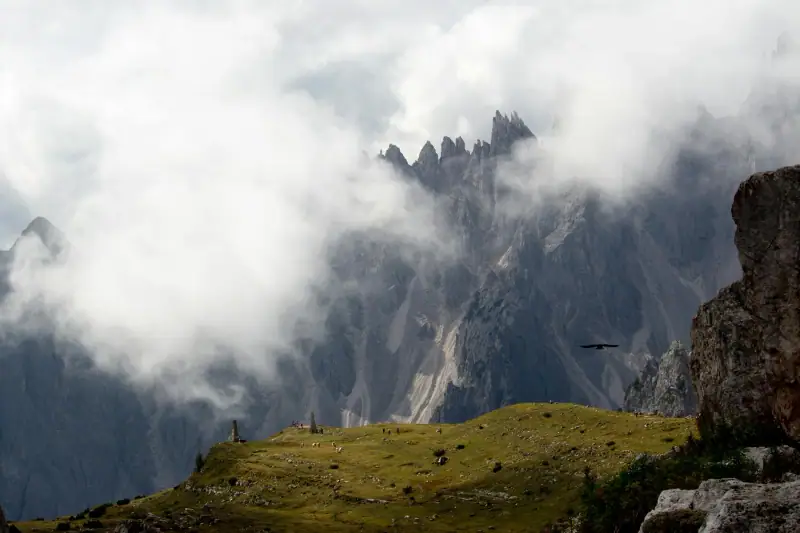
Bolzano’s location makes it an exceptional base for excursions to the finest sites in the Dolomites. From the city, with a rental car, you can reach:
Val Gardena and Ortisei (40 min)
The most famous valley in the Dolomites, with its wood carvers, alpine pastures and Sellaronda ski area. Ortisei is the main village, charming and authentic. See our complete guide to the Dolomites to plan your stay.
The Sciliar / Schlern massif (45 min)
Visible from Bolzano in good weather, the Sciliar plateau is reached from Siusi (Seis am Schlern). A world of pastures suspended between the Dolomite cliffs, with many family-friendly hiking trails.
Kalterer See / Lake Caldaro (20 min south)
The Bolzano locals’ favorite summer swimming spot: a small lowland lake with soft water (26 °C / 79 °F in July-August), surrounded by vineyards. Ideal for a relaxing day and local wine tasting.
Merano / Meran (30 min)
An elegant spa town of 40,000 people, Merano was a prized Austro-Hungarian health resort. Its Trauttmansdorff botanical gardens (ranked among the most beautiful in Europe), its arcaded historic center and its modern thermal baths deserve a day.
The Ötztal Alps (1 h 30)
If you have seen the mummy at the museum, crossing the Brenner Pass takes you into Austria, to the landscapes where Ötzi lived and died. A memorable Alpine loop between Bolzano and Innsbruck and back.
Practical information for visiting Bolzano
Getting there
By train: Bolzano station is well served by Trenitalia and ÖBB (Austrian railways). From Milan, allow 2 h 30; from Verona, 1 h 27 to 1 h 33 on a direct train; from Innsbruck, 2 h.
By car: Bolzano is on the A22 (the Brenner motorway linking Italy and Austria). From Milan, 2 h 30.
By plane: The nearest airport is Verona (VRN, 1 h by car) or Innsbruck (INN, 1 h 40 drive). Shuttles run from both airports to Bolzano station.
Getting around town
The city center is entirely pedestrian and easy to cover on foot. Bolzano has an excellent city bus network (SASA, €1.50 / about $2 per ride) serving the castles and outlying villages. The Ritten cable car leaves from Via Renon, a 5-minute walk from the station. For walking loops to the earth pyramids, see our guide to the Ritten earth pyramids without a car.
For excursions in the Dolomites, a rental car is essential, since mountain roads are not served by public transport.
Sample budget
| Item | Budget per night or day |
|---|---|
| Lodging (3-star hotel) | €80-130 (~$93-150) / night |
| Lunch at a restaurant | €15-25 (~$17-29) / person |
| Dinner at a restaurant | €25-45 (~$29-52) / person |
| Ötzi museum | €13 (~$15) / person |
| Runkelstein Castle | €10 (~$12) / person |
| Ritten cable car round trip | €12 (~$14) / person |
Bolzano is cheaper than Cortina or the Dolomites ski resorts, while offering an equivalent level of food and cultural quality.
When to go
Bolzano is pleasant all year. For the best visit:
- April-June: Blossoming cherry trees, mild temperatures (15-22 °C / 59-72 °F), few tourists. Ideal for hiking in the surrounding mountains.
- July-August: Heat (28-35 °C / 82-95 °F), a lively summer atmosphere. Plan on the Ritten cable car to cool off.
- September-October: The best season according to locals: grape harvest, fall colors, perfect temperatures, fruit markets. See our guide to the best time to visit the Dolomites to fine-tune your plans.
- November-December: Bolzano’s Christmas market is one of the most authentic in Europe (late November to January 6).
Suggested itinerary for 2 days in Bolzano
Day 1: The city and its museums
- Morning: Laubengasse, cathedral, herb market and covered market
- 10 am: South Tyrol Museum of Archaeology (Ötzi), 2 to 3 hours
- Lunch: an osteria in the center, Schlutzkrapfen or Knödel in broth
- Afternoon: Piazza Walther, shopping in the Tyrolean boutiques, a walk along the Talvera
- Evening: Dinner in a medieval cellar (Vogele), tasting Lagrein and speck
Day 2: Excursion and castle
- Morning: Cable car to the Ritten plateau, walk to the Longomoso earth pyramids (2 h)
- Back in town, picnic with market products
- Afternoon: Walk to Runkelstein Castle (30 min on foot) and visit the medieval frescoes
- Evening: Café terrace on Piazza Walther with a view of the illuminated cathedral
Bolzano is a city you are glad to come back to. Too often overlooked in favor of the Dolomites ski resorts, it is nonetheless one of the most original experiences in northern Italy, a city that refuses to choose between its identities and makes them a strength.
To organize your stay in the region, see our complete guide to the Dolomites, or plan your hikes in the Dolomites from Bolzano.
Frequently asked questions
How long do you need to visit Bolzano?
One to two days are enough to see the historic center, the Ötzi museum and Runkelstein Castle. Allow 3 to 4 days if you want to add an excursion to the Ritten plateau and a day in the surrounding Dolomites.
What language is spoken in Bolzano?
Bolzano is officially bilingual: Italian and German (South Tyrolean dialect) are both official languages. Most residents speak both fluently.
How do you get to Bolzano?
The nearest airports are Verona (1 h by car) and Innsbruck (1 h 40). By train, Bolzano is about 2 h 30 from Milan, 1 h 27 to 1 h 33 from Verona on a direct train, and 2 h from Innsbruck. By car, Bolzano is on the A22 Brenner motorway, 2 h 30 from Milan.
Is Bolzano a good base for exploring the Dolomites?
Yes, it is one of the best. Bolzano is in the heart of Trentino-South Tyrol and puts Val Gardena (40 min), Cortina d'Ampezzo (1 h 43 to 2 h 14), the Marmolada (1 h) and the Tre Cime (2 h) within driving distance.
Is the Ötzi museum in Bolzano really worth the detour?
Absolutely. The South Tyrol Museum of Archaeology is one of the most fascinating science museums in Europe. The Ötzi mummy (5,300 years old) is kept in perfect conditions and can be seen through a refrigerated window. Allow 2 to 3 hours for the visit.
What is the best season to visit Bolzano?
Bolzano is pleasant all year. Spring (April-May) is ideal for blossoming cherry trees and mild temperatures. Summer is hot (30-35 °C / 86-95 °F) and lively. Fall (September-October) is exceptional with the grape harvest and the colors. Winter brings the famous Christmas market, from late November to January 6.
More Dolomites guides
Keep reading
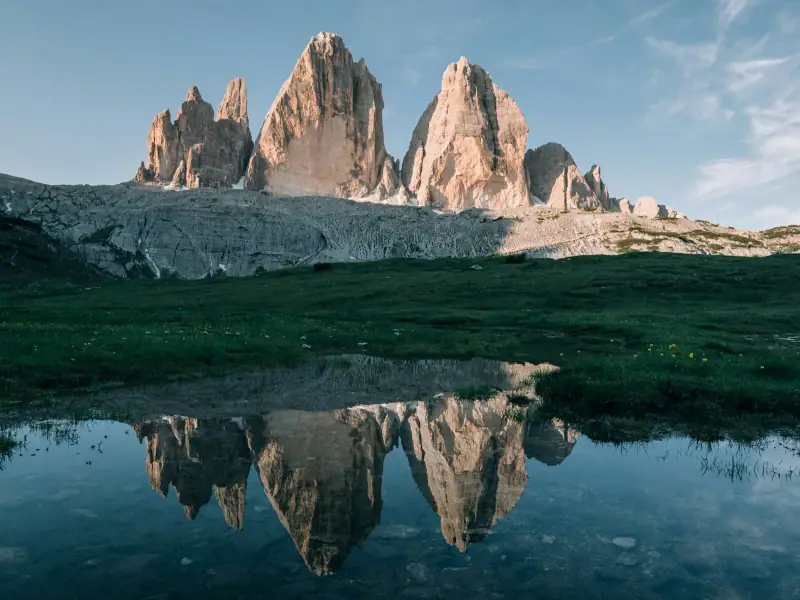
Tre Cime di Lavaredo: The Ultimate Guide to the Symbol of the Dolomites
Everything you need to visit the Tre Cime di Lavaredo: access, parking, hikes, best time of day and tips for avoiding the crowds.
Visiting Alta Badia: A Complete Guide to the Ladin Valley of the Dolomites
Alta Badia: Sellaronda skiing, high-altitude hikes, Michelin-starred dining and Ladin culture. Guide to Corvara, Colfosco and San Cassiano.
Visiting Bressanone: A Complete Guide to the Pearl of South Tyrol
Visiting Bressanone: Baroque cathedral, arcaded old town, Novacella Abbey, Plose mountain and Christmas market. A complete practical guide.
Ready-made
Dolomites itineraries
5 days
Dolomites with Kids: 5-Day Family Itinerary
Ortisei (Val Gardena)Cortina d'Ampezzo
5 days
Dolomites road trip in October: 5-day itinerary and passable roads
OrtiseiCanazeiCortina d'Ampezzo
3 days
Dolomites Weekend: A 3-Day Itinerary
A 3-day Dolomites weekend: Val Gardena, Tre Cime di Lavaredo and Alta Badia. Itinerary, lodging, budget and practical tips.