What to see
Visiting Jiufen: a complete guide to the red-lantern village
We may earn a commission when you book through links on this page, at no extra cost to you. We don't visit or try the places we cover: we summarize published sources. How we work
In short
- From Taipei Main Station, take a TRA train to Ruifang (50 to 60 min, NT$49 to 70), then bus 788 or 827 to Jiufen (about 20 to 25 min).
- One day is enough for the essentials; staying overnight lets you see the village at dawn and after the day-trippers leave.
- Best season is October to April; weekdays are far less crowded than weekends.
- Bring cash: many small stalls and teahouses do not take cards, and the nearest ATMs are in Ruifang.
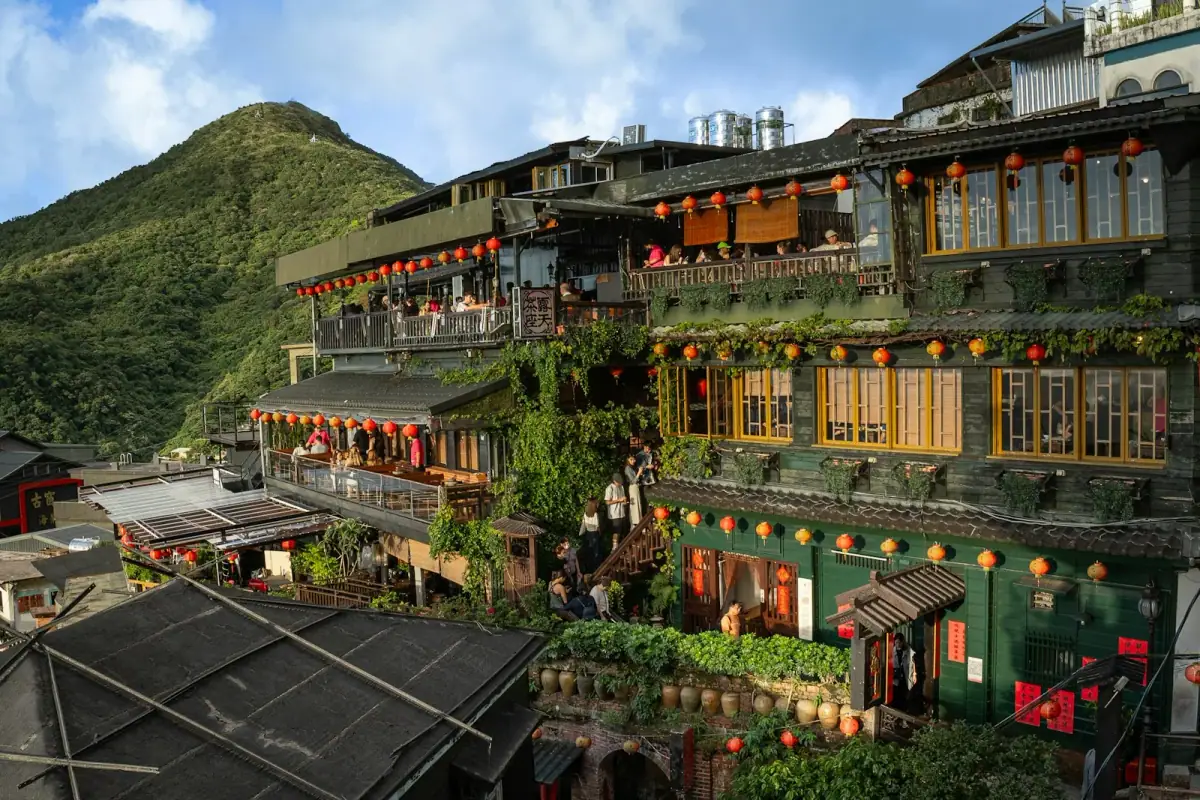
Clinging to a hillside above Keelung Bay, Jiufen is one of the most photographed villages in Asia. Its stepped alleys draped in red lanterns, its teahouses hanging over the drop and its near-permanent fog have made it a place out of time. Less than an hour from Taipei, it is an essential excursion on any trip to Taiwan.
Why is Jiufen so famous?
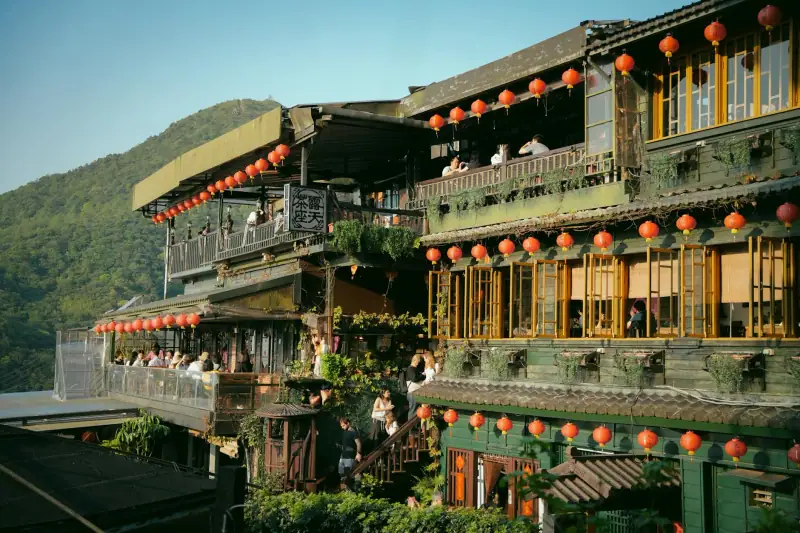
Jiufen used to be an isolated mountain village, settled by gold prospectors after a gold vein was discovered in the late 19th century. During the Japanese occupation (1895-1945), the town grew denser, and the half-timbered houses, stone stairways and red-roofed teahouses largely date from that period.
After gold mining declined in the 1970s and 1980s, Jiufen fell into obscurity, until the 1989 release of the film A City of Sadness (悲情城市) by director Hou Hsiao-hsien, which was shot there and won the Golden Lion at Venice. The film drew attention to the village’s singular architecture and triggered a first influx of tourists.
International fame came a few years later, fueled by rumors (never officially confirmed by the studio) that the setting of some scenes in Hayao Miyazaki’s Japanese animated film Spirited Away (2001) was inspired by Jiufen. The debate remains open among film fans, but the atmosphere of the lit-up night alleys undeniably evokes the film’s world.
Today, Jiufen is one of the most visited destinations in northern Taiwan. Administratively it belongs to Ruifang District, in the city of New Taipei (新北市).
Jiufen Old Street: the center of the village
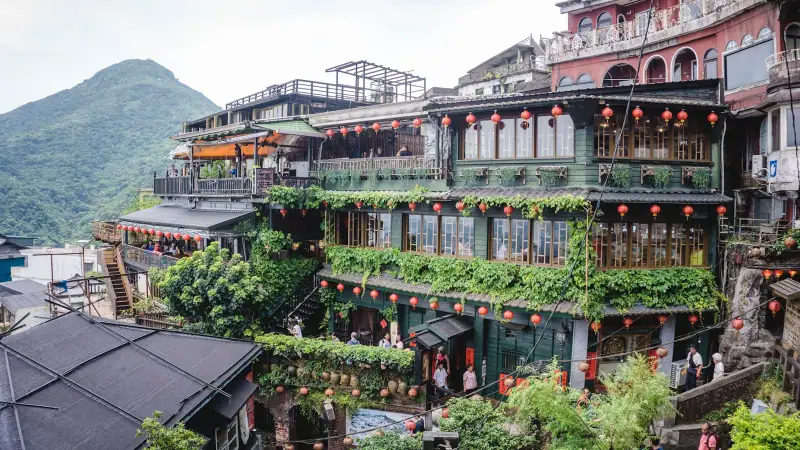
Old Street (基山街, Jishan Street) is the main artery and the meeting point of all visitors. It is a narrow, largely covered alley that climbs in steps from the village entrance to the viewpoints over the sea. Dozens of stalls line both sides, offering local food specialties, handmade souvenirs and drinks.
What to taste on Old Street
Food is one of Jiufen’s big attractions. The best-known specialties:
- Taro balls (芋圓, yù yuán): small, soft dumplings made from taro, sweet potato or yam, served in a bowl of cold coconut milk or hot sweet soup. They are the flavor symbol of Jiufen.
- Fishball soup (魚丸湯): a clear soup with stuffed fish balls, delicate and comforting in foggy weather.
- Pork intestine soup (豬腸湯): a robust soup made with pork intestines, a street-food dish much loved by locals in Taiwan.
- Yam cake (芋粿): a taro rice cake, pan-fried and served hot, slightly crispy on the outside.
- Caramel crepes and sweet snacks: all along the alley, craftsmen prepare treats in front of you.
The principle is simple: you snack as you walk. Bring a big appetite and a sturdy stomach, because portions are generous and temptations constant.
Stays in Jiufen
Teahouses with rooms, B&B with bay views and charming inns in the village.
The hillside teahouses
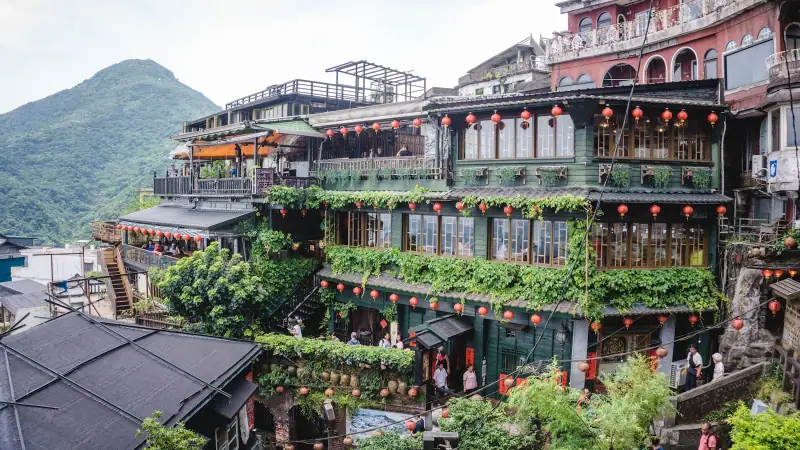
Jiufen is also the capital of teahouses (茶館, cháguan) perched on the cliffs. These establishments occupy multi-level wooden buildings, with large picture windows or open-air terraces offering a panoramic view over Keelung Bay and, in clear weather, as far as the Pacific Ocean.
The typical experience is to settle onto a tatami or at a low table, order a tray of Taiwanese oolong tea with a few local sweets, and spend an hour or two watching clouds drift over the sea. It is one of the most restful breaks you can treat yourself to in Taiwan.
Several establishments offer this kind of experience around the old town. Allow NT$200 to 400 (about US$7 to 13) per person for a full tea service with accompaniments. Most teahouses have open terraces you can use even if you do not order, but the best indoor views require an order.
Tip: arrive before 2 pm or after 4 pm to get a table with a view without waiting. Golden hour, just before sunset, gives the best light over the bay.
The climb to the A-Mei stairs
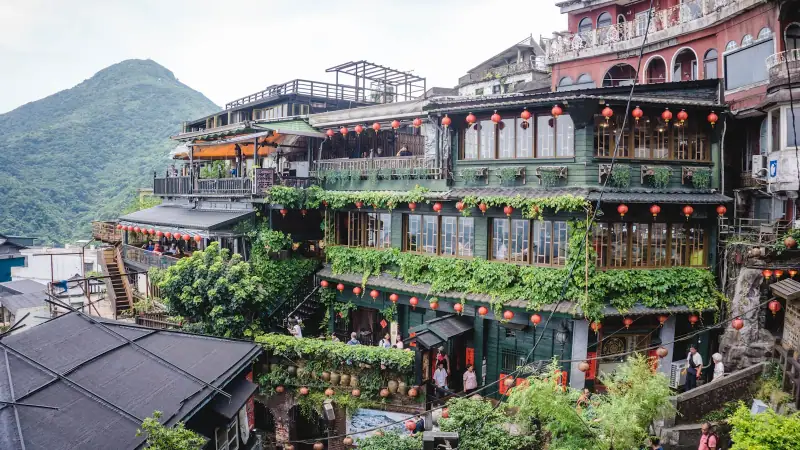
Jiufen’s most replicated image, the alley with stairs lined with red lanterns, is found on the climb to the teahouses of the so-called “A-Mei” area. These stone stairs, wrapped in hanging lanterns, take on an almost unreal character at nightfall when the lights come on gradually.
Technically, the most photographed stairs are on Shuchi Road (豎崎路), which climbs perpendicular to Old Street. It is a short passage, but very dense in atmosphere and in photographers. Be patient if you want a picture without crowds.
Practical tip: go up the stairs on the way out (toward the panoramic view), then come back down along Old Street on your return. That way you will not walk the same route twice.
Jinguashi: the neighboring mining village
About 3 kilometers (2 mi) from Jiufen, the village of Jinguashi (金瓜石) shares the same gold-mining history and mountain setting, but in an even calmer, better-preserved atmosphere. The Gold Ecological Park (黃金博物館) traces the history of mining in the Japanese era, with accessible tunnels and a well-documented exhibition.
You can walk between the two villages in about 40 to 50 minutes on a scenic path, or take a local bus. This Jiufen + Jinguashi combination makes an excellent full day from Taipei.
Excursions from Taipei to Jiufen
Guided tours combining Jiufen, Yehliu and Shifen in one day.
How to get to Jiufen from Taipei
Train + bus (recommended)
- Taipei Main Station → Ruifang: take a TRA train (the Taiwan Railway, not the HSR) on the lines toward Hualien or Ruifang. The trip takes about 50 to 60 minutes and costs NT$49 to 70 depending on the train type. Trains leave frequently all day.
- Ruifang → Jiufen: outside Ruifang station, take bus 788 or 827 (toward Jiufen/Jinguashi). The trip takes about 20 to 25 minutes. Allow NT$15 to 20 for the bus. Buses run every 15 to 30 minutes.
Alternative from Ruifang: a taxi for about NT$200 to 250 if you are traveling in a group or in bad weather.
Organized tour
Many agencies offer day trips from Taipei combining Jiufen with other sites in the north of the island: Yehliu Geopark (spectacular rock formations), Shifen (sky lantern releases) and sometimes Jinguashi. These minivan or air-conditioned bus tours last 8 to 10 hours and generally cost NT$1,000 to 1,800 (about US$32 to 58) per person, transport and guide included. It is a practical option for seeing several sites in one day.
By taxi or rental car
From central Taipei, allow about 50 to 60 minutes by taxi. The fare generally runs NT$800 to 1,200 (about US$26 to 39) depending on the time. By rental car, the mountain roads to Jiufen are winding but paved; the driving is manageable, but parking in the village is very limited.
To explore northern Taiwan at your own pace, see our complete guide to the must-sees in Taipei before planning excursions outside the capital.
When to visit Jiufen
Best season: October to April
The dry season (October to April) is ideal for visiting Jiufen. Temperatures range between 15 and 22 °C (59 to 72 °F), the sky is often clear and the views over the bay are at their best. December to February can be cool (10 to 15 °C / 50 to 59 °F) but very pleasant with a light coat.
Avoid summer
June to September is hot (28 to 34 °C / 82 to 93 °F), very humid, and Jiufen is often wrapped in low clouds or sea fog. The risk of typhoons from July to September can disrupt trains and buses. If you visit in summer, choose a day of bright sun and arrive early in the morning.
Weekend vs. weekday
On weekends, Jiufen can be extremely crowded, with several thousand visitors sharing alleys that are sometimes less than two meters (6.5 ft) wide. If you can, choose a weekday. The difference in atmosphere is spectacular.
Where to stay in Jiufen
Spending the night in Jiufen lets you experience the village in its most intimate dimension: in the early morning, before the groups arrive, the alleys are silent, the vendors open their stalls and golden light filters through the lanterns still lit.
The accommodation is mainly B&Bs (民宿, mínsù), family guesthouses run by local owners. Most are in traditional multi-story houses, some with terraces or windows overlooking the bay. Double rooms generally run from NT$1,200 to 2,500 (about US$39 to 81) a night, sometimes with breakfast included.
A few tips for choosing:
- Favor properties at the top of the village (on the Shuchi Road side or above Old Street) for the best views.
- Book ahead for weekends and public holidays; the good places are full several weeks in advance.
- Check pedestrian access: many properties cannot be reached by car, and luggage has to be carried up stairs.
To stay in Taipei and visit Jiufen as a day trip, see our guide where to stay in Taipei with the best areas for your budget.
Practical information for your visit
Old Street hours: most stalls open around 10 or 11 am and close between 9 and 11 pm. The most pleasant window is between 3 and 8 pm, when daylight fades and the lanterns begin to light up gradually.
Money: bring cash. Many small stalls and teahouses do not accept bank cards. The nearest ATMs are in Ruifang.
Weather: Jiufen is often in fog or rain, even when Taipei is sunny. A light raincoat and walking shoes with non-slip soles (wet stone stairs are slippery) are strongly recommended.
Restrooms: free public restrooms are found at several spots along Old Street, signposted in English.
Connectivity: 4G/5G coverage is good throughout the village. Check your carrier’s international plan, or use a travel eSIM or a Taiwanese SIM card bought at Taipei airport for a fast connection for Google Maps and online photos.
Accessibility: Jiufen is very poorly accessible by wheelchair or stroller. There are many stairs, and the alleys are often crowded.
Budget for a day in Jiufen
| Item | Estimate |
|---|---|
| Taipei-Ruifang train, round trip | ~NT$140 (~US$5) |
| Ruifang-Jiufen bus, round trip | ~NT$40 (~US$1) |
| Lunch + Old Street snacks | NT$200-400 (~US$7-13) |
| Teahouse (tea tray) | NT$200-400 (~US$7-13) |
| Gold Ecological Park entry (Jinguashi) | NT$80 (~US$2.60) if combined |
| Daily total | ~NT$600-1,000 (~US$20-32) |
For an overview of trip costs, our guide to the budget for a trip to Taiwan gives you all the details.
Fitting Jiufen into your Taiwan itinerary
Jiufen fits naturally into the first or last days of a stay in Taiwan, when you are still based in Taipei. In a 7-day Taiwan itinerary, the Jiufen day slots in ideally on day 2 or day 3, after the capital’s big highlights.
If you have more time, consider combining Jiufen with Taiwan’s north coast: Yehliu, Shifen, Pingxi and the Keelung River gorges make an exceptional two-day circuit from Taipei. The scenery changes enormously in a few kilometers (sea cliffs at Yehliu, a converted industrial valley at Shifen, Buddhist culture at Pingxi), which makes it one of the best road trips in the north of the island.
Jiufen is one of those places that stay in the memory long after you return. Not because of a particular museum or monument, but because the atmosphere is unique: the dull sound of gongs in a nearby temple, the smell of oolong tea mixed with hot taro balls, the mist clinging to the red roofs at sunset. It is Taiwan at its most elusive and most beautiful. See our complete guide to Taiwan to organize your whole trip.
Frequently asked questions
How do you get to Jiufen from Taipei?
The most convenient route combines train and bus. From Taipei Main Station, take a train to Ruifang (about 50 to 60 minutes, ticket around NT$49 to 70). From there, a local bus (line 788 or 827) climbs to Jiufen in 10 to 15 minutes. You can also take a taxi from Ruifang for about NT$200 to 250.
Is Jiufen really worth the detour?
Yes, especially on weekdays or outside sunny weekends. The village is very photogenic, with its narrow alleys, hillside teahouses and red lanterns. The atmosphere at dusk is unforgettable. On weekends, though, the crowds can be large, so aim to arrive in the middle of the day on a Tuesday or Wednesday.
Should you stay overnight in Jiufen?
A day is enough for the essentials. If you want to experience the village at dawn or after the day-trippers leave in the evening, staying overnight is an excellent option. The night atmosphere, when the lanterns are lit and the alleys almost deserted, amply justifies a night.
What is the best time to visit Jiufen?
October to April offers the best conditions: cool temperatures (15 to 22 °C / 59 to 72 °F), less rain and fewer crowds. Jiufen is at altitude and often in the clouds, which adds to its mysterious atmosphere, but choose fine days to enjoy the views of the bay. Summer (June to September) is hot, humid and rainy.
What should you eat in Jiufen?
Old Street is full of local specialties: taro balls (yu yuan) in a bowl of coconut milk or hot sweet soup, fishball soup, pork rib soup and yam cake. Drinks made with Taiwanese oolong tea are also a must, served in teahouses with sea views.
Can you combine Jiufen with another outing from Taipei?
Yes, easily. Jiufen and Yehliu are often combined in one day (organized tour or on your own). You can also link Jiufen with Shifen (sky lanterns) or the Jinguashi coast, a few kilometers away: the two villages share the same gold-mining history.
More Taiwan guides
Keep reading

Visiting Kaohsiung: a complete guide to the southern metropolis
Everything to visit Kaohsiung: Pier-2, Lotus Pond, Cijin, night markets, transport and practical tips for southern Taiwan's gem.
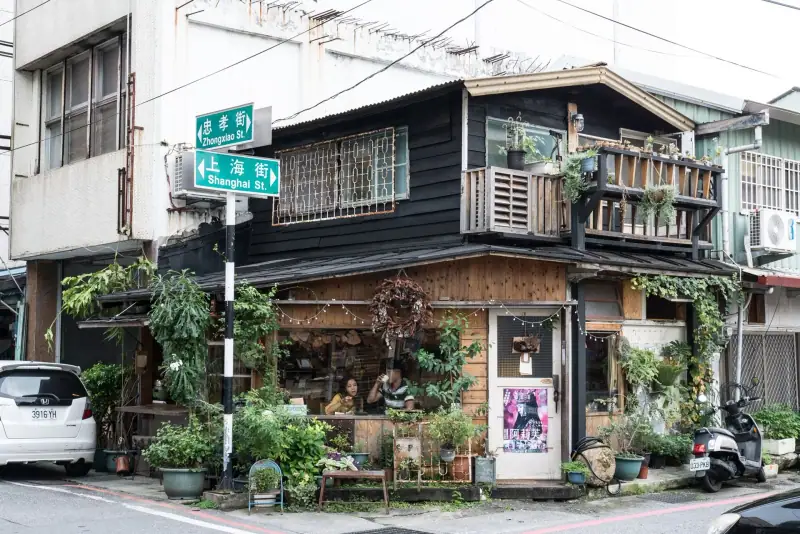
Visiting Hualien: a complete guide to the gateway to Taroko
Everything you need to visit Hualien: Taroko, Qixingtan Beach, Dongdamen night market, rafting, Amis culture and practical tips for eastern Taiwan.

Taipei must-sees: the 15 sights not to miss
Taipei's top sights: Taipei 101, Longshan Temple, the National Palace Museum, night markets and trendy districts. A full sightseeing guide.
Ready-made
Taiwan itineraries
10 days
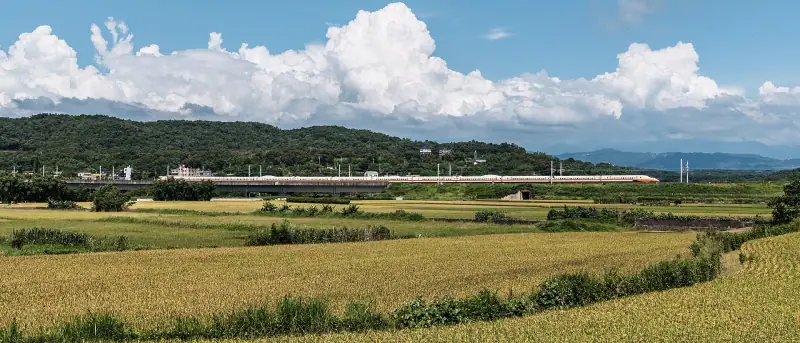
Taiwan in 10 days without a car: train and HSR itinerary, stops and travel times
TaipeiSun Moon LakeTainanKaohsiungKentingHualien
5 days
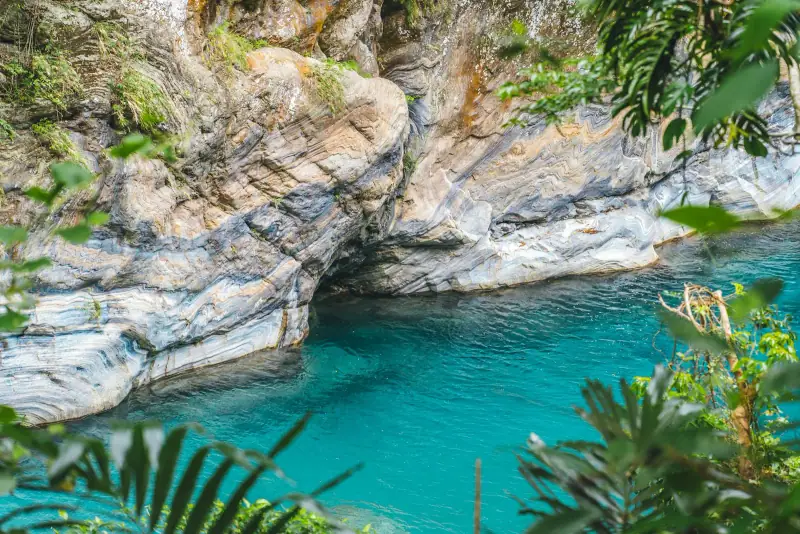
Eastern Taiwan road trip: the Pacific coast and Taroko Gorge
A complete guide to a road trip in eastern Taiwan: Taroko Gorge, Hualien, the Rift Valley, Highway 11 and Taitung in 5 to 7 days.

7 days
Taiwan in 7 days: the perfect itinerary for a first trip
TaipeiHualienSun Moon LakeTainan