Itineraries
Sri Lanka east coast road trip: from Trincomalee to Arugam Bay
We may earn a commission when you book through links on this page, at no extra cost to you. We don't visit or try the places we cover: we summarize published sources. How we work
Day by day
- Days 1-3Trincomalee: Koneswaram temple, Fort Frederick, Nilaveli and Pigeon Island
- Day 4Coastal drive to Batticaloa, stop at Passekudah Beach
- Day 5Batticaloa: Dutch fort, lagoon and markets
- Days 6-10Arugam Bay: surf, parks, wild beaches and sunsets
Weather through the year on this route
| Jan | Feb | Mar | Apr | May | Jun | Jul | Aug | Sep | Oct | Nov | Dec | |
|---|---|---|---|---|---|---|---|---|---|---|---|---|
| High °F (°C) | 8429 | 8731 | 8932 | 8831 | 8630 | 8429 | 8530 | 8530 | 8530 | 8429 | 8429 | 8329 |
| Low °F (°C) | 7222 | 7323 | 7524 | 7826 | 7826 | 7625 | 7625 | 7625 | 7625 | 7625 | 7424 | 7323 |
Normals 1991–2020 at Tissamaharama and Colombo: averages over 30 years, not a forecast. Source: NASA POWER (MERRA-2), grid of about 50 km. Figures computed by us in November 2026. Rain is shown only where a weather station confirms the figures.
In short
- The route follows the east coast north to south for about 280 km (174 mi): Trincomalee (days 1-3), Batticaloa (day 5) and Arugam Bay (days 6-10).
- Best season is April to September, with a peak in June-August; avoid November to February (northeast monsoon, heavy rain and rough seas).
- Trincomalee to Batticaloa is about 130-138 km (81-86 mi), 2 h 30 to 3 h; Batticaloa to Arugam Bay about 119-120 km (74-75 mi), 2 h to 2 h 30.
- A rental car or motorbike is the most flexible option; book Arugam Bay well ahead for July-August.
Sri Lanka’s east coast is one of the island’s big surprises. Less visited than the Cultural Triangle or the southern beaches, it reveals a Sri Lanka that is less polished and wilder, where immense white-sand beaches are often almost deserted, where Tamil and Sinhalese fishing villages coexist among coconut palms and lagoons, and where the Indian Ocean rolls in regular swells that make it one of the best surfing grounds in South Asia.
This road trip from Trincomalee to Arugam Bay follows the east coast from north to south over about 280 km (174 mi). It crosses three worlds: the great port of Trincomalee with its temples and magnificent bay, the lagoon city of Batticaloa with its culture and its singing fish, and finally Arugam Bay, the cosmopolitan surf village with a unique energy between beach relaxation and wild nature. It is best done between April and September, when the east coast is dry while the west begins to get monsoon rains.
The itinerary at a glance
Here is the outline of the road trip, from north to south:
Days 1-3: Trincomalee. Ideal starting point, with its Koneswaram temple, colonial fort, beaches and Pigeon Island.
Day 4: Drive to Batticaloa. About 130-138 km (81-86 mi) and 2 h 30 to 3 h of coastal road, with the option of a stop at Passekudah Beach.
Day 5: Batticaloa. A day in the city of lagoons, its Dutch fort and its markets.
Days 6-10: Arugam Bay. The star of the east coast. Surf, nature parks, wild beaches and sunsets.
Rent a car for the east coast
The east coast is ideally discovered by car. Compare local and international rental companies for your road trip.
Trincomalee: the northern gate of the east coast
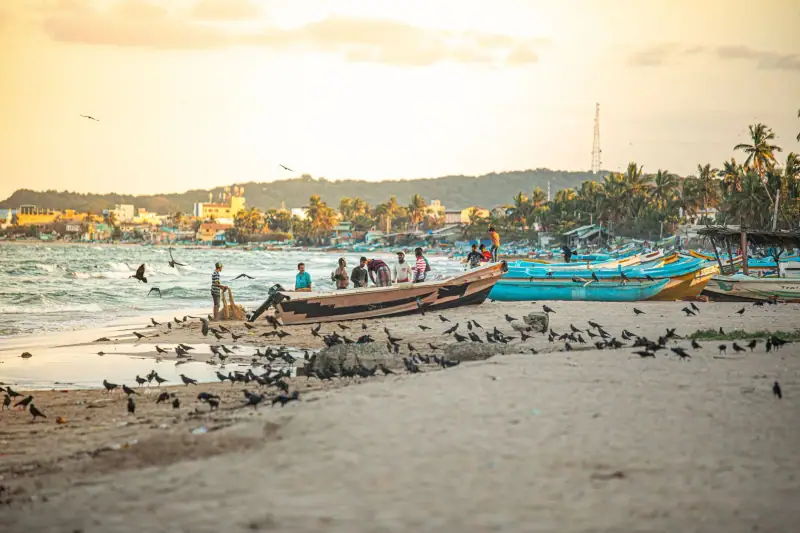
Trincomalee (“Trinco” to locals) is one of the largest natural harbors in the world. The bay is so vast, so sheltered and so deep that it was coveted by every colonial power in the region: Portuguese, Dutch and British succeeded one another here for three centuries. The town keeps the traces of these layered passages.
Our complete guide to Trincomalee details all the sites. Here are the essentials for this road trip.
Koneswaram temple
Built on Swami Rock, a cliff jutting into the sea at the eastern end of town, the Hindu temple of Koneswaram is one of the most impressive sites in Sri Lanka. Entry is free (an offering is welcome), and the view from the cliff over Trincomalee bay is breathtaking. It is the ideal place to watch the sunset. Dress respectfully (shoulders and knees covered).
Fort Frederick
Fort Frederick, built by the Portuguese in the 17th century and later modified by the Dutch and the British, occupies the tip of the Swami Rock headland. The Koneswaram temple stands inside the fort’s walls themselves: the two sites form a single whole on the same cliff above the sea. Still an active military base today, the fort is partly open to visitors. The colonial cannons pointed at the bay and the views over the town make it an interesting visit, especially to understand Trincomalee’s strategic history.
Nilaveli Beach and Pigeon Island
About 15 km (9 mi) north of central Trincomalee, Nilaveli beach is one of the most beautiful in Sri Lanka: several kilometers of immaculate white sand, shallow calm water perfect for swimming, and a relaxed atmosphere with a few guesthouses and seaside restaurants. This is where boats leave for Pigeon Island, a marine national park where snorkeling is remarkable, with corals still in good health, sea turtles and tropical fish in abundance. Pigeon Island is ideal in the morning, before the sea picks up.
Practical information for Trincomalee:
- Getting there from Colombo: about 260 km (162 mi), 5 to 6 hours by road (via Dambulla) or by direct bus (duration varies with stops)
- Trincomalee’s domestic airport has seasonal flights from Colombo, much faster
- Varied accommodation: a few mid-range hotels in the center, family guesthouses around Nilaveli Beach
Places to stay in Trincomalee
From a simple beach bungalow to a hotel with a bay view, book your Trinco accommodation before high season.
The coastal road to Batticaloa
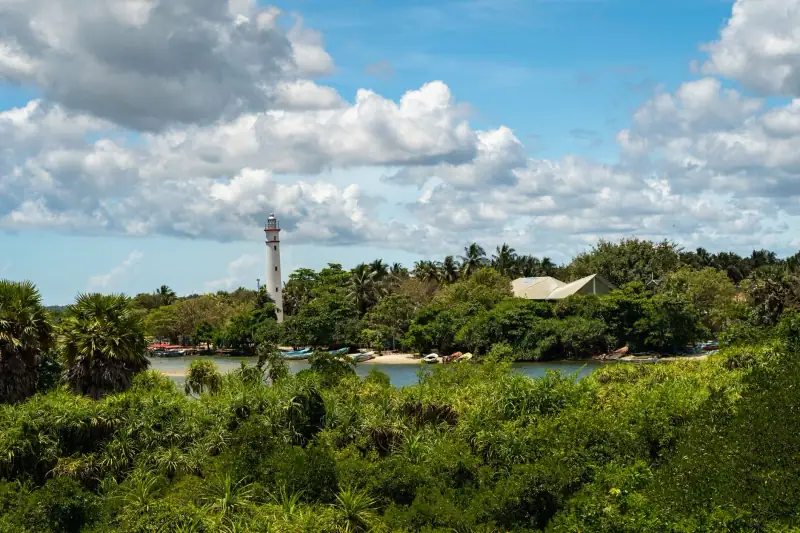
The stretch of road between Trincomalee and Batticaloa (about 130-138 km / 81-86 mi) is one of the most beautiful on the island, but also one of the least touristy. The road runs along the coast through fishing villages, lagoons dotted with water birds and coconut groves as far as the eye can see.
Passekudah Beach: a worthwhile stop
Passekudah bay, much closer to Batticaloa (about 35 km / 22 mi) than to Trincomalee (about 110 km / 68 mi), is an obvious stop. This crescent beach is protected by a natural reef that creates shallow water almost without waves, like a natural lagoon. Swimming is risk-free and the sandy bottom is ideal for children or swimmers uncomfortable in swell. A handful of resorts and guesthouses have appeared here in recent years, taking advantage of the beauty of the site.
Allow about 2 hours from Trincomalee to Passekudah, and another 45 min to Batticaloa.
Batticaloa: the city of the singing fish
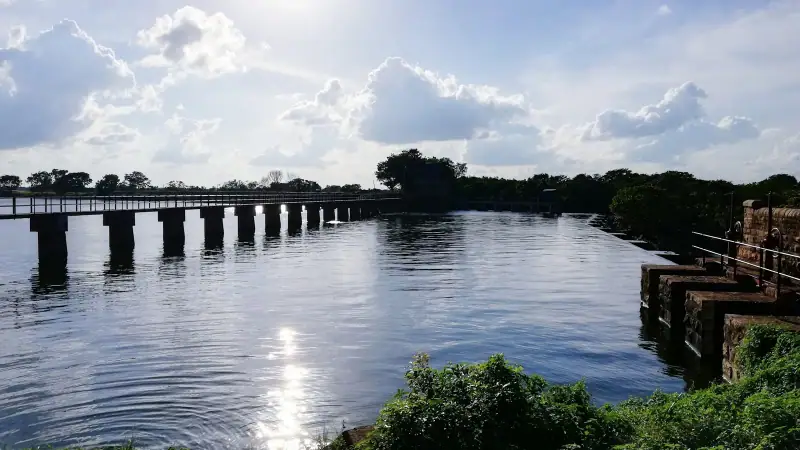
Batticaloa is a fishing and lagoon city, less visited by foreign travelers than Trincomalee or Arugam Bay, but with a strong cultural identity. The population is mostly Tamil, and the city was one of the hardest hit by the 2004 tsunami and decades of civil conflict. Rebuilt today, it has a quiet, almost melancholic atmosphere, well suited to observing local life.
Batticaloa Fort
Built by the Portuguese between 1622 and 1628, then captured and renovated by the Dutch from 1638, Batticaloa Fort stands on an island between the lagoon and the sea and is the symbol of the city. Today it houses administrative offices, but its ramparts and bastions remain accessible to visitors. The view over the lagoon from the fort walls is peaceful and photogenic.
The “singing fish” phenomenon
Batticaloa is known throughout Sri Lanka for its mysterious “singing fish”: on certain full-moon nights, between May and September, musical sounds seem to come from the bottom of the lagoon. The phenomenon has been documented for centuries (European travelers left descriptions of it as early as the 19th century, in the 1840s) and remains scientifically unexplained to this day. Some scientists attribute it to mollusks or fish producing sounds during reproduction. Locals sometimes offer boat trips on full-moon nights to listen to it.
The lagoon and its birds
The vast Batticaloa lagoon, separated from the sea by a narrow strip of land, is a remarkable ecosystem. Depending on the season, you can see flamingos, pelicans, herons, cormorants and kingfishers. A boat trip at sunrise is one of the best experiences in the city.
How long to stay in Batticaloa? One night is enough for most travelers. Bird lovers or fans of Tamil culture can make it a 2-night stop.
Arugam Bay: surf and nature paradise
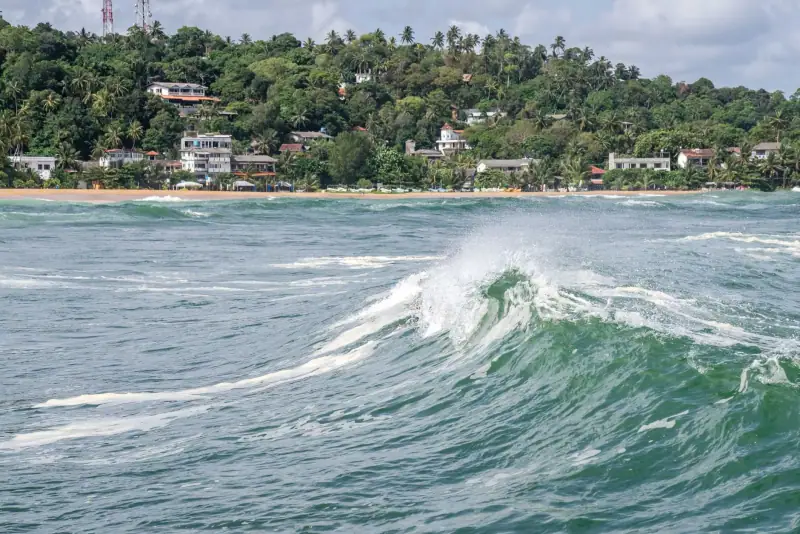
Arugam Bay (“A-Bay” to regulars) is one of South Asia’s great surf destinations. This fishing village, transformed by decades of beach tourism, has kept a human scale and a relaxed atmosphere that the big resorts no longer have. The main street crosses a thin strip of land between the lagoon and the sea, lined with cafés, surf schools, guesthouses and a few craft shops.
The distance between Batticaloa and Arugam Bay is about 119 to 120 km (74-75 mi), or about 2 h to 2 h 30 by road.
Surfing in Arugam Bay
Arugam Bay’s main spot, known as “Main Point”, is a long right that breaks regularly between June and September. It is one of the most consistent surf spots on the Indian subcontinent, regularly ranked among the best in Asia in specialist magazines. Intermediate to advanced surfers will find quality waves on well-formed swells.
For beginners, the main bay offers gentler waves and several surf schools offer suitable lessons. The ideal season to learn is the start of the season (April-June) before the swells gain power.
Other spots to explore:
- Whiskey Point (about 12 km / 7 mi north of Arugam Bay, in Urani village, ~15-20 min by tuk-tuk): a gentler spot, often recommended for beginners and longboarders
- Pottuvil Point (about 4-6 km / 2-4 mi north): a more exposed spot, for experienced surfers
- Elephant Rock: a reef break spot for the most advanced
Surf lessons and activities in Arugam Bay
Surf lessons for all levels, safari excursions and snorkeling near Arugam Bay.
Arugam Bay lagoon and its crocodiles
The lagoon bordering the west side of Arugam Bay is one of the strangest and most fascinating places on the east coast. It shelters a large population of mugger crocodiles (Crocodylus palustris), visible from the banks or on a boat trip. Locals know and respect them, and guided outings let you watch them safely. The lagoon is also a key habitat for many birds: purple herons, ibises, egrets and kingfishers rub shoulders in the mangroves.
Kumana National Park
About 20-25 km (12-16 mi) south of Arugam Bay, Kumana National Park (formerly Yala East) is one of Sri Lanka’s best-kept secrets. This park, little visited by foreigners, shelters remarkable wildlife: leopards, elephants, sloth bears, wild buffalo and a water bird nesting colony considered one of the most important in South Asia. The park is best known for its migratory birds (the nesting season is between April and July) but jeep safaris can offer leopard encounters at any time of day.
Practical information for Kumana:
- Safaris are done by jeep with a mandatory guide (book through Arugam Bay operators)
- Paid entry (national rates for foreigners)
- Leave early in the morning (sunrise) or late in the afternoon to maximize the chances of seeing wildlife
- The road between Arugam Bay and Kumana is partly a dirt track, so a 4x4 is preferable
Pottuvil beach
The village of Pottuvil, a few kilometers north of Arugam Bay, has its own long, windy beach, much less crowded than the main bay. Fishermen take their boats out early in the morning, and the atmosphere is that of an authentic coastal village. It is a peaceful spot for a morning walk before the surfers’ crowds.
Where to sleep on the east coast
Trincomalee
Accommodation in Trincomalee has improved in recent years, with a few mid-range hotels in the center and a growing number of guesthouses around Nilaveli Beach. The Nilaveli area is nicer to sleep in than the busy city center: choose accommodation within walking distance of the beaches to enjoy the sunsets. See our Trincomalee accommodation guide for a detailed selection.
Batticaloa
The offering is more limited in Batticaloa, dominated by a few local hotels in the center and family guesthouses. The city is mainly a one-night stop before Arugam Bay.
Arugam Bay
Arugam Bay has a complete range of accommodation for all budgets. Family guesthouses a few dozen meters from the beach are the most popular for their value. A few boutique hotels and mid-range resorts have opened in recent years to meet growing demand. Definitely book ahead in high season (July-August), as the best places are full several weeks in advance.
Places to stay in Arugam Bay
Surfers' guesthouses, bungalows facing the sea and peaceful resorts in Arugam Bay.
Getting to the east coast from Colombo
The east coast is the part of Sri Lanka that takes the longest to reach from Colombo airport. Here are the main options:
By car or bus (Colombo to Trincomalee): About 260 to 280 km (162-174 mi) by road, or 5 to 6 hours depending on traffic and the route chosen. The most common route goes through Kandy, then Dambulla and Habarana, crossing the Cultural Triangle.
By train (Colombo to Trincomalee): A direct night train links Colombo to Trincomalee with several departures a week. The journey takes about 7 to 8 hours, but the night train saves time by letting you sleep on the way. Tickets are booked ahead.
By domestic flight: Flights between Colombo (Ratmalana) and Trincomalee are operated in some seasons by Sri Lankan domestic airlines. Check availability before leaving.
Colombo to Arugam Bay directly: About 390-400 km (242-249 mi) and 7 to 8 hours by road (via Pottuvil). Direct buses leave from Colombo, but the duration is considerable. Most travelers break the trip with a night in Kandy or Ella along the way.
To organize the logistics of your trip, see our complete Sri Lanka road trip, which includes the east coast in a circuit of the island.
Food on the east coast
The east coast is a region with a strong Tamil culture, which is reflected in the food. You will discover dishes here that the center or south of the island may have served you in modified versions, but here in their most authentic expression.
Hoppers (appam): Small bowl-shaped fermented-rice pancakes, crispy at the edges and soft in the center, served with curry, sambols and sometimes an egg cracked in the middle. The classic east coast breakfast.
Kottu roti: Flatbread cut with a cleaver on the griddle with vegetables, eggs and meat or seafood. The characteristic sound of kottu, the clatter of metal knives on the griddle, is the soundtrack of any street in Trincomalee or Batticaloa in the evening.
Fresh fish: Naturally, the east coast is a paradise for seafood. Tuna, trevally, prawns, spiny lobster (in season): seaside restaurants offer the catch of the day grilled or prepared as a curry. In Arugam Bay, restaurants have blended Sri Lankan recipes and Western travelers’ preferences to create a relaxed surf cuisine.
Curd and treacle: Buffalo yogurt (thick and creamy) served with treacle, a thick, slightly caramelized palm syrup. It is the island’s classic dessert, but the east coast produces some of the best versions.
Practical information for this road trip
When to go: The east coast follows a monsoon cycle opposite to the west coast. The dry season runs from April to September, ideally June, July, August. Avoid November to February (northeast monsoon), a period of rain, rough seas and partly closed infrastructure.
Money: ATMs exist in Trincomalee and Batticaloa. In Arugam Bay there are a few, but they can run out of cash in high season. Prefer arriving with enough cash for a few days. Bank cards are accepted in mid-range and upscale accommodation but rarely in small local restaurants.
Health: Ask your doctor or a travel clinic, and see the official travel health pages (CDC in the US, TravelHealthPro in the UK). Mosquitoes are present at dusk and dawn, especially around lagoons. Repellent and long sleeves in the evening are essential.
Safety: The east coast is a peaceful region today. The civil conflict, which heavily affected the region until 2009, belongs to the past. Travelers are welcome. A few areas near the former front lines keep military restrictions, so ask locally before venturing off the established tourist routes.
Internet connection: Good 4G coverage in the three main towns. Outside towns, expect areas without signal. Download your offline maps (Maps.me or Google Maps) before leaving.
Indicative budget: The east coast is generally cheaper than the south coast or the Cultural Triangle. A “backpacker” budget of €25 to 40 (about $29 to 46) a day (accommodation + meals + local transport) is realistic. Mid-range, allow €60 to 90 (about $70 to 105) a day. Prices rise noticeably in Arugam Bay in July-August.
To plan your Sri Lanka trip as a whole, see our south coast vs east coast comparison and our guide to the best time to visit Sri Lanka.
The east coast remains one of the lesser-known faces of Sri Lanka, the one hurried travelers too often skip. Taking the time to follow its wild beaches, to listen to the night sounds on Batticaloa lagoon, to watch a surfer catch the perfect wave at Arugam Bay at sunset: it is another dimension of the island, calm, authentic and memorable.
Frequently asked questions
What is the best time for the east coast road trip?
The east coast dry season runs from April to September, with a peak in June-August. It is exactly the opposite of the west coast (which enjoys good weather from November to April). Avoid the east coast from November to February, the northeast monsoon period that brings heavy rain and rough seas.
How long does this east coast road trip take?
Allow at least 7 days to cover the essentials: 2 nights in Trincomalee, 1 night in Batticaloa and 4 nights in Arugam Bay. With 10 days, you can add excursions to the national parks, half days at Pigeon Island or Kumana, and take time to settle on the beaches.
How do you get around Sri Lanka's east coast?
The east coast is better covered by road than by train. Renting a car or motorbike is the most flexible way: coastal roads are generally in good condition between Trincomalee and Arugam Bay. Local buses link the main towns but schedules are irregular and journeys long. A private driver is comfortable for the long stages between towns.
Is Arugam Bay suitable for beginner surfers?
Yes, Arugam Bay has options for every level. The main spot (Main Point) is reserved for intermediate and advanced surfers, with a powerful right. But the main bay, with its softer waves, suits beginners perfectly. Many surf schools offer private or group lessons for newcomers. The ideal season to learn is June-July before the swells become too powerful.
Is there wildlife to see on the east coast?
Absolutely. Kumana National Park (south of Arugam Bay) is one of the most important bird refuges in South Asia and also shelters leopards, elephants and crocodiles. Wasgamuwa park, reachable from Batticaloa or Trincomalee, is renowned for its elephants. Batticaloa lagoon is a habitat for flamingos (depending on the season) and many water birds.
Do you need a visa to visit Sri Lanka?
Entry rules, including any electronic travel authorization (ETA), depend on your passport. Check the official travel advice of your government before you book: travel.state.gov (US), GOV.UK (UK), travel.gc.ca (Canada), Smartraveller (Australia) (checked November 2026). Where an ETA applies, it is requested online on the official Sri Lankan government site before departure.
How is the internet connection on the east coast?
4G coverage is decent in the main towns such as Trincomalee, Batticaloa and Arugam Bay. In rural areas between towns and in the national parks, the signal can be absent. Local SIM cards (Dialog, SLT-Mobitel) are very cheap and can be found at Colombo airport and in towns. Buy a SIM card on arrival, or check your carrier's international plan or use a travel eSIM.
More Sri Lanka guides
Keep reading
Hiking in Sri Lanka: the most beautiful trails
The best hikes in Sri Lanka: Adam's Peak, Ella Rock, Horton Plains, the Knuckles. Practical guides, difficulty levels and tips for each trek.
Negombo or Colombo: where to sleep near the airport in Sri Lanka?
Early or late flight in Colombo? Negombo vs downtown compared: distances, travel times, hotel prices and tips to choose well.
Diving and snorkeling in Sri Lanka: the best spots
The best diving and snorkeling spots in Sri Lanka: Pigeon Island, Hikkaduwa, Trincomalee, the Great Basses. Complete guide for divers and beginners.
Ready-made
Sri Lanka itineraries
10 days
Sri Lanka in 10 days with kids: stops and pace
NegomboSigiriyaKandyHikkaduwa
Can be adapted in the planner
14 days
Sri Lanka road trip: a 2-week itinerary by car
14-day Sri Lanka road trip: complete itinerary with the Cultural Triangle, Hill Country and south coast. By car, with or without a driver.