Where to stay
Where to Stay in Nuoro: The Best Neighborhoods and Accommodation
We may earn a commission when you book through links on this page, at no extra cost to you. We don't visit or try the places we cover: we summarize published sources. How we work
In short
- The centro storico is the most practical base: museums, restaurants and shops are on foot. Seuna is quieter, with views, on the slopes of Monte Ortobene.
- Nuoro is much cheaper than coastal towns: about €60 to 120 (about $70 to 140) for a good hotel or B&B in July and August.
- A car is strongly recommended: Olbia airport is about 100 to 110 km (62 to 68 mi) away and Cagliari about 180 km (112 mi).
- For farm stays, Barbagia agriturismi cost about €70 to 120 (about $81 to 140) a night with half board; book 6 to 8 weeks ahead in summer.
Nuoro is a town apart in Sardinia. Perched at about 550 m (1,800 ft) in the heart of the island, far from glitzy beaches and luxury marinas, it is the cultural and administrative capital of the Barbagia, that mountainous inland region that long lived apart from the outside world and forged a Sardinian identity of rare authenticity.
This is where Grazia Deledda, winner of the 1926 Nobel Prize in Literature, was born; her novels describe the life of the shepherds, peasants and women of the Barbagia with striking precision. This is where the most complex traditional costumes of Sardinia are still made, preserved and displayed at the Museo Nazionale del Costume. And this is where the roads start that lead to the Gorropu gorge, the hilltop villages of Orgosolo with its famous murals, and hikes in the Gennargentu massif.
But where should you stay in Nuoro to make your visit both comfortable and immersive? This guide goes through the different neighborhoods, the types of lodging available and practical tips by traveler profile.
Where to stay in Nuoro: the neighborhoods
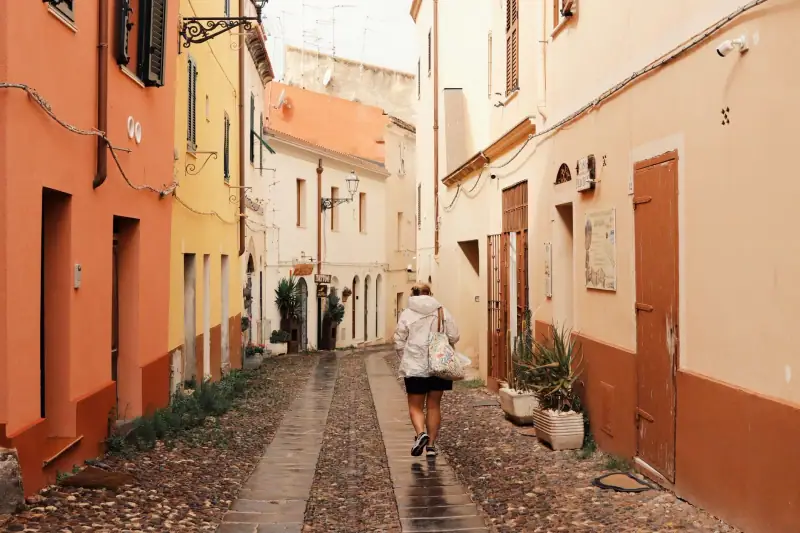
Nuoro is a human-sized town, with about 32,700 inhabitants, which makes its historic part easy to cover on foot. Lodging is concentrated in a few key areas.
Centro storico: in the heart of Nuorese life
The historic heart of Nuoro, which stretches around Corso Garibaldi and Piazza Satta, is the most practical area to stay in. Here you find the town’s emblematic museums, the Museo della Vita e delle Tradizioni Popolari Sarde (Museo del Costume) on Via Mereu and the birthplace of Grazia Deledda, along with the best restaurants, craft shops and the cafés where the Nuoresi start their day with an espresso and a shot of mirto.
Sleeping in the centro storico means access to local life on foot, with no car needed for daily movements. The covered market, the delicatessens selling Barbagia products (pecorino, bottarga, salumi), and the pizzerias and restaurants serving Sardinian ravioli (culurgiones) and wood-fired meats (arrosto) are all a few minutes’ walk away.
Pros:
- On-foot access to museums, restaurants and shops
- Authentic local atmosphere, far from mass-tourism areas
- Decent choice of B&Bs, small hotels and apartment rentals
- Practical starting point for excursions in the Barbagia
Cons:
- The town is at altitude (about 550 m / 1,800 ft): streets can be steep
- Parking is paid or difficult on the most central streets
- Lodging is more limited than in Cagliari or Alghero
Best for: Curious travelers, fans of Sardinian culture and heritage, a base for exploring the Barbagia.
Seuna: panoramic views and calm
The Seuna neighborhood is in the upper part of Nuoro, on the slopes of Monte Ortobene, which overlooks the town. This residential area, less touristy than the centro storico, offers panoramic views over the town’s rooftops and the wooded hills of the hinterland. You find a few B&Bs and family guesthouses, generally quieter and often run by residents who know the region well.
The climb up Monte Ortobene (about 955 m / 3,133 ft), which peaks with the famous statue of the Redeemer (Cristo Redentore, by the Calabrian sculptor Vincenzo Jerace, inaugurated in 1901), starts in effect from this area. Forests of holm oak offer pleasant walks a few minutes from the center.
Pros:
- Views of the town and the Barbagia
- Residential, quiet atmosphere, away from the bustle of the center
- Close to Monte Ortobene for hikers
- Often more affordable than the heart of the centro storico
Cons:
- A car or excellent fitness is needed to get down to the lower town
- Less nightlife and fewer restaurants close by
- Very limited lodging
Best for: Hikers, couples looking for calm, travelers who want to escape the bustle of the town center.
Hotels in Nuoro
Compare availability and book with free cancellation.
Outskirts and nearby countryside
The peri-urban area of Nuoro, within a radius of 5 to 10 km (3 to 6 mi), mixes housing, olive groves and the first patches of Barbagia scrub. You find a few agriturismi and rural houses for rent that let you sleep in a natural setting while staying a short distance from the town center. Access is by car only.
Pros:
- Green, natural setting
- Absolute calm
- Often rooms with a terrace and views of the hills
- Very competitive prices off season
Cons:
- A car is essential
- Few shops and restaurants nearby
- Possible feeling of isolation if you have no transport
Best for: Couples looking to get away, travelers with a car, short relaxing stays.
Oliena and Orgosolo: neighboring villages as an alternative
Although technically separate from Nuoro, the neighboring municipalities of Oliena (about 10 km / 6 mi to the southeast) and Orgosolo (about 20 km / 12 mi to the south) are very interesting alternatives for staying while exploring the region.
Oliena is a wine village known for its red Cannonau, nestled at the foot of the Supramonte massif. The atmosphere is that of an authentic Sardinian village, with lively craft production and hiking trails that start right from the village toward the Gorropu gorge.
Orgosolo is famous throughout Italy for its political and social murals (more than 150 murals can be seen in the village), witnesses to the social history of the Barbagia. Sleeping in Orgosolo lets you see the murals at dawn or dusk, when the day visitors have left.
Types of lodging in Nuoro and the Barbagia
B&Bs and guesthouses
This is the most common form of lodging in Nuoro and the surrounding villages. Nuorese B&Bs are often run by families or individuals who offer 2 to 6 rooms, a homemade breakfast (Sardinian bread, local cheeses, jams, traditional cakes) and valuable knowledge of the area. The welcome is generally warm and personal, a real plus when you want to soak up the local culture.
Indicative budget: between €50 and 90 a night (about $58 to 105) for a double room in a centro storico B&B, depending on the season and amenities.
Small hotels and town hotels
Nuoro has a few 3-star hotels in and around the centro storico, with basic services (reception, air conditioning, parking often available nearby). These properties suit travelers who want a practical night without seeking a particular experience. Prices stay reasonable compared with the coast: between €70 and 130 a night (about $81 to 150) in July and August for a decent 3-star.
Car rental in Nuoro
Essential for exploring the Barbagia, Orgosolo, the Gorropu gorge and the Cala Gonone coast.
Barbagia agriturismi
Agriturismi are the emblematic lodging of inland Sardinia. In the Barbagia, they often offer rooms decorated with traditional Sardinian textiles and pottery, a dinner based on farm produce (local pecorino and ricotta, wood-fired suckling pig, su porceddu, fresh pasta, cured sausages), and sometimes activities such as learning about pastoral techniques or transhumance.
The best agriturismi are often a few kilometers from Nuoro, in the municipalities of Mamoiada, Orgosolo, Oliena or Ovodda. Booking ahead is recommended in July and August because capacity is limited. Generally expect between €70 and 120 a night (about $81 to 140) with half board, which is excellent value given how rich the evening meal is.
Vacation rentals and apartments
For week-long stays or for families, apartments for rent in Nuoro’s centro storico give you a kitchen and more independence. Rental platforms offer entire homes from €50 to 80 a night (about $58 to 93) for 2 people outside high season, more in July and August.
Village houses in Barbagia towns
Some travelers choose to rent a house or rural gîte in a Barbagia village such as Mamoiada, Aritzo or Tonara to immerse themselves fully in local life. This option is ideal for stays of several days in the region, with a car, and for those who want to live where the classic tourist flows almost never arrive.
Comparison of areas: summary table
| Area | Atmosphere | Average budget | Best for |
|---|---|---|---|
| Centro storico | Lively, cultural | €60-130/night (~$70-150) | Culture, museums, food |
| Seuna / Monte Ortobene | Nature, panorama | €50-90/night (~$58-105) | Hikers, calm |
| Oliena | Wine village, authentic | €60-100/night (~$70-115) | Wine, Supramonte |
| Orgosolo | Art, history | €50-90/night (~$58-105) | Murals, deep Barbagia |
| Barbagia agriturismo | Rural, food-focused | €70-120/night half board (~$81-140) | Cuisine, Sardinian experience |
To prepare your itinerary in the Barbagia, see our guide to visiting Nuoro and our suggestions for hiking in Sardinia.
Activities and excursions from Nuoro
Gorropu gorge, Orgosolo, hikes in the Gennargentu, Barbagia villages.
When to book and at what price
Seasonality in Nuoro differs from that of the coastal towns. Tourist pressure is lower, but a few periods deserve attention.
July-August (high season): This is the busiest period, notably because of the many Sardinians from the region who come back to spend the summer with family, the patron saint festivals of the Barbagia villages and cultural festivals. Temperatures in town can exceed 35 °C (95 °F) during the day, but nights stay cool at altitude. Agriturismi fill up fast: book at least 6 to 8 weeks ahead for the best places.
June and September (shoulder season): These are the recommended periods. The heat is bearable (25 to 30 °C / 77 to 86 °F), the Barbagia landscapes are beautiful, and lodging is available at prices 20 to 30% lower than in August. In September, the vines begin to turn red around Oliena and the grape harvest brings some fine moments of local life.
November to April (low season): Nuoro stays alive all year: it is a lived-in town, not a seasonal resort. Winter can be cold (snow is possible in the Gennargentu) but the town keeps its activity. The Sardinian Carnival (Carnevale), with its processions of traditional masks (notably the Mamuthones of Mamoiada), takes place in February-March and is one of the most fascinating cultural events in Sardinia. Lodging then offers its lowest rates and availability is wide open.
Practical tips for a good stay in Nuoro
Take a car. It is unavoidable for exploring the Barbagia. Nuoro has no airport of its own; the closest are Olbia (about 100 to 110 km / 62 to 68 mi, 1 h 15 to 1 h 30 by road) and Cagliari (about 180 km / 112 mi, 2 h to 2 h 15). Pick up your rental car at the airport as soon as you arrive.
Plan for Monday closures. In inland Sardinia, many museums and cultural sites are closed on Mondays (and sometimes on Sunday afternoons). Check the opening hours of the Museo del Costume and the Grazia Deledda house before planning your day.
Respect local codes. The Barbagia is a region with strong attachment to its traditions and identity. The welcome is warm, but it has to be earned. A minimum of sincere curiosity about local culture (its costumes, its cooking, its craftspeople) opens many doors.
Bring cash. Outside the centro storico of Nuoro and tourist establishments, many small businesses (grocers, markets, some agriturismi) still work mainly in cash. Make sure you have some on hand.
Check the air conditioning in summer. In July and August, temperatures can be high in town (35 °C / 95 °F or more in the afternoon). Air conditioning is essential to sleep comfortably. Confirm it is included in your room and check that it works properly.
Book agriturismo dinner in advance. If you plan to have dinner at a Barbagia agriturismo (a highly recommended experience), note that most work by reservation and prepare a set number of meals per evening. Not booking, especially in summer, risks leaving you without a table.
To plan your whole stay in Sardinia, see our complete guide to Sardinia and our article on the Barbagia and its villages.
Flights to Sardinia
Compare flights to Cagliari or Olbia, the two airports closest to Nuoro.
Recommendation by traveler profile
You come for Sardinian culture → Choose a B&B or small hotel in the centro storico of Nuoro. You are within walking distance of the museums, traditional restaurants and local life. Plan at least two nights so you do not have to rush.
You are planning a road trip in the Barbagia → A base in an agriturismo between Nuoro and Oliena is ideal. Each day you head out to a different village (Mamoiada, Orgosolo, Aritzo, Tonara) and return in the evening for a meal by the fire.
You want to combine mountains and sea → Sleep two nights in Nuoro (or in the Barbagia), then go down to Dorgali or Cala Gonone for two beach nights. The Ogliastra coast is about 40 km (25 mi) from Nuoro.
You are in Sardinia for Carnival → Book in Mamoiada or a Barbagia village for the February-March Carnival. The Mamuthones, the Issohadores and the other masks of the Sardinian tradition are among the most impressive ethnographic spectacles in the Mediterranean.
You are on a tight budget → Nuoro is one of the most affordable destinations in Sardinia. A centro storico B&B can be found for €50 to 70 a night (about $58 to 81) off season, and half-board agriturismi at around €80 to 100 (about $93 to 115) all included offer unbeatable value. Avoid July and August if you can: June or September will give you the same experience for less.
Nuoro is the gateway to a Sardinia that most travelers never see: an island within the island, mountainous, proud, quietly generous. Choosing to sleep there rather than just pass through means agreeing to take your time. And that time is almost always rewarded.
Frequently asked questions
What is the best neighborhood to stay in Nuoro?
The centro storico is the most practical choice: museums, restaurants, shops and the feel of the city are all on foot. For a more nature-oriented, authentic stay, agriturismi in the immediate surroundings of the Barbagia (Oliena, Orgosolo) offer total immersion in inland Sardinian culture.
Is Nuoro worth sleeping in, or is it just a stopover?
Nuoro deserves one or two nights. The town has the Museo Nazionale del Costume, the Grazia Deledda museum and an old town with a strong character. It is also the ideal base for trips to Orgosolo (about 20 km / 12 mi), the Gorropu gorge and the Ogliastra coast.
Do you need a car to stay in Nuoro?
A car is strongly recommended to explore the surroundings. In town, the centro storico can be covered on foot, but to reach Orgosolo, Oliena, Dorgali or the coast at Cala Gonone, a car is essential. Regional ARST public transport exists but timetables are limited.
Are hotels expensive in Nuoro?
Nuoro is much cheaper than Sardinia's coastal towns. In high season (July-August), expect generally €60 to 120 (about $70 to 140) for a good hotel or B&B in the centro storico. Since the town is above all a cultural and nature destination, tourist pressure stays moderate compared with Olbia or Alghero.
What is the best time to visit Nuoro?
May-June and September-October are ideal: pleasant temperatures (20 to 28 °C / 68 to 82 °F), green or golden Barbagia landscapes, traditional festivals (notably Carnival in late winter and spring). Summer (July-August) is hot (sometimes over 35 °C / 95 °F in town), but it is also the season of patron saint festivals and local sagre. Winter is mild but some agriturismi close.
How do I reach Nuoro from Sardinia's airports?
From Olbia airport (about 100 to 110 km / 62 to 68 mi), allow 1 h 15 to 1 h 30 by car via the SS131 dcn. From Cagliari (about 180 km / 112 mi), about 2 h to 2 h 15 by car. ARST bus links exist from both cities, but journey times are much longer. A rental car remains the most convenient solution.
Can you explore the coast from Nuoro?
Yes, Nuoro is about 40 km (25 mi) from Cala Gonone (beaches and coves of the east coast) and about 30 km (19 mi) from Dorgali. This central position between the mountains and the sea makes Nuoro a versatile base for discovering both the Barbagia and the Ogliastra.
More Sardinia guides
Keep reading
Where to Stay on the Costa Smeralda: Hotels and Villages Guide
Find the best place to stay on the Costa Smeralda: Porto Cervo, Baja Sardinia, Porto Rotondo. Luxury hotels, villas and cheaper alternatives.
Where to Stay in Alghero: The Best Neighborhoods and Accommodation
How to choose where to stay in Alghero: historic center, Lungomare, Lido, Fertilia. Pros, tips and budget for your stay in Sardinia.
Where to Stay in Olbia: The Best Neighborhoods and Accommodation
Where to stay in Olbia: city center, port, Pittulongu, Golfo Aranci. Neighborhoods, lodging types and booking tips for Sardinia.
Ready-made
Sardinia itineraries
14 days
Sardinia Road Trip: The Complete Island Loop in 10-14 Days
Plan your Sardinia road trip: a complete 10 to 14 day itinerary, scenic roads, essential stops and driving tips.
7 days
Sardinia in 7 Days: A Complete Itinerary for an Unforgettable Week
7-day Sardinia itinerary: Cagliari, Chia, Ogliastra, nuraghi and Costa Smeralda. A day-by-day plan with practical tips.
5 days
Sardinia in 5 Days by Car: A Realistic Itinerary (Distances and Drive Times)
PalauCastelsardoAlghero