Itineraries
Northern Jordan Road Trip: Amman, Jerash and Ajloun
We may earn a commission when you book through links on this page, at no extra cost to you. We don't visit or try the places we cover: we summarize published sources. How we work
Day by day: 3-day version without Umm Qais
- Day 1Amman: Citadel, Roman Theater, dinner in Jabal Amman
- Day 2Jerash full visit, then Ajloun Castle
- Day 3Ajloun Forest Reserve hike, drive back to Amman
In short
- Plan 3 days minimum for Amman, Jerash and Ajloun; 4 days adds Umm Qais. The full loop is about 250 km (155 mi) by car.
- Distances: Amman to Jerash about 50 km (31 mi), Jerash to Ajloun about 32 km (20 mi), Ajloun to Umm Qais about 55 km (34 mi).
- Entry fees: Jerash 10 JOD, Ajloun Castle 3 JOD, Umm Qais 5 JOD (all included in the Jordan Pass, which starts at 70 JOD).
- Arrive at Jerash at opening (usually 8 am) to have the Oval Forum to yourself; tour buses arrive from 9:30 am.
Northern Jordan is often overshadowed by the country’s stars: Petra, Wadi Rum, the Dead Sea. That is a mistake: this green region holds one of the best-preserved Roman cities in the world, a medieval Arab castle overlooking oak forests, and ancient ruins on a promontory overlooking three countries. A road trip in northern Jordan covers three thousand years of history by car, on winding roads between olive trees and pines.
This 3 to 4-day circuit is a loop from Amman and covers the Amman and the North region: the capital, Jerash, Ajloun, and optionally Umm Qais. It combines well with a stop at the Dead Sea before heading south.
Stage 1: Amman, the gateway to the circuit
Amman is the logistical base for the whole circuit. If you arrive in the evening at Queen Alia airport, settle in one of the central neighborhoods, Jabal Amman or Abdali, and explore the city on your return or for a half day before departure.
What half a day in Amman gets you
If you have a few hours in Amman before heading north, focus on two key stops:
The Citadel (Jabal al-Qal’a) overlooks the whole city from 850 meters (2,790 ft) above sea level. The site holds remains of continuous occupation from the Bronze Age to the Islamic period. The Roman Temple of Hercules (2nd century AD) and the Umayyad Palace (8th century) are the centerpieces. The panoramic view over Amman’s seven hills is worth the climb on its own.
The Roman Theater at the foot of the citadel is one of the best-preserved in the Arab world. Cut into the hillside, it could hold 6,000 spectators. Stepping into the cavea and looking toward the stage gives a concrete idea of the grandeur of Roman Philadelphia.
For a taste of local life, a walk around Rainbow Street or the lanes of Weibdeh gives a glimpse of the modern capital before you dive into antiquity.
Our guide to the highlights of Amman covers the capital in detail if you decide to give it a full day.
Hotels in Amman
Choose your base in Amman for the start of the northern circuit: Jabal Amman, Abdali or Sweifieh depending on your budget.
Logistics tip: pick up the car on arrival
If you rent a car for this circuit (strongly recommended), pick it up as soon as you arrive at the airport. International rental agencies have counters in the arrivals terminal. Driving from your hotel to Jerash early the next morning is far more convenient than crossing Amman by taxi in the morning with your luggage.
Stage 2: Jerash, the Rome of the Middle East
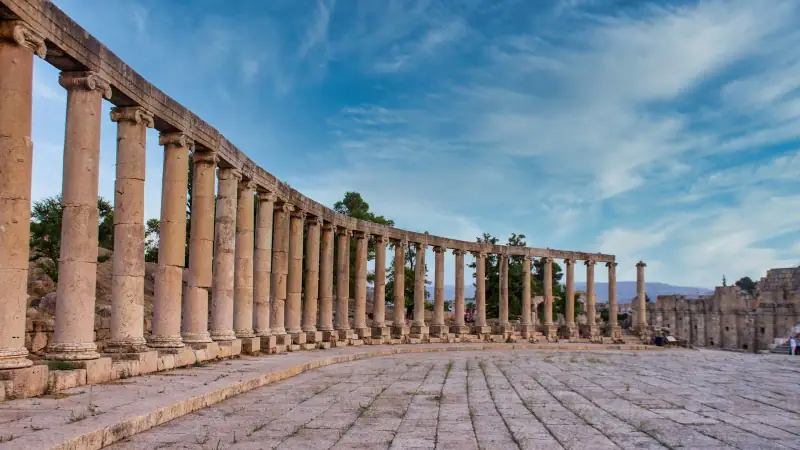
The road from Amman to Jerash first follows the northern suburbs of the capital, then crosses hills planted with olive trees and vines. In 50 km (31 mi) and less than an hour, you go from the concrete of modern Amman to the marble columns of a 2,000-year-old Roman city.
Why Jerash is a must-see
Jerash (ancient Gerasa) was a member of the Decapolis, the league of ten great Greco-Roman cities of the region. It reached its peak between the 1st and 3rd centuries AD, enriched by the caravan trade linking Arabia to the Mediterranean. An earthquake in 749 AD devastated the city, which fell into oblivion for centuries before archaeologists rediscovered it in the 19th century.
Unlike many ancient sites reduced to a few foundations, Jerash offers an almost intact Roman urban fabric: paved streets, standing colonnades, working theaters, monumental forums. The ruts cut into the limestone by Roman cart wheels are still visible underfoot.
The five sites not to miss
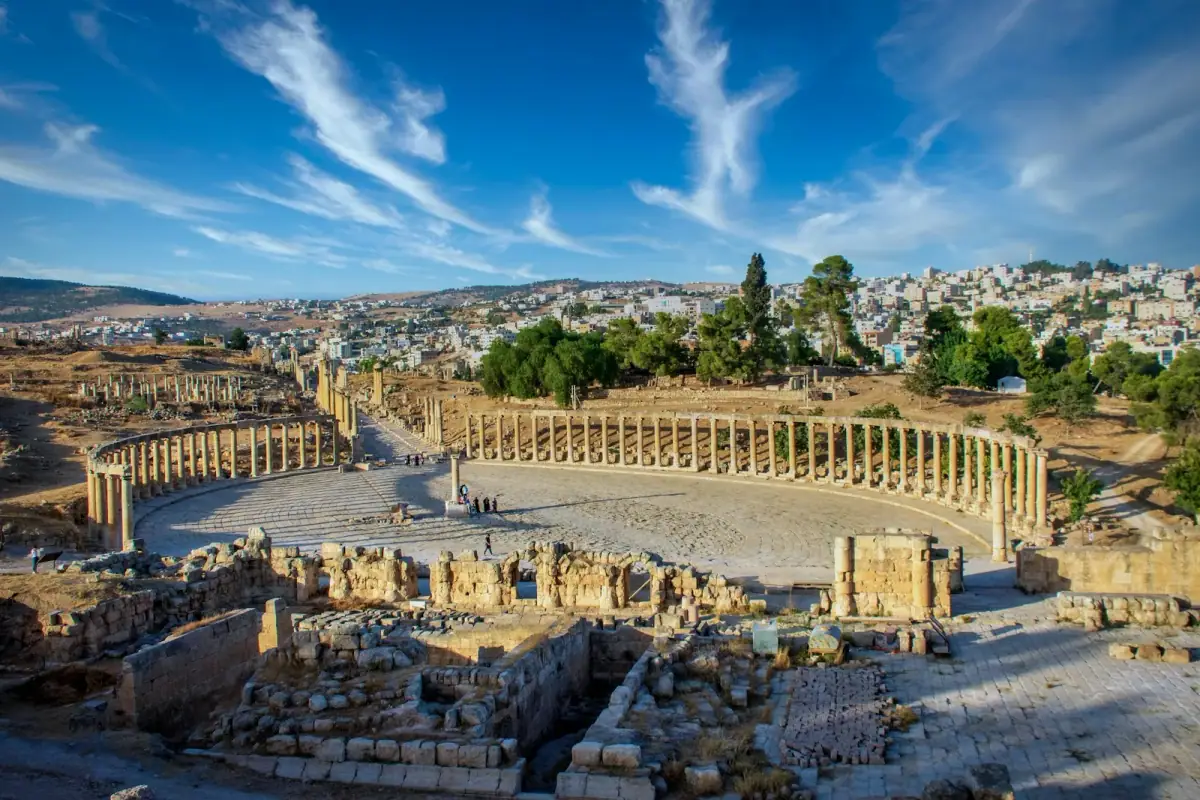
The Oval Forum is the emblematic image of Jerash: an elliptical plaza of 90 by 80 meters (295 by 262 ft), surrounded by 56 Ionic columns still standing. Unique in Roman architecture, this forum links the Cardo Maximus to the cross streets in an urban composition of rare sophistication. In the morning, low light passes through the columns and casts long shadows on the paving, one of the best photos in Jordan.
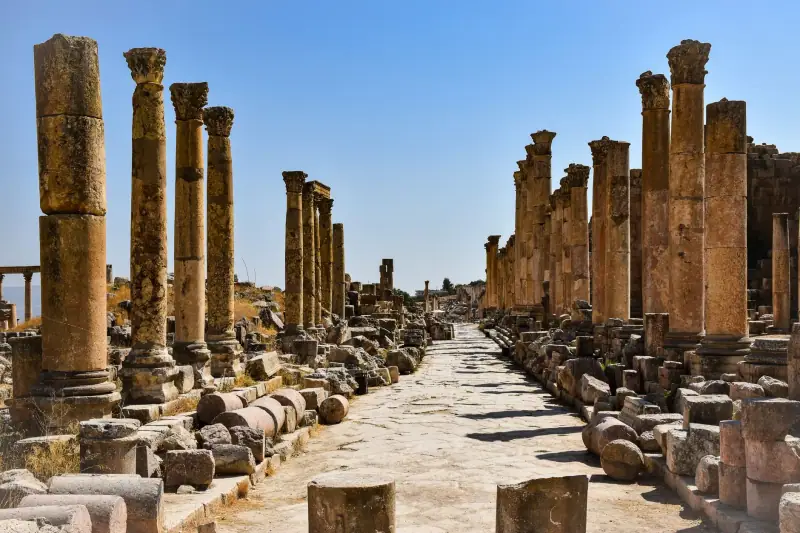
The Cardo Maximus is the backbone of the city. This 800-meter (2,625 ft) avenue, lined with Corinthian columns and covered porticoes, runs from the Oval Forum to the north. Walking along this Cardo in the sun, with the columns outlined against the blue sky, is one of the most evocative experiences in the country.
The Temple of Artemis is the architectural jewel of the site. Eleven Corinthian columns about 13 meters (43 ft) tall are still standing, their finely carved capitals defying two thousand years of erosion. Climb to the upper terrace to overlook the whole site.
The South Theater, with its 32 rows of seats cut into the hill, has remarkable acoustics. Test them by clapping your hands at the center of the orchestra.
Hadrian’s Arch, at the entrance to the site, was built in 129 AD to honor the emperor’s visit. At 22 meters (72 ft) high, it sets the tone for the rest of the visit.
Our complete guide to Jerash gives all the practical details to make the most of your visit, with a minute-by-minute itinerary.
Guided tours of Jerash and Ajloun
Guided visits, combined tours from Amman, Jordan Pass tickets included on some tours.
How long to spend at Jerash
Half day (3.5 to 4 hours): for the essentials at a good pace: Oval Forum, Cardo, Temple of Artemis, South Theater, Hadrian’s Arch.
Full day: if you have a particular interest in Roman archaeology or want to add the Jerash archaeological museum.
Tip: arrive at opening (usually 8 am) to have the Oval Forum to yourself. Tour buses arrive from 9:30 am.
Stage 3: Ajloun, castles and pine forests
From Jerash, the road to Ajloun heads west for about 32 km (20 mi). The landscape changes completely: you leave the stony hills and enter forests of oak, pine and wild olive. Northern Jordan is one of the few wooded areas of the country, a striking contrast with the southern deserts.
Qal’at ar-Rabad: the Arab castle
Ajloun is dominated by Qal’at ar-Rabad (or Ajloun Castle), a medieval Arab fortress built in 1184 by one of Saladin’s generals. Its mission: counter the Frankish Crusaders settled in the Jordan region and control the trade routes between Syria and Egypt.
Unlike the many Crusader castles of the region, Ajloun is a purely Islamic construction: square towers, machicolated battlements, vast vaulted halls, a defensive moat. The castle went through several phases of expansion in the 12th and 13th centuries before being damaged by the big earthquakes that struck the region in the 19th and 20th centuries.
The views from the ramparts are spectacular: on a clear day you can see the hills of the West Bank, the waters of the Jordan in the valley, and beyond, the heights of Palestine. Three countries meet in this panorama.
Entry costs 3 JOD (included in the Jordan Pass). Allow 1.5 to 2 hours to explore the castle and enjoy the views.
The Ajloun Forest Reserve
The Ajloun area holds a nature reserve run by the Royal Society for the Conservation of Nature (RSCN). Several marked hiking trails cross forests of kermes oak and strawberry trees. Routes include:
- Olive Forest Trail: 2 km (1.2 mi), easy, view of the Jordan Valley
- Soap House Trail: 8 km (5 mi) round trip, more strenuous, through the deep forest
The reserve also offers lodging in wooden cabins (RSCN chalets) for a night in the middle of the forest, a unique and calming experience after the archaeological sites.
Where to stay in Ajloun
For this circuit, a night in or near Ajloun lets you enjoy the sunset over the castle and leave early the next day for Umm Qais. Guesthouses and ecotourism lodges offer accommodation in an exceptional natural setting. Prices are generally lower than in Amman for equivalent comfort.
Stays in Ajloun and the northern region
Lodges, guesthouses and forest chalets in the Ajloun area for a night in the middle of Jordanian nature.
Stage 4 (optional): Umm Qais, three countries on the horizon
Umm Qais, ancient Gadara, sits on a promontory in the northwest of Jordan, about 55 km (34 mi) from Ajloun. This Decapolis site is less famous than Jerash, but its setting is one of the most dramatic in the country.
Gadara, the city of philosophers
Gadara was one of the most important intellectual centers of antiquity. The city produced several Greek poets and philosophers, including Meleager of Gadara (compiler of The Garland, the collection that formed the core of the Greek Anthology) and Menippus, the Cynic philosopher. A city that thought as much as it traded.
The archaeological site includes a North Theater with black basalt seating (local volcanic stone), a more modest West Theater, streets paved with basalt, and a Byzantine basilica, plus a museum set in a restored Ottoman house.
The three-country panorama
What makes Umm Qais unique is its geographic position. From the ramparts and terraces of the site, the eye takes in at once:
- Syria to the northeast, with the Golan Heights (occupied by Israel since 1967)
- The Sea of Galilee (Lake Tiberias) to the west, about 10 km (6 mi) away
- The West Bank and Israel to the southwest
This panorama over three countries, seen from 2,000-year-old ruins, is a rare geopolitical and human experience. Sunsets over the Sea of Galilee from this terrace are among the most beautiful in the region.
Entry: 5 JOD (included in the Jordan Pass). Recommended time: 2 to 3 hours.
Day-by-day itinerary
3-day version (without Umm Qais)
Day 1: Amman (half day + settling in)
- Afternoon: Amman Citadel + Roman Theater
- Evening: Dinner in the Jabal Amman neighborhood
- Night in Amman
Day 2: Jerash (full day)
- Morning: Leave Amman at 7:30 am → arrive in Jerash at 8:30 am
- 8:30 am-1:00 pm: Full visit of Jerash (Oval Forum, Cardo, Temple of Artemis, theaters)
- 1:00 pm: Lunch in Jerash (restaurants near the site entrance)
- 2:30 pm: Drive to Ajloun (32 km / 20 mi, 35 min)
- 3:30-5:30 pm: Ajloun Castle (Qal’at ar-Rabad)
- Night in Ajloun or back to Amman
Day 3: Ajloun (forest and countryside)
- Morning: Hike in the Ajloun Forest Reserve
- Afternoon: Drive to Amman (74 km / 46 mi, 1 h 10)
- Free evening in Amman
4-day version (with Umm Qais)
Days 1-2: same as above.
Day 3: Ajloun → Umm Qais
- Morning: Short hike in the forest reserve
- 10:30 am: Drive to Umm Qais (55 km / 34 mi, 55 min)
- 12:00-3:00 pm: Visit Umm Qais and the three-country panorama
- 3:30 pm: Late lunch at the site restaurant (with a view of the Sea of Galilee)
- Night in Irbid (nearest city) or in Umm Qais
Day 4: Return to Amman
- Morning: Irbid market or an optional visit
- Afternoon: Drive to Amman (115 km / 71 mi, 1 h 30)
- Evening: Amman
Practical tips for the road trip
Car rental
A car is essential for this circuit. The big international rental companies are at Queen Alia airport in Amman and in the city center. A few tips:
- Book in advance, especially in high season (March-May, September-November)
- Choose a standard sedan: the roads are paved and well maintained throughout the north. A 4x4 is not needed.
- Check the insurance coverage: the basic insurance included in the rental can have high deductibles. Extra coverage is often offered at €5-10 (~$6-12) per day.
- GPS is enough for this circuit: road signs in Jordan are decent on the main roads, with signs in Arabic and English.
Car rental in Jordan
Compare offers from Amman airport: sedans, SUVs, with or without unlimited mileage.
The Jordan Pass
If your trip to Jordan includes Petra, the Jordan Pass is a worthwhile investment. It covers:
- Jerash (10 JOD)
- Ajloun Castle (3 JOD)
- Umm Qais (5 JOD)
- Petra (50-60 JOD depending on the number of days)
- More than 40 other sites
It comes in three versions (1 day at Petra, 2 days, 3 days) starting at 70 JOD. Buy it online before you leave on the official site. Whether the pass also replaces an entry visa depends on your passport and the minimum length of stay: check the official site jordanpass.jo and your government’s travel advice before you book (checked November 2026).
Driving in Jordan
- Traffic drives on the right
- Roads in the north are well paved and signposted
- The maximum speed is 120 km/h (75 mph) on highways, 90 km/h (56 mph) on national roads, 50 km/h (31 mph) in built-up areas
- Avoid driving at night in rural areas (animals on the road, poor lighting)
- Fuel is available in all the stopover towns of this circuit
Best time to go
Spring (March-May): ideal, with mild temperatures (15-25 °C / 59-77 °F), green hills and almond trees in bloom. This is the best season for this northern circuit.
Autumn (September-November): excellent too, with summer heat gone, golden light and fewer people than in spring.
Summer (June-August): possible but hot at the open archaeological sites (30-38 °C / 86-100 °F). Bring plenty of water and sun protection.
Winter (December-February): the Ajloun area can get snow, which is spectacular but can complicate driving. Jerash remains open to visit.
Extending the circuit south
This northern road trip connects naturally to the rest of a trip to Jordan. From Amman, you can continue to:
- The Dead Sea and Madaba: 1 day south of Amman, on the road to Petra
- The full Jordan road trip: Amman → Jerash → Ajloun → Dead Sea → Petra → Wadi Rum → Aqaba in 7 to 10 days
Our full Jordan itinerary in 7 days places this northern circuit in an overall plan from Amman to Aqaba. And if you want to extend your exploration to the whole country, our guide to the road trip in Jordan gives you all the logistics for a 10 to 14-day circuit.
Northern Jordan deserves much more than a day trip from Amman. Between the Roman columns of Jerash, the medieval towers of Ajloun and the three-country panorama from Umm Qais, this circuit packs three thousand years of history into a landscape of olive and pine trees that few travelers expect to find in this desert country. Leave early, drive slowly, and let yourself be surprised.
Sources
- Jordan Tourism Board (Visit Jordan): figures checked November 2026
- Jordan Pass (official site): figures checked November 2026
Frequently asked questions
How many days do you need for northern Jordan?
Allow 3 days minimum to cover Amman, Jerash and Ajloun at a comfortable pace. With 4 days you can add Umm Qais in the northwest and explore the Ajloun area in more depth. This circuit fits well at the start of a trip before heading south to Petra and Wadi Rum.
Do you need a rental car to visit northern Jordan?
A rental car is strongly recommended for this circuit. Public transport (minibuses, service taxis) exists between Amman, Jerash and Ajloun, but frequencies are irregular and do not let you combine several sites in a day. A small sedan costs €25 to 45 (about $29-52) per day from Amman, with fuel and basic insurance included.
Which roads should you take between Amman and Jerash?
From central Amman, take Route 35 (King's Highway) north for about 50 km (31 mi) to Jerash. The trip takes 45 to 60 minutes depending on traffic. To reach Ajloun from Jerash, take Route 20 west for about 30 to 35 km (19 to 22 mi), 30 to 40 minutes by road.
Is the Jordan Pass useful for this northern circuit?
Yes, the Jordan Pass pays off well on this circuit. It covers entry to Jerash (10 JOD), Ajloun Castle (3 JOD), Umm Qais (5 JOD) and many other sites. It starts at 70 JOD and it pays for itself once you add Petra. Whether it also replaces an entry visa depends on your passport and the minimum stay: check the official site jordanpass.jo and your government's travel advice.
Can you do northern Jordan from Amman without a night on site?
Jerash alone can be visited as a day trip from Amman. To combine Jerash, Ajloun and Umm Qais, a night in Ajloun or in the northern countryside is recommended: it lets you enjoy the sunset over the olive trees and leave early the next morning for Umm Qais.
Is there hiking in northern Jordan?
Yes, the Ajloun area has several marked hiking trails through oak and pine forests, a vegetation that is rare in Jordan. The Ajloun Forest Reserve (run by the RSCN) offers routes of 2 to 8 km (1.2 to 5 mi) for different levels. The views of the Jordan Valley from the ridges are striking.
What are the distances between the main stops of the northern circuit?
Amman to Jerash: about 50 km (31 mi), 45 min. Jerash to Ajloun: about 32 km (20 mi), 35 min. Ajloun to Umm Qais: about 55 km (34 mi), 55 min. Umm Qais to Amman: about 115 km (71 mi), 1 h 30. The full loop is about 250 km (155 mi), easily done by car over 3 to 4 days.
More Jordan guides
Keep reading
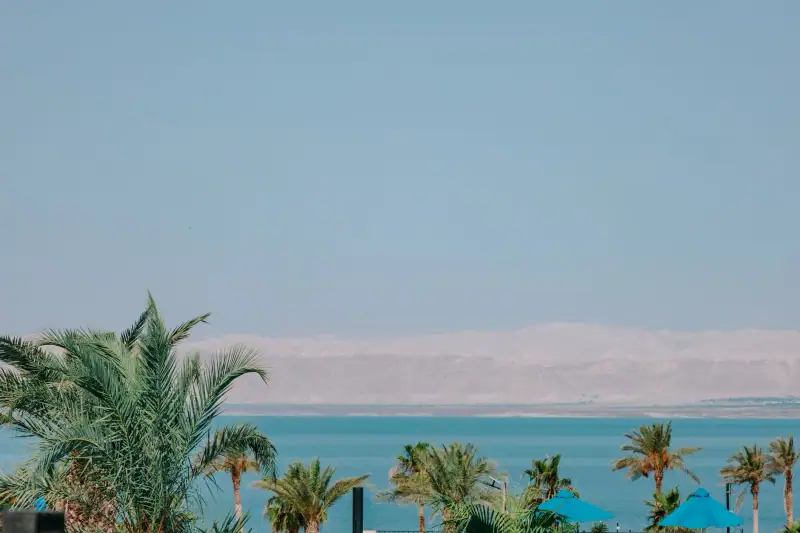
Where to Stay Near the Dead Sea: Best Resorts and Lodging
Where to stay near the Dead Sea in Jordan: luxury resorts, budget alternatives in Madaba, private beaches and practical tips.
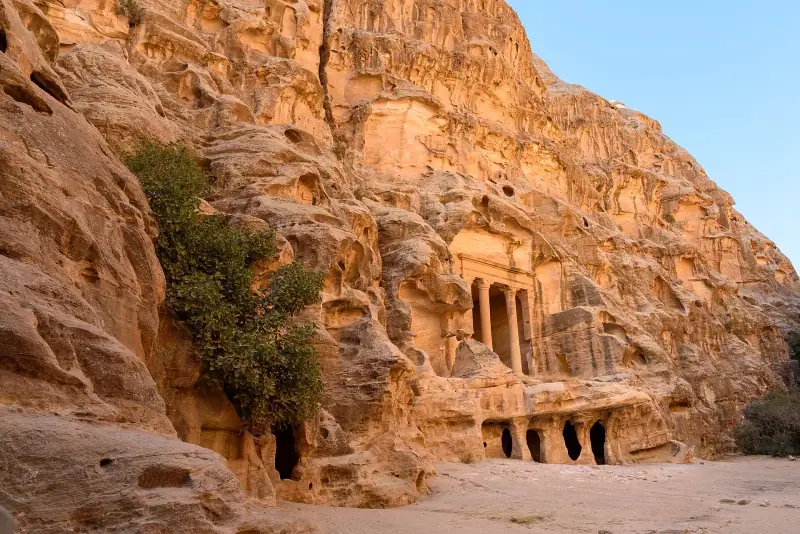
Little Petra (Siq al-Barid): Getting There Without a Car, Prices and Visit Time
Little Petra is 9 km from Wadi Musa: taxi or walk, ticket, official hours, visit time, the Painted House and the trail to the Monastery.
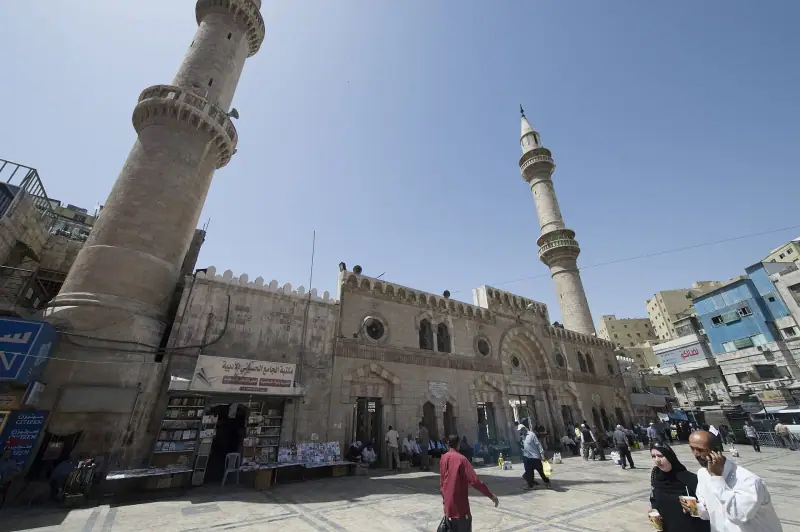
Amman Top Sights: What Not to Miss
The top sights of Amman: Citadel, Roman Theater, Rainbow Street, museums and neighborhoods. All you need to see in Jordan's capital.
Ready-made
Jordan itineraries
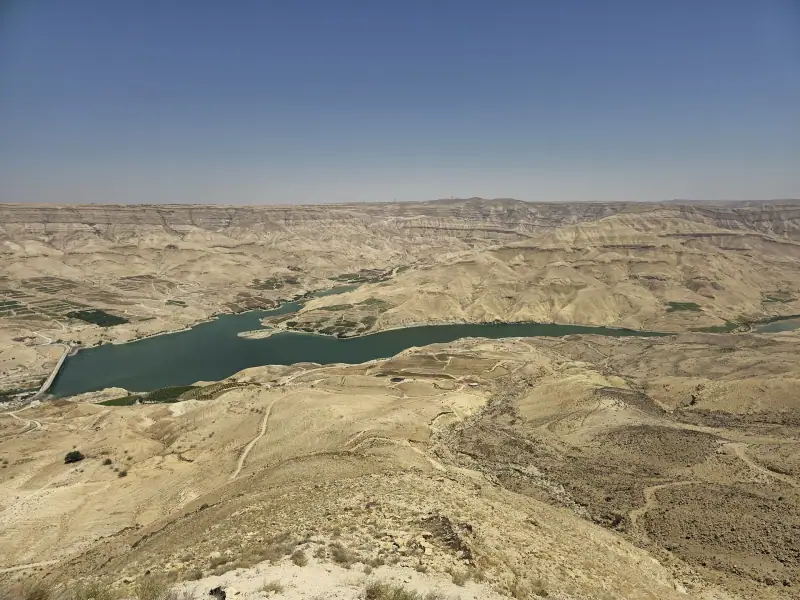
10 days
Road Trip in Jordan: The Self-Drive Guide
Plan your Jordan road trip: King's Highway, Desert Highway, Wadi Rum and Aqaba. Itinerary, driving tips and rental car basics.
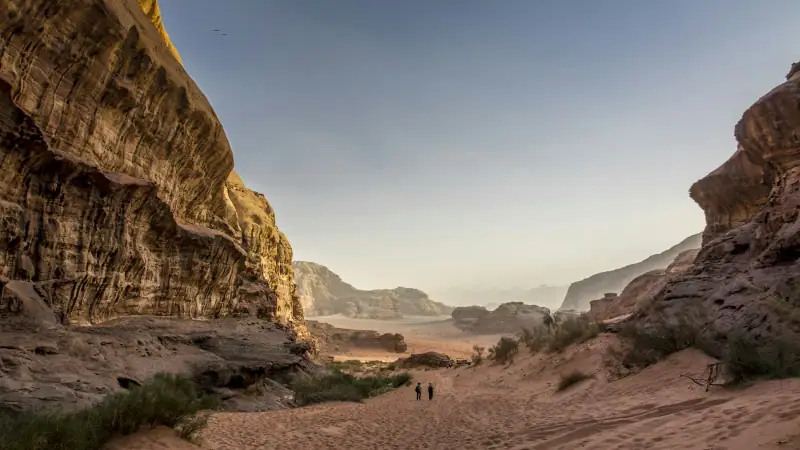
5 days
Jordan in 5 Days Without a Car: A Realistic Bus and Taxi Itinerary
Jordan in 5 days without a car: Amman, Petra, Wadi Rum and Aqaba by JETT bus, minibus and taxi. Distances, travel times, schedules and a realistic budget.