What to see
Visiting Durrës: Complete Guide to Albania's Ancient Dyrrachium
We may earn a commission when you book through links on this page, at no extra cost to you. We don't visit or try the places we cover: we summarize published sources. How we work
In short
- Durrës is 38 km (24 mi) from Tirana: furgons run every 30 minutes (45-60 min, 200 lek). The Tirana-Durrës train is closed for reconstruction.
- The Roman amphitheater (300 lek, about €3, or $3) held up to 20,000 spectators and has a Byzantine chapel in its underground galleries.
- One full day covers the amphitheater, archaeological museum and Byzantine walls. Add a night if you want the beaches.
- Best months are May-June and September. Ferries run to Bari (about 10 h) and Ancona (about 16 h).
Founded in 627 BC by Greek colonists from Corinth and Corcyra (Corfu) under the name Epidamnus, then renamed Dyrrachium by the Romans, Durrës is one of the oldest towns in the Balkans and one of the least known to travelers. The second-largest city in Albania with about 100,000 inhabitants (210,000 in the metropolitan area) and the country’s main port, Durrës layers an extraordinary history: Greek city, Roman capital, Byzantine stronghold, Venetian port, then Ottoman town and finally a Soviet-era seaside resort.
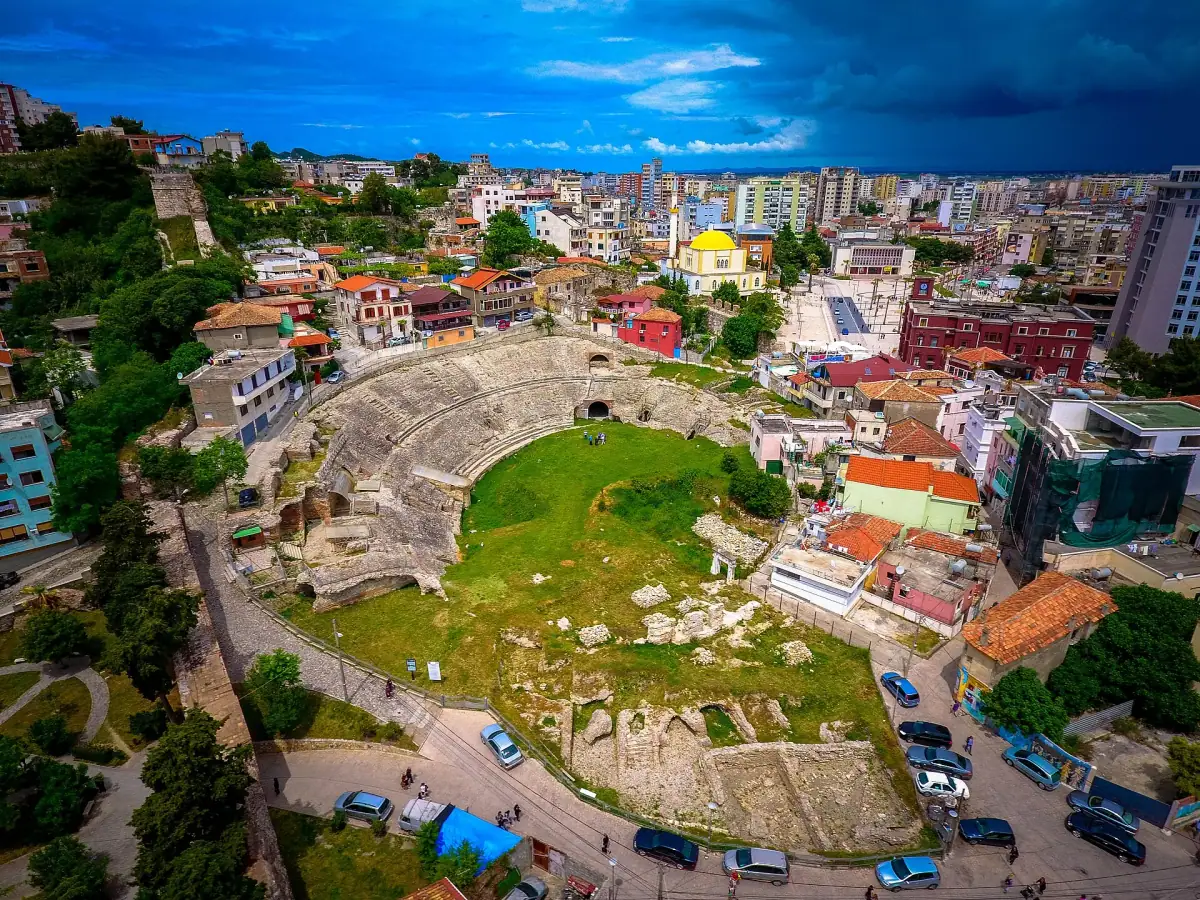
Today Durrës shows a paradoxical face: gray Communist apartment blocks stand beside the ruins of a Roman amphitheater that held 20,000 spectators, and 5th-6th-century Byzantine walls rise between residential buildings. It is precisely this striking mix of eras, combined with its long Adriatic beaches and its closeness to Tirana, that makes Durrës a stop worth making on any road trip in Albania.
The Roman amphitheater: the archaeological jewel of the Balkans
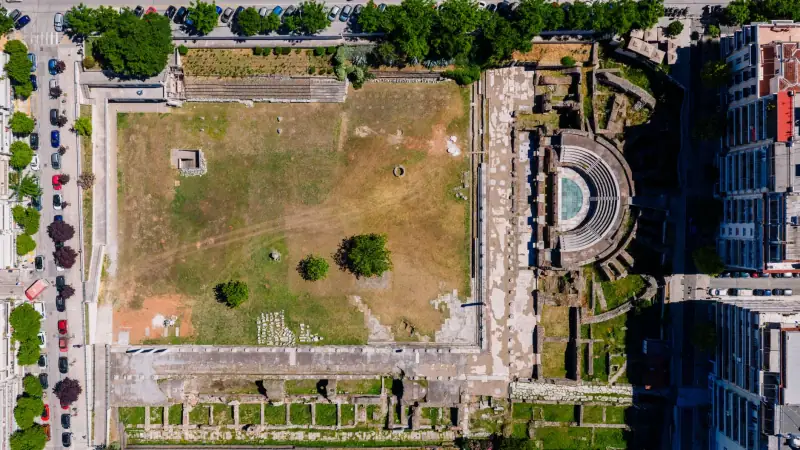
The main attraction of Durrës is without doubt its Roman amphitheater (Amfiteatri Romak), one of the most remarkable in the whole Balkan peninsula and the best-preserved Roman structure in Albania.
Exceptional Roman architecture
Built in the 2nd century AD (early in the century, under Emperor Trajan) at the height of Roman Dyrrachium, the amphitheater could hold up to 20,000 spectators, an impressive figure for a Roman provincial town. Its dimensions (132.4 m / 434 ft long, 113.2 m / 371 ft wide) make it one of the largest in Eastern Europe.
What makes the visit unique in Europe: the amphitheater has been only partly excavated. A large part of its structure is still buried under a modern residential neighborhood, whose houses lean literally against the Roman walls of the 1st century. You can see apartment windows cut into former Roman galleries, a coexistence of history and daily life you see nowhere else.
The Byzantine chapel in the catacombs
The real treasure of the amphitheater is hidden in its underground galleries: a Byzantine chapel from the second half of the 4th century, found during 20th-century excavations, is decorated with mosaics and frescoes of remarkable quality. Dyrrachium’s first Christian communities held their rites here, turning the arena galleries into a clandestine place of worship. The mosaics were added in the 6th century.
The mosaics show saints, biblical scenes and geometric motifs typical of early Christian Byzantine art. The state of preservation is astonishing for works 16 centuries old.
Practical information: Admission 300 lek (about €3, or $3). Open daily, roughly 9 am to 7 pm in summer and 9 am to 4-5 pm in winter (check hours locally). The amphitheater is in the city center, a 10-minute walk from the port. Local guides offer guided tours for an extra 500-1,000 lek, highly recommended to put the different eras in context.
Places to stay in Durrës
Stay in the city center or on the seafront for easy access to the beaches and the Roman ruins.
The archaeological museum: 3,000 years of history in one place
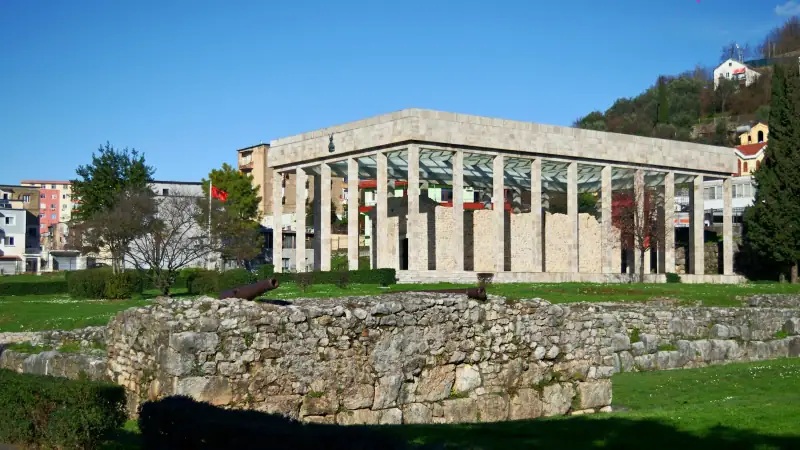
The Durrës Archaeological Museum (Muzeu Arkeologjik) is one of the most important in Albania and an essential complement to the amphitheater visit. Housed in a circular building from the 1980s, it holds a collection of more than 3,000 objects covering every period of the city’s history.
The Greek and Illyrian collections
The ground-floor rooms present finds from the Greek and Illyrian period (7th-2nd centuries BC): imported Corinthian ceramics, transport amphorae, gold and silver jewelry, terracotta figurines of local deities. The quality of the pieces shows the commercial reach of ancient Epidamnus at its peak.
The marble head of Artemis from the 2nd century BC, from the sanctuary of Artemis in the forum, is the centerpiece of the Illyrian collections, remarkably fine for a provincial work.
The Roman era and the Via Egnatia
Dyrrachium was the western starting point of the famous Via Egnatia, the great Roman road linking the Adriatic to Byzantium (Istanbul) over 1,120 km (696 mi). The museum presents a reconstruction of this road, fundamental to Balkan history, along with objects found along its Albanian stretch.
The Roman floor mosaics (1st-3rd centuries), lifted from their original sites, are particularly impressive; some measure several square meters and show mythological scenes in opus vermiculatum.
Practical information: Admission 400 lek. To check before your visit: the museum, damaged by the 2019 earthquake, reopened after restoration; the fee and hours may have changed. Ask your accommodation or call the museum directly. Usually open Tuesday to Sunday from 9 am to 3 pm, closed Monday. Allow 1 h 30 to 2 h for a full visit.
The Byzantine walls and the Venetian Tower
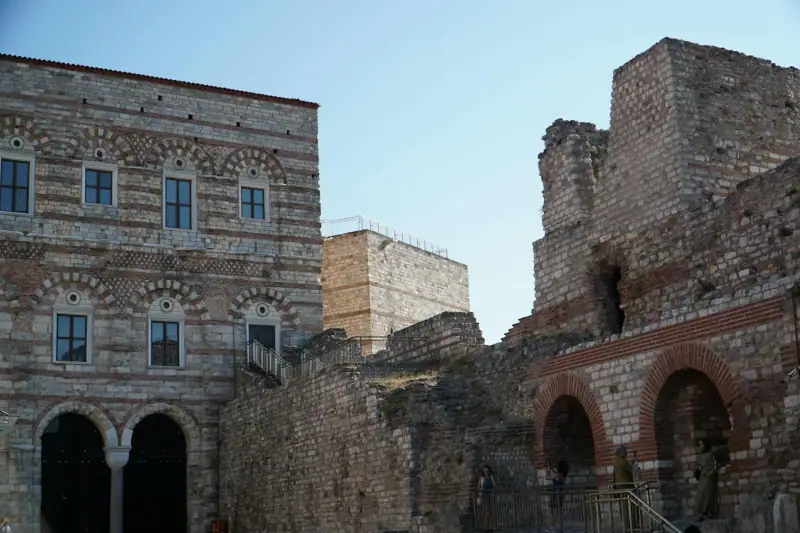
Walking through central Durrës, you come across, with astonishment, sections of 5th-6th-century Byzantine walls emerging between the facades of Communist apartment blocks, as if two eras 15 centuries apart had decided to live together without consulting each other.
The fortifications of Anastasius I
These imposing fortifications were built by the Byzantine emperor Anastasius I (reigned 491-518), a native of Dyrrachium, to protect the city from barbarian invasions, the Visigoths, Huns and Ostrogoths who followed one another in the Balkans after the fall of the Western Roman Empire. Built with reused Roman stones and bricks, these Dyrrachium walls ran for more than 3.5 km (2.2 mi) with a height of 12 m (39 ft), forming the strongest fortifications in the western Balkans.
Today several dozen meters of these walls are still standing, built into the contemporary urban fabric. The best-preserved section is behind Freedom Square (Sheshi Liria), where you can walk along the wall for about 50 m (165 ft) and see the different overlapping building phases.
The Venetian Tower
Overlooking the port from a strategic position, the Venetian Tower (Kulla Veneciane), despite its name, is the subject of a historiographical debate among researchers. Some archaeologists and historians (Léon Rey, Gjerak Karaiskaj) argue for a Venetian date (late 15th century), based on architectural and comparative analysis. Other researchers (Michael Kiel, Eduard Shehi) propose an Ottoman construction after the conquest of 1501, based on stratigraphy and archival sources. This scientific disagreement reflects the complexity of Balkan urban archaeology: it is impossible to state with certainty that the question is settled for good.
It offers a fine view of the port, the Adriatic Sea and the Durrës seafront. Access is open and free.
Day trips from Durrës
Tirana, Berat, or the southern beaches: explore Albania from Durrës with a guided tour.
The beaches of Durrës: 10 km of Adriatic sand
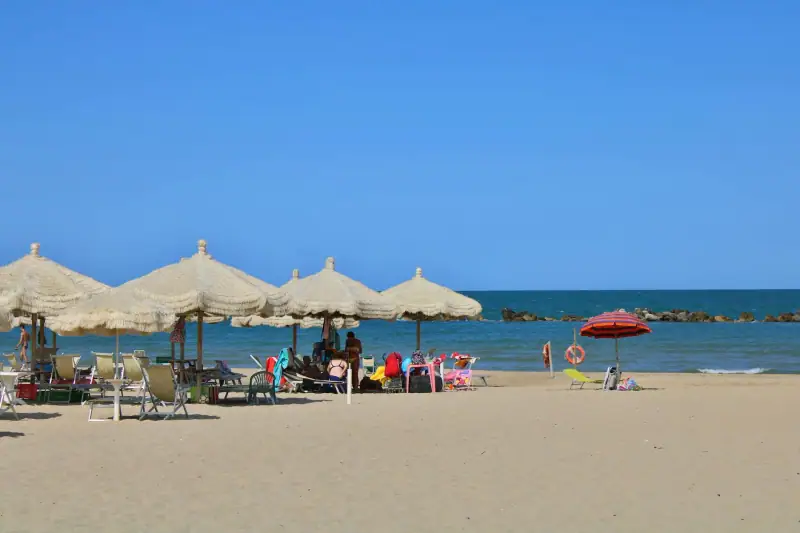
The Durrës beach (Plazhi i Durrësit) stretches about 10 km (6 mi) north of the city, from the port entrance to the resort of Currila. It is one of the longest sand beaches in Albania and the most visited in the country, mostly by Albanians.
The central beach
The beach in front of the city center is very lively, with rows of umbrellas, restaurants and cafés on the promenade. The water is clean and the sand fine, but it is the most crowded spot in July and August. Perfect if you want the popular Balkan beach atmosphere: music, the smell of grilled food, families stretched out under umbrellas.
Beach entry is free, but renting a lounger with an umbrella costs 200-400 lek a day depending on the season.
Currila and Shkëmbi i Kavajës
About 1.6 km (1 mi) to the north, Currila beach is less crowded, with slightly clearer water. At Shkëmbi i Kavajës (literally “the Kavaja rock”), a rocky cliff overlooks the sea and offers a wilder setting, with a few well-hidden pebble beaches reached by stairs cut into the rock.
These more distant sections are ideal for those looking for a bit of peace away from the bustle of the central beach. Local minibuses (50 lek) run regularly from the city center to Currila in summer.
Practical tip
Durrës is not the Albanian Riviera: the water is blue-green but less spectacularly turquoise than the southern beaches. If you come mainly for paradise beaches, head to the Albanian Riviera or Sarandë. The beaches of Durrës are ideal for pleasant family swimming combined with a cultural visit.
Food in Durrës: between the sea and Albanian traditions
A seaport for 2,600 years, Durrës excels at Adriatic seafood and fish, prepared in the simple, tasty Albanian tradition.
Specialties to try
- Hoqë i pjekur: whole octopus grilled over embers, eaten with fresh lemon and garlic, the signature dish of the fishermen’s taverns at the port.
- Tavë kosi: the Albanian national dish, a baked lamb and yogurt casserole, also delicious in the city-center restaurants.
- Peshk i pjekur: whole fish grilled over embers, served with seasonal vegetables and cornbread (misër) baked in the embers.
- Byrek: savory pastry with meat, spinach or cheese, ideal for a hearty breakfast for under 150 lek.
- Raki e vjetër: raki aged for several years, amber and smooth, served as a digestif in the port’s fish restaurants.
Where to eat
The port district (Lagjja e Portit) has the best fish taverns, frequented by sailors and fishermen. Avoid tourist restaurants with laminated photo menus on the sidewalk; look for small handwritten signs in Albanian with fishing nets hanging on the wall.
The ruga Tregtare (shopping street) and its side lanes in the center offer many kafeterije (café-restaurants) for a quick, cheap lunch.
Meal budget: 600-1,200 lek (€6-12, ~$7-14) for a main dish and a drink in a local tavern.
Getting to Durrës and getting around
From Tirana (38 km / 24 mi)
- Furgon: Tirana Kombinat terminal, departures every 30 minutes from 6 am to 8 pm, 45-60 minutes, 200 lek. Fast and convenient.
- Car: SH2 national road Tirana-Durrës, 35-45 minutes. Paid parking in the city center (100-200 lek/h).
- Taxi: From Tirana, expect 2,500-3,500 lek in a traditional taxi or €20-25 (~$23-29) in a tourist taxi.
- Train: The Tirana-Durrës rail service is currently closed for reconstruction and is not expected to reopen before 2027 (uncertain schedule).
From Shkodër (107 km / 66 mi)
Furgon connection via Tirana or direct bus, about 1 h 45 (direct trip).
Ferry from Italy
The port of Durrës is Albania’s main international port, linked by regular ferries to:
- Bari (Italy): crossing ~10 h, several companies, fares from about €40 (~$46) per person (foot passenger, vehicle not included).
- Ancona (Italy): crossing about 16 to 16 h 30, fares from about €80 (~$93) per person depending on the season.
Connections are daily in high season. Be sure to book ahead in July and August.
Car rental in Durrës
Ideal for exploring the beaches and reaching Tirana, Berat or the Riviera at your own pace from Durrës.
Where to stay in Durrës
Durrës has a wide range of accommodation, from minimal budget to seaside resort.
In the city center (ideal for culture)
Hotels and guesthouses in the city center give walking access to the amphitheater, the museum and the Byzantine walls. Allow €20-40 (~$23-46) a night for a double room in a family guesthouse, €50-80 (~$58-93) in a decent hotel with air conditioning. Ideal for travelers who come mainly for the history.
On the seafront (ideal for beaches)
Hotels on Epidamni Boulevard and along the seafront promenade offer proximity to the beach and a view of the Adriatic Sea. Prices climb in July-August (€60-120, or about $70-140, a night) but remain very reasonable by European standards. Book ahead in high season: seafront hotels are full from June.
In Currila (a quieter setting)
About 2 km (1.2 mi) from the center, the resort of Currila has newer hotel complexes with pools, well suited to families. Frequent shuttles to the city center.
When to visit Durrës
| Period | Temperatures | Sea | Crowds | Best for |
|---|---|---|---|---|
| March-April | 12-20 °C (54-68 °F) | 14-16 °C (57-61 °F) | Very low | Culture, ruins |
| May-June | 22-30 °C (72-86 °F) | 18-23 °C (64-73 °F) | Moderate | Culture + beach |
| July-August | 30-36 °C (86-97 °F) | 24-26 °C (75-79 °F) | Very high | Beach (crowded) |
| September-October | 22-28 °C (72-82 °F) | 20-24 °C (68-75 °F) | Low | Everything |
| November-February | 7-14 °C (45-57 °F) | 14-16 °C (57-61 °F) | Almost none | Low season |
Best month: September is the perfect month in Durrës. The sea is still warm (23-25 °C / 73-77 °F), the beaches empty of summer vacationers, hotels offer unbeatable prices and the archaeological sites can be visited without lines.
Practical tips
- Recommended length: One full day is enough for the cultural sights (amphitheater + museum + walls). Add a night if you want to enjoy the beaches. See our Albania budget guide to size your stay.
- Daily budget: €30-55 (~$35-64) all-inclusive (lodging, meals, museum entries, local transport).
- Currency: Albanian lek. Many ATMs in the city center and on the seafront. Large hotels accept bank cards.
- Safety: Durrës is a safe city. The port district can be quieter at night; stay on the main roads after 11 pm.
- Recommended combination: Durrës + Tirana is easy to visit in 2 days: one night in Durrës for the beaches and ruins, one night in Tirana for the capital.
- App: Google Maps works well in Durrës. Download the offline map, as the data network can be slow in some neighborhoods.
- Tipping: Not required but appreciated: 50-100 lek in casual restaurants, 200-300 lek in more formal places.
A perfect day in Durrës
8:30 am: Byrek breakfast in a bakllava shop in the center (150 lek).
9:30 am: Visit the Roman amphitheater at opening, before the morning rush of visitors. Allow 1 h 30 to 2 h with the Byzantine chapel.
11:30 am: Archaeological museum, 1 h 30 for the Illyrian and Roman collections.
1:00 pm: Fish lunch in a port-district tavern (800-1,200 lek).
2:30 pm: Stroll along the seafront, Venetian Tower, Byzantine walls.
4:00 pm: Swim at the central beach or head out to Currila.
7:00 pm: Aperitif on the promenade with a view of the Adriatic sunset.
8:00 pm: Dinner in a seafood restaurant on Epidamni Boulevard.
Durrës deserves much more than a simple stop on the road from Tirana to the Riviera. With its 2,600 years of layered history, its Roman ruins set in the modern urban fabric and its long Adriatic beaches, the city offers a combination of culture and seaside that is unique in Albania. For a complete itinerary in Albania, plan at least one night in Durrës. You will leave convinced that this city deserves far more visitors than mass tourism sends it today.
Frequently asked questions
How do you get to Durrës from Tirana?
Durrës is 38 km (24 mi) from Tirana, reached in 45-60 minutes on the SH2 national road depending on traffic. Furgons (minibuses) leave Tirana's Kombinat terminal for Durrës every 30 minutes; the trip takes 45-60 minutes and costs 200 lek. By car or taxi from Tirana, allow 45-60 minutes (1 h or more in high season). The Tirana-Durrës train service is currently closed for reconstruction and will not reopen before 2027 (the official schedule is uncertain; check with Hekurudha Shqiptare).
Is it worth spending a night in Durrës?
Yes, especially in summer if you want to enjoy the beaches. Durrës is often visited as a day trip from Tirana, but a night there lets you see the ruins without the morning crowd, have dinner on the seafront and swim at sunset. For a cultural visit only, one full day is more than enough.
Is the Roman amphitheater in Durrës impressive?
Absolutely. The Durrës amphitheater is one of the largest and best-preserved in the Balkans, able to hold up to 20,000 spectators. It stands out for its accessible underground galleries, a Byzantine chapel from the second half of the 4th century found in the catacombs (with mosaics dating from the 6th century), and above all for being partly buried in a residential neighborhood, a unique experience in Europe.
Are the beaches in Durrës clean and pleasant?
The Durrës beaches (Plazhi i Durrësit) stretch 10 km (6 mi) to the north. The city-center beach is lively and well equipped but quite crowded in July and August. Farther away toward Currila and Shkëmbi i Kavajës (5-10 km / 3-6 mi), you find quieter sections with clearer water. The water is clean (northern Adriatic) but less turquoise than on the Riviera. It is a family swimming sea rather than a spectacular one.
When is the best time to visit Durrës?
May-June and September are ideal: pleasant heat (24-30 °C / 75-86 °F), good sea temperature and less crowded beaches. July-August is the beach high season, very lively but overloaded. For a purely cultural visit (amphitheater, museum), March-April or October are perfect, with few people and very low prices. Winter is mild (10-16 °C / 50-61 °F) for those not looking for the beach.
Can you take a ferry from Durrës to Italy?
Yes, Durrës is Albania's main international port, with regular connections to Bari and Ancona (Italy). The crossing to Bari takes about 10 hours, to Ancona about 16 to 16 h 30. Several companies operate these routes, with daily departures in high season. It is the main sea entry into Albania from Italy. Be sure to book ahead in July and August.
More Albania guides
Keep reading
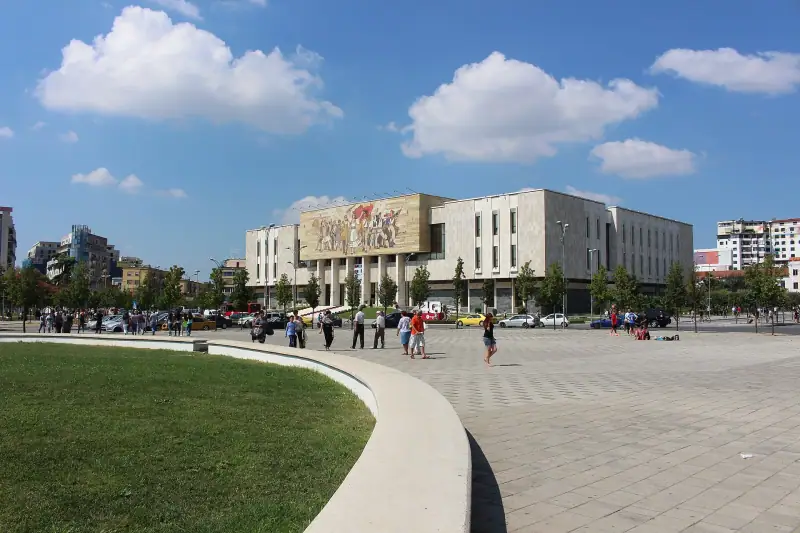
Tirana Highlights: What to See and Do in Albania's Capital
Tirana highlights: Skanderbeg Square, BUNK'ART, Blloku, museums and neighborhoods to explore. A complete guide to visiting Albania's capital.
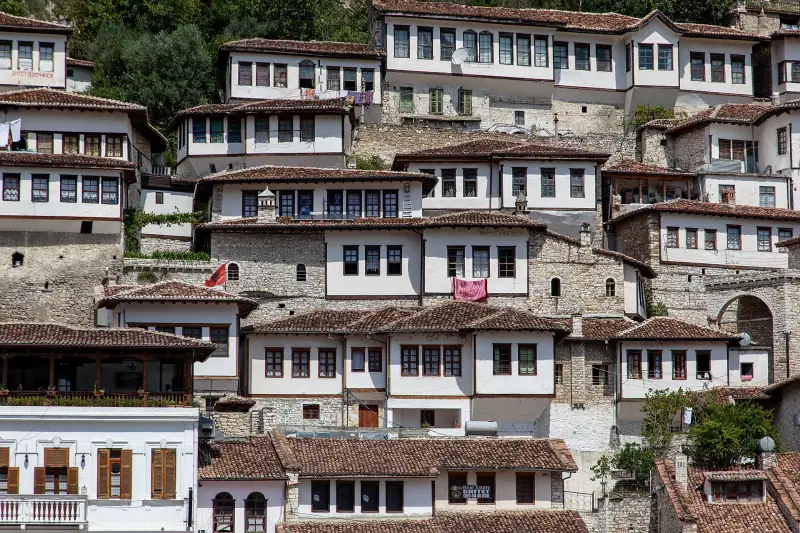
Visiting Berat: Complete Guide to the City of a Thousand Windows
Complete guide to visiting Berat: castle, Mangalem, Onufri Museum, Gorica. What to see, where to stay, how to get there. Albania's UNESCO heritage town.
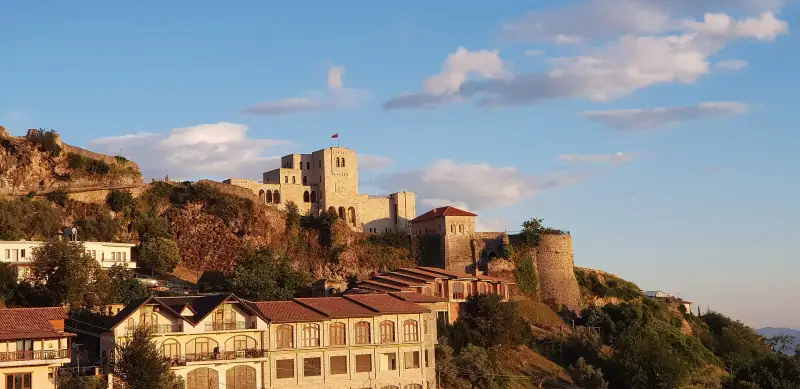
Krujë from Tirana without a car: bus, schedule, price and is it worth the detour?
Getting to Krujë from Tirana by bus: station, schedule, fare, Skanderbeg Museum entry, visit length and a straight answer: is it worth the detour?
Ready-made
Albania itineraries
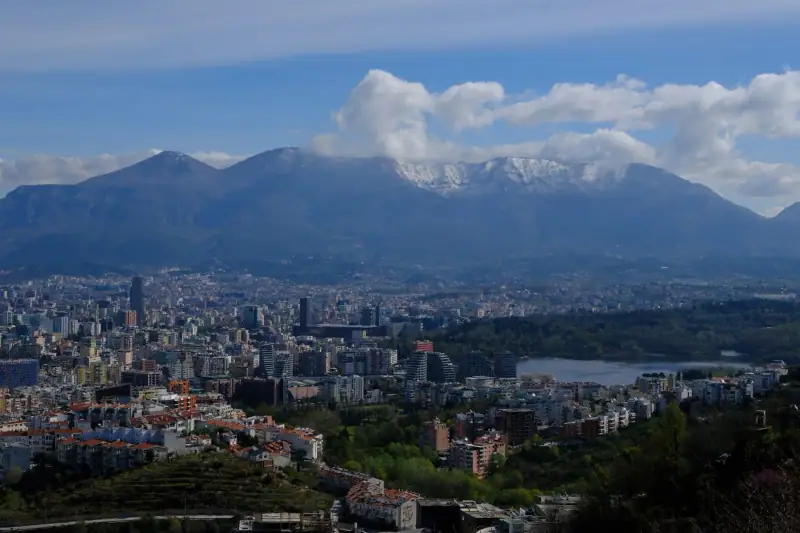
Tirana vs Sarandë: which city should be your base in Albania?
Tirana or Sarandë: a full comparison of Albania's two headline destinations to help you pick a base based on your interests and budget.
5 days
Albanian Alps Road Trip: Shkodër, Theth and Valbonë in 5 Days
ShkodërThethValbonë
8 days
Albania in 8 Days Without a Car: A Realistic Bus and Furgon Itinerary
TiranaBeratGjirokastërSarandë