What to see
Visiting Berat: Complete Guide to the City of a Thousand Windows
We may earn a commission when you book through links on this page, at no extra cost to you. We don't visit or try the places we cover: we summarize published sources. How we work
In short
- Plan two days if you can. One full day covers the castle, Mangalem, Gorica and the Onufri Museum (about 200 lek, €2, or about $2).
- From Tirana, furgons take 2 h to 2 h 30 for 400-500 lek (€4-5, ~$5-6); by car allow 1 h 45 via the SH3. There is no train.
- Best seasons are spring and fall (20-28 °C / 68-82 °F). July and August can reach 35-40 °C (95-104 °F), so visit early or late in the day.
- Apollonia is 55-60 km (34-37 mi) west, about 1 h by car. Public transport is awkward, so a rental car is recommended.
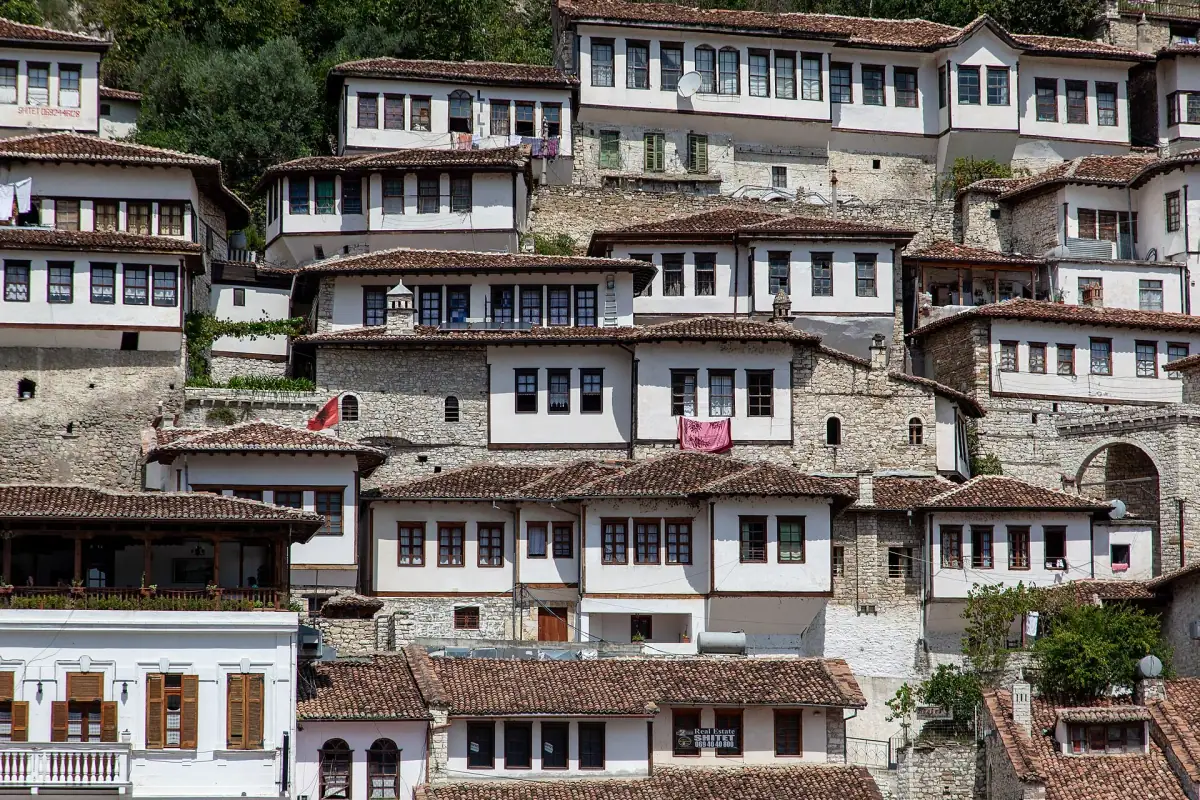
Nicknamed the city of a thousand windows (Qyteti me njëmijë dritare in Albanian), Berat is one of the most beautiful towns in the Balkans. Its white Ottoman houses, with their stacked rows of windows, cling to the hillside like honeycomb cells, mirrored in the calm waters of the Osum River that cuts the town in two. Listed as a UNESCO World Heritage site since 2008, it is far from a frozen museum: families live here, craftsmen work here, and Albanian life goes on at its own pace.
Two hours from Tirana, Berat is often squeezed into Albanian itineraries as a one-day stop, which is a mistake. The town deserves two days at least: to climb to the castle at sunrise, get lost in the lanes of Mangalem, cross the Ottoman bridge to the Christian quarter of Gorica, and take the time to understand what ten centuries of coexistence between Christians and Muslims in one town mean.
Berat Castle (Kalaja): an inhabited citadel
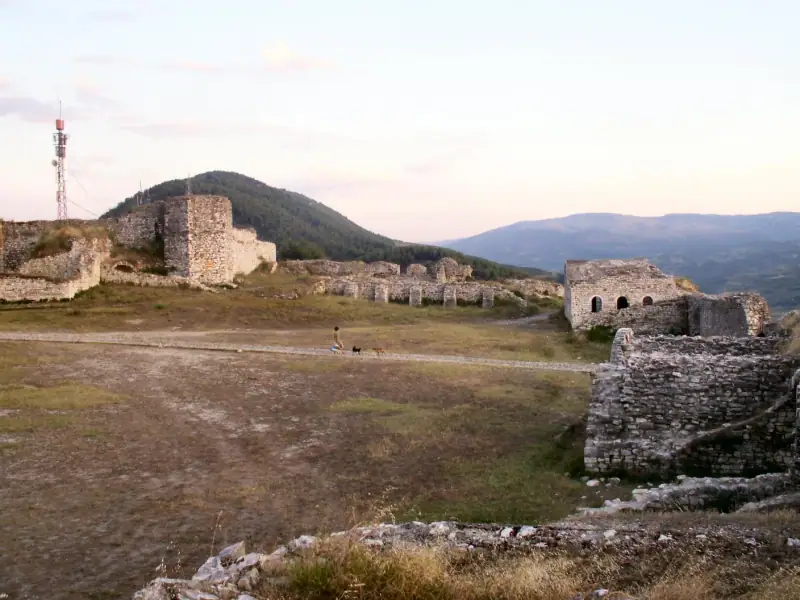
Berat Castle, known locally as Kalaja, is the obvious starting point for any visit. Perched at 214 m (702 ft) above sea level on a rocky spur overlooking the town, it is one of the best-preserved medieval citadels in the Balkans, and above all one of the few still inhabited today.
The first fortifications date from the 4th-3rd centuries BC, built by the Illyrians. The Byzantines, Angevins, Serbs and then Ottomans each left their mark on the ramparts and towers. Inside the citadel, about twenty Albanian families still live today, surrounded by ruins of Byzantine churches, Ottoman mosques, medieval cisterns and lush vegetation.
What you see in the castle
A walk inside the castle walls easily takes 2 h to 2 h 30:
- The ramparts: the best preserved date from the Byzantine era (9th-14th centuries). From the walkway, the view over the Osum valley, the houses of Mangalem and the surrounding hills is striking.
- The Church of the Dormition of the Theotokos (rebuilt in 1797 on medieval foundations): now turned into the Onufri Museum, the church holds the most important collection of Byzantine and post-Byzantine icons in Albania. The works of the painter Onufri (16th century), famous for his unique carmine red, are the museum’s most precious pieces. Admission: about 200 lek (€2, or about $2).
- The ruins of Byzantine churches: a dozen churches, including St. Michael’s, clinging to the cliff above the void, can be seen inside the walls. Some are being restored.
- The Red Mosque (Xhamia e Kuqe): built in the 15th century and listed as a cultural monument since 1961. It is now in ruins and has not been converted into an archaeological museum; the latter is in another structure of the castle.
- The inhabited Ottoman houses: the lanes between the monuments are lined with 18th-19th-century homes, with flowered courtyards and carved wooden gates. This is the most authentic Berat.
Getting there: A paved road climbs from the lower town to the castle. On foot from the Mangalem district, allow 20-30 minutes of fairly steep climbing. By taxi from the center, the ride generally costs €3-5 (~$3-6). Entry to the castle grounds is in principle free (excluding the museums inside), but an entry fee of about 300 lek may be asked depending on the time: check locally.
Guided tours of Berat
Explore the castle and the Ottoman neighborhoods with a passionate local guide.
The Mangalem neighborhood: the thousand windows
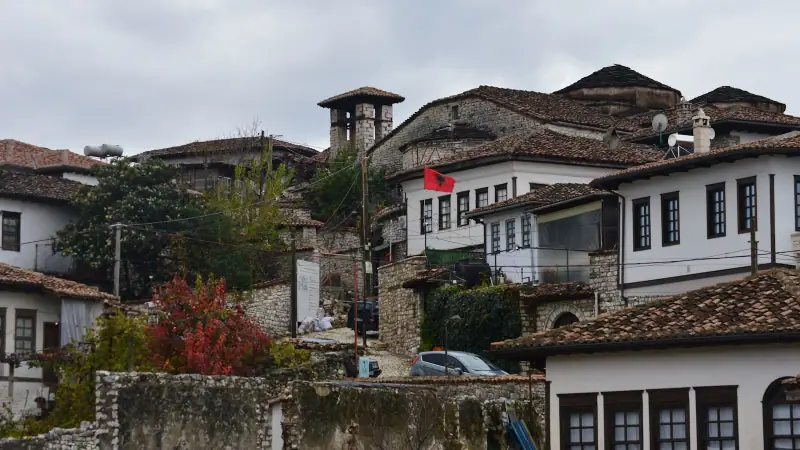
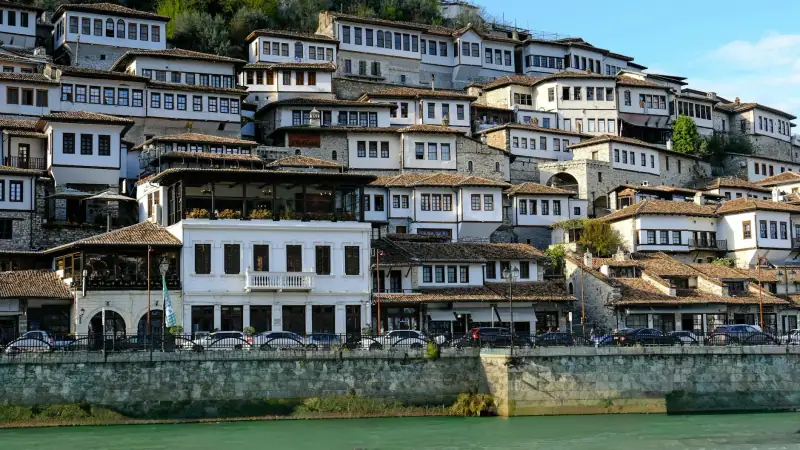
If the castle is the viewpoint over Berat, the Mangalem neighborhood is the living heart of the historic town. Located on the east slope of the castle hill, on the river side, this 18th-century Ottoman district is the one that gave Berat its legendary nickname.
The houses of Mangalem follow a particular Ottoman architecture: each floor juts out slightly over the one below, with a facade pierced by three to five rows of white-painted wooden windows. Stacked on top of one another on the hillside, these facades create the striking visual effect that made Berat famous: hundreds, even thousands of windows looking at the valley at once.
Getting lost in the lanes
The best way to explore Mangalem is to not try to see everything, and instead let the cobbled lanes guide you by following the signs toward the castle. Most paths lead up to the ramparts sooner or later; it is almost impossible to truly get lost.
Along the way, notice the architectural details: the oda (guest reception rooms) overhanging the street on the first floor, the Ottoman water cisterns (sebil), the neighborhood fountains, and the wooden doors with ornate ironwork.
The neighborhood’s main street, which runs along the Osum River, has a few guesthouses, cafés and restaurants in restored Ottoman buildings. It is the ideal spot for an iced coffee (kafé e ftohtë) before starting the climb to the castle.
The Bachelors’ Mosque
The Bachelors’ Mosque (Xhamia e Beqarëve, 18th century) is the most beautiful mosque in the neighborhood. Its whitewashed facade and harmonious proportions make it a remarkable example of Berat’s Ottoman architecture. Close to the historic bazaar, it can be seen from the main street.
The Gorica neighborhood: the Christian bank
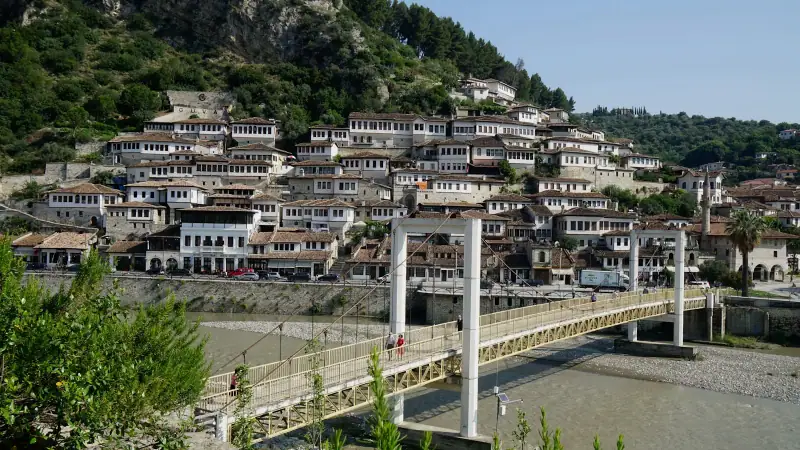
On the other side of the Osum River, linked to Mangalem by a humpback Ottoman bridge, the Gorica neighborhood is the Christian counterpart of the town. Less visited by tourists, it has a calmer atmosphere and unique views of Mangalem from the opposite bank.
Gorica is the historic district of Berat’s Orthodox Christian families. Its houses, similar in style to those of Mangalem but more modest, climb a slope covered with vegetable gardens and fig trees. Several small Orthodox churches dot the neighborhood; some are closed outside services, others can be visited on request.
The Gorica Bridge spanning the Osum between the two neighborhoods is a monument in itself. Of Ottoman origin (1780, first version in wood), it was rebuilt in stone in the 1920s. Its century-old stone arches withstand the seasonal floods and make up the classic viewpoint over the facades of Mangalem. It is the best vantage point on the Mangalem facades, and the emblematic photo of Berat that everyone brings home.
Where to stay in Berat
Ottoman guesthouses in Mangalem or modern hotels in the lower town.
The Onufri Museum: jewel of Byzantine art
The Onufri Museum is one of the most important museums in Albania and one of the most significant collections of Byzantine icons in the Balkans. Housed in the Church of the Dormition of the Theotokos (rebuilt in 1797 on medieval foundations) inside the castle, it displays 173 works in total, 106 icons and 67 liturgical objects (embroideries, gospel books, devotional objects), dating from the 14th to the 20th century.
Onufri, the master of red
The star of the museum is the painter Onufri (16th century), a major figure of Albanian post-Byzantine painting. His hallmark is a carmine red of unique intensity, whose formula is a historical secret never solved; no source allows the pigments or processes used to be identified with certainty. His icons, with their intense expressions and luminous gilding, stand out immediately from the other works in the museum for their dynamism and color.
Besides Onufri’s works, the museum shows icons by other Albanian and Greek masters, illuminated gospel books, liturgical embroideries and Orthodox devotional objects. The labels are in Albanian and English.
Hours: generally 9 am-5 pm, Tuesday to Sunday (closed Monday). Admission: about 200 lek (€2, or about $2) per person. Hours and prices can change with the season; check locally.
The Ethnographic Museum
Below the castle, still in the Mangalem district, the Berat Ethnographic Museum is set in a magnificent 18th-century Ottoman house, one of the best preserved in Albania. The house itself is often more interesting than its collections: Ottoman interior architecture with an oda (formal reception room), carved wooden ceilings, decorated fireplaces and wall alcoves.
The collections trace daily life in Berat from the 18th to the 20th century: traditional regional costumes, craft tools (looms, pottery, forge), kitchen utensils, wedding ceremony objects. An interesting section documents life under Enver Hoxha’s Communist regime (1944-1985). Admission: about 200 lek.
Car rental in Albania
Essential for exploring Apollonia and the Berat area at your own pace.
Around Berat: half-day trips
Apollonia (55-60 km / 34-37 mi west)
The Apollonia archaeological site is one of the most interesting excursions from Berat. Founded around 600 BC by Greek colonists from Corinth and Corcyra, Apollonia was a great Hellenistic and then Roman city, and at its peak one of the most important towns on the Adriatic coast (about 60,000 inhabitants in the 1st century BC). Augustus (Octavian) stayed there and studied rhetoric and philosophy in 44 BC; the city had sided with Caesar in the civil war, which made it a trusted place for the Julio-Claudians.
Today the site preserves a remarkable odeon (a 2nd-century AD performance hall), a bouleuterion (council chamber), the remains of the Agora portico and temples. The adjacent museum, set in a 13th-century monastery (around 1250-1270), holds the archaeological collection. Allow 2 h for the visit. Access from Berat is difficult by public transport (via Fier); a rental car is recommended.
The Osum valley and gorges
The Osum River that runs through Berat rises in Korçë County (village of Vithkuq), southeast of Berat. Going up the valley by car, you reach the Osum gorges, a spectacular canyon about 26 km (16 mi) long, accessible from the village of Çorovodë, about 50 km (31 mi) from Berat. In summer (May-September), local operators offer rafting or inflatable kayak trips down the gorges, an unforgettable experience in wild scenery. Ask your accommodation for contacts and conditions.
Food in Berat: what to eat
Berat’s cuisine is representative of the culinary tradition of central Albania, with a few regional specialties tied to livestock and to produce from the Osum valley.
Typical dishes to try
- Fërgesë Berati: Berat’s version of this emblematic Albanian dish. Green and red peppers, tomatoes, melted sheep’s cheese (djathë i bardhë) and sometimes sautéed veal or liver at the bottom of a clay pot. Served bubbling at the table. A must-try.
- Tavë kosi: lamb simmered under a blanket of yogurt and beaten eggs, baked in a clay dish. An Albanian national dish originally from Elbasan, found throughout Albania with regional variations.
- Byrek me spinaq: phyllo pastry with spinach and sheep’s cheese, served hot in the morning at the bakeries of the bazaar. The classic Albanian breakfast, under €1 (~$1).
- Local grape raki: the Berat region is known for its vineyards and its craft raki production. Guesthouse families often serve a homemade one, to be enjoyed in moderation.
- Baklava and trilece: Ottoman pastries are well represented in the sweet shops of the lower town, notably walnut baklava and trilece (a three-milk cake of Balkan origin).
Where to eat in Berat
The best-known restaurants are concentrated in the lower town, along the banks of the Osum, and in the Mangalem district. Several Ottoman guesthouses serve quality home cooking in their inner courtyard. Allow €6-12 (~$7-14) for a main meal with a drink; Berat remains very affordable.
Where to stay in Berat
In the historic district (Mangalem)
Several guesthouses have been set up in restored Ottoman houses in the Mangalem district. It is the ideal place to immerse yourself fully in the atmosphere of the historic town: waking up with a view of the white facades, flowered terraces and breakfasts with local products. Allow €30-60 (~$35-70) for a double room depending on the season and services.
In the lower town
The lower town (the modern part of Berat, on the banks of the Osum) has more standard hotels, often better equipped (air conditioning, parking) and cheaper (€20-40, ~$23-46, for a double room). It is a good option if you have a car.
In the castle
A few guesthouses are set inside the castle itself (Kalaja), between the ramparts and the ruined churches. The experience is unique, waking up in a medieval citadel and hearing the bells of the few families still living there, but the facilities are basic and getting there on foot can be physical with luggage.
How to get to Berat
From Tirana: This is the most common trip. Furgons leave Tirana’s south bus station (Sheshi Kombinatit) regularly from about 6 am to 5 pm. Trip: about 2 h to 2 h 30. Fare: 400-500 lek (€4-5, ~$5-6). By car via the SH3: 1 h 45 to 2 h depending on traffic.
From Gjirokastër: By car, allow 2 h 30 to 3 h via Tepelëna and the national road. By public transport, you generally have to go through Vlorë.
From Vlorë: About 1 h by road (around 80 km / 50 mi). Furgon connections exist but are less frequent; check the schedules locally.
From Sarandë: No direct connection. Going through Vlorë is recommended: 3 h to 5 h from Sarandë to Vlorë (winding coastal road over the Llogara Pass, very slow in summer), then 1 h from Vlorë to Berat. By car, allow 4 h to 6 h depending on the season.
Practical tips for visiting Berat
Morning light is magical: The facades of Mangalem face east. Get up early to photograph them bathed in golden morning light before the tourists arrive, particularly between 7 am and 9 am in summer.
Good shoes are essential: Whether climbing to the castle, strolling through Mangalem or crossing Gorica, the lanes are paved with round pebbles and the slopes are steep. Flat sandals are not recommended.
Cash: Berat has a few ATMs in the lower town, but accommodations and restaurants in the historic district mostly work in cash.
Local guide: Berat is even better with a guide. Local guesthouses often offer contacts or organize guided tours themselves (€30-50, ~$35-58, for a half day for a group). The gain in historical understanding is real.
Avoid midday in summer: Between noon and 3 pm in July and August, the temperature in the castle can exceed 38 °C (100 °F) and the lanes of Mangalem are baked by the sun. Plan your visits early in the morning and late in the afternoon.
Combining with Gjirokastër: Berat and Gjirokastër are the two Albanian towns listed together as UNESCO World Heritage. They make a natural pair in any trip through southern Albania.
Suggested itinerary: 2 days in Berat
Day 1: The castle and Mangalem
Morning (8 am): Walk up to the castle from Mangalem before the heat. Visit the ramparts, the ruined churches and the Onufri Museum (1 h 30 to 2 h). Panoramic view of the town and the valley.
Lunch (12:30 pm): Walk down into Mangalem for lunch in a guesthouse courtyard or a restaurant in the neighborhood. Fërgesë Berati is a must-try.
Afternoon (2:30 pm): Nap, or visit the Ethnographic Museum in the Ottoman house (1 h). Stroll through the lanes of Mangalem, coffee by the Osum.
Evening: Cross the Ottoman bridge to Gorica to admire the facades of Mangalem from the opposite bank at sunset. Dinner on a terrace by the river.
Day 2: Gorica, a day trip and the lower town
Morning (9 am): Relaxed exploration of the Gorica neighborhood: small Orthodox churches, gardens, views of Mangalem. A 1 h 30 walk.
Late morning (11 am): Leave by car for Apollonia (1 h) or for the Osum gorges depending on your itinerary.
Afternoon: Back to Berat, a stroll through the historic bazaar, shopping for local products (sheep’s cheese, olives, craft raki).
Evening: Xhiro (the evening stroll) in the lower town, lively at the end of the day as locals come out for fresh air on the main boulevard.
Berat in the context of a trip to Albania
Geographically, Berat holds a central position in Albania, roughly halfway between Tirana and Gjirokastër, between the Adriatic coast and the inland mountains. It fits naturally into any road trip in Albania as a stop between the capital and the south.
In a 7-day itinerary in Albania, Berat is usually paired with Gjirokastër to form a “southern UNESCO circuit.” The two towns are about 2 h 30 apart by road via Tepelëna. For those who want to go deeper into things to do in Berat, hiking in the surrounding hills, rafting in the Osum gorges and trips to Apollonia add a lot to a stay.
Berat is not the kind of destination you “do” in passing. It is a town you have to earn: it asks you to take time to walk at its pace, to look up at the white facades, to agree to get lost in its lanes and to chat with the residents who live in some of the most beautiful architecture in the world. And that is precisely why it remains, long after you return, one of the strongest images you bring back from Albania.
Sources
Frequently asked questions
How long do you need to visit Berat?
A full day covers the highlights: the castle, the Mangalem and Gorica neighborhoods, and the Onufri Museum. Two days are ideal to stroll without rushing, visit the museums and take a day trip to the Apollonia archaeological site, an hour away by road.
How do you get to Berat from Tirana?
Furgons (minibuses) leave regularly from Tirana's south bus station (Sheshi Kombinatit) for Berat. The trip takes about 2 h to 2 h 30 and costs 400-500 lek (€4-5, ~$5-6). By car, allow 1 h 45 via the SH3. There is no train between Tirana and Berat.
How do you get to Berat from Sarandë?
There is no direct furgon between Sarandë and Berat. You generally have to go through Vlorë (about 2 h 20 to 3 h from Sarandë on the winding coastal road over the Llogara Pass), then continue to Berat (about 1 h 30 to 1 h 45 from Vlorë). The total is about 4 to 5 hours by minibus connections or rental car.
Is Berat Castle open to the public?
Yes, Berat Castle (Kalaja) is open to visitors. It is a living site: several families still live there, along with a few guesthouses and the Onufri Museum. Access to the plateau is in principle free (check locally: an entry fee of about 300 lek may be asked depending on the time), and the museums inside charge admission (about 200-300 lek each).
When is the best time to visit Berat?
Spring (April-June) and fall (September-October) are the best seasons: pleasant temperatures (20-28 °C / 68-82 °F), beautiful light for photographing the Ottoman facades, and few tourists. Summer is hot (35-40 °C / 95-104 °F in July and August), though the evenings stay lively. Winter is mild and rainy; some accommodations close.
Can you take a day trip from Berat to Apollonia?
Yes. The Apollonia archaeological site is about 55-60 km (34-37 mi) west of Berat, 1 h by road. It is hard to reach by public transport from Berat (you have to go through Fier). With a rental car, it is an excellent half-day trip that combines well with Berat: allow 2 h for the visit. A local guide or an organized tour from Berat simplifies the logistics.
Is Berat a UNESCO World Heritage site?
Yes. Berat has been on the UNESCO World Heritage List since 2008, as an extension of the already listed site of Gjirokastër (listed in 2005). The combined property is called "Historic Centres of Berat and Gjirokastra." Both towns are recognized for their exceptional Ottoman architectural ensembles, which show the blending of cultures in the Balkans.
More Albania guides
Keep reading
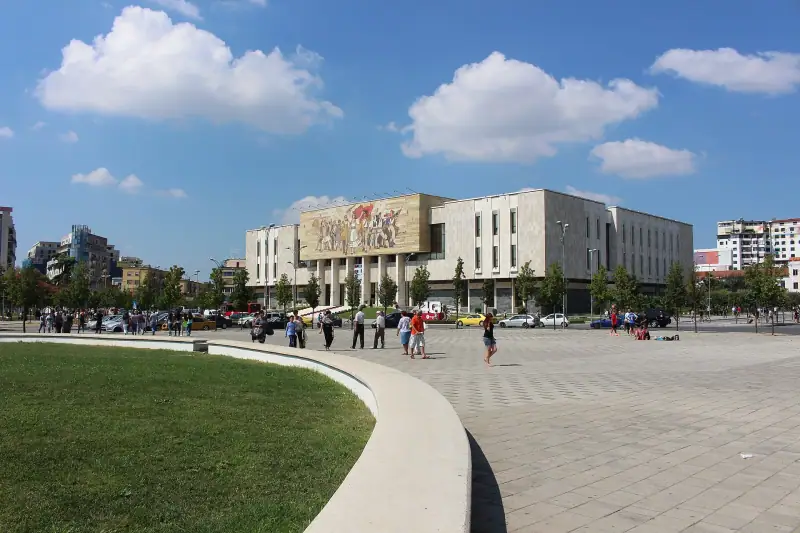
Tirana Highlights: What to See and Do in Albania's Capital
Tirana highlights: Skanderbeg Square, BUNK'ART, Blloku, museums and neighborhoods to explore. A complete guide to visiting Albania's capital.
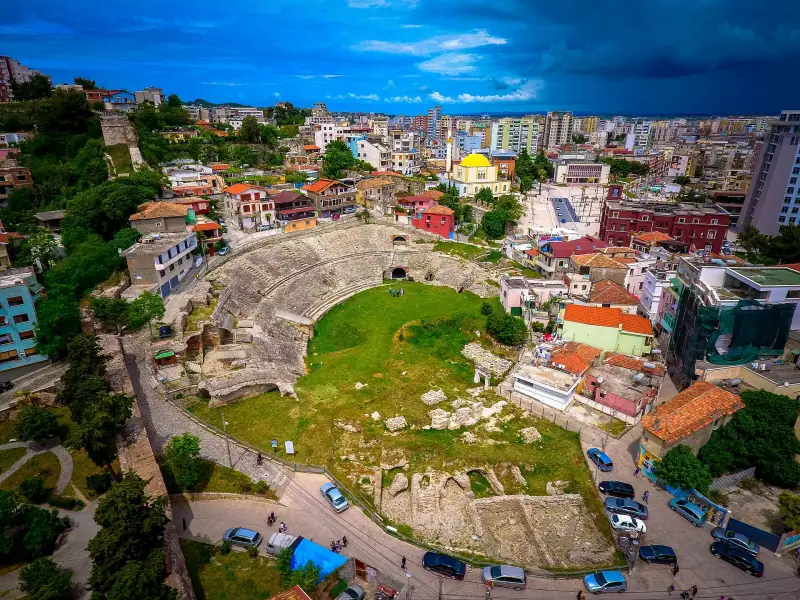
Visiting Durrës: Complete Guide to Albania's Ancient Dyrrachium
Complete guide to visiting Durrës: Roman amphitheater, archaeological museum, Adriatic beaches, Byzantine walls and practical tips.
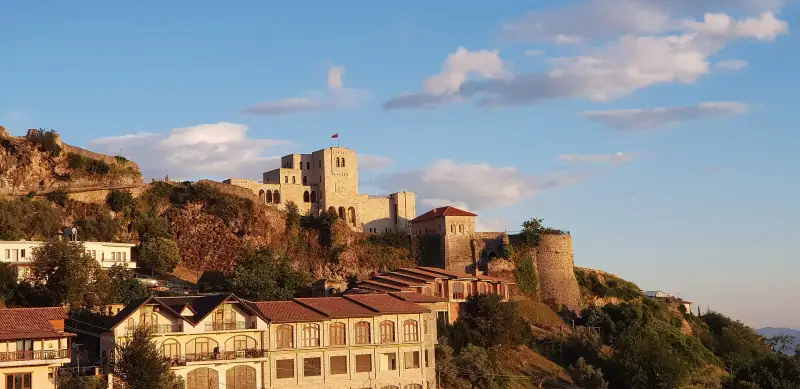
Krujë from Tirana without a car: bus, schedule, price and is it worth the detour?
Getting to Krujë from Tirana by bus: station, schedule, fare, Skanderbeg Museum entry, visit length and a straight answer: is it worth the detour?
Ready-made
Albania itineraries
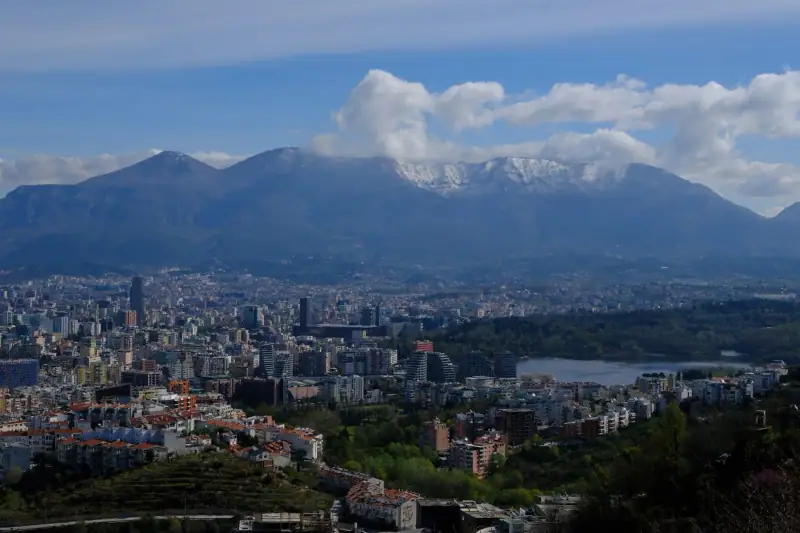
Tirana vs Sarandë: which city should be your base in Albania?
Tirana or Sarandë: a full comparison of Albania's two headline destinations to help you pick a base based on your interests and budget.
5 days
Albanian Alps Road Trip: Shkodër, Theth and Valbonë in 5 Days
ShkodërThethValbonë
8 days
Albania in 8 Days Without a Car: A Realistic Bus and Furgon Itinerary
TiranaBeratGjirokastërSarandë