What to see
Visiting the old town of Rhodes: ramparts, palace and lanes
We may earn a commission when you book through links on this page, at no extra cost to you. We don't visit or try the places we cover: we summarize published sources. How we work
In short
- The old town is a UNESCO World Heritage site (since 1988), with ramparts about 4 km (2.5 mi) around, the Palace of the Grand Master and the Street of the Knights.
- Allow a full day for everything at a relaxed pace; half a day covers the essentials (palace, Street of the Knights, ramparts).
- The old town is visited on foot; leave any rental car outside the walls.
- In midsummer go early in the morning or late in the day to avoid the heat and the cruise groups.
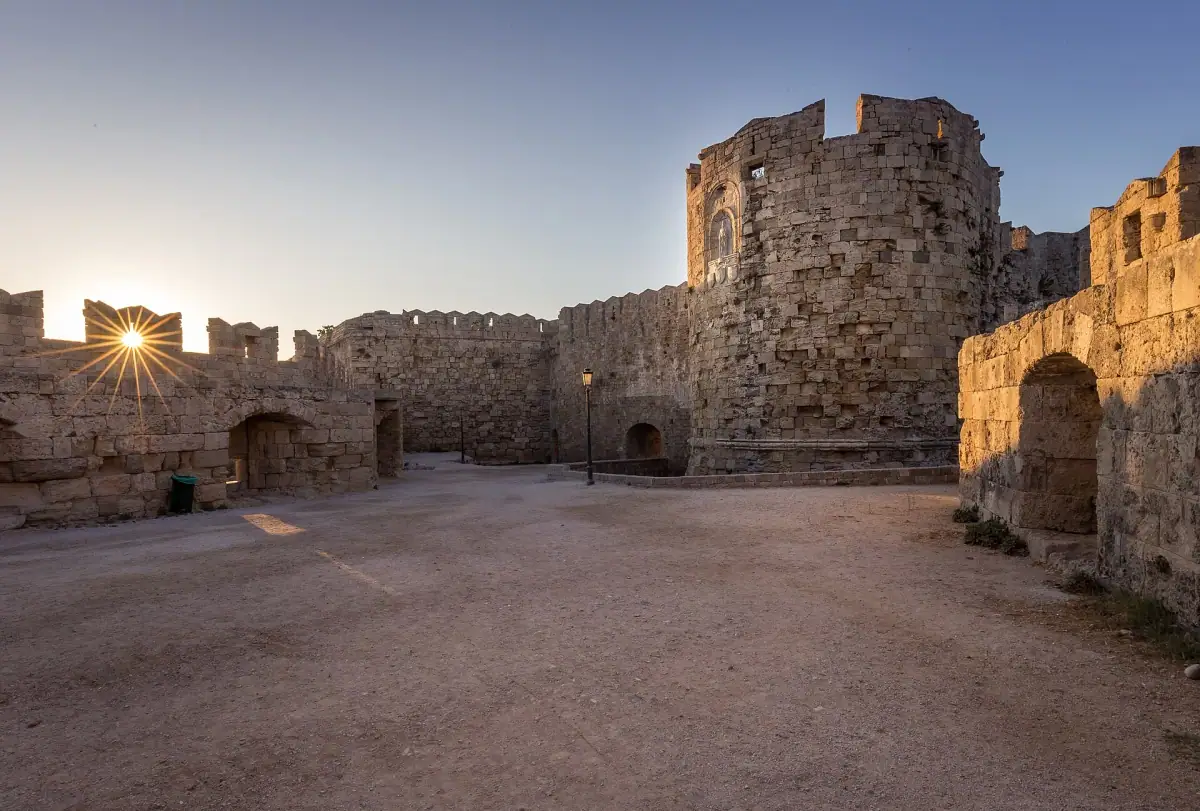
Surrounded by ramparts that withstood sieges, the old town of Rhodes is one of the best-preserved medieval cities in Europe. The Knights of St John settled there in 1309 and fortified it until they left in 1522, after the siege led by the Ottomans. Each period left its mark: a Gothic palace, mosques, a hammam, houses with balconies and a Jewish Quarter.
This guide offers a walking route, from the main monuments to the quieter lanes. To choose where to stay, see our comparison of where to stay in Rhodes, and to round out your trip, our guide to visiting Lindos.
The ramparts and the city gates
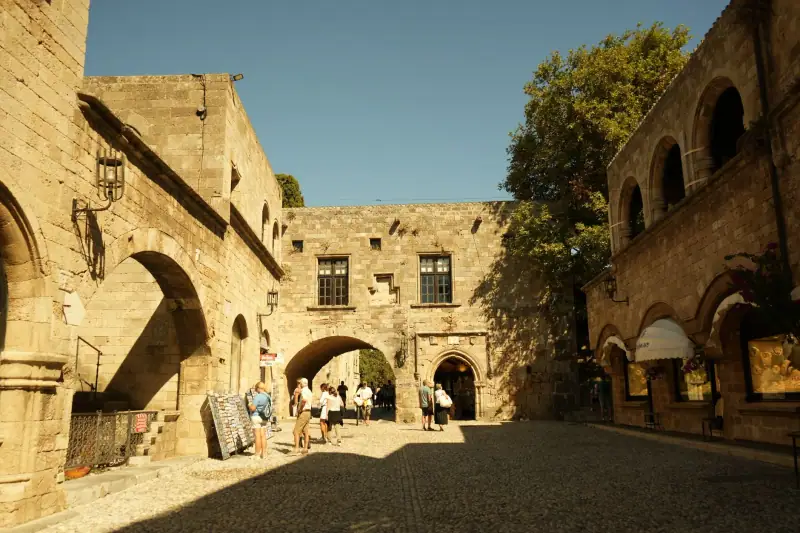
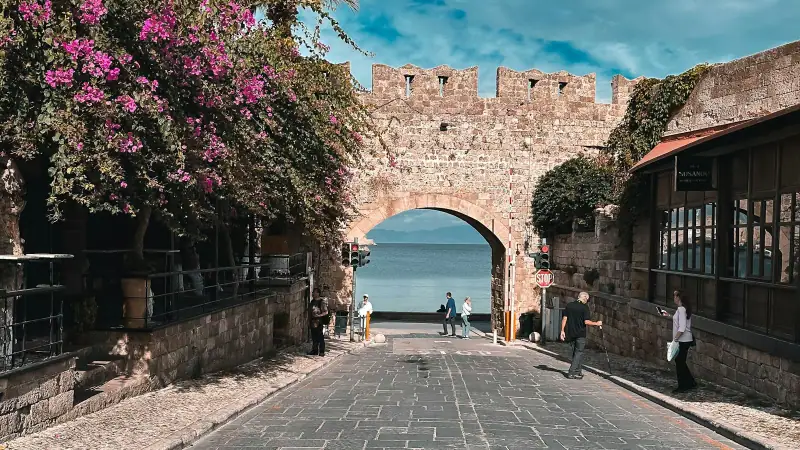
The fortified wall is about four kilometers (2.5 mi) around and encircles the whole old town. Thick, flanked by towers and bastions, these walls were reinforced over the decades against the Ottoman threat. Several gates let you in: the Amboise Gate, reached by a bridge over the old moat, is one of the most impressive, while the Liberty Gate opens onto Mandraki harbor.
The moat running along the walls can be walked and gives a fine view of the thickness of the defenses. A section of the wall walk can be visited at certain times: ask there, as access varies with the season.
For a first look, walk around the walls from the outside late in the day, when the golden light brings out the stone.
The Palace of the Grand Master
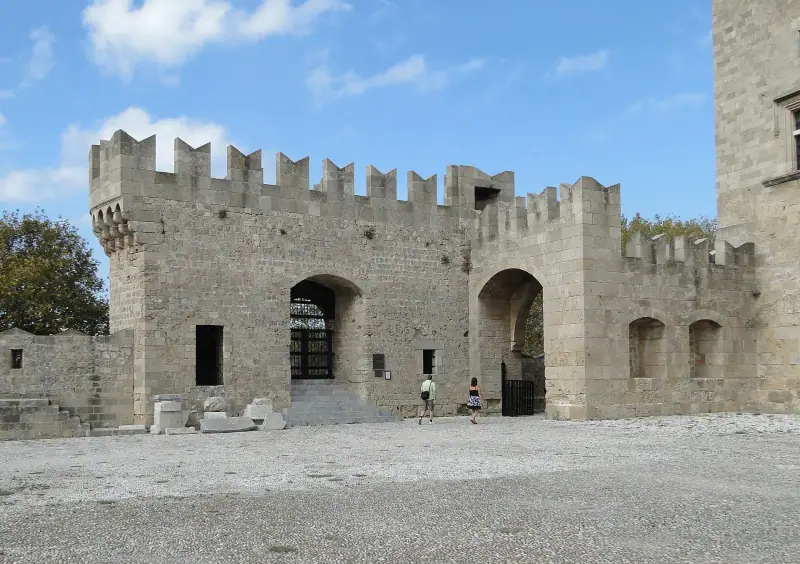
Imposing and massive, the Palace of the Grand Master dominates the northern part of the old town. It served as the residence and fortress of the leaders of the Order of St John. Badly damaged by the explosion of a powder store in the 19th century, it was heavily restored in the 20th century during the Italian occupation.
Inside are rooms with floors decorated with mosaics from antiquity, brought from the island of Kos, and medieval-style furniture. The palace also hosts exhibitions on the history of the city. Hours and admission prices vary by season: check them before you come and allow about an hour for the visit.
A guide to understand the history of the Knights and the different periods of the city, without missing the essentials.
The Street of the Knights
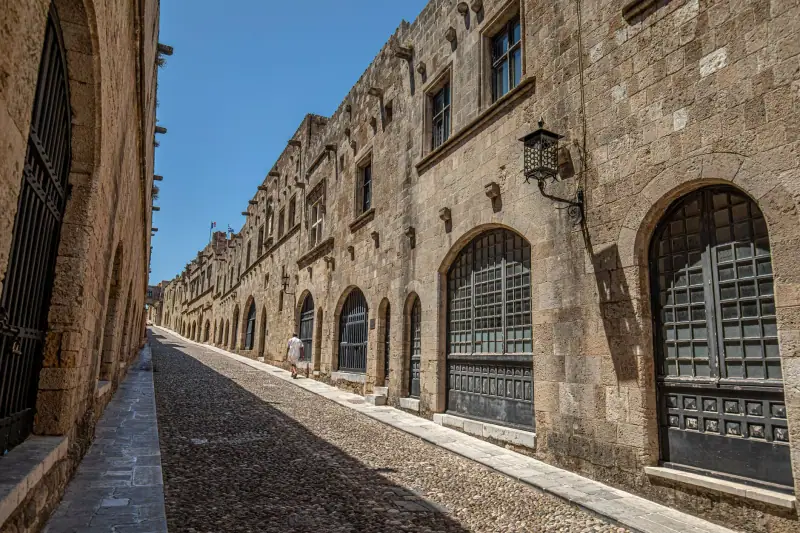
The Street of the Knights (Odos Ippoton) is the most famous in the old town. Paved and straight, it climbs toward the palace and is lined with facades of pale stone. These buildings were the “inns” where the knights lived, grouped by their language of origin: carved coats of arms can still be spotted.
The best time for a walk there is early morning, before the groups arrive: the street is then calm and the stone takes on fine tints. At the bottom of the street is the knights’ former hospital, now an archaeological museum, which lets you dive into the island’s ancient history.
The Ottoman town and Socrates Street
After the knights left, the city came under Ottoman rule and changed its face. Mosques, public baths, fountains and houses with overhangs bear witness to this period. The Suleiman Mosque, with its recognizable architecture, recalls the conquest of 1522.
Socrates Street (Sokratous), the main shopping street, links the Liberty Gate to the Turkish quarter. It is lined with shops selling souvenirs, sponges, jewelry and ceramics. Compare prices before buying and do not hesitate to push a door in the side streets, often quieter and cheaper.
The Jewish Quarter and Martyrs’ Square
In the north-east of the old town, the Jewish Quarter (Evraiki) is among the most peaceful corners. A Jewish community has lived there for several centuries. The Kahal Shalom Synagogue, one of the oldest in Greece, is still active, and a small museum traces the community’s history.
Jewish Martyrs’ Square, with its central fountain, pays tribute to the residents deported during the Second World War. The mood there is more reflective than elsewhere: an interesting pause between two monuments.
Charming houses, small hotels and apartments steps from the ramparts: compare availability and traveler reviews.
Mandraki harbor
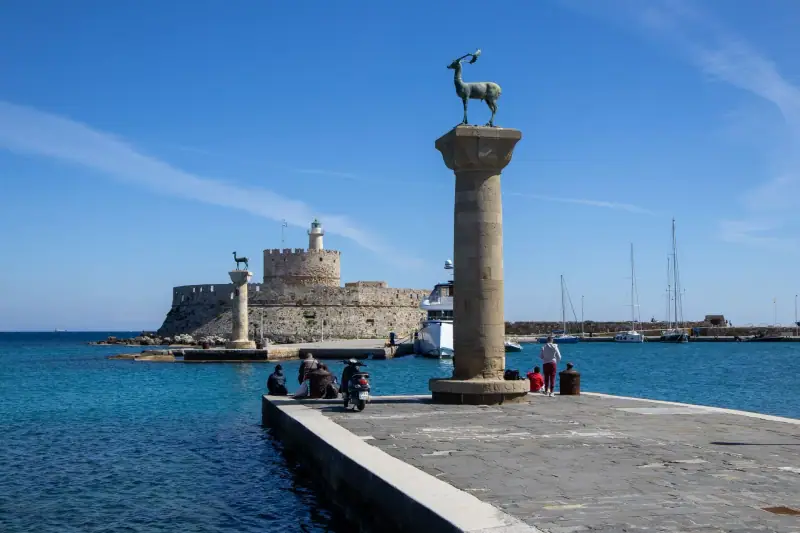
Leaving the old town by the Liberty Gate, you reach Mandraki harbor, on the north coast of the city. This is where, according to tradition, the Colossus of Rhodes stood, a statue of the god Helios raised in the 3rd century BC and toppled by an earthquake a few decades later. No trace remains and its exact location is still debated: only two pillars bearing deer, at the harbor entrance, mark the spot symbolically.
The harbor is pleasant late in the day: you can watch the excursion boats, the sailboats and St Nicholas Fort, which closes off the jetty. Departures to neighboring islands, such as Symi, leave from the city’s ports; ask about the in-season schedules.
Where to eat in the old town
The lanes are full of tavernas and terraces serving classic Greek food: Greek salad, grilled fish, souvlaki, moussaka or tzatziki. Places closest to the main thoroughfares are also the most touristy and the priciest.
For a better experience, move away from the main streets, look for tavernas used by locals and ask for the dish of the day. A meal on a terrace beneath the ramparts remains one of the pleasures of an evening in Rhodes.
Tasting, cooking class or food walk: discover the island's flavors with a guide.
A one-day walking route
Here is a simple outline for a full day:
- Early morning: enter by the Amboise Gate, then the Street of the Knights before the groups arrive.
- Late morning: visit the Palace of the Grand Master.
- Lunch: a break on a terrace in a lane away from the main roads.
- Early afternoon: Socrates Street, the Suleiman Mosque and the Ottoman quarter.
- Mid-afternoon: the Jewish Quarter and Jewish Martyrs’ Square.
- End of the day: walk to Mandraki harbor, then dinner in the old town.
Practical tips
- Season: May, June, September and early October are the most pleasant. In July and August, the heat and the cruise crowds make the midday visit tiring.
- Gear: comfortable shoes with non-slip soles, as the cobblestones are uneven and slippery. Hat, water and sunscreen are essential.
- Dress: shoulders and knees covered for places of worship.
- Access: the old town is visited on foot. If you rent a vehicle to explore the island, leave it outside the walls.
- Hours: those of museums and monuments change with the season and on public holidays; check them before you go.
- Duration: a full day lets you see everything without rushing; half a day is enough for the essentials.
Frequently asked questions
How long does it take to visit the old town of Rhodes?
Allow a day to see everything at a relaxed pace: half a day is enough for the essentials (palace, Street of the Knights, ramparts), the rest for wandering the lanes and taking a break on a terrace.
Is the old town of Rhodes a UNESCO site?
Yes, the medieval city of Rhodes has been a UNESCO World Heritage site since 1988.
Can you drive inside it?
Traffic is very limited inside the walls and the maze of cobbled lanes is visited on foot. Leave the vehicle outside, in a car park or at your hotel.
What is the best time of year to visit?
Spring and early fall are the most pleasant. In midsummer, it is best to go out early in the morning or late in the day to avoid the heat and the cruise groups.
Does the Colossus of Rhodes still exist?
No. The giant statue of Helios, one of the seven wonders of the ancient world, collapsed in an earthquake in the 3rd century BC and no visible trace remains. Its exact location is still debated.
More Rhodes guides
Keep reading
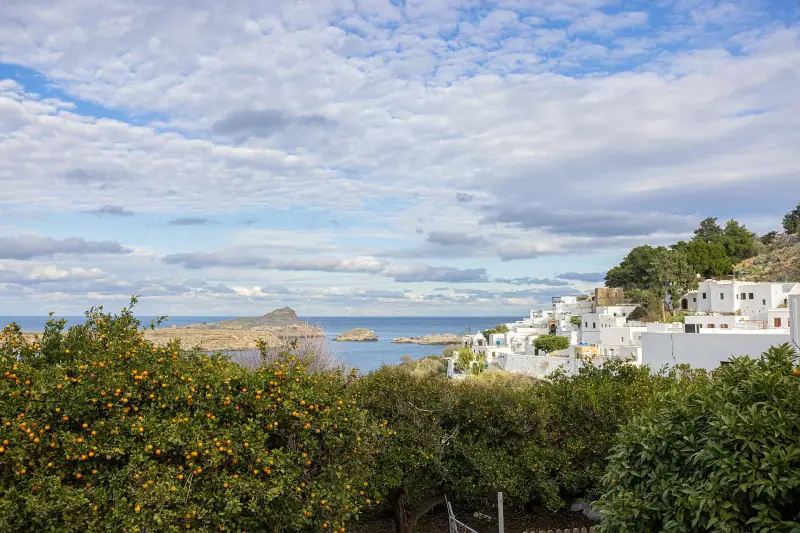
Complete guide to visiting Rhodes: regions, highlights and tips
Everything to plan your trip to Rhodes: towns and regions, must-see sites, when to go, transport, where to stay and budget, with all our detailed guides.
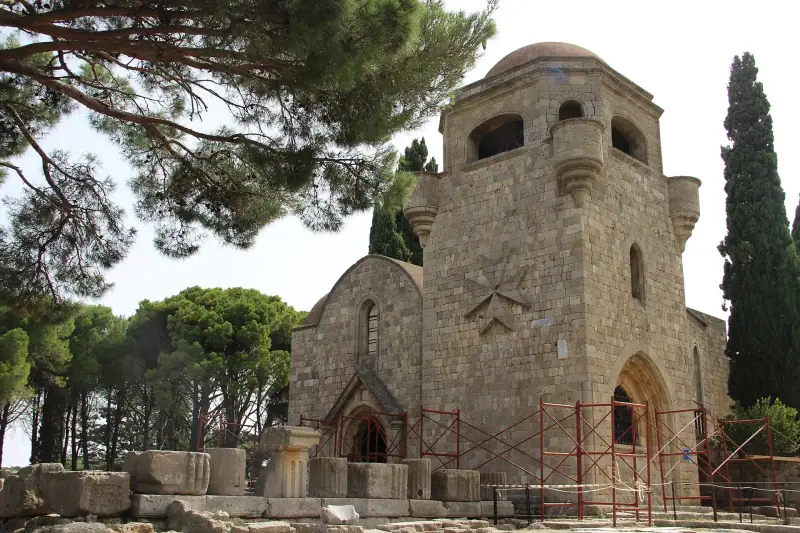
Visiting Filerimos in Rhodes: hours, ticket price and how long it takes
Filerimos in Rhodes: €10 ticket, summer and winter hours, free days, visit time, Way of the Cross, monastery and access from Rhodes Town.
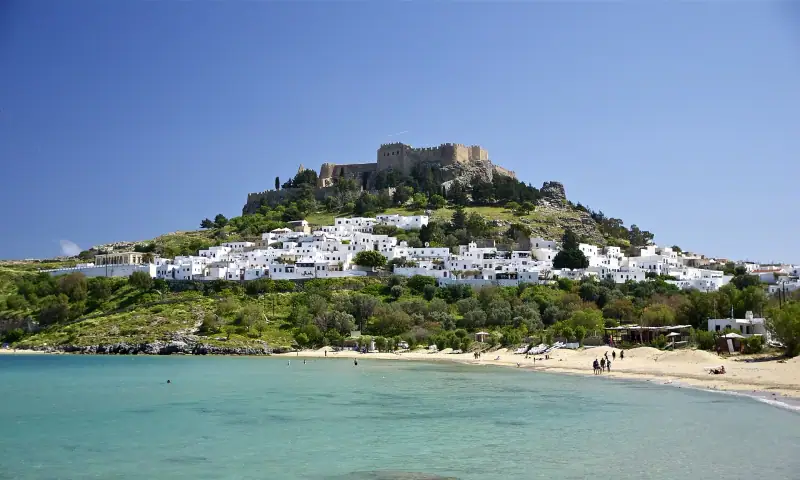
Visiting Lindos, Rhodes: acropolis, lanes and St Paul's Bay
What to see in Lindos? Acropolis and Temple of Athena, white lanes, Panagia church, St Paul's Bay: a one-day plan, access and practical tips.
Ready-made
Rhodes itineraries
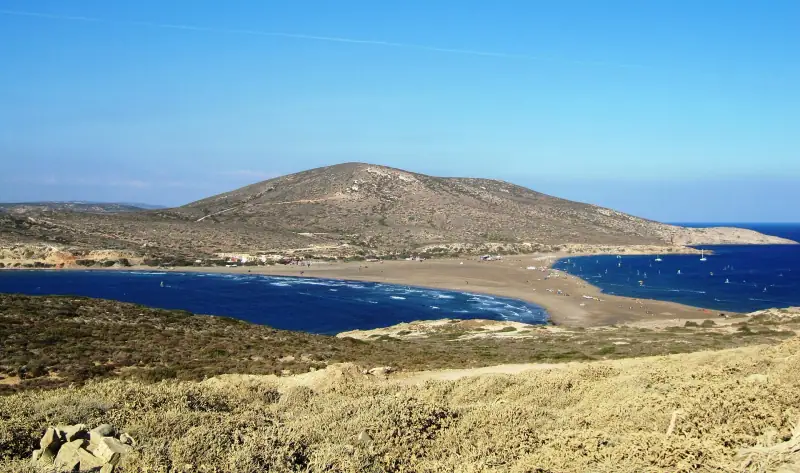
5 days
Rhodes in 5 days: old town, Lindos, Symi and the south
What to do in Rhodes in 5 days? Day-by-day itinerary: old town, Filerimos, Kamiros, Lindos, a trip to Symi and the wild south, with distances and tips.
Can be adapted in the planner
3 days
Rhodes road trip in 3 days: driving around the island
Rhodes road trip in 3 days: a day-by-day itinerary around the island by car, from Lindos to Prassonissi, with distances, stops and tips.
4 days
Rhodes in 4 days without a car: a realistic bus and boat itinerary
Rhodes in 4 days without a car: old town on foot, Lindos by bus (55 km, 1 h 30), Symi by boat and Faliraki beach. Stops, travel times and pitfalls.