Things to do
Garni temple: visiting Armenia's only Greco-Roman temple
We may earn a commission when you book through links on this page, at no extra cost to you. We don't visit or try the places we cover: we summarize published sources. How we work
In short
- Entry to the Garni site costs 1,500 AMD (about €3.50 / $4) for adults; the Azat gorge is free if you go down directly from the village.
- Allow 1 h 30 to 2 h for the archaeological site, plus about 1 h 30 for the Azat gorge; Garni plus Geghard fills a half day from Yerevan.
- Marshrutky leave from Kilikia bus station for about 300 AMD (about $0.80); a taxi costs 3,000-4,000 AMD one way (about $8-10).
- Summer can reach 35-40 °C (95-104 °F): arrive before 9 am and bring at least 2 liters of water for the gorge.
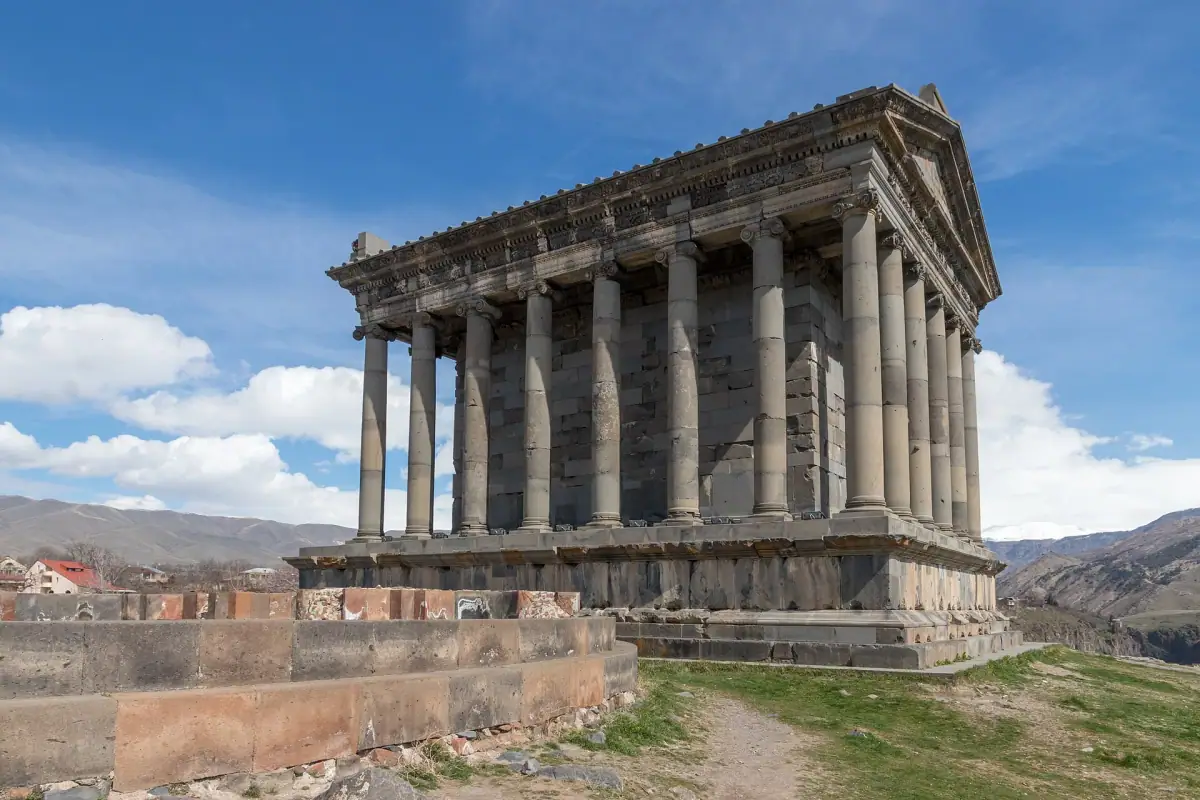
About 30 km (19 mi) from Yerevan, on a rocky spur of volcanic basalt overlooking the deep Azat gorge, stands one of the most singular monuments of the Caucasus: Garni temple. One of a kind, it is the only Greco-Roman building still standing in the whole former USSR. Its silhouette of Ionic columns, raised against the Armenian sky with snow-capped peaks in the background, is one of the most striking images of the country. Here is everything you need to know to organize your visit.
History of Garni temple
A royal temple at the crossroads of influences
Garni temple was built in the 1st century CE, probably under King Tiridates I (53-58 and 63-88 CE), who maintained complex diplomatic relations with Rome. The exact date is debated, but a Greek inscription on the site mentions the construction of an “impregnable fortress”.
The temple is dedicated to the sun god Mihr (the Armenian equivalent of Mithra), an Indo-Iranian deity very popular in the region before the adoption of Christianity. Its architecture is purely Hellenistic: a peristyle of 24 Ionic columns in dressed basalt, a raised podium, a triangular pediment, and decoration carved with rosettes and acanthus leaves.
Christian conversion and partial destruction
In 301 CE, when Armenia adopted Christianity, the temple underwent a brutal transformation. According to the historian Agathangelos, King Tiridates III ordered the destruction of pagan temples. Garni was partly dismantled, but its stones were reused to build royal baths and a summer palace on the same site, which paradoxically preserved a large part of the original materials.
The final blow came with the 1679 earthquake, which almost entirely destroyed the temple, reducing it to a pile of stones carefully labeled by archaeologists.
The Soviet reconstruction (1969-1975)
The real resurrection of Garni temple is the work of Soviet archaeologists. From January 1969 to mid-1975, a team led by Alexander Sahinian undertook an anastylosis, a reconstruction using the original stones found on the spot. Thanks to the inscriptions and numbering engraved by the ancient builders, 70% of the present temple is made of authentic stones. Missing elements were replaced with painted concrete so they would be visually distinguishable.
The result is impressive: the temple stands again in all its majesty, with its 24 columns 6.54 meters (21.5 ft) high and its 2.5-meter (8 ft) podium.
Garni + Geghard excursion from Yerevan
A guided day tour including both emblematic sites, with transport and an English-speaking guide.
What to see at the Garni site
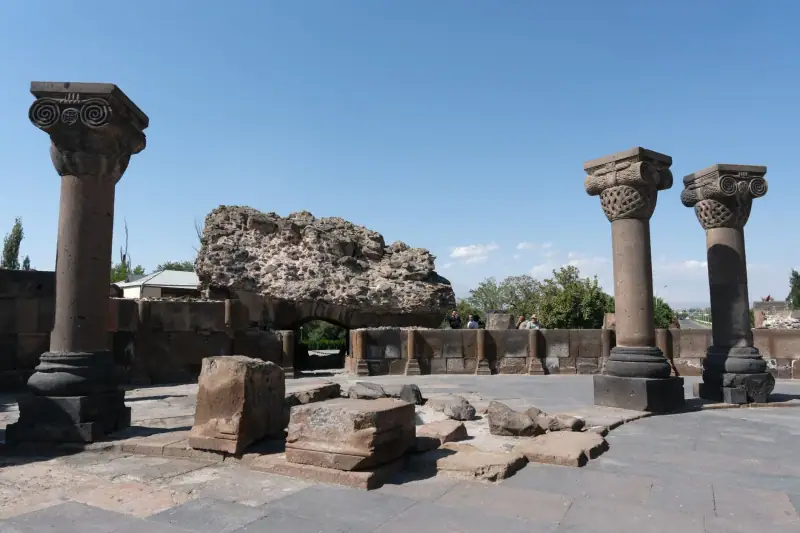
The main temple
The highlight of the visit is of course the temple itself. Take the time to walk all the way around to appreciate the carved reliefs and the quality of the stone joints. A few details to observe:
- The podium: the column bases are decorated with egg-and-dart and bead motifs characteristic of the Ionic order.
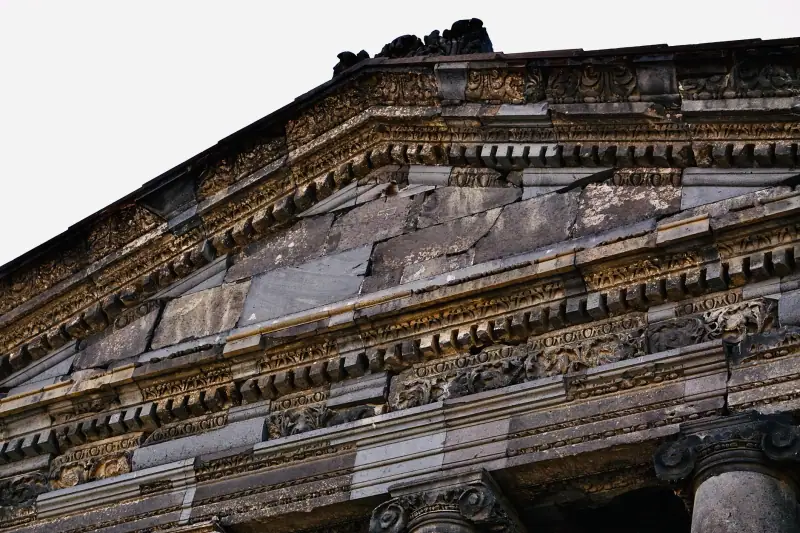
- The pediment: although partly reconstructed, it keeps fragments of the original entablature with its meander and palmette friezes.
- The cella: the inner room is now open. During excavation periods, you can see the foundations and traces of the original interior layout.
- The orientation: the temple faces east-northeast, toward the rising point of the Sun at the summer solstice, an intentional astronomical axis.
The Roman baths and their mosaics
Inside the fortified complex, do not miss the ruins of the baths (Roman bath of the 2nd-3rd century). Technically less spectacular than the temple, but the archaeological interest is considerable: the floor is covered with a Hellenistic mosaic depicting personifications of the sea and rivers, with Greek inscriptions identifying the figures.
The mosaic is one of the best preserved in Armenia. It is protected by a canopy and partly visible from the walkways, admirable up close.
The royal palace and the excavations
Ongoing excavations on the site have uncovered the foundations of a royal palace (1st century CE) adjacent to the temple. Archaeologists found fragments of interior decoration, ceramics and inscriptions. Some of the finds are displayed in the small site museum (access included in the entrance ticket).
The view over the Azat gorge
The Garni site is built on a spur surrounded on three sides by the Azat gorge, a river that has cut vertical cliffs 100 to 300 meters (330-980 ft) high into millions of years of basalt lava. The view from the fortress ramparts over the gorge and the hexagonal basalt columns is breathtaking.
The Azat gorge: the symphony of stones
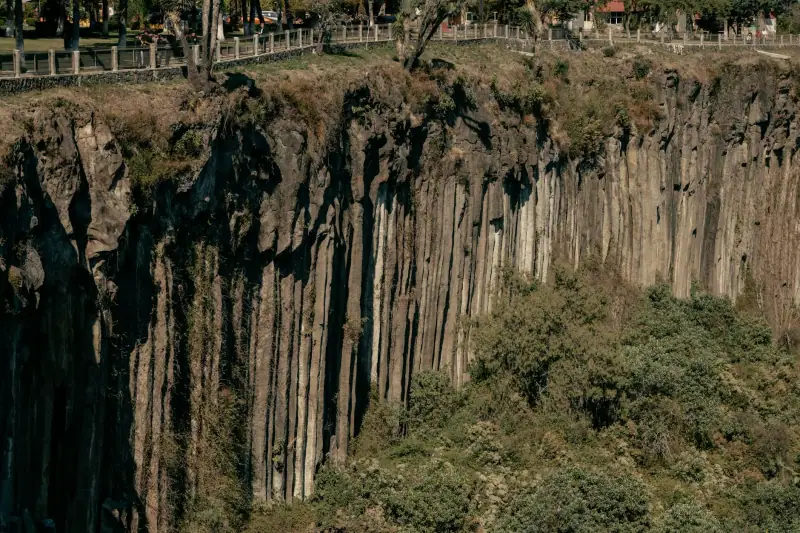
The real natural jewel of Garni lies below: the Azat gorge and its unique geological formation, locally nicknamed “the stone organ” or “the symphony of stones”.
Hexagonal basalt columns
The gorge walls are made of hexagonal basalt columns formed about 127,000 years ago by the slow cooling of lava flows. When lava solidifies slowly and evenly, it contracts into prisms with a hexagonal section; the columns can be up to 50 meters (164 ft) high and are so regular they look like giant organ pipes.
The phenomenon is similar to the Giant’s Causeway in Northern Ireland, but here the combination with the river, the vegetation and the Mediterranean light creates something unique.
Car rental in Yerevan
To explore Garni, Geghard and the gorge at your own pace, a car is ideal. Compare rates online.
Going down into the gorge
From the archaeological site, a trail descends into the gorge in a 30 to 40 minute walk (elevation loss of about 150 meters / 490 ft). The trail is not marked but clearly visible. At the bottom, you can follow the Azat river for a few hundred meters to admire the basalt columns from the floor.
Warning: The climb back is physical, especially in summer. Bring water, wear suitable shoes, and allow 45 minutes to 1 hour to climb back up. The descent is not recommended for people with reduced mobility.
Season: Spring and fall are ideal. In summer, the very hot descent calls for an early-morning start. In winter, the trail can be slippery with frost.
What to see at the bottom of the gorge
- The basalt columns seen from below: the perspective changes completely, and you realize the monumental scale of the formations.
- The Azat river: a small mountain river with clear water, lined with plane trees in summer.
- The beehives: local beekeepers set up hives on the sides of the gorge; Garni honey is renowned across Armenia.
- A viewpoint on the temple from below: from certain spots at the bottom, you can glimpse the temple columns silhouetted on the cliff edge.
How to get to Garni from Yerevan
By public transport
Marshrutka (minibus): the cheapest solution. Minibuses leave from the Kilikia bus station (Barekamutyun metro station in Yerevan). Approximate frequency every 30-60 minutes. Fare: 300 AMD one way (about $0.80). Note: the last return is generally around 5-6 pm, so check the schedule there.
The minibus drops you in the village of Garni, a 10-minute walk from the archaeological site.
By taxi or ride-hailing
From Yerevan, expect:
- One way: 3,000-4,000 AMD (about $8-10)
- Round trip with a 2-hour wait: 8,000-12,000 AMD (about $21-32)
- Garni + Geghard circuit: 15,000-20,000 AMD (about $41-55)
The GG Taxi and Yandex Go apps work well in Yerevan. For a Garni + Geghard circuit, negotiate directly with a driver: prices are fixed on the apps but negotiable outside them.
By rental car
The distance from Yerevan is about 30 km (19 mi; 40-45 min without traffic, 50-60 min with). Take the Artashat road then follow the signs to Garni. The road is in good condition and presents no difficulty. Parking at the site is free and spacious.
Our articles on hiking in Armenia and Armenian monasteries have more advice to help you plan your day.
Flights to Yerevan (Zvartnots)
Zvartnots International Airport serves Yerevan. Compare fares.
Organizing your day: the ideal excursion
Recommended program (full day)
Option A: Garni + Geghard (half day)
- 8:30 am: Leave Yerevan by taxi or car
- 9:15 am: Arrive at Garni, visit the temple (1 h 30)
- 10:45 am: Descent into the Azat gorge (optional, +1 h 30)
- 12:30 pm or 11 am: Drive to Geghard (10-11 km / 6-7 mi, 15-20 min)
- 1 pm: Visit Geghard monastery (1 h 30)
- 2:30 pm: Return to Yerevan (40 km / 25 mi, 45 min)
Option B: Garni + gorge + lunch (relaxed day)
- 9 am: Leave Yerevan
- 10 am: Visit Garni temple
- 11:30 am: Descent into the gorge
- 1:30 pm: Lunch at a Garni restaurant (gorge view)
- 3 pm: Drive to Geghard
- 4 pm: Visit Geghard
- 5:30 pm: Return to Yerevan
Restaurants in Garni
Several restaurants are set near the site, often with a terrace overlooking the gorge:
- Restaurant Mihr: traditional setting, khorovats (Armenian barbecue), dolma, bean soup. Expect 3,000-5,000 AMD per person (about $8-14).
- Garni Birthplace: cafe-restaurant in a village house, local atmosphere.
Visiting in summer: recommendations
Summer (July-August) is very hot at Garni (35-40 °C / 95-104 °F possible). For a comfortable visit:
- Arrive before 9 am at the temple (low light, no crowds, bearable temperature)
- Bring at least 2 liters of water if you go down into the gorge
- Wear a cap and sunscreen, as there is no shade on the archaeological site
- The gorge is 5-8 °C (9-14 °F) cooler; go down at midday if needed
Practical information
| Item | Details |
|---|---|
| Admission | 1,500 AMD (about €3.50 / $4) |
| Hours | 10 am-9 pm in summer, 10 am-5 pm in winter |
| Parking | Free at the site |
| Audio guide | Not available at the site |
| Recommended time | 1 h 30-2 h without the gorge, 3-4 h with the gorge |
| Accessibility | Main site accessible (laid-out paths), gorge not wheelchair accessible |
What is included in the ticket:
- Access to Garni temple
- Access to the Roman baths and mosaics
- Access to the site museum
- Access to the fortress ramparts
On-site guides: Local guides offer their services at the site entrance for 3,000-5,000 AMD (about $8-14), worth it to understand the architectural details and history.
Hotels in Yerevan near Garni
Yerevan is the ideal base to explore Garni, Geghard and the sites around the Armenian capital.
Garni in photography: the best spots
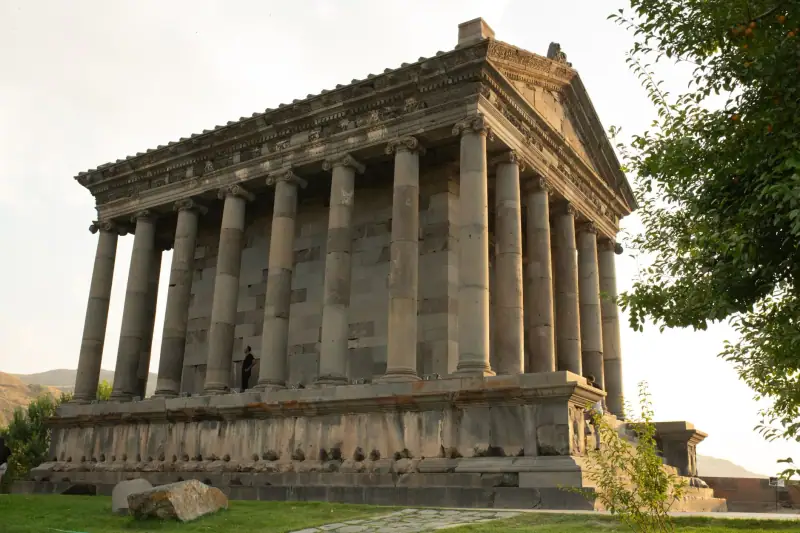
Garni temple is one of the most photographed places in Armenia. Here are the best angles:
From the archaeological site
- Main (east) face: the classic view with the 6 facade columns. Best light in the late afternoon (sun behind the photographer).
- Northwest angle: lets you frame the temple with the gorge in the background, the most spectacular composition.
- From the north ramparts: a plunging view over the Azat gorge with the basalt columns in the foreground.
From the gorge
- Low angle from below: the temple perched on its spur is visible from some points below. A striking view but hard to find; follow the trail to the bottom and look northeast.
- The basalt columns in evening light (around 5-6 pm): the low light accentuates the hexagonal shapes of the columns.
Technical tips
- Morning golden hour (7-9 am): soft light, few tourists, cool temperatures. The temple faces east, so the main facade is in full light in the morning.
- Blue hour (1 hour before and after sunset): the gorge’s basalt columns take on exceptional golden tones.
- Recommended lens: wide-angle (24-35 mm full frame) for overall views of the temple, telephoto (70-200 mm) for carved details.
Combining with other sites
Garni fits naturally into several circuits from Yerevan:
Circuit 1: Garni + Geghard (classic)
The most popular combination. About 10 km (6 mi) from Garni, Geghard monastery is UNESCO-listed and partly carved into the living rock. A full half day, doable by shared taxi.
Circuit 2: Garni + Vayots Dzor (vineyards)
Continuing south from Geghard, you reach the wine region of Vayots Dzor and the Areni vineyards in 1 h 30. Spend the night in Goris to explore the south the next day. See our 7-day Armenia itinerary.
Circuit 3: Garni + gorge hike (sporty)
For hikers, the Azat gorge offers a trail of several kilometers round trip from the bottom of the gorge. See our guide to the best hikes in Armenia for route details and the equipment needed.
Garni temple is an experience like no other: seeing Hellenistic columns outlined against a Caucasian sky, with the basalt gorge below and sometimes the snowy peaks of Aragats on the horizon, you understand at a glance the extraordinary crossroads of civilizations that is Armenia. It is an essential stop in any Armenian stay, even a short one, and the descent into the gorge turns it into a memorable half day well beyond a simple archaeological site.
Frequently asked questions
Is Garni temple free?
No, entry to the Garni site costs 1,500 AMD (about €3.50 / $4) for adults. Access to the Azat gorge is free if you reach it directly by going down from the village.
How long does it take to visit Garni?
Allow 1 h 30 to 2 h for the archaeological site alone. Add 1 h 30 if you go down into the Azat gorge. Combined with Geghard (25 km / 15.5 mi), plan a full half day (4-5 h) from Yerevan.
How do you get to Garni from Yerevan?
By minibus (marshrutka) from the Kilikia bus station in Yerevan for about 300 AMD (about $0.80). By taxi, expect 3,000-4,000 AMD (about $8-10) one way. A rental car is the most flexible solution (40 km / 25 mi, 45 min).
Can you combine Garni and Geghard in one day?
Yes, it is the classic excursion from Yerevan. The two sites are about 10 km (6 mi) apart (15-20 minutes by road). Leave early (8:30 am) from Yerevan, visit Garni in the morning then Geghard in the afternoon. You will be back in Yerevan by 5 pm.
What is the best time to visit Garni?
April-May (spring with flowers) and September-October (golden light, fewer tourists) are ideal. In summer (July-August), come early in the morning to avoid the heat and the groups. The site is open all year.
Is there a mosque or a Roman bath at Garni?
Yes, a Roman bath! The site includes the ruins of a Roman bath (2nd century) with perfectly preserved mosaics depicting sea gods, one of the best-preserved mosaic floors in Armenia. Don't miss it.
More Armenia guides
Keep reading
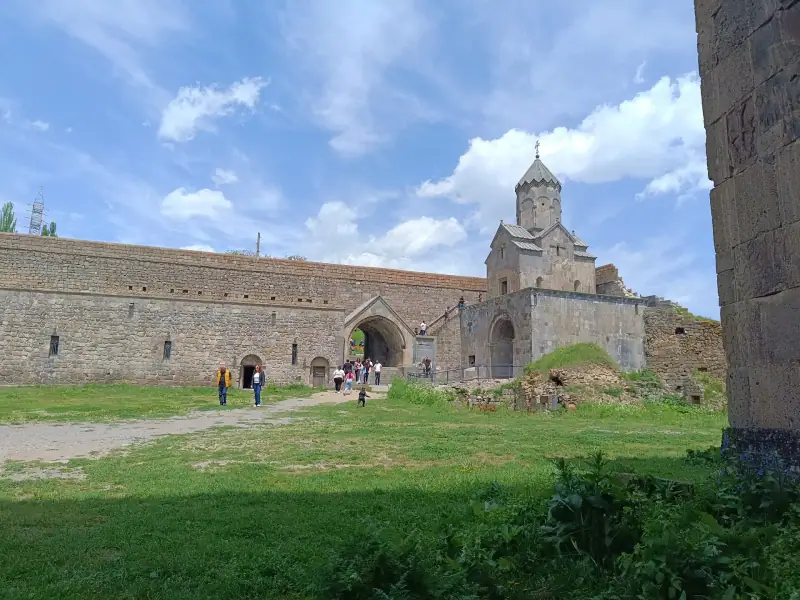
Wings of Tatev aerial tramway: complete guide
All about the Wings of Tatev aerial tramway: hours, fares, access, the monastery and tips for visiting this spectacular site in southern Armenia.
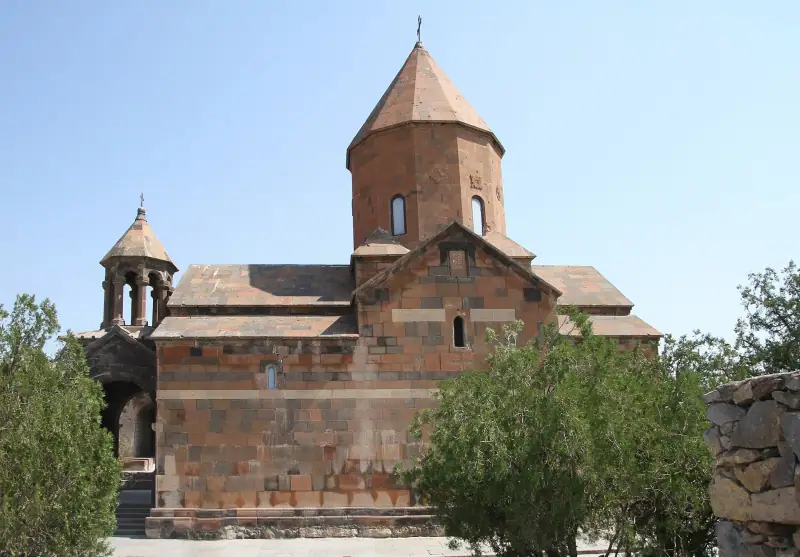
Khor Virap: price, access from Yerevan and the best time to see Ararat
Khor Virap from Yerevan: free entry, minibus or taxi, going down into the pit, the best hour to see Ararat without haze and what to combine.
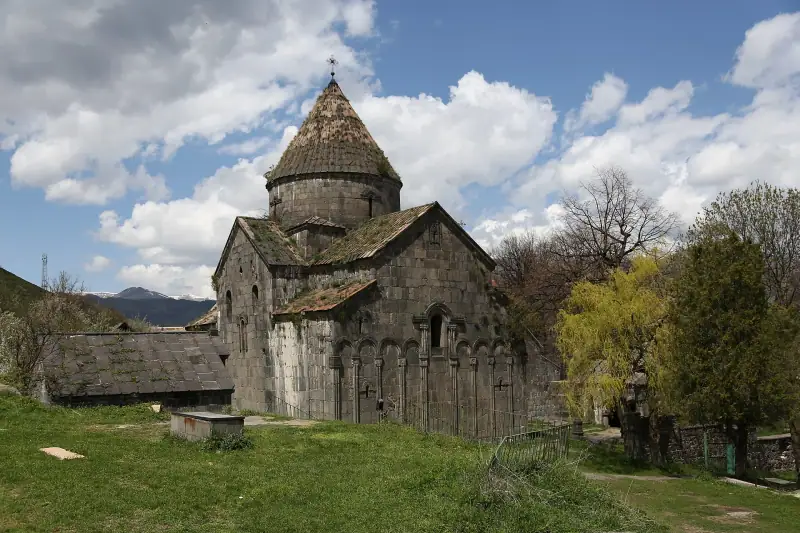
Haghpat and Sanahin without a car: getting there from Yerevan, schedules and is it worth the detour
Haghpat and Sanahin from Yerevan without a car: marshrutka via Alaverdi, schedules to check, 11 km trail between the monasteries and visit time.
Ready-made
Armenia itineraries
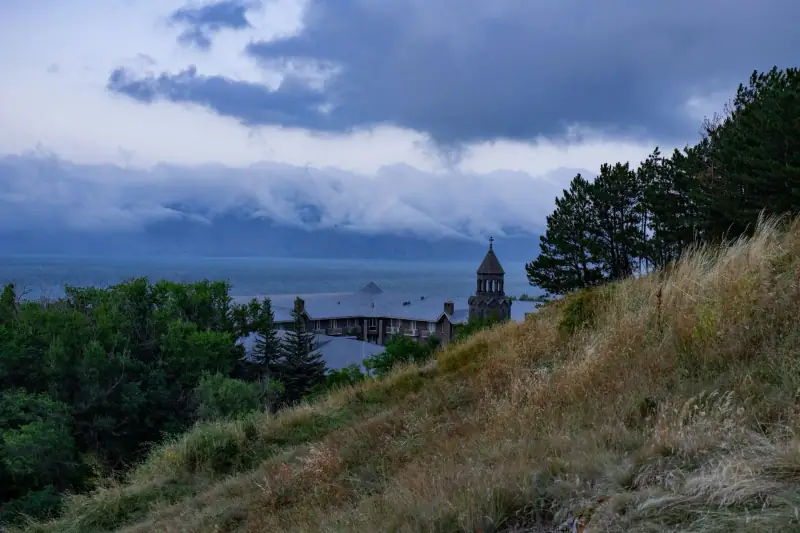
4 days
Northern Armenia: a guide to the Dilijan and Lake Sevan region
Discover northern Armenia: Dilijan's forests, high-altitude Lake Sevan, Haghartsin and Goshavank monasteries, hikes and nature. A 3-4 day itinerary.
10 days
Armenia road trip: a 10 to 14-day driving itinerary
YerevanDilijanAlaverdi or a Debed Valley guesthouseGyumriYerevanJermukSisian or GorisYerevan
5 days