Things to do
Hiking from Mestia to Ushguli without an agency: route, budget and practical guide 2026
We may earn a commission when you book through links on this page, at no extra cost to you. We don't visit or try the places we cover: we summarize published sources. How we work
In short
- The classic Mestia-Ushguli trek takes 4 days and 3 nights, with guesthouses and half board at each stage village, so no tent is needed.
- Budget is about €150-200 (about $174-232) per person for 4 days, excluding guide and 4x4 transfers; the return minibus from Ushguli costs 30-40 GEL.
- The ideal window is mid-June to mid-September; the Adishchala River ford and the Chkhunderi Pass (2,655 m / 8,711 ft) call for care in bad weather.
- Download offline maps (Maps.me or OsmAnd) and bring cash in GEL: mobile coverage is weak between Zhabeshi and Adishi, and few guesthouses take cards.
The Mestia-Ushguli trek is THE iconic hike in Georgia, but most articles assume you will book an agency at €300-500 (about $348-580) all in. In reality, this trek is one of the easiest to do completely on your own in the Caucasus: a passable trail, guesthouses at every stage, and prices cut by half or two-thirds. Here is the complete route, the real budget and everything you need to know before setting off alone.
Is the Mestia-Ushguli trek without an agency really doable?
Yes, and it is even the option chosen by most independent hikers who come through Svaneti. The route follows a well-defined valley, punctuated by villages where you can sleep each night. You need no tent, no bivouac gear and no porter.
What makes this trek accessible without an agency:
- Decent trail marking along most of the route (red and white marks, cairns in the more open sections)
- Family guesthouses in every stage village, with half board
- Moderate elevation compared with other Caucasus treks (max. about 600-700 m / 1,970-2,300 ft of climbing per day)
- An organized minibus return from Ushguli, with no need to walk back
What still justifies a guide for some profiles: crossing the Chkhunderi Pass (2,655 m / 8,711 ft) in poor visibility, a flooded glacial river (Adishchala) to ford, or a beginner with no experience of independent navigation.
Day-by-day route (4 days / 3 nights)
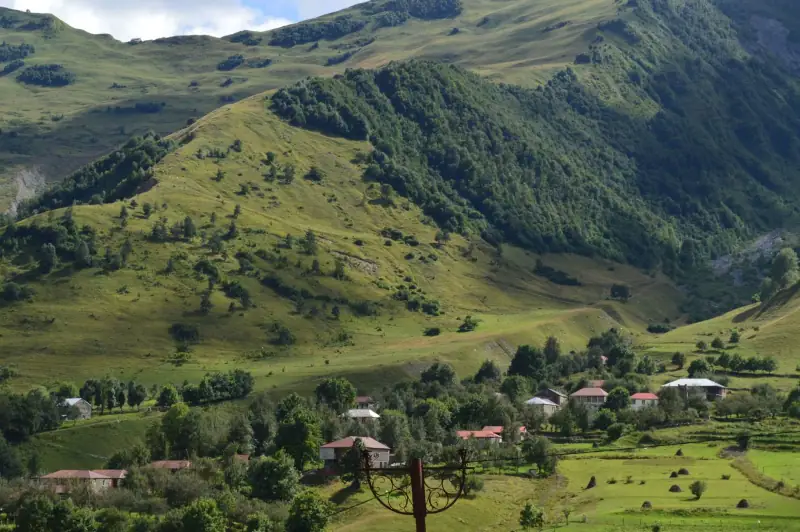
Day 1: Mestia to Zhabeshi (about 6 h, 18 km / 11 mi)
The trail leaves Mestia through the Mulkhura valley, follows the river then climbs gently via the Gvaldi Pass (2,000 m / 6,560 ft) toward the village of Zhabeshi, at the foot of Mount Tetnuldi (4,852 m / 15,919 ft). Moderate elevation gain (~400 m / 1,310 ft). You can shorten it by taking a shared 4x4 to Mazeri at the start of the trek if you are short on time, but the classic route does start on foot from Mestia.
Day 2: Zhabeshi to Adishi (about 7 h, 17 km / 10.6 mi, 700 m / 2,300 ft up)
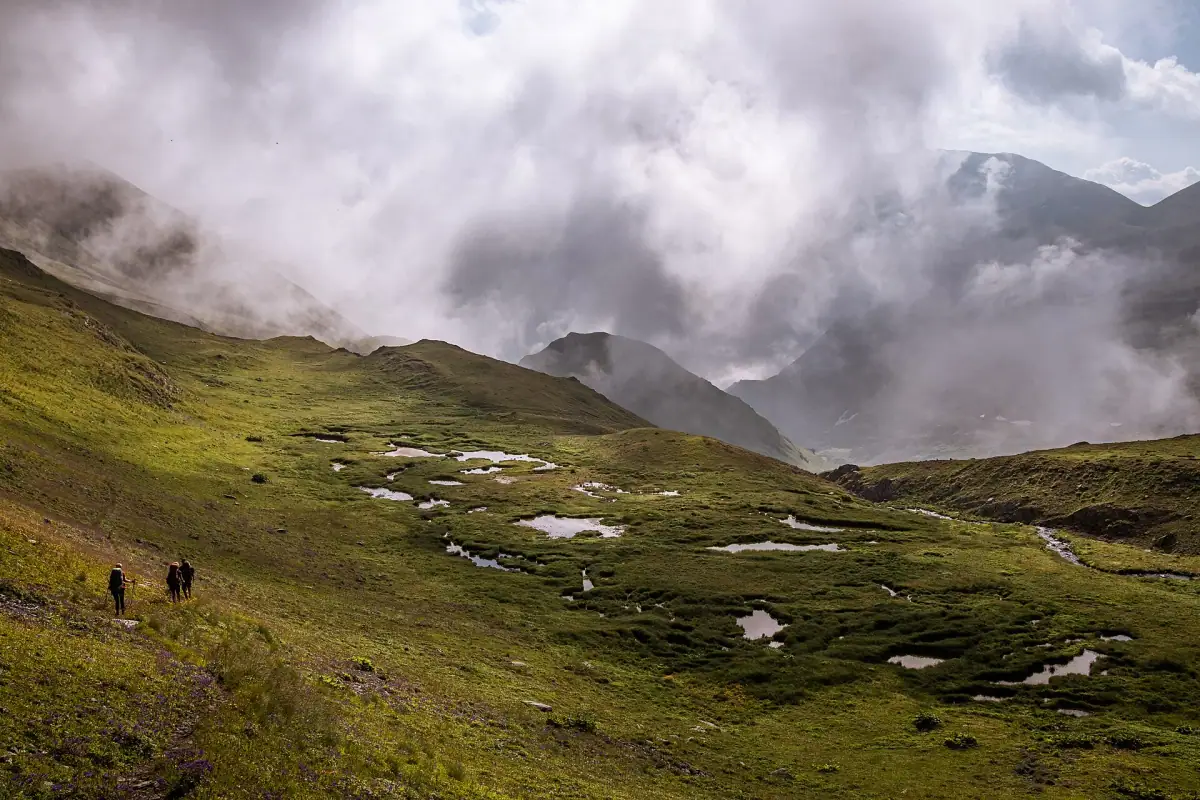
The most physically demanding stage, with the climb toward the pass leading to Adishi, one of the most remote villages in Svaneti, still largely cut off from the road network. It is also the most spectacular stage, with a view of Adishi Glacier.
Day 3: Adishi to Iprari (about 6-7 h, 16 km / 10 mi)
Leaving Adishi, the glacial Adishchala River is forded before the ascent of the Chkhunderi Pass (2,655 m / 8,711 ft), the highest point and classic crossing of the route. A long balcony stage with an open view of Adishi Glacier and the Caucasus range, before descending through the village of Khalde to Iprari. This is the least frequented stage of the trek.
Watch out: the level of the Adishchala varies strongly with the time of day (lower early in the morning, higher at the end of the day with melt) and after heavy rain. Local horses sometimes offer the crossing for about 10-15 GEL (to confirm locally) if the level is too high.
Day 4: Iprari to Ushguli (2-3 h) then a village visit
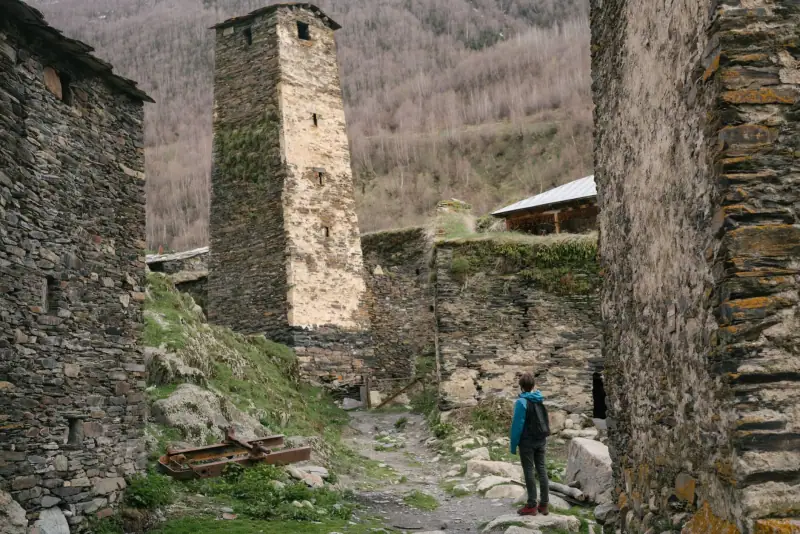
A short walk to the heart of Ushguli, which groups the hamlets of Zhibiani, Chvibiani, Chazhashi and Murqmeli, one of the highest inhabited villages in Europe (2,100 m / 6,890 ft), famous for its medieval Svan towers listed by UNESCO. The afternoon is devoted to visiting the village and, weather permitting, the optional hike to the foot of Shkhara Glacier.
Real budget for the independent trek
Here is a detailed estimate per person for the 4 days, as a couple or solo, excluding gear:
| Item | Indicative price |
|---|---|
| Guesthouse night + half board (x3) | €60-90 (~$70-104), €20-30 (~$23-35) a night |
| Meals/snacks outside half board | €10-15 (~$12-17) |
| Water and snacks | €5-8 (~$6-9) |
| Return minibus Ushguli to Mestia | ~€10-13 (~$12-15), 30-40 GEL |
| Total over 4 days | ≈ €150-200 (~$174-232) |
For comparison, an agency generally offers this same trek with a guide and porterage for between €300 and 500 (about $348-580) per person. The gap comes from the guide, the organization of transfers and sometimes the porterage of bags by 4x4 from village to village.
Budget tip: almost all guesthouses include half board (dinner + breakfast) in the room price, which greatly simplifies the food budget and avoids carrying food.
Where to sleep each night: guesthouses by stage
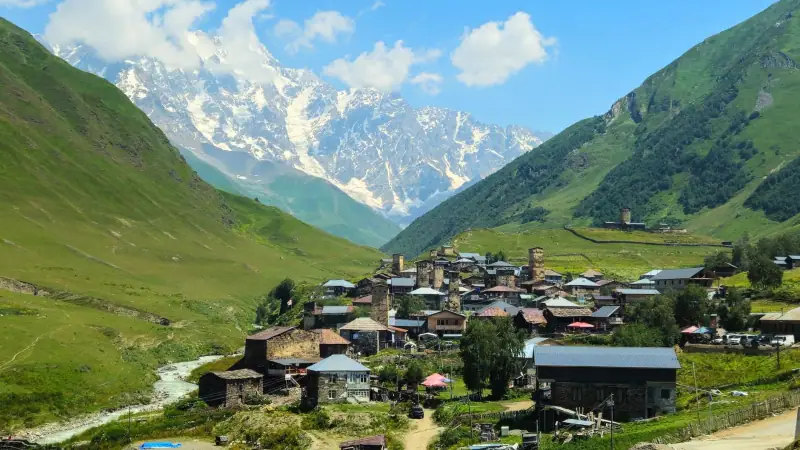
There is no centralized online booking for most of these family guesthouses. Booking is often done by phone, WhatsApp or in person.
- Zhabeshi: several family guesthouses on the main street, easy to spot by the “Guest House” signs
- Adishi: more limited supply (3-4 houses), booking advised in high season through your Mestia guesthouse, which can often make a call for you
- Iprari / Ushguli: wide choice, notably in Chazhashi and Murqmeli, some with a view of the medieval towers
For the first and last night in Mestia, see our selection where to stay in Mestia.
Gear and navigation: what you really need to bring
- Offline map: download the Georgia map on Maps.me or OsmAnd before leaving, as the mobile network is absent or very weak between Zhabeshi and Adishi
- Cash in GEL: very few mountain guesthouses accept bank cards, so bring cash withdrawn in Mestia (see our guide to cash and ATMs in Georgia)
- Health: ask your doctor or a travel clinic what to bring, and see the official travel health pages (CDC in the US, TravelHealthPro in the UK). The village nearest to a medical center is several hours’ walk away
- Layered clothing: temperature differences between the valley and the passes can exceed 15 °C (27 °F) in the same day
- Poncho or waterproof jacket: afternoon showers are frequent in summer in the Caucasus
How to get back from Ushguli to Mestia
Once in Ushguli, two options for the return:
- Shared minibus (marshrutka): the cheapest, about 30-40 GEL (about €10-13 / $12-15) per person, departure generally late morning. Your guesthouse can reserve a seat the evening before.
- Private 4x4: more flexible on timing, between 150 and 250 GEL for the vehicle (to share if you are in a group), a trip of 2 h 30 to 3 h on an unpaved track.
You can also leave directly from Ushguli for other destinations (Kutaisi, Batumi) via connections in Mestia or Zugdidi, but this generally requires an extra night in Mestia to line up the schedules.
Best time for this independent trek
The ideal window runs from mid-June to mid-September. Before mid-June, some passages and fords are difficult or even dangerous because of snowmelt. After mid-September, several mountain guesthouses gradually close and nights get cold at altitude. July-August remains the busiest period, with frequent afternoon thunderstorms: always start early in the morning to avoid being exposed at the end of the day on the balcony sections.
To refine your overall plan, see our guide to the best time to visit Georgia.
The Mestia-Ushguli trek on your own takes a bit more organization than an all-inclusive package, but remains well within reach of a self-reliant hiker in good physical shape. To extend your stay in Svaneti, discover our complete guide to Svaneti, our selection of the best hikes in Georgia and adjust your Georgia travel budget according to your full itinerary.
Frequently asked questions
Can you really do the Mestia-Ushguli trek without a guide or an agency?
Yes. It is one of the most accessible treks in the Caucasus to do on your own: the trail is marked for most of the route, guesthouses dot each stage and the mobile network works on and off. A guide is still useful in bad weather at the Chkhunderi Pass (2,655 m / 8,711 ft) or if the Adishchala River floods, but is not essential for the classic 4-day route.
How many days does it take to hike from Mestia to Ushguli?
Allow 4 days and 3 nights for the classic route (Mestia, Zhabeshi, Adishi, Iprari/Ushguli), with stages of 6 to 8 hours of walking. Fit hikers can finish in 3 days by merging two stages, but 4 days leave a margin in case of bad weather.
What budget should you plan for this trek on your own?
Allow €35 to 50 (about $41-58) per day per person all in: a night in a guesthouse with half board (€20-30 / about $23-35), snacks and water (€5 / about $6), and the return minibus Ushguli-Mestia (30-40 GEL, about €10-13 / $12-15). Over 4 days, the total budget is around €150 to 200 (about $174-232) per person, excluding a guide and 4x4 transfers.
Do you need to book guesthouses in advance?
In July-August, booking at least the first 2-3 nights is recommended, especially in Adishi where supply is limited. Outside high season, it is possible to find a room on arrival, but the villages are small and some guesthouses close early at the end of the season.
How do you get back from Ushguli to Mestia at the end of the trek?
A shared minibus (marshrutka) links Ushguli to Mestia in 2 h 30 to 3 h on a track, generally late morning, for about 30-40 GEL per person (rate to confirm with your guesthouse). Ushguli guesthouses help arrange a seat the evening before. A private 4x4 costs 150-250 GEL for the whole vehicle.
Is the trail dangerous, or can you get lost?
The main route follows the valley and is hard to miss, but it crosses areas without network or dense signage between Zhabeshi and Adishi. An offline GPS map (Maps.me or OsmAnd with the Georgia map downloaded) is strongly recommended, as is care at the river ford after Adishi, before the Chkhunderi Pass, which can be tricky after heavy rain.
More Georgia guides
Keep reading
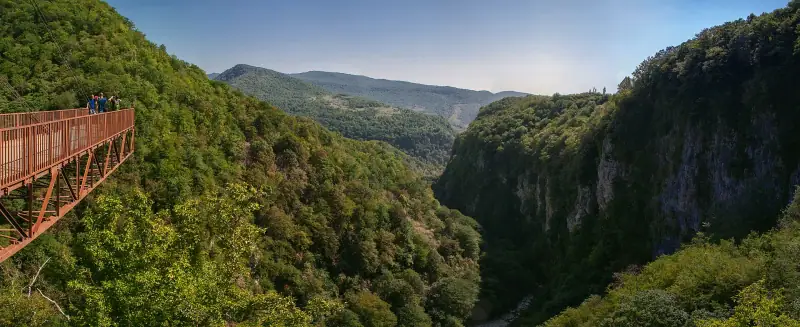
Martvili Canyon and Okatse Canyon from Kutaisi without a car: prices, transport, booking
Martvili and Okatse from Kutaisi without a car: marshrutka, taxi or tour, ticket and boat prices, season, rain and tips to see both in one day.
Visiting a winery in Kakheti from Tbilisi without a car: prices, booking, how to do it
Wine tasting in Kakheti without renting a car: marshrutka, full-day taxi or organized tour. Prices, booking ahead or on the spot, and season.
Georgia travel budget: how much does a trip cost? (2026)
How much does a trip to Georgia cost? Accommodation, meals, transport, activities: a complete budget guide for traveling cheap or in comfort.
Ready-made
Georgia itineraries
10 days
Georgia road trip: a 10-day route from Tbilisi to Svaneti
A 10-day Georgia road trip: Tbilisi, Kazbegi, Svaneti, Kutaisi and Kakheti. Detailed route, roads, places to stay and practical tips.
10 days
Georgia in 10 days without a car: a realistic itinerary by train and marshrutka
TbilisiKazbegiKutaisiMestiaBatumi
3 days
Batumi in 3 days: what to do on the Georgian Riviera
A practical guide to visiting Batumi in 3 days: beach, boulevard, old town, Botanical Garden, excursions in Adjara. Places to stay and tips.