Where to stay
Where to Stay in Canazei and the Val di Fassa: Hotels, Huts and Tips
We may earn a commission when you book through links on this page, at no extra cost to you. We don't visit or try the places we cover: we summarize published sources. How we work
In short
- Canazei and Alba di Canazei are best placed for skiers; Pozza di Fassa and Vigo di Fassa are quieter, with prices 15 to 25% below Canazei.
- Ski-season hotels with half board run about €110-200 (about $130-230) per person; agriturismo cost €60-90 (about $70-105) for two with breakfast.
- Book 2 to 4 months ahead for December-March and July-August; June and September-October rates are often 30 to 40% lower.
- Mountain huts cost roughly €35-55 (about $41-64) per person with half board, and need booking weeks ahead in summer.
The Val di Fassa is one of the most spectacular valleys in the Dolomites. Framed by limestone walls in ocher and golden tones, this Ladin-speaking valley stretches about 15 to 20 km (9 to 12 mi) in the heart of Trentino, between the Costalunga Pass and the Pordoi Pass. Its main village, Canazei, is the ideal starting point for hiking around the Marmolada, the highest peak in the Dolomites (3,343 m / 10,968 ft), and for skiing the legendary Sellaronda circuit.
Choosing your lodging well in the Val di Fassa gives you a strategic base among peaks, mountain huts and Ladin traditions. This guide helps you sort it out, village by village and category by category.
Canazei: the heart of the valley
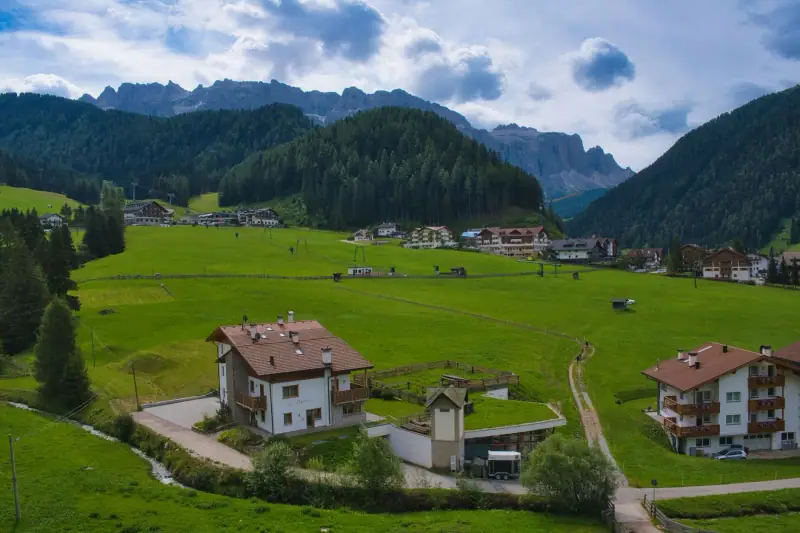
Canazei is the liveliest village in the Val di Fassa, with a main street (Via Roma) lined with shops, restaurants and hotels. At about 1,460 meters (4,790 ft), it enjoys an exceptional setting: the view of the surrounding Dolomites (Sella, Marmolada, Sassolungo) is striking from anywhere in the village.
Charming hotels in the village
Canazei’s family hotels have a long tradition of hospitality. Many have been run by Ladin families for several generations, with a warm but discreet sense of welcome. The 3- and 4-star properties generally offer half board, with a hearty dinner after a day in the mountains. High-season ski prices generally range from €110 to 200 (about $130-230) per person with half board; in summer, rates often drop to around €80 to 150 (about $93-175) a night for a double room.
The best places cluster around Via Roma and the adjoining lanes. Several hotels have a spa or wellness area, welcome after a long day of hiking or skiing, as well as covered parking, essential in winter.
The hamlet of Alba di Canazei
Two kilometers (1 mi) upstream from Canazei, Alba di Canazei (about 1,517 m / 4,977 ft) is a quieter hamlet, slightly higher and with even more direct access to certain lifts in the area. It is an excellent option for skiers who want to limit shuttle rides. The atmosphere is more residential and calmer than in the main town.
Several tourist residences and family hotels offer apartments with equipped kitchens, ideal for families or week-long stays. Prices are often slightly lower than in central Canazei.
Pozza di Fassa and Vigo di Fassa: the quiet alternative
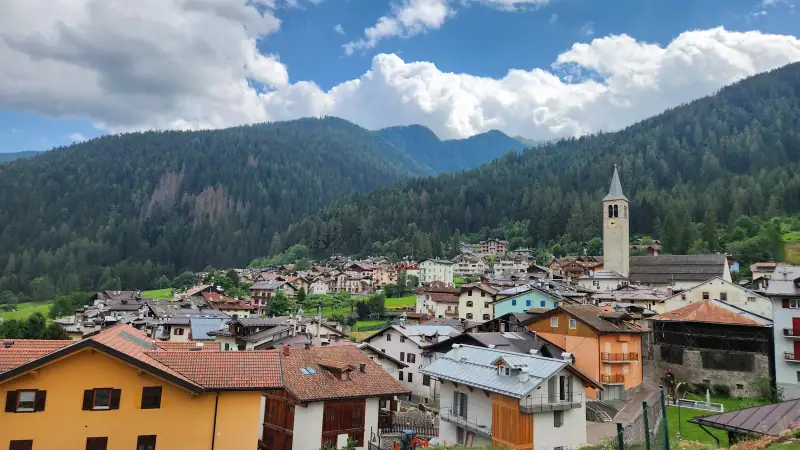
Heading down the valley from Canazei, Pozza di Fassa (about 1,320 m / 4,331 ft) and Vigo di Fassa (1,382 m / 4,534 ft) form a pair of more discreet villages on either side of the Avisio torrent. Both are linked to the Dolomiti Superski area and offer a range of lodging that is more affordable than in Canazei, while staying within reach of all the valley’s activities.
Pozza di Fassa: thermal waters and serenity
Pozza di Fassa is best known for its thermal baths (QC Terme Dolomiti). Several hotels in the municipality offer integrated access to the spa or preferential rates, which makes it an ideal option for travelers looking for a wellness break. Lodging is varied: family guesthouses, 3- and 4-star hotels, and a few residences with apartments. Prices are generally 15 to 25% lower than in Canazei for equivalent comfort.
Vigo di Fassa: the perch with a view
Vigo di Fassa is a balcony village perched on the east side of the valley, reached from Pozza di Fassa by a short road (~2 km / 1 mi). From Vigo, a cable car goes up to Ciampedie (~2,000 m / 6,562 ft), the entry point to the Catinaccio (Rosengarten) massif, but it does not link Pozza to Vigo. The view of the Catinaccio group from Vigo’s terraces is one of the finest in the whole Val di Fassa. Lodging here is more intimate: small family guesthouses, a few charming hotels and B&Bs. The atmosphere is especially peaceful.
Mazzin, Campitello and Soraga: Ladin authenticity
Outside the big resorts, the Val di Fassa has several villages that have kept their authentic Ladin character. Mazzin, Campitello di Fassa and Soraga are three examples of communes where typical wooden architecture, Baroque chapels and street names in Ladin recall the valley’s unique cultural identity.
Campitello di Fassa: skiing and traditions
Campitello di Fassa (1,448 m / 4,751 ft) is a human-scale village with good ski infrastructure: the Col Rodella cable car gives access to the Sassolungo group and the Sellaronda. It is a good alternative to Canazei for families looking for a preserved village atmosphere with lifts nearby. Lodging here is mostly family hotels and tourist residences, often cheaper than in Canazei.
Mazzin and Soraga: for lovers of quiet
Mazzin (1,372 m / 4,501 ft) and Soraga (1,207 m / 3,960 ft) are two villages at the entrance of the valley, less visited by tourists but well served by ski shuttles and local buses. Agriturismo are more numerous here, offering simple but comfortable rooms and often meals made with local products. It is the ideal option for travelers who want to soak up Ladin culture without the bustle of the big resorts.
Car rental in the Val di Fassa
Explore the passes and neighboring valleys at your own pace.
Mountain huts: sleeping under the stars
The Val di Fassa gives access to about ten huts staffed in summer, offering the chance to overnight at altitude between hiking stages or to be as close as possible to the peaks. These huts, often built of wood and stone, with shared dorms and double rooms, are part of the authentic alpine experience in the Dolomites.
The Pian dei Fiacconi hut (Marmolada)
Located at about 2,626 meters (8,615 ft) on the north flank of the Marmolada, the Rifugio Pian dei Fiacconi is one of the starting points for reaching the Marmolada glacier. It is reached from Canazei by the Passo Fedaia road, then only on foot from the pass to the hut (about 1 hour of walking). The Fedaia-Pian dei Fiacconi gondola was taken out of service in 2019 and has not been replaced to date. Rooms are simple, the panorama exceptional. Booking is essential in summer, generally several weeks ahead.
The Col Rodella hut
The cable car from Campitello di Fassa climbs to Col Rodella (2,484 m / 8,150 ft, geographic point). The hut reached from this area is the Rifugio Des Alpes, at about 2,387 meters (7,831 ft), with panoramic views of the Sassolungo and the Sellaronda. It has a few rooms and dorms for hikers who want to enjoy sunrise over the Dolomites. The experience is memorable.
Other huts in the area
Several other huts line the trails of the upper valley, notably around the Rosengarten (Catinaccio) massif on the Vigo di Fassa side. All are affiliated with the Club Alpino Italiano (CAI) or the Deutsche Alpenverein (DAV); members of these clubs get preferential rates. Without membership, expect generally €35 to 55 (about $41-64) per person for a night with half board in a mountain hut.
Budget lodging in the Val di Fassa
Agriturismo in the valley
Agriturismo are small mountain farms that offer guest rooms in a typically alpine setting. In the Val di Fassa, they are often run by Ladin families and serve regional specialties: Schlutzkrapfen (spinach and ricotta ravioli), Kaiserschmarrn (thick pancakes with powdered sugar), alpine cheeses and smoked cold cuts. Prices are attractive: between €60 and 90 (about $70-105) a night for two people, breakfast included.
Rental apartments
For stays of a week or more, renting an apartment is the cheapest solution in the Val di Fassa. Many families offer independent apartments in traditional chalets. These rentals let you cook for yourself and set your own pace. Expect €80 to 130 (about $93-150) a night for an apartment for 2-4 people, depending on the season and the village chosen.
Hostels and shared lodging
The Val di Fassa has a few hostels and shared lodgings, notably in Pozza di Fassa and Canazei. These options are rare compared with other alpine destinations, but they cut your lodging budget significantly, especially for solo hikers or small groups.
Activities and excursions in the Val di Fassa
Guided tours, guided hikes, via ferrata and skiing.
Practical tips for booking your lodging
Half board or room only?
In the Val di Fassa, the half-board tradition is deeply rooted. Most family hotels include it in their standard rate, especially in ski season. Half board is generally a good deal: dinners at Tyrolean-Ladin hotels are hearty and well prepared (mountain soups, pasta with cheese, grilled meats, homemade desserts), and à la carte restaurants charge high prices in peak season. In summer, some hotels offer a choice between half board and bed & breakfast only.
Book with or without the ski pass included?
In winter, many hotels in the valley offer all-inclusive packages that include the Dolomiti Superski pass. These can mean significant savings if you ski every day. Compare the price of the pass alone (around €70 to 90 / about $81-105 per day per adult in high season; check the 2026-2027 rate on the Dolomiti Superski website) with what the hotel offers. Packages are often a good deal for stays of 5 to 7 nights.
Getting there by car and parking
The Val di Fassa is reached by road from Trento (about 60 km / 37 mi via the SS48, about 1 hour), Bolzano (via the Costalunga Pass / SS241, about 50 km / 31 mi), or over the Pordoi Pass from Cortina d’Ampezzo. The main road follows the Avisio up to Canazei. In winter, snow chains are required and secondary passes can be closed. Most hotels have parking; check whether it is free or paid when you book.
Shuttles and public transport
The Val di Fassa is served by the Trentino Trasporti bus network, which links Trento to Canazei year-round. In winter, free shuttles (ski buses) run between the villages and the main lifts. In summer, some passes (Pordoi, Sella, Gardena, Campolongo) are reserved for bikes and walkers during the “Dolomites Vives” days, with organized shuttles for motorists. Plan for this if you are staying in July or August.
Planning your stay in the Val di Fassa
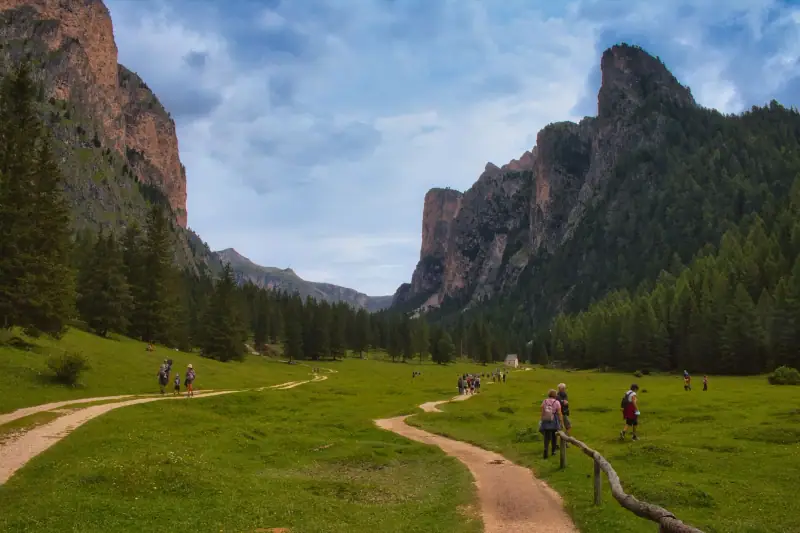
Before settling on lodging, read our complete guide to Canazei and the Val di Fassa for the must-see sights, the main hikes and the excursions around the Marmolada. For skiers, our guide to skiing in the Dolomites gives all the information on the Dolomiti Superski area and the Sellaronda circuit.
If you are thinking of branching out to other valleys, our article on lodging in Val Gardena and our guide to hiking in the Dolomites will help you build your route. For a quieter base at the foot of the Pale, see also where to stay in San Martino di Castrozza or Fiera di Primiero.
The Val di Fassa is a destination you have to earn: the access road is winding, lodging is booked far ahead, and prices match the quality of the setting. But once you are settled in Canazei, Pozza di Fassa or a mountain agriturismo, you will understand why this Ladin valley ranks among the most beautiful in the Italian Alps. The surrounding Dolomites are a UNESCO World Heritage site, and the sun that sets them ablaze at dusk, tinting the rock red and orange in the enrosadira, is reason enough for the trip.
Frequently asked questions
Where should you stay in Canazei to be close to the ski slopes?
Hotels in central Canazei and in the hamlet of Alba di Canazei are best placed for skiers: several lifts start from these areas or can be reached on foot or by free shuttle. In the Val di Fassa, Pozza di Fassa and Vigo di Fassa are also well linked to the Dolomiti Superski area.
What is the most expensive time to stay in the Val di Fassa?
The two peaks are Christmas-New Year plus the high ski season (late January to mid-March), and the heart of summer (July 10 to August 20). The shoulder periods, June and September-October, offer excellent conditions with rates often 30 to 40% lower.
Is there ski-in ski-out lodging in the Val di Fassa?
Yes, mainly in Canazei and Alba di Canazei. A few hotels and tourist residences offer direct or near-direct access to certain lifts. Check the exact location with each property, as the valley's topography varies a lot from one area to another.
Does lodging in the Val di Fassa usually include breakfast?
The great majority of family hotels and guesthouses offer half board (room + breakfast + dinner), which is deeply rooted in local tradition. The Tyrolean-Ladin breakfast is hearty: artisan bread, cold cuts, mountain cheeses, jams and pastries. Some hotels also include the ski pass in winter packages.
Can you find budget lodging in the Val di Fassa?
Yes, especially in quieter villages such as Mazzin, Pozza di Fassa and Soraga. Agriturismo and private guest rooms are often 30 to 50% cheaper than a standard hotel in Canazei, while offering an authentic immersion in Ladin culture.
Do you need to book far ahead in the Val di Fassa?
Yes, especially for ski stays in December-March and summer stays in July-August. Book 2 to 4 months ahead for the best places. In the off-season (May-June and October), you can easily find lodging with a few weeks' notice, sometimes even at the last minute.
More Dolomites guides
Keep reading
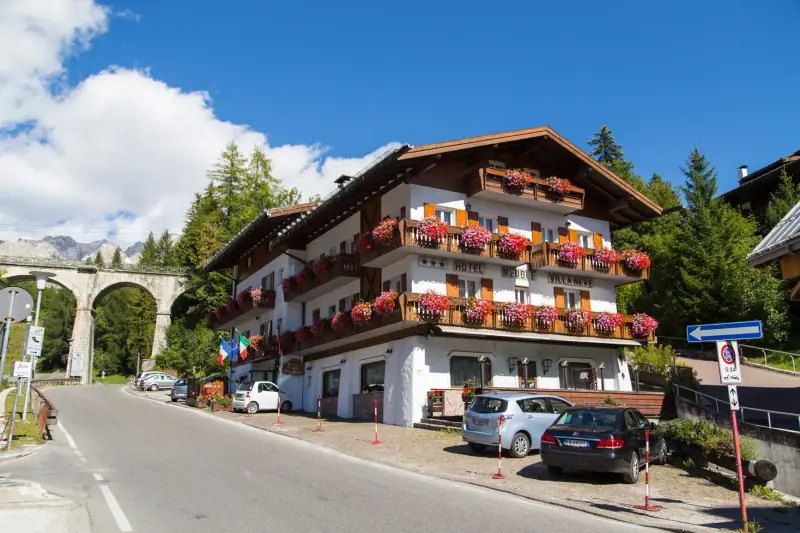
Where to Stay in Cortina d'Ampezzo: Hotels, Chalets and Mountain Huts
The best places to stay in Cortina d'Ampezzo: luxury hotels, alpine chalets and affordable options in the queen of the Dolomites.
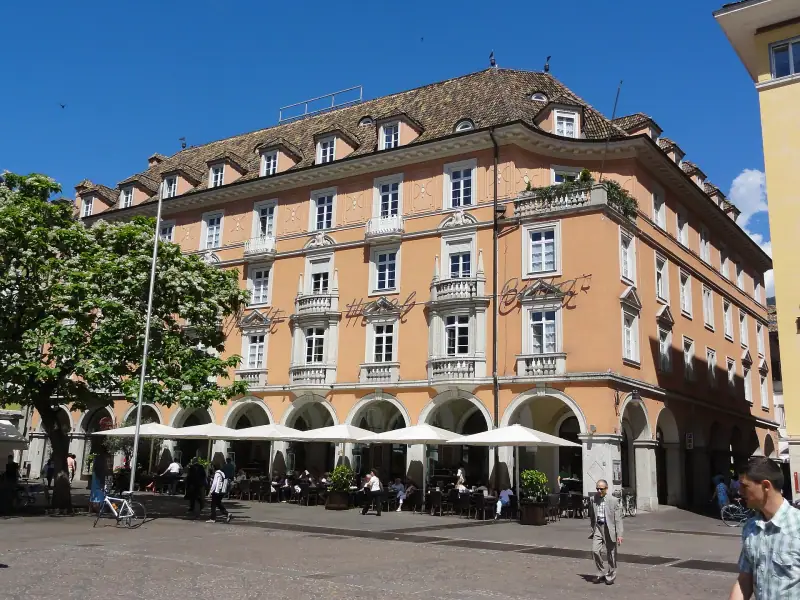
Where to Stay in Bolzano: Neighborhoods, Hotels and Tips
The best places to stay in Bolzano: historic center hotels, Piazza Walther, the Gries district and budget options in the South Tyrol capital.
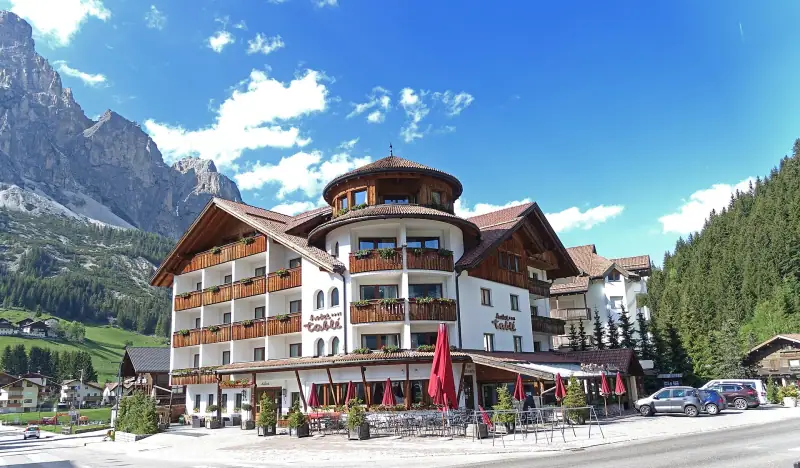
Where to Stay in Alta Badia: Lodging in Corvara, San Cassiano and La Villa
Where to stay in Alta Badia: hotels, garni and apartments in Corvara, San Cassiano, La Villa and Colfosco, with tips by season and budget.
Ready-made
Dolomites itineraries
5 days
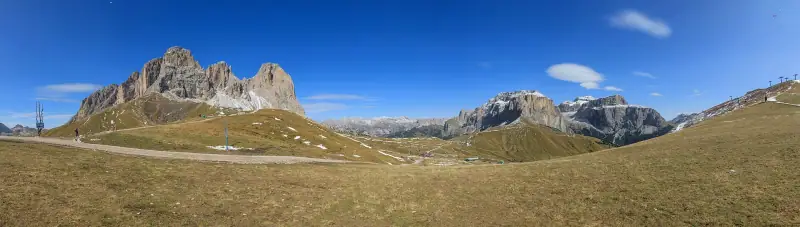
Dolomites with Kids: 5-Day Family Itinerary
Ortisei (Val Gardena)Cortina d'Ampezzo
5 days
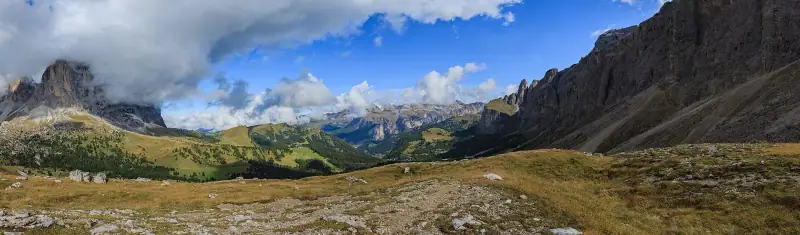
Dolomites road trip in October: 5-day itinerary and passable roads
OrtiseiCanazeiCortina d'Ampezzo
3 days
Dolomites Weekend: A 3-Day Itinerary
A 3-day Dolomites weekend: Val Gardena, Tre Cime di Lavaredo and Alta Badia. Itinerary, lodging, budget and practical tips.